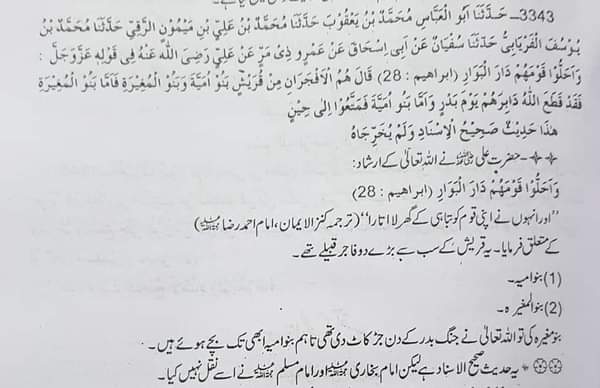
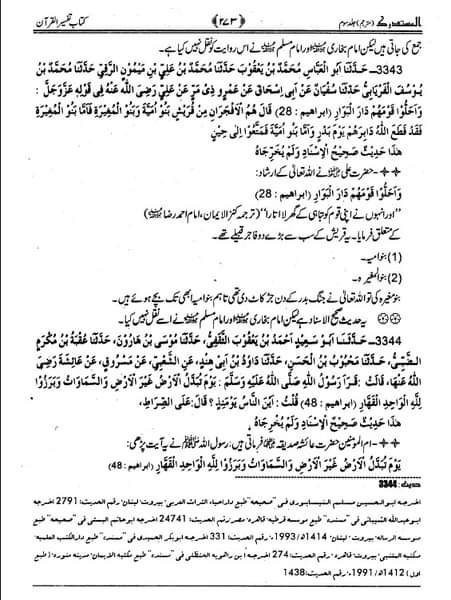
मौला अली अलैहिस्सलाम का क़ौल बनु उमैया के लिए।
मौला अली अलैहिस्सलाम ने फ़रमाया की दो सबसे बड़े फासिक और फ़ाजिर कबीले बनु उमैया और बनु मुग़ीरा है।
– अल मुस्तदरक लील हाकिम जिल्द 3, सफा न 273, हदीस न. 3343


मौला अली अलैहिस्सलाम का क़ौल बनु उमैया के लिए।
मौला अली अलैहिस्सलाम ने फ़रमाया की दो सबसे बड़े फासिक और फ़ाजिर कबीले बनु उमैया और बनु मुग़ीरा है।
– अल मुस्तदरक लील हाकिम जिल्द 3, सफा न 273, हदीस न. 3343


He (Ibn Sa`d) said: Hishŕm Ibn Muhammad Ibn al-Sa’ib al-Kalbi informed us on the authority of his father; he said:
The father of Ibrahim was a resident of Harrán; (Cf. Genesis, Chapter 12, verse 31, which runs thus: And Terah took Abram, his son,-and they came unto Haran and dwelt there) it was one year struck with famine, so he migrated to Hurmuzjurd (Al-Tabari says the name of the place was Kutha, vide Vol. I, p. 119) along with his wife, the mother of Ibrahim, whose name was Nuna the daughter of Karanba Ibn Kutha from the family of Arfakhshad Ibn Sam Ibn Nih.
He (lbn Sa`d) said: Muhammad Ibn ‘Umar al-Aslami informed us on the authority of more than one scholar; he said:
Her name was Abyuna, from the descehdents of Afrayim (Ephraem) the son of Urghuwa (Reu) Ibn Faligh (Peleg) Ibn ‘Abir lbn Shalikh Ibn Arfakhshad Ibn Sam Ibn Nuh.
He (Ibn Sa`d) said: Hisham Ibn Muhammad informed us on the authority of his father; he said:
Ibrahim’s maternal grandfather, Karanba, dug the Kuthŕ canal; his (Ibrahim’s) uncle was the custodian of the idols of the king Nimrudh (Nimrod). He was born at Hurmuzjurd (Al-Tabari says: There is difference of opinion about his birth place. It was al-Sus, or Babylon or Kutha or al-Warka or Harran vide Vol. I, p. 119) and he was given the name of Ibrahim. Then he migrated to Kutha, a place situated in Babil (Babylon). When Ibrahim came of age he opposed his people and preached to them that they should worship Allah. Having received this news the king Nimrudh imprisoned him for seven years. Then he erected a compound with stones and piled dry pieces of wood in it; then he kindled fire and threw Ibrahim in it. Ibrahim said: Most Excellent is He in whom I trust. He, then, came out safe, unhurt. (Cf. al-Tabarl, Vol. I, pp. 123-124)
He (lbn Sa`d) said: Hisham Ibn Muhammad informed us on the authority of his father, he on the authority of Abu Salih, he on the authority of Ibn ‘Abbas; he said:
When Ibrŕhim move from Kutha and came out of the fire, he spoke Syriac; but when he crossed the Euphrates from Harran, Allah changed his language and as he had crossed the Euphrates he was called `Ibrani (Hebrew) Nimrudh sent (a party) to pursue him with these instructions: Do not let escape any one who speaks Syriac; bring him before me. They overtook Ibrahim but he was talking Hebrew, so they let him go and could not understand his speech
He (lbn Sa`d) said: Hisham Ibn Muhammad informed us on the authority of his father; he said:
Ibrahim migrated from Babylon to Syria where Sarah (Sarai) came and offered herself to him. He married her and proceeded with her to Harran (Haran); he was thirty-seven years old. There he sojourned for a short time and then proceeded to Urdun (Jordan) where he stayed for some time; then he departed for Egypt where he lived for some time. Then he returned to Syria and alighted at al-Sab`a, a land between ‘Iliyŕ, and Palestine. There he dug a well and erected an altar. Some of its residents harassed him and he departed from there and came at a place between al-Ramlah and ‘Ilya. There also he dug a well and he grew in prosperity and obtained wealth and slaves. He was the first to receive guests and the first to prepare tharid (This is the name of a dish in which crumbs of bread are soaked in syrup or soup) and the first to experience old age (Cf. al-Tabari, Vol. I, p. 160)
He (Ibn Sa’d) said: Muhammad Ibn `Abd Allah al-Asadi informed us: Sufyan al-Thawri informed us on the authority of ‘Asim, he on the authority of Abu `Uthman: `Asim says: I think he informed us on the authority of Salman; he said:
Ibrahim prayed to Allah to grant him benevolence. In response two-third of his head turned grey. Thereupon he exclaimed what it was! He was informed that it was a warning in this world and lustre in the hereafter.
He (Ibn Sa`d) said: Muhammad Ibn ‘Abd Allah al-Asadi informed us: Sufyan Ibn Sa’id informed us on the authority of his father, he on the authority of `Ikrimah; he said:
Ibrahim’s patronymic was Abu al-Adyaf (father of the guests).
He (Ibn Sa`d) said: Ma’n Ibn ‘Isa informed us: Malik Ibn Anas informed us on the authority of Yahyá Ibn Sa’id, he on the authority of Sa`id Ibn al-Musayyib, he on the authority of Abu Hurayrah; he said:
Ibrahim got him circumcised at al-Qaddum at the age of one hundred and twenty and after that he lived for eighty years.
He (Ibn Sa`d) said: Hisham Ibn Muhammad informed us on the authority of his father, he on the authority of Abu Sŕlih, he on the authority of Ibn `Abbas; he said:
When, Allah (Himself) chose Ibrahim for a friend, (Al-Qur’an, IV p. 125) and commissioned him as Prophet, he had three hundred slaves whom hé freed. They embraced Islam and fought along with him with sticks. He (Ibn Sa`d) said: They were the first mawlas who fought along with their master.
He (Ibn Sa`d) said: Hishám Ibn Muhammad informed us on the authority of his father; he said:
Isma’il (Ishmael), the eldest of Ibrŕhim’s children, was born of Hŕjarah (Hagar), a Coptic woman, Ishaq (Isaac) who was blind was born of Sarah, daughter of Buthwil (Bethul) Ibn Nahur (Nahor) Ibn Sarugh (Serug) Ibn Arghuwa Ibn Falikh ‘Abir lbn Shalikh Ibn Arfakhshad Ibn Sam Ibn Nuh, and Madan (Medan), Madyan (Midian), Yaqshan (Yaqsán according to al-Tabara, Vol. I) (Jokshan), Zimran (Zimran), Ishbaq (Yashaq according to al-Tabari, p. 160) (Ishbak) and Shukh (Suh according to al-Tabari, p. 160) (Shuah) were born of Qanturah (Keturah), (Genesis, Chapter 25, verse 1-2) the daughter of Maftur who was an aboriginal Arab (‘Arab al-`Aribah). Then Yaqshán’s descendants settled at Makkah and Madyan settled in a town which was named after him and others went to other places. (Prior to their departure) they said to Ibrahim: 0 father ! you allowed Ismŕ`il and Ishaq to live with you and ordered us to dwell in a foreign and desolate land. He replied: I have been so commanded (by Allŕh). (Cf. al-Tabari, Vol. I, p. 160)
He (Ibn Sa`d) said: He taught them one of Allah’s names with which they invoked for rains and succour from Allah. The people of al-Khizr came to those who dwelt in Khurŕsŕn and said: He must be the best of mankind or king who taught you this name, so they called their kings Khaqan. (Cf. al-Tabari, Vol. I, p. 160)
He (Ibn Sa`d) said: Muhammad Ibn `Umar al-Aslami informed us; he said:
When Ibrahim begot Ismŕ`il he was ninety years old and he was the eldest of his children. Then Ishaq was born after thirty years, when Ibrahim was one hundred and twenty years old. Then Sarah died and Ibrahim married a Kan`ŕni woman whose name was Qanturah. She bore four children to him. They were Madha, Zimrán, Sarhaj and Sabaq.
He (Ibn Said) said: He married another woman whose name was Hajuna who bore him seven children, Nafis, Madyan, Kayshan, Sharukh, Umayyim, Lut and Yaqshan. Thus there were in all thirteen children of Ibrahim. (Cf. al-Tabari, Vol. I, p. 160)
He (Ibn Said) said: Hisham Ibn Muhammad informed us on the authority of his father; he said:
Ibrahim went to Makkah three times. In his last visit he asked the people to perform pilgrimage; every one who heard him complied. The first to respond, even before al-`Amaliq, were Banu Jurhum. Then they embraced Islam and Ibrahim returned, to Syria where he died at the age of two hundred years. (According to the Bible one hundred and seventy-five years, vide Genesis, Chapter 25, verse 7)


विलायत की बात शुरू करने से पहले बता दूँ कि विलायत को मानना भी ईमान का हिस्सा है और खुदा को पाने के लिए बहुत ज़रूरी है। सिर्फ मौला अली को ही नहीं बल्कि अली सहित पूरी अहलेबैत से मवद्दत करना ज़रूरी है।
हम अक्सर तकरीरों में या जुमा की नमाज़ के खुत्बों में सुनते हैं कि नमाज़ फर्ज़ है, रोज़े फर्ज़ हैं, ज़कात देना फर्ज़ है, हज अदा करना फर्ज़ है। बताने वाले ये भी बताते हैं कि ये चार फों के पहले एक फर्ज और है ईमान, जब तक ये दिल में नहीं आएगा, किसी आमाल में ना दिल लगेगा, ना ही कामयाबी मिलेगी। तो बताया ये जाता है कि ये पाँच अरकान हर मुसलमान पर फर्ज़ हैं और इसमें ना शक की गुंजाइश है ना ही किसी फिरकेबाजी की, सारे ही लोग इस से सहमत हैं। हर रोज़ होने वाली तकरीरों में सालों से ये बातें होती आ रही हैं लेकिन हालात ज्यों के त्यों हैं। कभी आपने सोचा कि ऐसा क्यों?
लोग कलमा पढ़ रहे हैं, ईमान वाले होने का दावा कर रहे हैं लेकिन अमल शैतानों वाले। दरअसल गलती इनकी नहीं है और मुझे आजतक ये भी समझ नहीं आया की हक़ छिपाया क्यों जाता है, वह भी आलिमों के द्वारा। आज हमारी हालत इतनी खराब इसलिए है क्योंकि हमने
बुनियाद ही कमजोर कर रखी है।
मेरे अपनों! इन सारे अरकानों से पहले भी एक फर्ज़ है, ईमान से पहले भी एक फर्ज़ है और जब तक ये अदा ना किया जाए, ईमान भी दिलों में आ ही नहीं सकता और वह फर्ज़ है “अहलेबैत से मुहब्बत”
आका मुहम्मद सल्लललाहु अलैहे वसल्लम ने फरमाया, “लम यद खुलि-ल ईमानु फी रजुलिन हत्ता युहिब्बुल अहलेबैति”, यानी “तुम्हारे अंदर ईमान तब तक दाखिल नहीं होगा, जब तक तुम मेरी अहलेबैत से मुहब्बत ना करो।”
अगर आप कुरआन को पढ़कर समझें तो आप आयत ए मवद्दत पढ़कर इस नतीजे पर पहुंचेंगे की हमें, अहलेबैत से मवद्दत करना है। आलिम मवद्दत के मायने भी मुहब्बत बताते हैं और हब्ब / हुब्ब के मायने भी मुहब्बत बताते हैं।
इक दफा मैंने एक अल्लाह वाले बुजुर्ग से इस बारे में पूछा की अगर मायने एक ही हैं तो दो अलग लफ्ज़ इस्तेमाल क्यों किए जा रहे हैं?, तब उन्होंने बताया कि ये सब साजिशन किया जा रहा है, उन्होंने कहा कि ये दोनों अलग लफ्ज़ है जैसे बत्तख़ पानी में रहती है लेकिन पानी में रहना उसके जिंदा रहने के लिए शर्त नहीं। वह पानी में रहना पसंद करती है लेकिन पानी के बिना भी रह सकती है। ये है मुहब्बत।
और जिस तरह मछली पानी में रहती है, पानी से निकालते ही मर जाती है यानी उसे पानी सिर्फ़ पसंद नहीं है बल्कि उसके जिंदा रहने की ज़रूरत है। ये है मवद्दत। समझये आता है कि अहलेबैत अलैहिस्सलाम से मुहब्बत करना है तो मवद्दत के दर्जे तक करना है। अफसोस! हमारे बहुत सारे आलिमों ने हक़ बताना छोड़ दिया।
अब बात करते हैं विलायत की, आप सब जानते ही हैं कि आका सल्लललाहु अलैहे वसल्लम, अल्लाह के आख़िरी रसूल हैं यानी बाद ए मुहम्मद सल्लललाहु अलैहे वसल्लम, अब कोई नबी या रसूल, दुनिया में नहीं आएगा। फिर दुनिया को हिदायत कैसे मिलती रहेगी?

अल्लाह अपने बंदों में से ही किसी को हादी बना देता है और हिदायत आम करने के लिए रब ने बारह इमामों को चुना, इसके बाद भी ये सिलसिला नहीं रोका बल्कि विलायत के ज़रिए इसे जारी रखा जो बाद ए नबी से अब तक चलता आ रहा है और इमाम मेंहदी अलैहिस्सलाम के जुहूर और दुनिया के मिटने के पहले तक चलता रहेगा।
ये हमारी गलती है कि हमें आलिम तो याद रह जाते हैं जैसे अबु हनीफा रहमातुल्लाह आलेह लेकिन हम उन वलियों को भूल जाते हैं जिन्हें आलिम भी अपना उस्ताद माना करते थे। ऐसा ही एक नाम है बहलोल दाना का, जिन्हें दुनिया पागल समझती रही और वह जिंदा रहते में ही जन्नत का सौदा करवा देते थे। हज़रत अबु हनीफा, बहलोल को अपने उस्तादों में से एक बताते थे, कोई जाकर पूछे आलिमों से कि इतने बड़े आलिम, उस शख्स से क्या सीखने जाते थे, जिसे दुनिया पागल कहती थी?

आज कुछ मसलकों को ऐतराज़ हो जाता है बुजुर्गों की शान बयान करने पर। शिया-सुन्नियों के बीच का एक मुद्दा विलायत ए अली भी है, कुछ लोग कहते हैं कि शिया अपनी अजानों में अली की विलायत का ऐलान करते हैं, कुछ कहते हैं शियाओं का कलमा अलग है।
तो मेरे अपनों एक बात बता दूँ सुन्नियों में भी कई मसलक अजान के साथ दरूद जोड़कर पढ़ते हैं, इसका भी जिक्र कहीं नहीं, दूसरी और ज़रूरी बात ये कि अहले तशय्यो, कलमे में अलीयुन वलीयुल्लाह पढ़ना मुस्तहब मानते हैं, कुछ वाज़िब मानते हैं, फर्ज़ उनके यहाँ भी नहीं है। । खैर हम तो वह कौम हैं जिसने कभी अपने आलिमों से ये भी नहीं जानना
चाहा कि कलमा होता क्या है?
सोचता हूँ तो ताज्जुब होता है, आपस में लड़ाई की एक वजह “अलीयुन वलीयुल्लाह” कहना है, ऐसा कौन-सा मुसलमान है जो अली मौला को अल्लाह का वली नहीं मानता, किसी ने कह दिया तो ऐतराज़ कैसा, हकीकत ये है कि मानते तो सब हैं कुछ कहते हैं, कुछ दिल में रखते हैं लेकिन दिल तो सबका ये ही कहता है कि मौला अली, अल्लाह के वली हैं।
इन अल्लाह के वलियों को विलायत, मौला अली अलैहिस्सलाम के ही सदके से मिलती है। चाहे शियाओं को देख लें या सुन्नियों को, जिनके भी पीर हैं वह अली मौला के नाम पर ही बैअत लेते हैं।
इन बुजुर्गों ने जो दीन की ख़िदमत की है, उसे चाहकर भी नहीं भुलाया जा सकता, चाहे वह शाहबाज़ कलंदर रहमातुल्लाह आलेह हों, चाहे अब्दुल कादिर जीलानी रहमातुल्लाह आलेह हों, चाहे ख्वाजा मोईनुद्दीन चिश्ती रहमातुल्लाह आलेह हों या कोई और। इन सारे वलियों ने दीन की तब्लीग के लिए जो रास्ता निकाला, उसके आगे बड़े से बड़े जालिमों ने भी घुटने टेक दिए और ये भी हकीकत है कि अल्लाह हर दौर में, अपने वलियों के जरिए, अपने दीन का काम लेता रहता है और आगे भी इन्हीं को ज़रिया बनाएगा।
जिस तरह हमें तौहीद ए अल्लाह पर ईमान रखना है, जिस तरह से हमें रिसालत ए मुहम्मद पर ईमान रखना है, ठीक इसी तरह से हमें विलायत ए अली भी मानना है। अली को पाए बिना नबी नहीं मिलते और जिसे नबी नहीं मिलते उसे खुदा मिल ही नहीं सकता। तो विलायत ए अली के बारे में फिक्र करें और अपने ईमान का हिस्सा बनाएँ।
एक और ज़रूरी और फिक्र करने लायक बात ये है कि हमारे हालात खराब चल रहे हैं, चारों ओर से बस परेशानियाँ ही परेशानियाँ आ रही हैं,
आज हम ये रोना रोते हैं कि सब कुछ हमारे ख़िलाफ़ चल रहा है लेकिन हम ये भूलकर बैठे हैं कि हमारे आका सल्लललाहु अलैहे वसल्लम हमें जिन दो चीजों को थामने का कहकर गए थे, हमने वह ही दो चीजों को छोड़ रखा है-कुरआन और अहलेबैत।
पहली बात तो ये याद रखें की अहलेबैत अलैहिस्सलाम किसी एक मसलक या कौम के नहीं, इश्क में शिया या सुन्नी नहीं होता, यहाँ तक अहलेबैत को चाहने वाले दूसरे मज़हबों में भी आसानी से मिल जाते हैं और मैंने बहुत सारे ग़ैर मुसलमानों के मुँह से पंजतन की तारीफ़ सुनी हैं।
यहाँ तक कुछ लोगों का कहना ये भी है कि ना सिर्फ मुसलमानों को बल्कि तमाम इंसानियत को अहलेबैत से कुछ ना कुछ सीखते रहना चाहिए और मैं भी मानता हूँ कि अहलेबैत अलैहिस्सलाम इस्लाम के साथ साथ, इंसानियत के भी मुहाफिज़ हैं।
अहलेबैत की अज़मत और फजीलत बयान कर पाना नामुमकिन है। इल्म और अक्ल में अहलेबैत को घेर पाना नामुमकिन है। हमें चाहिए की हम अहलेबैत अलैहिस्सलाम से बहुत मुहब्बत करें और उनके बताए तरीकों पर अमल करते रहें, उनके बताए रास्ते पर चलें। याद रखें इश्क का इज़हार, अमल से होता है।
अगर अपनी नस्लों में इस्लाम और इंसानियत को जिंदा रखना चाहते हो तो उन्हें अहलेबैत की तरफ़ मोड़ दो। उन्हें हैदर ए कर्रार की ज़िन्दगी समझाओ, उन्हें मौला अली की शुजाअत और जंग समझाओ, अपनी औलाद को सुलह ए हसन समझाओ. अगर चाहते हो औलाद बुज़दिल ना बने तो उसे करबला समझाओ, हज़रत हुसैन अलैहिस्सलाम की कुर्बानी और सब्र समझाओ.
एक बात हमेशा कहता हूँ कि जब तक अहलेबैत का जिक्र मिम्बरों से म नहीं किया जाएगा तब तक कौम के हालात नहीं बदलेंगे।
कुरआन और अहलेबैत को छोड़कर, हालात बदलने का तसव्वुर भी करना, जहालत के सिवा और कुछ नहीं।

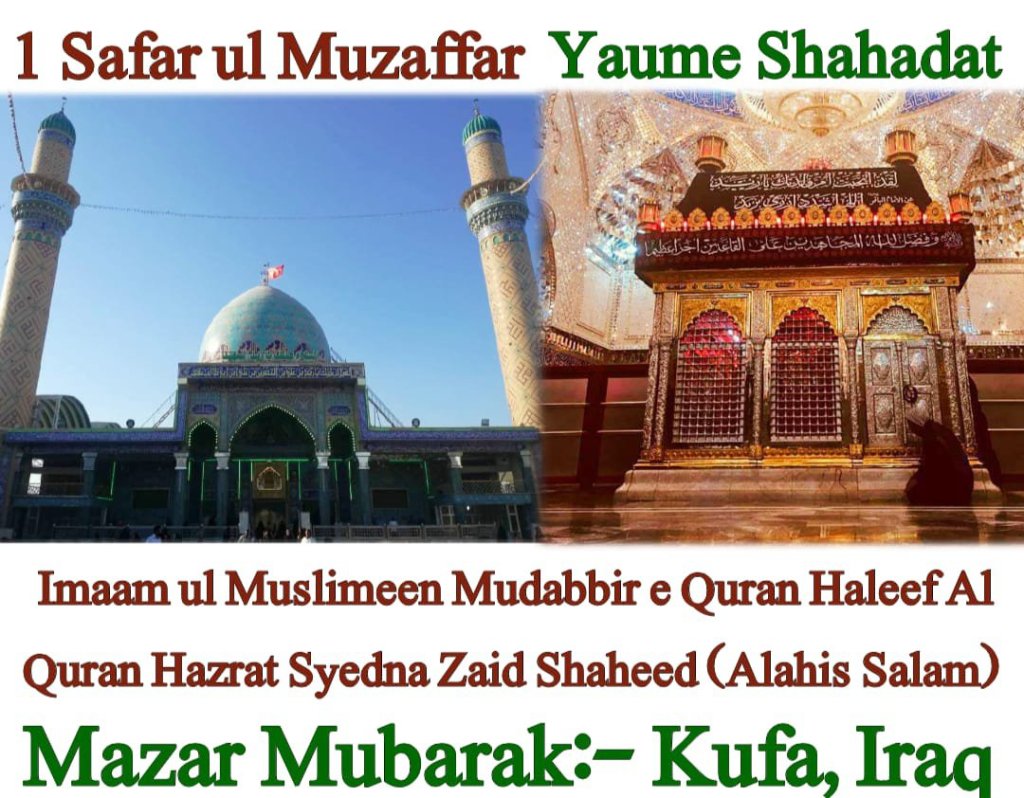
2 Safar ko Unki Shahadat hai Jinke Murid Imam-e-Aazam Abu Hanifa Jaisi Azeem Hasti hai! Unke baareme Muhaddis-e-Akbar Imam Shuabi ne farmaya:
“Allah Ta’ala ki Qasam! Kisi aurat ne bhi Unse zyada Fazilat ka Hamil, Unse zyada Faqih, Unse zyada Shujaah aur Unse zyada Zahid paida nahi kiya!!”
Aur Unke bare Khud Imam-e-Aazam Abu Hanifa RadiAllahu Anhu farmate hain:
“Maine Unke Zamane me Unse zyada Faqih, Unse zyada Aalim, Unse zyada Haazir Jawab, Unse zyada baat ki Wazahat karne wala kisiko nahi dekha!!”
Wo Azeem Hasti hain Imam Hussain Alaihissalam ke Potey, Imam Zainul Aabideen Alaihissalam ke Shahzade, Hazrat Sayyeduna Imam Zaid bin Ali Alaihi-Mussalam!!
(Imam Muhammad al Baqir Alaihissalam ke Bhai)
Aap Ilm o Amal ke Samandar to they he aur Aap Haq ki aawaz buland karne se bhi nahi darte they (jo ke Ahle Bayt-e-Athaar ki Shaan hai!)
Aapne hukumat ke kiye jaane waale zulm ke khilaf aawaz uthayi to hukumat ne Imam Abu Hanifa ko Unke khilaf fatwa deno ko kaha. To Imam-e-Aazam ne fatwa diya ke Jo Imam Zaid Alaihissalam ki Madat karega usko Badr Waalo jaisa Sawab milega!!

Jab Imam Zaid Alaihissalam ko Shaheed kiya gaya to us hukmraan ne Aapke Jism-e-Aqdas se kapde nikaale aur Aapko suli par chadhaya aur kaha ke Ahle Bayt ke Log koi khaas nahi hote Inke Jism bhi maut ke baad sad jaate hain (maazAllah).
To 4 saal tak Aapka (ba-zaahir) murda Jism-e-Pak suli pe latka raha lekin jo bhi shakhs kareeb se guzrata usko Mushk se behtar khushu aati!! Aur Allah ne Aapke Satr ki Hifazat ki!!
Jab Aapke Shahdat ki Khabar Aapke Bhatije Imam Jafar as Sadiq Alaihissalam tak pahunchi to gum ke maare Aap nidhaal hogaye, kai hafto tak Apne Chacha ke gum me rote rahe. Aur farmaya:
“Allah Rabbul Izzat ki Qasam! Imam Zaid Hum me sabse zyada Quran ko padhne waale, Allah ke Deen ki Hum me sabse zyada Samajh bujh rakhne waale aur Hum me sabse zyada Sulah Rehmi karne waale they. Allah Rabbul Izzat ki Qasam! Duniya aur Aakhirat me ab Hum me Unki Misl koi bhi maujud nahi..”
Imam Zaid Alaihissalam Bahot Bade Muhaddis bhi they aur aaj duniya me available gaaliban jo sabse purani Hadees ki Kitaab hai, Wo Imam Zaid bin Ali Alaihi-Mussalam ki Murattab ki hui “Musnad Zaid” hai! Jisme Aapne Apni Sanad se Aaqa SallAllahu Alaihi wa Aalihi wa Sallam ki Ahadees Riwayat ki Hain aur Wo Kitab pdf aur hard copies me kai languages me maujud hai!
kamse kum 2 rakat Nafl padhke Uska Sawab Aapki Bargah me Bataor-e-Hadiya pesh karen.. InshaAllah
Allahumma Salle Ala Sayyedina Muhammadiw wa Ala Aali Sayyedina Muhammadin
(SallAllahu Alaihi wa Ala Aalihi wa Sahbihi wa Baarik wa Sallim)


कातिल ने किस सफाई से पोंछी हैं आस्तीन वह जानता नहीं कि लहू बोलता भी है 65 हिज. में हज़रत मुहम्मद बिन हनफीया और हज़रत मुख्तार ने खूने इमाम आली मकाम रज़ि अल्लाहु अन्हु का बदला लेना शुरू किया और कहा कि मैं इंशाअल्लाह इसी तरह बनी उमैया और उसके मुआवनीन का खून बहाऊंगा जिस तरह. बख्त नम्र ने यहूदियों का खून बहाया था।
(मिरातुल-असरार) जिस रोज़ हुजूर सल्लल्लाहु अलैहि व सल्लम जंगे तबूक में तशरीफ
उसी रोज़ मुख़्तार कूफा में पैदा हुआ। मुख़्तार के वालिद का नाम हज़रत उबैदा था और वालिदा का नाम हुलिया था। मुख्तार के मां-बाप ने मुख्तार को तमाम उलूम व फुनून पर महारत दे रखी थी। यज़ीद पलीद के मरने के बाद हर चहार जानिब अफरा तफरी का माहौल था। इसी दर्मियान मुख़्तार सकफी खूने इमाम हुसैन रजि अल्लाहु अन्हु का बदला लेने के लिए निकले। और सबसे पहले मुख्तार सीधा हज़रत सैय्यदना इमाम जैनुल आबेदीन रज़ि अल्लाहु अन्हु के पास मदीना पहुंचा और उनकी ख़िदमत में हाज़िर हो कर अर्ज़ किया कि हुजूर मैं खूने इमाम आली मकाम का इंतिक़ाम लेने के लिए निकला हूं, सारे यज़ीदियों को चुन-चुन कर कत्ल करूंगा। बस आपकी दुआ चाहिए जैसा कि उन्होंने आले रसूल को कत्ल किया है।
यह सुन कर हज़रत सैय्यदना इमाम ज़ैनुल आबेदीन रज़ि अल्लाहु अन्हु रोने लगे और फरमाया कि ऐ मुख्तार अगर वह लोग भाग जाएं तो तू क्या करेगा।
मुख्तार ने कहा हुजूर रब्बे काबा की कसम अगर वह सांप के सूराख़ में भी छुप जाएं तब भी खूने इमाम का बदला लिए बेगैर न छोडूंगा हज़रत सैय्यदना इमाम जैनुल आबेदीन रज़ि अल्लाहु अन्हु से दुआ व इजाज़त लेकर मुख्तार मदीना से रुख्सत हुआ और कसीर फौज तैयार किया और हज़रत सैय्यदना मुहम्मद हनफीया की हिमायत में कूफा पहुंचा, यह वही मुहम्मद हनीफा हैं जो हज़रत अली के बेटे हैं।
 Aal-e-Qutub Aal-e-Syed Abdullah Shah Ghazi