
Month: September 2021

Forty-Seven Sayings About Imam Ali (AlahisSalam) From Prophet (Sallallahu ‘Alayhi Wasallam)

Forty-Seven Sayings About Imam Ali (AlahisSalam) From Prophet (Sallallahu ‘Alayhi Wasallam)
1) The Prophet (Sallallahu ‘Alayhi Wasallam)said, “The title of the believer’s book is love for Ali (A.S).” Al-Manaqib of Ibn Al-Maghazeli, 243; Tarikh Baghdad of Al-Khatib Al-Baghdadi, 4/410; Al-Jami^ of Al-Sayuti, 2/145; Yanabi^ Al-Mawda.
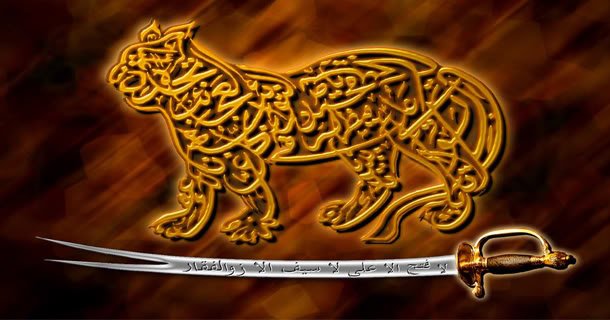
2) The Prophet(Sallallahu ‘Alayhi Wasallam) said, “There is no sword but Dhul-Fiqar, and there is no man but Ali (A.S).” Mustadrak Al-Sahihain of Al-Hakim Al-Nisabori, 2/385; Sunan Al-Bayhaqi, 3/376; Ibn Al-Maghazeli, 197; Al-Tabari, 2/514; Al-Riyadh Al-Nudhra, 2/190.
3) The Prophet(Sallallahu ‘Alayhi Wasallam) said, “The carrier of my flag in this life and the Hereafter is Ali (A.S).” Kenz Al-Omal, 6/122; Al-Tabari, 2/201; Al-Khawarizmi, 250; Al-Fadha’il of Ahmad, 253; Ibn Al-Maghazeli, 42/200.
4) The Prophet (Sallallahu ‘Alayhi Wasallam) said, “My Lord commanded me to close all the doors except the door of Ali (A.S).” Al-Khasa’is of Al-Nisa’i, 13; Mustadrak Al-Sahihain of Al-Hakim Al-Nisabori, 3/125; Al-Tirmidhi, 13/173; Al-Bayhaqi, 7/65; Yanabi^ Al-Mawda, 282; Musnad Ahmad, 4/369; Ibn Al-Maghazeli, 245; Yanabi^ Al-Mawda, 126.
5) The Prophet (Sallallahu ‘Alayhi Wasallam)said, “The truest believers are three: the believer during the time of Al Ya-Sin, the believer during the time of Pharaoh, and the best of all, Ali (A.S).” Al-Manaqib of Ahmad, 194, 239; Kenz Al-Omal, 5/31; Al-Jami^ of Al-Suyuti, 2/83; Ibn Al-Maghazeli, 245; Yanabi^ Al-Mawda, 126.
6) The Prophet(Sallallahu ‘Alayhi Wasallam) said, “The one who wants to live my life and die my death will attach himself to Ali (A.S).” Musnad of Ahmad, 5/94; Mustadrak Al-Sahihain of Al-Hakim Al-Nisabori, 3/128; Kenz Al-Omal, 6/217; Al-Tabarani.
7) The Prophet (Sallallahu ‘Alayhi Wasallam) said, “The caller will call out on the Day of Judgment, ‘O Muhammad, blessed be your father, and Ibrahim, and blessed be your brother, Ali (A.S).” Al-Fadha’il of Ahmad, 253; Ibn Al-Maghazeli, 67; Al-Khawarizmi, 83; Al-Riyadh Al-Nudhra, 2/201.
8) The Prophet(Sallallahu ‘Alayhi Wasallam) said, “Every prophet has an executor and inheritor, and my executor and inheritor is Ali (A.S).” Kenz Al-Omal, 6/158; Tarikh Baghdad of Al-Khateeb Al-Baghdadi, 11/173; Shawahid Al-Tanzil, 2/223; Yanabi^ Al-Mawda, 94.
9) The Prophet(Sallallahu ‘Alayhi Wasallam) said, “Dear God, don’t take my life until you have shown me the face of Ali (A.S).” Al-Riyadh Al-Nudhra, 2/201; Al-Fadha’il of Ahmad, 253; Ibn Al-Maghazeli, 67; Akhtab Khawarizm, 83.
10) The Prophet (Sallallahu ‘Alayhi Wasallam) said, “We were created from the same tree, I and Ali (A.S).” Al-Tirmidhi, 13/178; Ibn Al-Maghazeli, 122; Asad Al-Ghaba, 4/26; Al-Riyadh Al-Nudhra, 2/216.
11) The Prophet(Sallallahu ‘Alayhi Wasallam) said, “The most knowledgeable person in my nation after me is Ali (A.S).” Manaqib Al-Imam Ali Ibn Abi TAlib (A.S) of Ibn Al-Maghazeli Al-Shafi^i.
12) The Prophet (Sallallahu ‘Alayhi Wasallam) said, “Embellish your gatherings by mentioning Ali (A.S).” Mustadrak Al-Sahihain of Al-Hakim Al-Nisabori, 3/109; Musnad Ahmad, 4/368, 5/419; Al-Khasa’is of Al-Nisa’I, 9; Ibn Al-Maghazeli, 16; Al-Manaqib of Akhtab Khawarizm, 94; Tarikh Baghdad of Al-Khateeb Al-Baghdadi, 8/290; Yanabi^ Al-Mawda.
13) The Prophet (Sallallahu ‘Alayhi Wasallam)said, “The most judicious person in my nation is Ali (A.S).” Ibn Al-Maghazeli, 70; Arjah Al-MatAlib, 544.
14) The Prophet (Sallallahu ‘Alayhi Wasallam)said, “I am the warner, and the guide after me is Ali (A.S).” Musnad Ahmad, 1/151; Al-Tirmidhi, 2/135; Al-Khasa’is of Al-Nisa’I, 20; Kenz Al-Omal, 1/247; Ibn Al-Maghazeli, 222.
15) The Prophet(Sallallahu ‘Alayhi Wasallam) said, “Exemption from the Hellfire comes with love for Ali (A.S).” Mustadrak Al-Sahihain of Al-Hakim Al-Nisabori, 2/241; Tarikh Baghdad of Al-Khateeb Al-Baghdadi, 6/851; Akhtab Khawarizm, 86; Ibn Al-Maghazeli, 90.
16) The Prophet (Sallallahu ‘Alayhi Wasallam)said, “Of whomever I was master, Ali (A.S) is his master.” Mustadrak Al-Sahihain of Al-Hakim Al-Nisabori, 3/129; Kenz Al-Omal, 6/157; Al-Dilmi.
17) The Prophet(Sallallahu ‘Alayhi Wasallam) said, “There would not be one sufficient for Fatima if God had not created Ali (A.S).” HAliyat Al-Awliya’, 1/34; Al-Riyadh Al-Nudhra, 2/177; Ibn Al-Maghazeli, 242; Al-Khawarizmi, 42; Yanabi^ Al-Mawda, 112.
18) The Prophet (Sallallahu ‘Alayhi Wasallam)said, “For the one who believes and trusts in me, I recommend the wilayat of Ali (A.S).” Al-Jami^ of Al-Suyuti, 1/230; Al-Riyadh Al-Nudhra, 2/168; Tarikh Baghdad of Al-Khateeb Al-Baghdadi, 1/316; Ibn Al-Maghazeli, 49; Yanabi^ Al-Mawda, 266.
19) The Prophet (Sallallahu ‘Alayhi Wasallam)Qsaid, “The first of you to reach the Pond is the first of you who accepted Islam: Ali (A.S).” Kenz Al-Omal, 6/154; Al-Tabarani, 5/32; Al-Riyadh Al-Nudhra, 1/165; Dhaka’ir Al-^Aqi, 65; Ibn Al-Maghazeli, 230.
20) The Prophet (Sallallahu ‘Alayhi Wasallam) said, “No one is permitted on the Bridge except by the wilayat of Ali (A.S).” Ibn Al-Maghazeli, 15; Al-Isti^ab, 2/457.
21) The Prophet (Sallallahu ‘Alayhi Wasallam) said, “No one can give account of me but Ali (A.S).” Ibn Al-Maghazeli, 119, 242; Al-Riyadh Al-Nudhra, 2/177; Yanabi^ Al-Mawda, 112, 419; Al-Khawarizmi, 253.
22) The Prophet (Sallallahu ‘Alayhi Wasallam) said, “The most miserable person from the beginning of the world to the end is the murderer of Ali (A.S).” Mustadrak Al-Sahihain of Al-Hakim Al-Nisabori, 3/141; Musnad Ahmad, 4/263; Al-Khasa’is of Al-Nisa’i 39; Al-Tabari, 2/408; Kenz Al-Omal, 5/58.
23) The Prophet (Sallallahu ‘Alayhi Wasallam)said, “There is a tree in Paradise called Tuba. Its roots are in the house of Ali, and its branch is Ali (A.S).” Mustadrak Al-Sahihain of Al-Hakim Al-Nisabori, 3/109; Musnad Ahmad, 4/370; Al-Khasa’is of Al-Nisa’i, 25; Al-Tirmidhi; Al-Tabarani.
24) The Prophet (Sallallahu ‘Alayhi Wasallam) said, “Ali (A.S) is the distinguisher between truth and falsehood.” Mustadrak Al-Sahihain of Al-Hakim Al-Nisabori, 3/132; Musnad Ahmad, 1/331; Yanabi^ Al-Mawda, 92.
25) The Prophet (Sallallahu ‘Alayhi Wasallam)said, “The most righteous one is Ali (A.S).” Al-Bayhaqi, 4/35; Kenz Al-Omal, 7/176; Al-Jami^ of Al-Suyuti, 2/276; Ibn Al-Maghazeli, 93.
26) The Prophet (Sallallahu ‘Alayhi Wasallam)said, “The hand of Ali (A.S) and my hand are equal in justice.” Mustadrak Al-Sahihain of Al-Hakim Al-Nisabori, 3/14; Al-Tabari, 2/272; Al-Tirmidhi, 2/299; Ibn Al-Maghazeli.
The Prophet (Sallallahu ‘Alayhi Wasallam)said, “Ali (A.S) is my brother in this life and the Hereafter.” Al-Khasa’is of Al-Nisa’i, 5; Al-Tirmidhi; Yanabi^ Al-Mawda, 61; Ibn Al-Maghazeli, 37; Yanabi^ Al-Mawda, 57.
28) The Prophet (Sallallahu ‘Alayhi Wasallam)said, “Ali (A.S) is the best of humanity, and the one who denies it has blasphemed.” Ibn Al-Maghazeli, 129; Yanabi^ Al-Mawda, 233; Tarikh Baghdad of Al-Khateeb Al-Baghdadi, 5/37; Al-Khawarizmi, 235.
29) The Prophet (Sallallahu ‘Alayhi Wasallam) said, “Ali (A.S) is the door of servitude, and whoever passes through that door is a true believer.” Mustadrak Al-Sahihain of Al-Hakim Al-Nisabori; Kenz Al-Omal, 6/156; Al-Dilmi.
30) The Prophet(Sallallahu ‘Alayhi Wasallam) said, “Ali (A.S) is the Imam of goodness, the fighter against iniquity, the helper of those who come to his aid, and the deserter of those who desert him.” Kenz Al-Omal, 6/153; Al-Darqatani.
31) The Prophet(Sallallahu ‘Alayhi Wasallam) said, “Ali (A.S) is the Imam of the pious, the prince of believers, and the leader of the resplendent.” Mustadrak Al-Sahihain of Al-Hakim Al-Nisabori, 3/129; Kenz Al-Omal, 6/153.
32) The Prophet(Sallallahu ‘Alayhi Wasallam) said, “Ali (A.S) is to me what Haroun was to Musa.” Mustadrak Al-Sahihain of Al-Hakim Al-Nisabori, 3/137; Ibn Al-Maghazeli, 65, 104; Al-Tabarani; HAliyat Al-Awliya’, 1/63; Akhtab Khawarizm, 229.
33) The Prophet (Sallallahu ‘Alayhi Wasallam)said, “Ali (A.S) holds a right over this nation like the right of a father over his son.” Muslim, 2/361; Al-Tirmidhi, 2/299; Al-Hakim, 3/130; Musnad Ahmad, 3/198; Al-Nisa’i, 7; Asad Al-Ghaba, 3/40.
34) The Prophet(Sallallahu ‘Alayhi Wasallam) said, “Ali (A.S) is with the Qur’an, and the Qur’an is with Ali.” Al-Bukhari, 5/19; Muslim, 2/360; Al-Tirmidhi, 5/304; Mustadrak Al-Sahihain of Al-Hakim Al-Nisabori, 3/109; Ibn Majah, 1/28; Musnad Ahmad, 3/328.
35) The Prophet(Sallallahu ‘Alayhi Wasallam) said, “Ali (A.S) and his shi^a are the successful ones.” Ibn Al-Maghazeli, 47; Mizan Al-^Itidal, 2/313.
36) The Prophet (Sallallahu ‘Alayhi Wasallam)said, “Ali (A.S) is the door of my knowledge, and the one who will clarifies for my nation that which I was sent with.” Tafsir Al-Tabari, 3/171; Shawahid Al-Tanzil, 2/356; Al-Darr Al-Manthour, 6/379; Yanabi^ Al-Mawda, 61.
37) The Prophet (Sallallahu ‘Alayhi Wasallam) said, “Love for Ali (A.S) is faith, and hatred for Ali is hypocrisy.” Ibn Al-Maghazeli, 67; Al-Khawarizmi, 236; Fara’id Al-Samateen; Yanabi^ Al-Mawda.
38) The Prophet (Sallallahu ‘Alayhi Wasallam)said, “Ali (A.S) is the partition between Heaven and Hell.” Mustadrak Al-Sahihain of Al-Hakim Al-Nisabori, 3/127; Kenz Al-Omal, 5/30; Al-Jami^ of Al-Suyuti, 1/374; Al-Tirmidhi; Ibn Maghazeli, 80.
39) The Prophet (Sallallahu ‘Alayhi Wasallam)said, “The position of Ali (A.S) amongst the people is like Surat Qul Hu Allahu Ahad in the Qur’an.” Muslim, 1/48; Al-Tirmidhi, 2/299; Al-Nisa’i, 27; Musnad Ahmad, 6/299; Ibn Al-Maghazeli, 191.
40) The Prophet (Sallallahu ‘Alayhi Wasallam)said, “Ali (A.S) is the beloved between two friends, myself and Ibrahim.” Yanabi^ Al-Mawda, 88; Fara’id Al-Samateen; Bea^ Al-Abrar; Moniq Ibn Ahmad Al-Khawarizmi.
41) The Prophet (Sallallahu ‘Alayhi Wasallam) said, “Whoever splits with Ali (A.S) has split with me, and whoever splits with me has split with God.” Ibn Al-Maghazeli, 45; Yanabi^ Al-Mawda, 181.
42) The Prophet (Sallallahu ‘Alayhi Wasallam)said, “Ali (A.S) is from me and I am from him, and he is the protector of every true believer after me.” Ibn Al-Maghazeli, 69; Yanabi^ Al-Mawda, 125.
43) The Prophet(Sallallahu ‘Alayhi Wasallam) said, “Ali (A.S) is the most beloved of God and His Prophet in all of creation.” Kenz Al-Omal, 5/33; Al-Riyadh Al-Nudhra, 2/211; Ibn Al-Maghazeli, 219.
44) The Prophet(Sallallahu ‘Alayhi Wasallam) said, “Mentioning Ali (A.S) is a form of worship, and looking upon him is a form of worship.” Mustadrak Al-Sahihain of Al-Hakim Al-Nisabori, 3/123; Kenz Al-Omal, 6/156; Al-Tabarani; Ibn Al-Maghazeli, 240, 278; Al-Khawarizmi, 62.
45) The Prophet (Sallallahu ‘Alayhi Wasallam) said, “Love for Ali (A.S) is a good deed, so don’t ruin it with bad deeds.” Al-Tabarani; Yanabi^ Al-Mawda, 2/3.
46) The Prophet (Sallallahu ‘Alayhi Wasallam) said, “Ali (A.S) holds the position of the Ka^aba.” Mustadrak Al-Sahihain of Al-Hakim Al-Nisabori, 3/122; Musnad Ahmad, 3/82; Al-Tabarani, 6/155; Kenz Al-Omal.
47) The Prophet (Sallallahu ‘Alayhi Wasallam) said, “Ali (A.S) stands in relation to me as my head to my body.” Mustadrak Al-Sahihain of Al-Hakim Al-Nisabori, 3/141; Al-Jami^ of Al-Suyuti, 1/583; Tarikh Baghdad of Al-Khateeb Al-Baghdadi, 1/51; HAliyat Al-Awliya’, 1/182; Al-Riyadh Al-Nudhra, 2/219.

Hadith Shajra e Noor

❤ Ek Mustafa ❤ Ek Murtaza ❤
.
Hazrat Salman Farsi RadiAllaho Anho Se Marwi Hai Ke Huzoor Nabi E Akram (صلى الله عليه وآله وسلم) Ne Farmaya : Aadam Alaihissalam Ki Takhleeq Se 14,000 Saal Pahle Allah Rabbul izzat Ke Huzoor Mai Aur Ali (عليه السلام) Aik Noor The.
.
Jab Allah Ne Aadam Alaihissalam Ko Takhleeq Farmaya To Us Noor Ko Do Hisso Me Taqseem Farma Diya (Us Noor Ka) Aik Hissa Mai Hoo’n Aur (Us Noor Ka) Dusra Hissa Ali (عليه السلام) Hai
.
Reference :
– Fazail E Sahaba Imam Ahmad ibne Hanbal 2/662#1130
– Manaqib E Ali -imam Magazali 1/142#130
– Tareekh E Damishq-imam ibne Asakir 67/42,
– Riyaz Un Nazra-Muhibuddeen Tabri 3/120
.
اَللّٰھُمَّ صَلِّ عَلَی سَیِّدِنَا مُحَمَّدٍ وَ عَلَی اٰلِ سَیِّدِنَا مُحَمَّدٍ وَ بَارِکْ وَ س٘لِّمْ
Ali AlahisSalam THE MIRACLE OF Nabi Pakﷺ part 18
THE DESPATCH OF
SURA BARAAT
Though many of the Meccans had embraced Islam and called themselves Muslims they still
worshipped their idols secretly and performed many of their old rites which Islam had forbidden. The
Prophet (ﷺ) received a revelation in the form of Sura Baraat from Allah forbidding these people
from doing such unIslamic rites. As the Prophet (ﷺ) himself could not go to Mecca he deputed Abu
Bakr to carry the Sura to Mecca and recite it before the pilgrims, and explain to them its significance
and its meanings. Abu Bakr taking his friend Umar and some three hundred people with him left for
Mecca. The Prophet (ﷺ) also gave him two hundred camels to sacrifice them on his behalf. Hardly
Abu Bakr had gone some distance when the Prophet (ﷺ) received another revelation from Allah
asking the Prophet (ﷺ) to either proceed himself with the mission or send somebody who was from
him. As the Prophet (ﷺ) could not go himself he asked Ali (A.S.) to rush and take the Sura Baraat
from Abu Bakr and fulfil the mission himself. The Prophet (ﷺ) also gave his own camel Ghadzba to
Ali (A.S.) so that it may take Ali (A.S.) faster to catch Abu Bakr. The Prophet (S.A.W) also instructed Ali
(A.S.) to take Abu Bakr with him, but if he refuses to accompany him then ask him to return.
Ali (A.S.) met Abu Bakr at Ara and gave him the Prophet (ﷺ)’s message. Abu Bakr though handed
over the Sura to Ali (A.S.).
Ali (A.S.), on reaching Kaaba, read Sura Baraat to the pilgrims and declared, “I have been ordered by
the Prophet (ﷺ) to tell you :-
(1) That no one shall henceforth go round the Kaaba in nude.
(2) That all the agreements signed by the Prophet (ﷺ) with many of the tribes stand cancelled from
to day.
(3) That from this year no infidel will be allowed to visit the Kaaba.”
Towards 9 A.H. missions from various parts of Arabia came to the Prophet (ﷺ) and embraced
Islam, except the Christians of Najran, a city of Yemen, who still doubted his mission and turned down
all his invitations. Finally they agreed to send a deputation of fourteen learned people who would meet
the Prophet (ﷺ) and know from him his mission. The delegation was led by three famous scholars,
Abdul Masseb, Aquib Sayeed and Abdul Harris. On reaching Madina they changed their clothes and
wore rich silken garments and golden rings to impress the Prophet (ﷺ). When the Prophet (ﷺ)
saw them coming in this garb he instead of welcoming them turned his face away from them.
Disappointed by the Prophet (ﷺ)’s attitude they went to Usman and complained about the Prophet
(ﷺ’s treatment. Usman brought them to Ali (A.S.) for his advice. Ali (A.S.) seeing them in rich
garments advised them to change their dresses and wear their original priestly dresses. The delegates
accordingly wore their priestly dresses and again went to the Prophet (ﷺ) who answered their
salutations and said, “By the Lord who has appointed me as His messenger, I could see the Satan
accompanying you when you first came to meet me”

Mu’awiya’s appointment of Yazeed as his successor
Mu’awiya forced people to give bayya to Yazeed
Legendary Salafi scholar Muhammad Rasheed Raza (d. 1935) who is known as ‘reformer’ and who has been praised by several Salafi scholars including Al-Albaani has stated in his authority work Mujalat al-Manar, volume 33 page 441:
فإن متبع الحق مستقل الفكر فيه بلا هوى ولا تعصب لمذهب يجزم بأن معاوية نفسه كان باغيًا خارجًا على الإمام الحق كالخوارج ، وأنه طالب ملك ، ويؤيد ذلك إكراه الناس على جعل هذا الملك لولده يزيد المشتهر بالفسق
Anyone delving into the truth with a free mind unclouded by emotion or sectarian affiliation, shall confirm that Mu’awyia was rebel (Baghi) and one that departed (Kharij) against the true Imam, he sought the throne and forced the people to transfer the throne to his son Yazeed who was known for his lechery (Fisq).
In Volume 24 page 33, he stated:
معاوية واستخلافه ليزيد الفاسق الفاجر بقوة الإرهاب من جهة ورشوة الزعماء من أخرى
Mu’awyia inaugurated Yazeed the Fasiq sometimes by means of terror while sometimes by means of bribe.
His book has been translated into Urdu language by the name of ‘Imamate al Uzma’ published by Quran Mahal, Molvi Musafir Khana, Karachi:
Imamate al Uzma page 99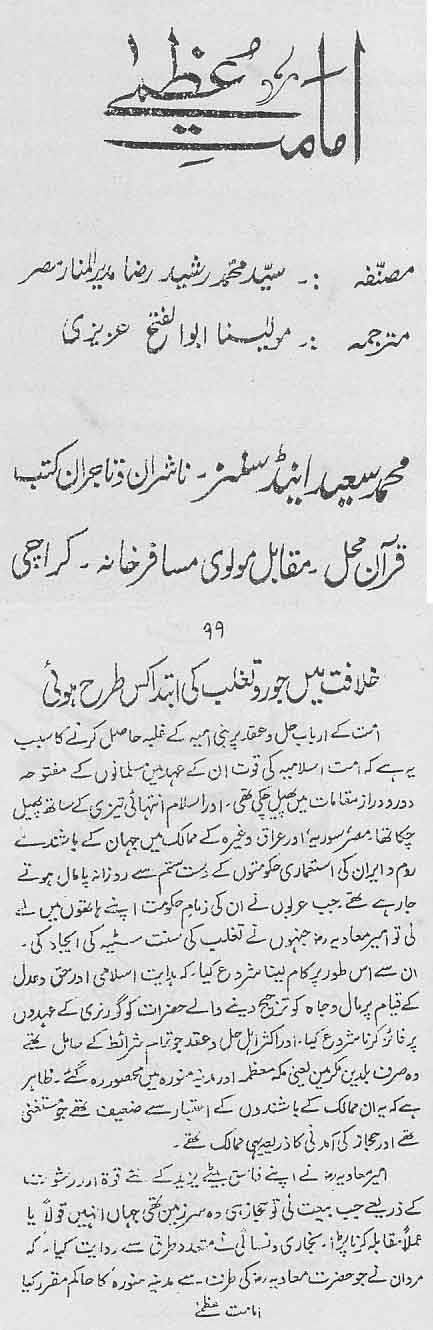
————————————————————————————————————-
Deobandi scholar Rasheed Akhtar Nadwi in “Tahzeeb o Tamadun-e- Islami” comments on page 1:
“Mu’awiya forced people to give bayya to Yazeed”.
Tahzeeb-o-Tamadun-e-Islami, part 3 page 2 by Rasheed Akhtar Nadvi (Idara Saqafat-e-Islamia, Lahore)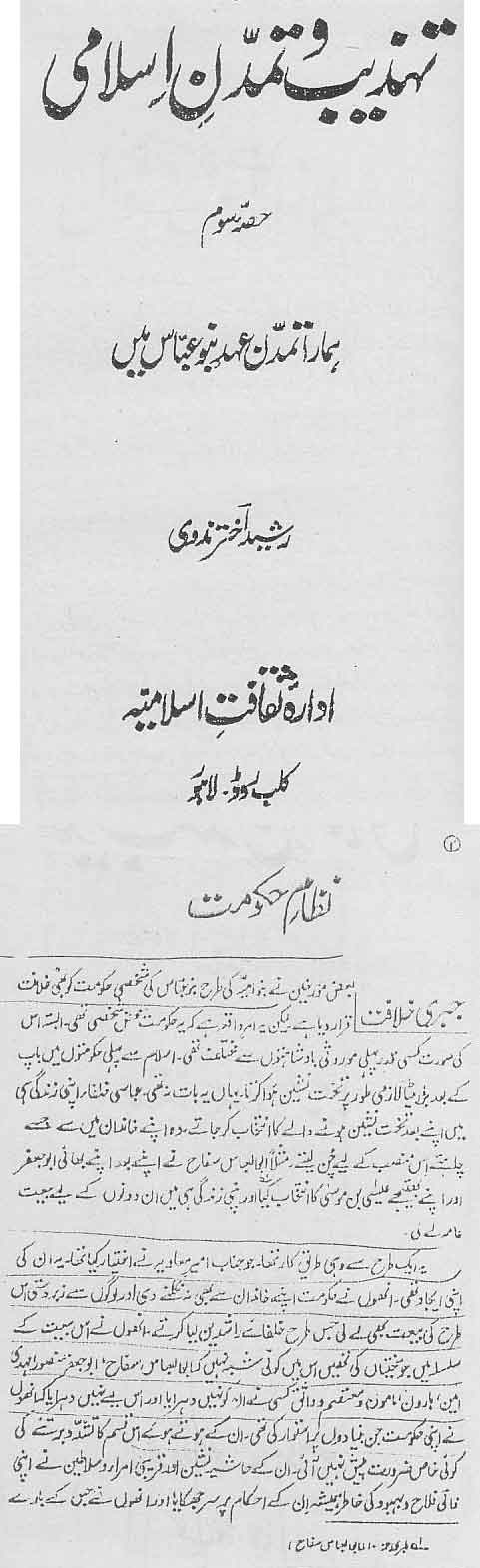
——————————————————————————————————
Professor Saeed Akbar Allahbadi in his book “Musalman ka ‘Uruj-o-Zawal” (Urdu) page 53 likewise states:
“Mu’awiya attained power by force and secured it for Yazeed in the same manner. People who did not agree were forced to give it”.
Musalman ka ‘Uruj-o-Zawal page 53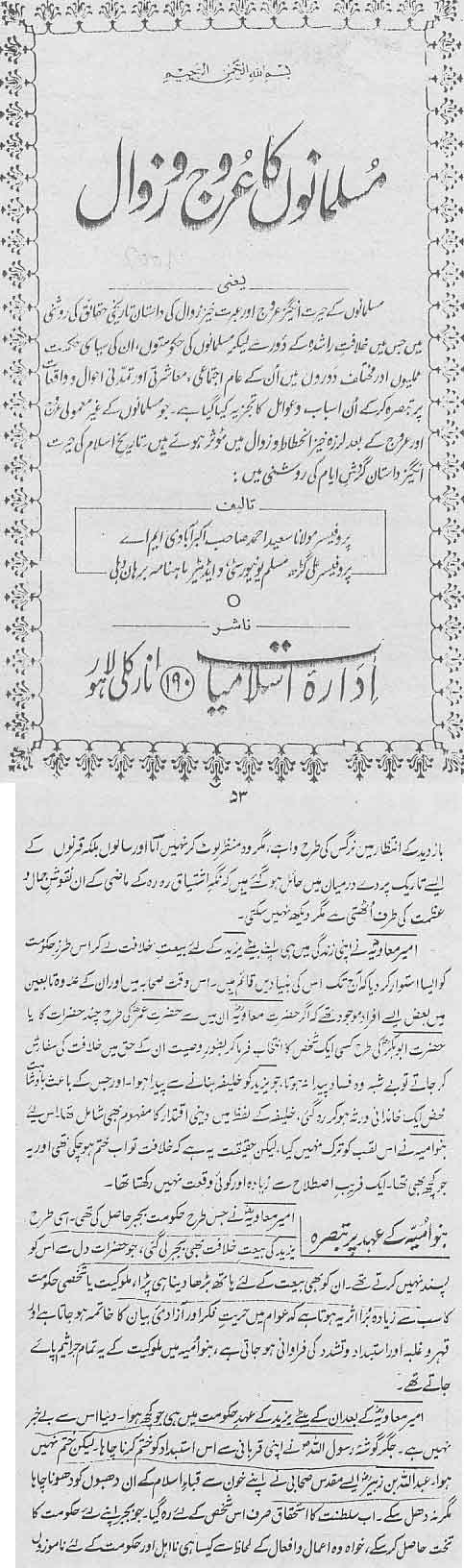
Abu Sulaiman had proclaimed that Mu’awiya:
consulted the grandest companions, the masters of the people and the district’s governors. They all accepted. Delegations from the districts came with acceptance to give allegiance to Yazeed
What Abu Sulaiman fails to explain is the method Mu’awiya used that resulted in delegates giving bayya to Yazeed. Let us shed light on his methods by citing the comments of Syed Qutb Shaheed in “Social Justice in Islam” (English translation pages 209-210):
“With the coming of Mu’awiya, the caliphate in Islam became a monarchy, a tyranny confined to the Umayyad family…
It will be sufficient at this point to quote as proof of this the account of the oath of allegiance to Yazid. From here we may discover the foundation of Umayyad power and find out whether Mu’awiya who established that power was true to the spirit of Islam or to some other ideal. Mu’awiya summoned delegates to represent all the provinces at the taking the oath of allegiance to Yazid. Then Yazid Ibn al Muqaffa stood up and said “The Commander of the Faithful is here”, and he indicated Mu’awiya, “If he dies his successor is here” and he indicated Yazid. “And if anyone refuses – here” and he pointed to his sword. The, said Mu’awiya, “Sit down O best of preachers”.
After the oath was taken to Yazid in Syria Mu’awiya gave Said ibn al-’As the task of gaining the acceptance of the people of the Hejaz. This he was unable to do, so Mu’awiys went to Mecca with an army and with full treasury. He called together the principal Muslims and addressed them thus:
“You all know that I have lived among you, and you are aware also of my ties of kindred with you. Yazid is your brother and your nephew. It is my wish that you take the oath of allegiance to Yazid as the next Caliph; then it will be you who will bestow offices and depose from them, who will collect and apportion money”. He was answered by Abdullah ibn Al Zubair, who gave him a choice of three things to do, first he might do as Allah’s Messenger had done and appoint no successor, second he might do as Abu Bakr had done and nominate a successor, third he might do as Umar had done, and hand over the whole matter to a council of six individuals, none of whom was a member of his own immediate family. Mu’awiya’s anger was kindled, and he asked “Have you any more to say?” “No”. Mu’awiya turned to the remainder of the company “And you?” “We agree with what Ibn Al Zubair has said”, they replied. Then he addressed the meeting in threatening terms: “The one who warns is blameless. I was speaking among you, and one of you was bold to get up and call me a liar to my face. That I will bear and even forgive. But I stand to my words, and I swear by Allah that if any of you speaks one word against the position that I take up, no word of answer will he receive, but first the sword will take his head. And no man can do more than save his life”.
Thereupon the commander of Mu’awiya’s guard ordered two men to stand over each of the nobles of the Hejaz who opposed him and to each he said, “If your man leaves his guards to speak one word, either for me or against me, then let the guards strike off his head with their swords”. Then he mounted the pulpit and proclaimed: “These men are the Leaders and the choicest of the Muslims; no matter can be successfully handled without them, nor can any decision be taken without their counsel. They are now satisfied to take the oath to Yazid , and have indeed already taken that oath by the name of Allah”. So the people took the oath.
Social Justice in Islam, (English translation) pages 209-210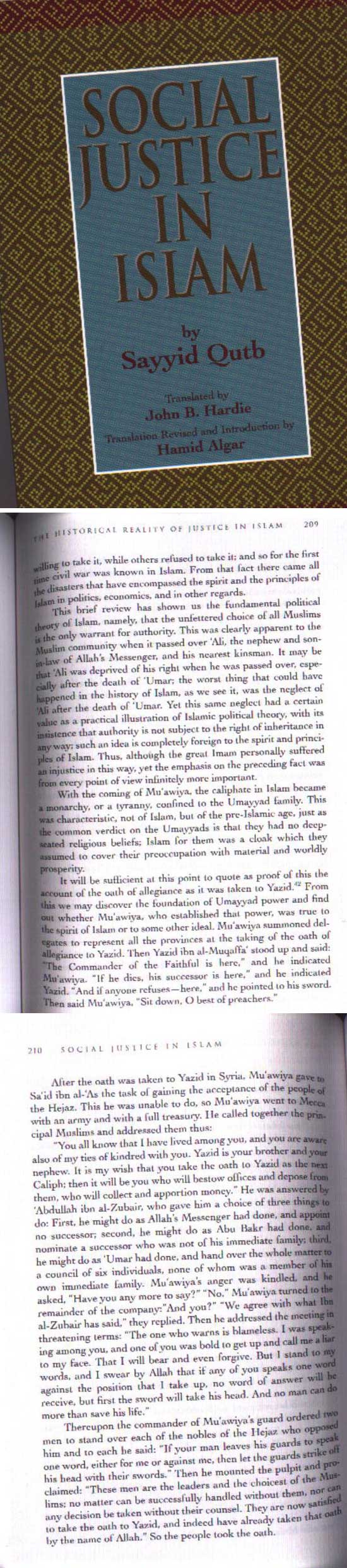
Mu’awiya bribed people to give bayya to Yazeed
We read in Tarikh al Kamil, Volume 3 page 350:
“Mu’awiya kept Mugheera in his post. Mugheera arrived at Kufa and spoke to his close representatives, bribing them with 30,000 dirhams to maintain their support. Mugheera sent his son Musa bin Mugheera to Head a delegation that visited Damascus, there they [the group] reiterated their support for the nomination of Yazeed as Khalifa. Mu’awiya summoned Musa and asked him how much money his father had spent to buy these individuals, he replied 30,000 dirhams”.
Mu’awiya killed all those who posed a hurdle for him making Yazeed Khalifah
Muawiyah not only used his money, but he also made use of violence to secure his filthy son’s seat succession to the throne. Victims of such violence included Abdur Rahman bin Khalid bin Waleed. Though Abdur Rahman was not a Shia rather a Nasibi, when it cames to the love of his filthy son, Muawiyah didn’t even spare one of his companions.
- al Bidaya wa al Nihaya, Volume 8 page 31 Dhikr 31 Hijri
- al Istiab, Volume 1 page 250, Dhikr Abdur Rahman bin Khalid
- al Nasa al Kafiya, page 62
- Asadul Ghaba, page 440 Dhikr Abdur Rahman bin Khalid bin al-Walid
- Tarikh Kamil, Volume 2 page 213
- Shazarath’ul Dhahab, Volume 1 page 55 Dhikr 46 Hijri
عبد الرحمن بن خال بن الوليد
القرشى المخزومى وكان من الشجعان المعروفين والأبطال المشهورين كابيه وكان قد عظم ببلاد الشام لذلك حتى خاف منه معاوية ومات وهو مسموم
“Khalid bin Walid’s son Abdur Rahman was from amongst the brave men and was popular in Syria hence Mu’awiya was against him and was poisoned”
We read in al-Istiab:
“Abdurehman was againt Ali and Bani Hashim … he had fought in Sifeen alongside Muawiyah…When Muaiywah decided to take bayah from people for his Yazeed, he gave a sermon to the people of Syria in which he said: ‘the time of my death is approaching, I am elderly and I want to make a ruler for you people, what do you people want?’. They said: ‘We like Abdurehman’. Muawiya didn’t like it but kept it within him and once Abdurehman got ill, Muawiya told the doctor to treat him and gave him a syrup that could kill him, the doctor administered it and killed him by giving him poison.”
 Aal-e-Qutub Aal-e-Syed Abdullah Shah Ghazi