29 SAFAR AL MUZAFFER URS SHARIF ALA HAZRAT PEER MAHER ALI SHAH R.A
Peer maher ali shah r.a madine me the to khowab me sarkar do alam sallal allaho alyhe wasallam ki ziyarat hoi farmae ky qadiyan me ek dajjal hai jo meri shariyat ko kaat raha hai or tum yaha per baithe ho … peer maher ali shah wapas lahor me aae or isk khelaf kitabe likhi jiska qadiyanio k pas aaj tak jawab nai… mirza gulam ahmed qadiyani lanati kazzab ne peer maher ali shah r.a ko munazre ka challenge diya or lahor ki jama masjid bhi tae kr di… or kaha ky jo sure fateha ki bahtaren tafseer likhe ga is se uski ilmi qabiliyat pata chale gi… peer maher ali shah farmae ky ye baat to thik hai magar ham qalam ko hukm den or kahe aye qalam likh tafseer sure fateha ta mirza kazzab har gaya… alhamdulillah.. us wakat peer maher ali shah se pucha gaya aap itna yakeen se kayse kah rahe the qalam ko hukm den to peer saheb ne farmaya MERE KHOWAB ME SARKAR S.A.W.M KI ZIYARAT HOI FARMATA AYE MAHER ALI KAL MIRZA QADIYANI KY MUQABLE ME AGR MURDE KO BHI ZINDA KARNA PADA TO ALLAH S.W.T TUMHARI DUA QUBOL KRK MURDE ZINDA KR DE…
Is tarah peer maher ali shah r.a ne qadiyaniyat ko wo zillat amez shikast di ky aaj bhi india pakistan bangadesh wagira me qadiyani fitna itna urooj pe nai hai
Khayal rahe peer maher ali shah r.a ka daur ahmed raza ka daur dono ek hi hai..
After Martyrdom of Imam Ali AlaihisSalam Imam Hasan started by giving a powerful address. “Today, they have killed an illustrious elder on the day when the Quran was first revealed. He was of such excellent and noble qualities that neither the personalities which have gone nor those which will follow in future can achieve them. He, in the company of the Prophet PBUH waged war against the infidels. He made himself the shield for the Prophet. The Prophet used to make him his standard bearer. Jibrael used to walk on his right side and Mikael on his left. He never came back from the field unvictorious. Yet, at the time of his demise he had only seven hundred dirham with which he wanted to buy a slave for his family. He did not leave anything else. For, he had always spent whatever came into the imperial treasury on the poor and needy.” (This is startling considering that the revenues that came to the Caliph’s government exceeded millions of pounds.) At that moment Imam Hasan could not control himself and started crying. The crowd also started crying.
At the end of his father’s elegy, Ubaidullah Ibn Abbas stood up and called the people to pledge their loyalty to the grandson of the bringer of good tidings, the son of the Warner, the son of the summoner to God (powerful and exalted). The congregation needed no such promptings. Imam al Hasan was adored by all.
He was also by all accounts, the image of his grandfather and a charming conversationalist who never spoke ill of any one. He was also a genuine ascetic, who had already performed pilgrimage twenty-five times, travelling the whole 250 miles on foot between Medina and Mecca. He is one of the great unsung heroes of Islam, a pacifist and a scholar.
It was Hasan who stood guard over Usman’s door until rendered unconscious by the assault of the mutineers.
He preached the teachings of the Quran, not as a cause for war but call for peace. Again and again, he stressed that the lesser jihad, the armed struggle should be a just preparation for the greater jihad, which was a life long struggle to master one self,
He quoted the Quran Sura 2, verse 216: “God has prescribed the jihad for you though it is a loathsome duty.”
Hasan was ahead of his time in his vision of Islam as a religion of peace. The garrison soldiers of Kufa, the same men who had refused to fight for his father on the fourth day of Siffeen and after that tragic day at Neherwan, now angrily demanded that he lead them to war. Far too many Muslims had grown used to the idea that their faith would be reflected in military victory, they erroneously saw glorious triumphs in this world, fame, wealth and glory as proofs of righteousness of Islam. They could no longer understand that Mohammed’s teachings were entirely about the individual’s relationship to God and was not a charmed banner under which they were destined to conquer the world.
Hasan did preach that like all true Muslims, they should aspire to abandon worldly ambitions, that shame is better than hellfire and that he should not seek worldly dominion but the favor of the God and spare the blood of people.
Instead, the soldiers began to publicly abuse the prince until they had worked up their passion to a riot. Hasan’s house was looted, his prayer mat was ripped from underneath him and his tunic pulled from his shoulders. Only the protection of the mounted warriors of Rabia tribe, devoted partisans of
Ali and his family stopped Hasan from being martyred on that day.
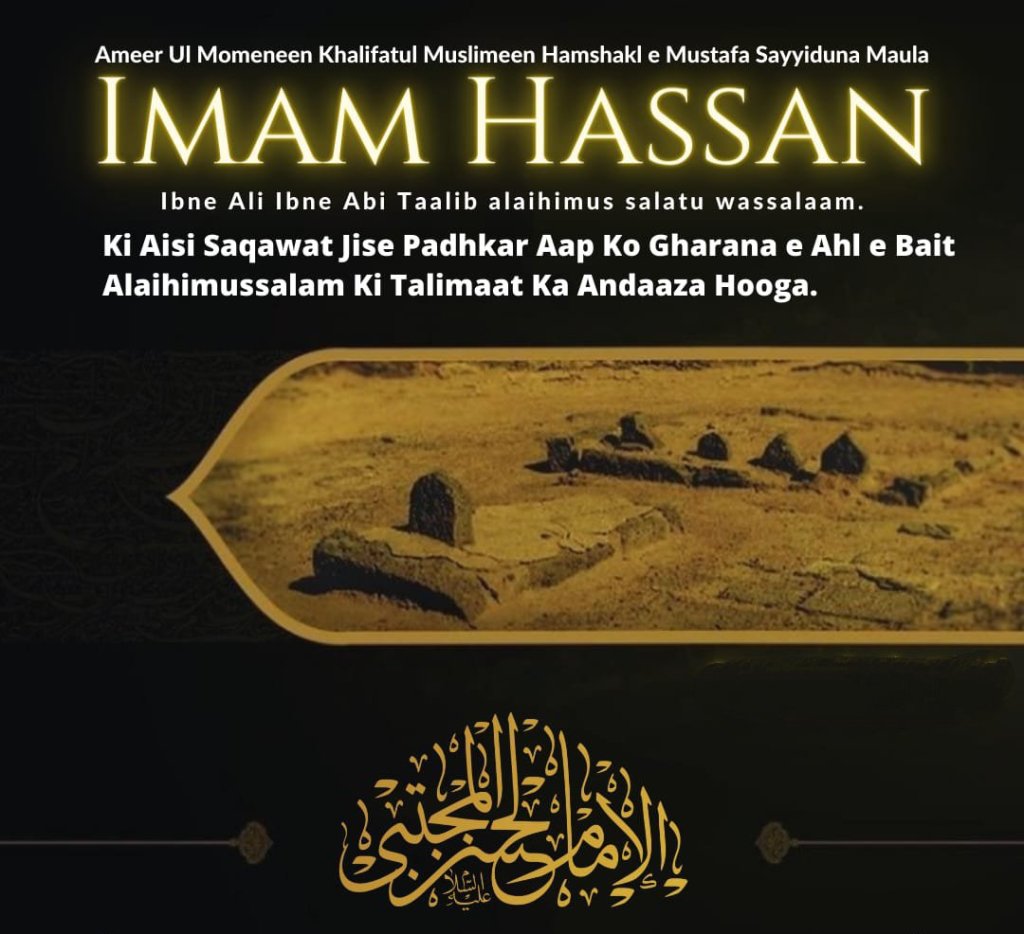
The violence only made Hasan absolutely determined to end schism within Islam and halt any further bloodshed between Muslims. Hasan agreed to relinquish all authority to Muawiya in exchange for an agreement not to harm any supporter of Ali, and to govern by the book of the God and the example of the Prophet. He explained to the congregation in Kufa Mosque that he had ceded his right to rule for the best interest of the community and for the sake of sparing blood.’ Muawiya had already sent his seal attached to a completely blank draft of the proposed treaty—so that Hasan could fill in whatever terms he desired. Hasan was assured of an annual salary of a million dirham with which he could generously support his companions, all the Bani Hashim and old clients of his father.
Zainab undertook the nursing of the wound of her brother until it had healed. For some time after the recovery of her brother she forgot the past calamities and felt that after abdicating the government her brother’s life had been saved and the family had been rescued from annihilation.
But Moavia wanted that this caliphate should be converted into monarchy and retained in the family of Bani Ummaya. In the lifetime of Hazrat Hasan he could not take oath of allegiance for Yazeed.
In the peace treaty there was a clause which stated that after the demise of Moavia, Hazrat Imam Hasan will be the lawful guardian of the government. This condition had made Moavia anxious. It was not because he was very particular about his contracts and treaties to be confirmed.
The main source of his anxiety was that Muslims would not accept Yazeed against Hazrat Imam Hasan as Caliph.
Moavia still remembered the day when after the treaty he went to the pulpit and took the name of Hazrat Ali with indignity. Imam Husain immediately stood up to refute but Imam Hasan took hold of his hand and asked him to sit down. Imam Hasan himself addressed Moavia.
“O the person who has taken the name of Hazrat Ali with unseemly lack of respect, I am Hasan. My father is Ali, you are Moavia and your father Sakhar. My mother is Fatima and your mother is Hind. My grandfather is the Messenger and your grandfather, Harab. My grandmother is Khadija and your grandmother is Qateela. Now may God curse the person amongst both of us, who exceeds in profanity, hypocrisy and in enormity of evil mindedness and wickedness, May God curse such a person.’
From the four corners of the mosque loud voices were raised saying Ameen.
With the honour and devotion which Imam Hasan enjoyed amongst masses, the wish of Moavia could never be fulfilled. The fear of the sword of Moavia kept the masses quiet. They did not have the courage to utter a word but they had great respect and honour for Imam Hasan. the
Imam Hasan and Imam Hussain after the peace treaty proceeded towards Medina in order to ensure peace in the Islamic world. But Imam Hasan’s remorseless enemies would later attempt to blacken his saintly pacific nature by planting the canard of his having a hundred wives and extravagant weddings, although Hasan’s seven marriages and descendents are accurately chronicled.
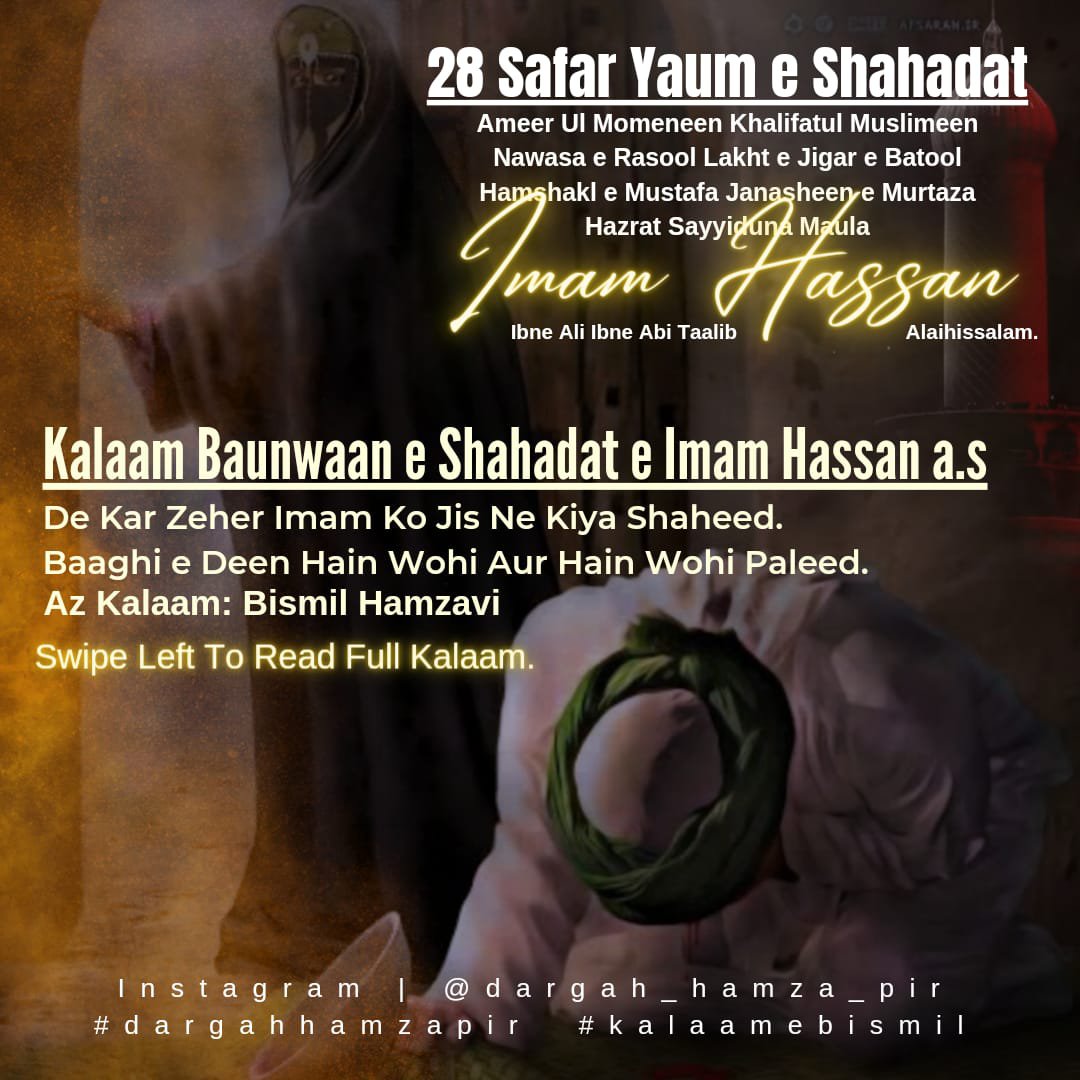
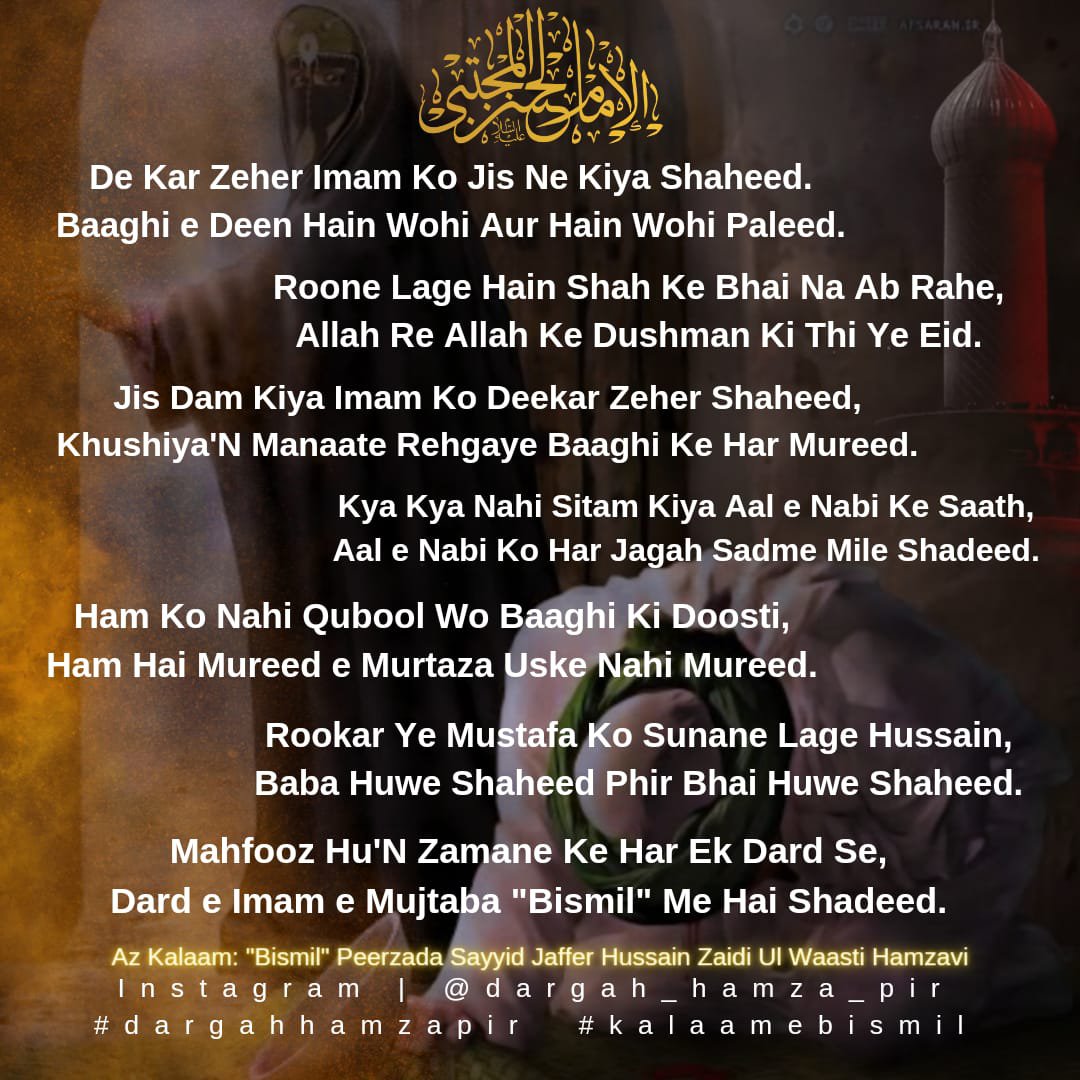
Moavia tried many a times to obtain oath of allegiance for Yazeed but in the presence of Imam Hasan it would never be possible. Now Imam Hasan’s life became a burden for Moavia, therefore he hatched a conspiracy. He arranged to poison Imam Hasan. Moavia sent poison to one of the wives of Imam Hasan, Jada, daughter of Ashash bin Qais, so that she could give him poison in a drink. It was promised that if she will perform the task then Moavia will give her one lakh dirham and will get her married to his son Yazeed. When Jada had performed the task then Moavia sent her the stipulated money and conveyed the message that she could not be married to Yazeed because for him his son’s life is very dear. After that she married a person from the tribe of Ahl Talba. When she had children and her sons had any dispute with the children of Quraish, then the children of the Quraish used to taunt them and say you are children of a woman who had poisoned her husband.
Zainab accompanied the bier of her brother for some distance. He was buried in the grave yard of Baqee. She returned to her house wrapped in melancholy.
During the month of Ramadan, Hazrat Ali was in the Duabit of eigenting the homes of his children. His appetite was greatly reduced and he used to take only a few morsel of food. When asked about it, he said
“I wish when my death comes, I should be on an empty stomach.”
On the night of the 19th of Ramadan, the Imam (a.s.) went to his daughter Umme Kulsum’s house. She offered him two breads of barley and a bowl of milk and some salt. When he saw the food he said, “In the footsteps of the Prophet (a.s.) I have never had more than one type of food on my spread. O daughter there is accountability for the legitimate and retributation for the illegitimate. Do you want your father to stay longer at the station of accountability on the Day of Judgment? Remove one of the two things from the spread!
Umme-Kulsum took away the bowl of milk and AmirulMumineen (a.s.) ate a few morsel of bread with salt. After the meal, according to his practice, he stood upon the mat to offer his prayer looked up repeatedly at the twinkling stars and said, “By Allah! I am not lying nor making any wrong
statement! This is the night about which the promise has been made.”
When Ali set out for the Mosque, a flock of domestic birds raised a loud outcry as he passed through the yard. One of the attendants threw a stick at them but was at once stopped by Ali “Leave them, be alone, for their cries are only lamentations foreboding my death.” Umme-Kusum said, “Father! God forbid! Pray, do you not say such things.’ ”
He said, “That is the truth which has come out of my mouth.” Then Imam (a.s.) told Umme- Kulsum, “My daughter! These birds cannot speak! Take care of feeding them. If you cannot do it then free them so that they can find their food by going around the world.” Umme- Kulsum bid adieu to her father with tears in her eyes. When he reached the mosque it was still dark. He went to place from where azan echoed and called people to prayer. This was the last time that his voice resounded calling the people to pray, and was heard in every household of Kufa.
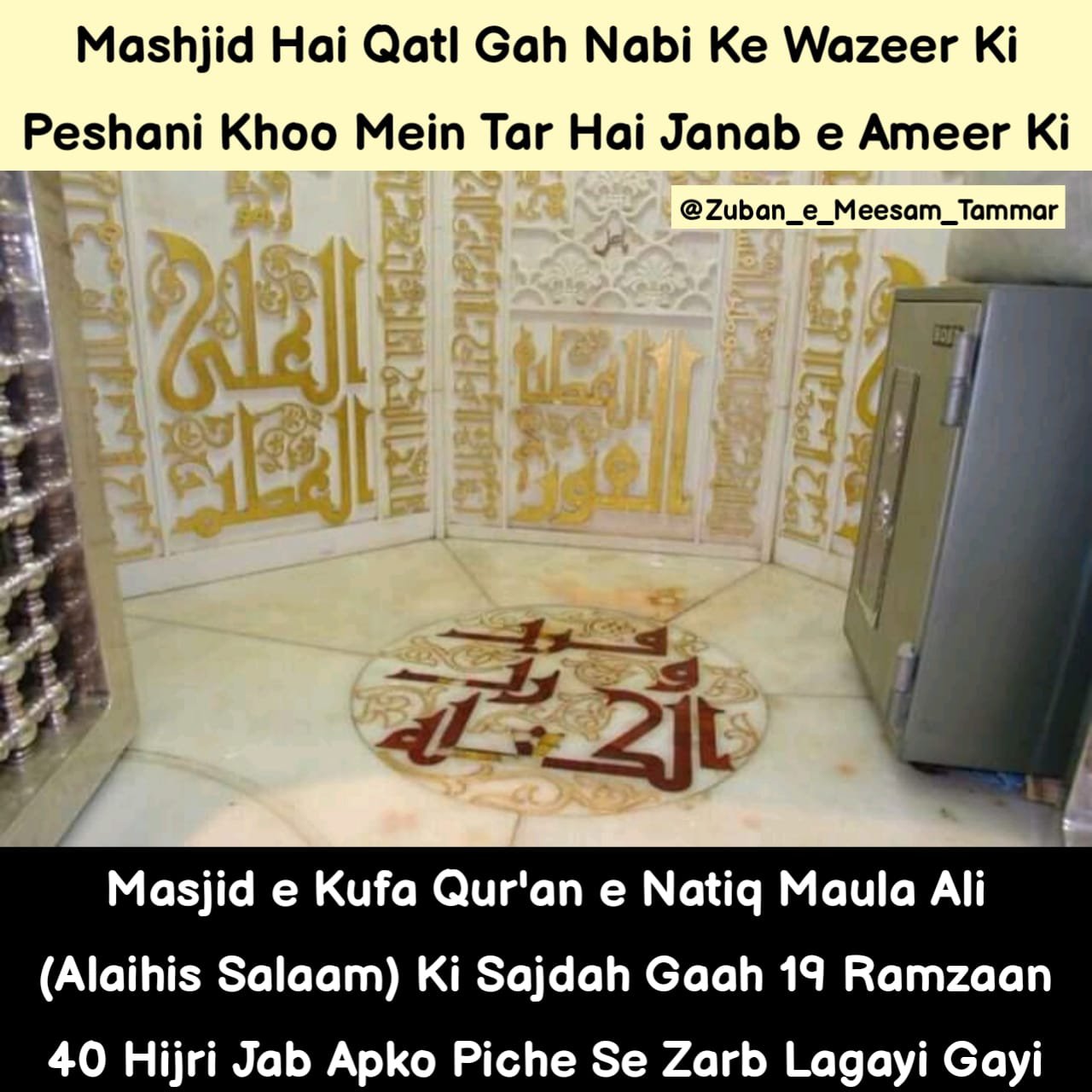
After the awakening call, the Imam (a.s.) stood in the arch for the prayer. When the Imam bent for prostration, Ibn Muljim hit his poisoned sword on the Imam’s (a.s.) head so hard that his skull cracked. The Imam (a.s.) proclaimed, “In the name of Allah, and in the religion of Allah’s Messenger, I have really succeeded.”
Shortly afterwards people started coming, for the dawn prayer in the Mosque. They found him lying wounded in a pool of blood on his prayer mat.
Loud lamentations and cries were raised that the cousin of the Prophet had been killed. People started coming to the mosque in hordes, Imam al-Hasan and Imam al-Hussain ran towards the mosque in panic where people were crying
inconsolably and were shouting, “Amir al Mumineen has been martyred!” The sons of the Prophet went forward and saw the arch of the mosque was drenched in the blood and the Imam was writhing in pain on the floor.
Seeing the head and face of Amir-Mumineen covered in blood Imam al-Hasan asked in a choked voice “Father! Who has shed your blood?” The Imam lifted his head, looked at Hasan and said “My son! First offer your prayers!” Therefore, Imam al- Hasan (a.s.) led the congregation and Ali (a.s.) sat in prayer. After the prayer Imam (a.s.) was brought to the courtyard of the Mosque. People had already gathered in large numbers outside and inside the Mosque.
On the ill-omened night of 19 Ramadan, Zainab was sitting at home and was unaware of the calamity which had taken place in the mosque. Shortly after the Muazzin had finished his Azana heart breaking cry calling out for assistance was heard coming from the mosque. An unknown fear withered her heart but she tried to compose herself. After that, in a state of distress and anxiety she heard the noise coming closer towards her house and it was not long before, the lamentation came from very close to her house. Zainab immediately understood that these distressing and mournful cries were indicative of her father’s assassination. Zainab, for the second time, gathered all her faculties which threatened to shatter her any moment. She composed herself and prepared to welcome her father.
Hazrat Ali, due to the poison stained blow of the sword, had to be brought on the shoulders of the people.
Zainab fell down before her father and started washing all his wounds crying all the time. On the other side, Umme Kulsum was standing and addressed her father’s assassin,
“O enemy of God! My father will not be harmed by your blow and you will be disgraced.” It was obvious that Zainab had heard the affair of Ibne Muljim from the people who were coming to inquire about his health. Yes, she had heard that Ibne Muljim was one of the three Kharjites who were attempting to murder Hazrat Ali, Ameer Moavia and Umroo binal, so that he could avenge the death of his brothers who were killed in Neherwan.
Ibne Muljim had come to Kufa from Mecca. He went to meet a person from amongst his friends who belonged to tribe of, “Tumur rubab.” There, he saw Quttam binte Akhzar who was amongst the most beautiful women of her time. Her father and brothers had been killed in the battle of Neherwan. As soon as he saw her, he was enamoured of her and wanted to tie the knot with her.
Quttam inquired, “What will be my dower?” Ibne Muljim replied, “Whatever your desire” Quttam said, “My dower will be three thousand dinar, one slave, one maid and the murder of Ali Ibne Abi Talib.”
Ibne Muljim pretended to be deep in thought for some time because he wanted to keep his mission a secret and said, “Whatever you desire I will give thee but the murder of Ali is not possible for me.” Quttam in order to allure him towards her said, “If you will murder Ali, my heart will be soothed and I will be accessible to you.” Ibne Muljim looked at her attentively and said.
“By God, I have undertaken this journey only for the sake of murdering Ali and not for any other purpose. ”
Quttam brought two other persons to help him. And on the appointed night, she put swords in a sling around their neck and sent them towards the mosque.
This affair was settled in such a way that a poet has described, “No one has seen the type of dower like that of Quttam.”
“Three thousand dirham, one slave, one maid and the murder of Hazrat Ali, the Amirul Momineen.”
“However, enormous dower could be, it could never surpass the priceless murder of Hazrat Ali.”
“Any unexpected murder could not match the sudden murder of Hazrat Ali by Ibne Muljim.”
When Hazrat Ali was carried to his house from the mosque, troops after troops gathered at the entrance of his gate. When they were denied entry they understood that the injury was deep and there was danger of death. One of the persons asked the door keeper to convey this prayer to the Commander of the believers, “May God shower blessings on you in your life and in your death. You have limitless knowledge and magnificence of God is in your heart.”
In the mean time, physicians from Kufa had assembled. Amongst them were the famous surgeon and physician, Athir ibn’Amr al Sakuni. After inspecting the wound, he said it was mortal and there was no chance of survival. The poisoned sword had penetrated the brain and the venom had spread. Hearing this, hearts of people started sinking and tears started flowing from their eyes.
The physician said, “O commander of the believers, please make a will.” Therefore, Imam called both his sons to write his will. After that moment, Zainab and Umme Kulsum did not leave the side of their father, as they wanted to receive the bounty of affection from their glorious father,
The commander of the Faithful breathed his last on the 21″ night of Ramzan, 40 Hijri. He left behind his two sons to confront the clever enemy Ameer Moavia. He left behind Aqeela Zainab and Umme Kulsum so that they could observe with their own eyes the Ahl-Bait being hemmed in the flames of perfidy and sedition, which had been ignited to avenge of Hazrat Usman’s murder.








 Aal-e-Qutub Aal-e-Syed Abdullah Shah Ghazi