EDUCATION IN ISLAMIC HISTORY

The Registan complex in Samarkand, Uzbekistan contains three madrasas in the same square


From the very earliest days of Islam, the issue of education has been at the forefront at the minds of the Muslims. The very first word of the Quran that was revealed to Prophet Muhammad ﷺwas, in fact, “Read”. Prophet Muhammad ﷺonce stated that “Seeking knowledge is mandatory for all Muslims.” With such a direct command to go out and seek knowledge, Muslims have placed huge emphasis on the educational system in order to fulfill this obligation placed on them by the Prophet ﷺ.

Throughout Islamic history, education was a point of pride and a field Muslims have always excelled in. Muslims built great libraries and learning centers in places such as Baghdad, Cordoba, and Cairo. They established the first primary schools for children and universities for continuing education. They advanced sciences by incredible leaps and bounds through such institutions, leading up to today’s modern world.

Attitudes Towards Education

Today, education of children is not limited to the information and facts they are expected to learn. Rather, educators take into account the emotional, social, and physical well-being of the student in addition to the information they must master. Medieval Islamic education was no different. The 12th century Syrian physician al-Shayzari wrote extensively about the treatment of students. He noted that they should not be treated harshly, nor made to do busy work that doesn’t benefit them at all. The great Islamic scholar al-Ghazali also noted that “prevention of the child from playing games and constant insistence on learning deadens his heart, blunts his sharpness of wit and burdens his life. Thus, he looks for a ruse to escape his studies altogether.” Instead, he believed that educating students should be mixed with fun activities such as puppet theater, sports, and playing with toy animals.

The First Schools

Ibn Khaldun states in his Muqaddimah, “It should be known that instructing children in the Qur’an is a symbol of Islam. Muslims have, and practice, such instruction in all their cities, because it imbues hearts with a firm belief (in Islam) and its articles of faith, which are (derived) from the verses of the Qur’an and certain Prophetic traditions.”

The very first educational institutions of the Islamic world were quite informal. Mosques were used as a meeting place where people can gather around a learned scholar, attend his lectures, read books with him/her, and gain knowledge. Some of the greatest scholars of Islam learned in such a way, and taught their students this way as well. All four founders of the Muslim schools of law – Imams Abu Hanifa, Malik, Shafi’i, and Ibn Hanbal – gained their immense knowledge by sitting in gatherings with other scholars (usually in the mosques) to discuss and learn Islamic law.

Some schools throughout the Muslim world continue this tradition of informal education. At the three holiest sites of Islam – the Haram in Makkah, Masjid al-Nabawi in Madinah, and Masjid al-Aqsa in Jerusalem – scholars regularly sit and give lectures in the mosque that are open to anyone who would like to join and benefit from their knowledge. However, as time went on, Muslims began to build formal institutions dedicated to education.

From Primary to Higher Education

Dating back to at least the 900s, young students were educated in a primary school called a maktab. Commonly, maktabs were attached to a mosque, where the resident scholars and imams would hold classes for children. These classes would cover topics such as basic Arabic reading and writing, arithmetic, and Islamic laws. Most of the local population was educated by such primary schools throughout their childhood. After completing the curriculum of the maktab, students could go on to their adult life and find an occupation, or move on to higher education in a madrasa, the Arabic world for “school”.

Madrasas were usually attached to a large mosque. Examples include al-Azhar University in Cairo, Egypt (founded in 970) and al-Karaouine in Fes, Morocco (founded in 859). Later, numerous madrasas were established across the Muslim world by the great Seljuk vizier, Nizam al-Mulk. At a madrasa, students would be educated further in religious sciences, Arabic, and secular studies such as  medicine, mathematics, astronomy, history, and geography, among many other topics. In the 1100s, there were 75 madrasas in Cairo, 51 in Damascus, and 44 in Aleppo. There were hundreds more in Muslim Spain at this time as well.

These madrasas can be considered the first modern universities. They had separate faculties for different subjects, with resident scholars that had expertise in their fields. Students would pick a concentration of study and spend a number of years studying under numerous professors. Ibn Khaldun notes that in Morocco at his time, the madrasas had a curriculum which spanned sixteen years. He argues that this is the “shortest [amount of time] in which a student can obtain the scientific habit he desires, or can realize that he will never be able to obtain it.”

When a student completed their course of study, they would be granted an ijaza, or a license certifying that they have completed that program and are qualified to teach it as well. Ijazas could be given by an individual teacher who can personally attest to his/her student’s knowledge, or by an institution such as a madrasa, in recognition of a student finishing their course of study. Ijazas today  can be most closely compared to diplomas granted from higher educational institutions.

Education and Women

Throughout Islamic history, educating women has been a high priority. Women were not seen as incapable of attaining knowledge nor of being able to teach others themselves. The precedent for this was set with Prophet Muhammad’s own wife, Aisha, who was one of the leading scholars of her time and was known as a teacher of many people in Madinah after the Prophet’s ﷺdeath.

Later Islamic history also shows the influence of women.  Women throughout the Muslim world were able to attend lectures in mosques, attend madrasas, and in many cases were teachers themselves. For example, the 12th century scholar Ibn ‘Asakir (most famous for his book on the history of Damascus, Tarikh Dimashq) traveled extensively in the search for knowledge and studied under 80 different female teachers.

Women also played a major role as supporters of education:

The first formal madrasa of the Muslim world, the University of al-Karaouine in Fes was established in 859 by a wealthy merchant by the name of Fatima al-Fihri.

The Abbasid caliph Harun al-Rashid’s wife, Zubayda, personally funded many construction projects for mosques, roads, and wells in the Hijaz, which greatly benefit the many students that traveled through these areas.

The wife of Ottoman Sultan Suleyman, Hurrem Sultan, endowned numerous madrasas, in addition to other charitable works such as hospitals, public baths, and soup kitchens.

During the Ayyubid period of Damascus (1174 to 1260) 26 religious endownments (including madrasas, mosques, and religious monuments) were built by women.

Unlike Europe during the Middle Ages (and even up until the 1800s and 1900s), women played a major role in Islamic education in the past 1400 years. Rather than being seen as second-class citizens, women played an active role in public life, particularly in the field of education.

Modern History

The tradition of madrasas and other classical forms of Islamic education continues until today, although in a much more diminshed form. The defining factor for this was the encroachment of European powers on Muslim lands throughout the 1800s. In the Ottoman Empire, for example, French secularist advisors to the sultans advocated a complete reform of the educational system to remove religion from the curriculum and only teach secular sciences. Public schools thus began to teach a European curriculum based on European books in place of the traditional fields of knowledge that had been taught for hundreds of years. Although Islamic madrasas continued to exist, without government support they lost much of their relevance in the modern Muslim world.

Today, much of the former Ottoman Empire still runs education along European lines. For example, what you are allowed to major in at the university level depends on how you do on a certain standardized test at the end of your high school career. If you obtain the highest possible grades on the test, you can study sciences such as medicine or engineering. If one scores on the lower end of the spectrum, they are only allowed to study topics such as Islamic sciences and education.

Despite the new systems in place in much of the Muslim world, traditional education still survives. Universities such as al-Azhar, al-Karaouine, and Darul Uloom in Deoband, India continue to offer traditional curricula that bring together Islamic and secular sciences. Such an intellectual tradition rooted in the great institutions of the past that produced some of the greatest scholars of Islamic history and continues to spread the message and knowledge of Islam to the masses.

THE BAHIA MUSLIM SLAVE REVOLT

From the 1500s through the 1800s, European nations were engaged in a tragic and ruthless practice known as the slave trade. During this period, over 12 million Africans were boarded onto ships and taken to North and South America to work as slaves. The legacy of this inhumane treatment lives on today, in the form of racism and economic disadvantage for blacks in the Americas, and disunity and war in Africa. One aspect of slavery that has been overlooked in historical studies is the impact of slave revolts. Needless to say, the African slaves did not go willingly to their new lives. In many cases, they fought back against their masters, refusing to accept the life they’d been thrown into.

One of the most notable (and successful) of these rebellions was the Bahia Revolt, which took place in 1835 in Brazil. This revolt, unlike some others, was planned and led entirely by Muslims. The story of how they were able to plan a revolt in such horrid conditions and have such a large impact is remarkable. The most interesting and defining factor of the revolt was its Islamic character.

Background

Brazil was originally a Portuguese colony, up until 1822 when it gained its independence. Regardless of the government, however, the slave trade went on from the earliest Portuguese settlements through the late 1800s. In the eastern state of Bahia, slaves made up about one third of the labor force. Understanding the origin of these slaves is very important to understanding how the revolt was so successful. Most of the slaves came either from Senegambia (on the western coast of Africa), or from the Bight of Benin (modern-day Benin, Togo, and Nigeria). The slaves from these areas were almost entirely Muslim. The Wolof and Mandinke people of Senegambia were entirely Muslim by the 1400s and were very learned in Islamic matters, with many scholars among them. The Yoruba, Nupe, and Hausa people from Benin were also entirely Muslim since at least the 1500s.

Organizing Revolt

In 1814 and 1816, the Muslims of Bahia attempted to organize a revolt against the Portuguese. They wanted to overthrow the local law enforcement, free all the slaves, and commandeer ships back to Africa. Unfortunately, some slaves were serving as informants to the local police, and the revolt was crushed before it even started, with its leaders being killed. Over the next 20 years, intermittent minor revolts by Muslims and non-Muslims alike were met with no success in bringing freedom to Bahia’s slaves.

Before discussing the revolt in 1835, we must understand the unifying factor Islam played in the organization of the slaves. The Wolof, Mandinke, Hausa, Nupe, and Yoruba all spoke different languages. While some people have ignorant ideas about Africa being one monolithic entity, it is a diverse continent of different people, cultures, and nations. These Muslim slaves in Bahia were as diverse as a group of French, German, Russian, and Greek speakers. Despite their ethnic differences, the unifying factor between all of them was Islam. Islam provided them with a common language to speak (Arabic), common customs, dietary habits, and behaviors. The Muslims of Bahia would be much more connected to fellow Muslims of a different ethnicity than non-Muslims who spoke the same language as them. Throughout Islamic history, unity such as this has led to greater strength and solidarity.

The failed revolts of 1814 and 1816 forced Bahia’s Muslims to go into hiding. Outward expressions of Islam were repressed by the authorities. Despite this, throughout the 1820s and 1830s, the Muslim leaders and scholars focused greatly on converting other Africans (be they Catholic or animist) to Islam. Even the Brazilian authorities noticed an increase in the number of people practicing Islam, but did not pay it much attention.

The people who organized the revolt were exclusively Muslim scholars. Due to the strength of the Muslim community, they were well respected by the people and held in a position of honor and esteem. Among these leaders were men such as:

Shaykh Dandara – a wealthy freedman who was an imam

Shaykh Sanim – an elderly slave who established a school to teach people about Islam

Malam Bubakar Ahuna – the leading scholar throughout Bahia, who organized Muslim community events

These Muslim scholars, as well as many others, used the mosques as a base of operations. There they discussed plans for revolt, stored weapons, and educated the local Africans. It was through these mosques that Malam Bubakar distributed his call to jihaad (holy struggle, or military resistance). He wrote out a document in Arabic that called on Muslims to unify in preparation for the coming revolt against their Brazilian masters.

The Revolt

The authorities had received some information that a rebellion was brewing, so they took proactive steps and exiled Malam Bubakar 6 months before the revolt was scheduled. Despite this, the plans for the revolt were already finalized and distributed to Muslims throughout Bahia.

The revolt was to take place after the fajr (dawn) prayer on January 25th, 1835, which was the 27th of Ramadan, 1250 in the Muslim calendar. Some Muslims consider the 27th to be the most probable date for Laylat al-Qadr, the Night of Power, when the Quran was revealed to Prophet Muhammad ﷺ. The Muslims of Bahia chose this date in the hopes that the heightened spiritual state of the community would lead to greater chances for success.

Because of the massive size of the planned revolt, word was bound to reach the Bahia police about the revolt. The night before the revolt was scheduled to take place, they raided one of the local mosques and found Muslims armed with swords and other weapons. The fight that ensued led to the death of one officer. Thus, the revolt had to start early.

Albeit a few hours early, the Muslim revolutionaries from this mosque marched out of the mosque, ready to begin the revolt in the dead of night. They were dressed in long white thobes (tunics) and kufis (skullcaps) that clearly identified them as Muslims. Because the revolt was scheduled to begin at dawn, not all the mosques came out in revolt at the same time. Regardless, those that did start the revolt around midnight marched throughout the streets of Salvador, gathering other slaves (both Muslim and non-Muslim) to join them in their revolt. Before the rest of the mosques even joined, there were about 300 slaves and freedmen marching through the city.

Eventually, the governor of Bahia managed to mobilize the local armed forces to confront the rebels. The few hundred Africans now met over 1,000 professional soldiers with advanced weaponry in the streets of Salvador. The battle lasted for about an hour, and led to the death of over 100 Africans and 14 Brazilian soldiers. The Brazilian authorities clearly won the battle. The revolt never managed to overthrow the local government, nor to board ships headed back to Africa. It appeared to be a failure.

Aftermath

The leaders of the revolt, the Muslim scholars, were put on trial and killed. The numerous slaves who took part in the revolt were given punishments ranging from imprisonment to lashings. Although on the surface the revolt appears to be a failure, there is more to it than that.

After the revolt, a general fear of Africans, particularly Muslims, gripped the people of Brazil. The Brazilian government passed laws that led to a mass deportation of Africans back to Africa. One of the original goals of the Bahia Revolt was to be returned to Africa, so this can be seen as a partial victory for the rebellion.

More importantly, however, the Bahia Revolt spurred the anti-slavery movement throughout Brazil. Although slavery continued to exist in Brazil until 1888, the revolt began the public discussion about the role of slaves and the benefit or detriment they provided to Brazilian society. It is seen as one of the most important events in leading towards freedom for Brazilian slaves.

It is important to note that the single defining factor for the Bahia Revolt was its Islamic character. It was organized and led by Muslim scholars, planned in Muslim mosques, and supported by a largely Muslim African population. Without Islam as a unifying factor, such a revolt never would have been possible, nor would the effect it had have been so great.

Furthermore, Islam continued as a strong force in Brazil for decades. The violent Brazilian reaction to oppress Islam in the aftermath of the revolt did nothing to stamp out Islam. It is estimated that in 1910, there were still over 100,000 Muslims throughout Brazil. This is a testament to the strength of the Muslim community of Brazil and their dedication to Islam.

Any discussion on the history of Islam in the Western Hemisphere must include the heroic actions of these Muslims. Islam is not a new religion in North and South America, brought by recent immigrants from the Middle East and South Asia, as many tend to believe. Rather, it is a religion that has greatly influenced the course of North and South American history in the past, and will continue to do so in the future.

Story of Moaning Pillar (Ustun-e-Hannana) and Prophet Muhammad (صلى الله عليه و آله وسلم)– Rumi’s Masnavi

The “Yearning Pillar” or “Moaning Pillar (ustun-e ḥannāna) was a wooden pillar in the time of the Prophet Muḥammad (صلى الله عليه و آله وسلم). Prophet used to lean against it while preaching. When Companions built a proper pillar, Prophet heard him lamenting. Prophet bless him to be the tree of eternal paradise. The story is beautifully rendered by Mevalna Rumi. 


The Yearning Pillar was complaining of its separation from the Prophet.

The Prophet said, “O pillar, what do you want?”

It said, “My soul has turned into blood because of being separated from you.

I was your support: now you have run away from me: you have made a place to lean against on the pulpit.”

 “Do you desire,” he said, “to be made a date palm, so that the people of the East and the West shall gather fruit from you?

 Or that God should make you a cypress in the other world, so that you will remain everlastingly fresh and flourishing?”

 It replied, “I desire that of which the life endures forever.”

Listen, o heedless one! Do not be less than a piece of wood!

So that you may know that everyone whom God has called to Himself remains detached from all the work of this world.

Whoever obtains his work and business from God, gains admission there and abandons worldly work

Worldly dominion is lawful only to those who indulge the body: we (lovers) are devoted to the everlasting kingdom of Love.

 He (the prince) is in Love’s employ: do not deprive him of his employment, do not let him be employed in anything but loving you.

The high position (business) that veils me from seeing your face is the very essence of being disgracefully dismissed, even though it is called ‘high position.

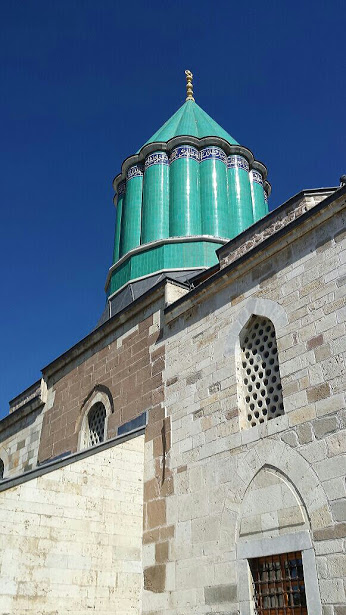
mevlana rumi shrine

An apple that ravaged a Sufi’s soul

Abu Saleh Mousa Jangi Dost lived sometime in the eleventh century in Naif town in the district of Gilan, present day Iran. He had renounced the world and wandered from village to village, town to town, in search of the truth; to tread the path of the just. One day he was weary from his travels on foot. Hunger and fatigue seized his limbs. He came to a river. Jangi Dost sat there on the banks in contemplation. He performed his ablutions and said his namaaz.
And just there, he saw an apple, gleaming red, floating on the river. Hunger pangs were gnawing at his stomach. Jangi Dost rushed into the river, waded through the waters and grabbed the apple, bobbing tantalizingly in the water. In seconds, there was just the core left.
The next moment his heart sank. He had committed a sin. Jangi Dost had eaten an apple that belonged to someone else. He had eaten the fruit without his permission. He had to hunt for the nearest garden. He must track down the owner and seek his forgiveness; for hunger had forced him to violate his creed: honesty.
Years later in the khanqah of Baba Farid in Ajodhan, now Pakpattan, a similar story played out.
Nizamuddin Auliya was a disciple of Baba Farid. Everyone in the khanqah was assigned various chores. Nizamuddin’s responsibility was to boil a broth of wild fruits. Baba Farid and his disciples led a life of poverty. Whatever food came as futuh or unasked for gifts, Baba Farid distributed amongst the poor. He never kept anything for the next day, as it would show he had no trust in God to provide. When there was no futuh, they ate broth made of wild fruit. Nizamuddin was boiling the broth, when he found there was no salt in the kitchen. He went to the grocer and bought some salt on credit since he had no money. He placed the broth before his master.
Baba Farid put his hand into the broth and stopped. “My hand has become heavy. Perhaps, there is something in it that I am not permitted to put a morsel in my mouth,” he said.
Nizamuddin trembled. He placed his head on the ground and said: “My master, Jalal, Badruddin Ishaq and Husamuddin bring wood, wild fruit and water for the kitchen. This man boils the wild fruit and prepares the broth. He brings it before his master. There seems nothing to doubt. The master knows that.”
Baba Farid asked about the salt. Nizamuddin placed his head on the ground again and told him how he had got it.
“Dervishes prefer to die of starvation rather than incur debt to satisfy their desires. Debt and resignation are poles apart and cannot co-exist,” Baba Farid said. He did not touch the broth.
Now Jangi Dost’s soul was ravaged. He had satisfied his hunger, but how? He had eaten an apple that belonged to someone else.
Jangi Dost began his tired walk upstream, his limbs aching, his soul ravaged by the crime he had just committed. Guilt pounded his heart, it raced as he picked up his pace to look for the orchard. Panic set it. And then in the distance, he saw a branch of a tree. It was hanging over the river. “It must be the orchard. I must hasten,” he said to himself.
He came upon the garden and gingerly entered. He looked around. An old man sat quietly in one corner. Jangi Dost asked after the owner.
“What is your problem, son? What troubles you so? I am the owner you eagerly seek.”
Jangi Dost recognized the man as his panic ceased and his heart was relieved that he could own up to the sin that he had committed. He could seek forgiveness. The old man was none other than the noted saint, Abdullah Somai.
“Oh Sir, I have sinned. I was hungry. I saw an apple float down the stream and I quietened my hunger by eating the fruit. Please forgive me.”
Abdullah Somai couldn’t believe his ears. He stared hard at Jangi Dost, whose panic returned, thinking the saint would erupt in anger and not forgive him.
Abdullah Somai looked at the newcomer again. He saw a man of noble upbringing; of serene disposition; of honour.
“How innocent is this young man?” Abdullah Somai thought. “Every day, scores of apples are stolen from my garden, but nobody comes to beg my pardon. Here is this man who has eaten an apple that he picked from the river and has come to seek my pardon. I have not seen such an honest person in my life.”
“What is your name my son?”
“Mousa Kunyat Abu Saleh, but people call me Jangi Dost.”
“And your father?”
“Abdullah Al Jili.”
Abdullah Somai smiled.
“Abdullah Al Jili, the great saint, the descendant of Imam Hassan! Yes, I know him. He is famous for his piety, integrity and spiritual knowledge.”
“Then will you please forgive me?”
“No, I will not forgive you unless you fulfil a condition. You must tend to my garden for two years.”
Jangi Dost was quiet. He was hesitant to take up the responsibility. But he knew Abdullah Somai would not back down. He would have to look after the garden. Abdullah Somai had been searching for an honest man to manage his orchard, and in Jangi Dost, he had found a man who mirrored his soul.
For the next two years, Jangi Dost toiled hard under the hawk eyes of Abdullah Somai. The apple trees blossomed. Abdullah Somai made good money. And right then he knew: Jangi Dost would make a good husband to his precious daughter.
At the end of the two years, Jangi Dost approached Abdullah Somai and asked with all humility if he could take his leave. He had, after all, fulfilled his obligations and he could now go.
‘But you cannot leave!’
‘You have another task. You must marry my daughter. She who is blind. She who is deaf. She who is dumb. And crippled.’
Jangi Dost thought he had just heard the pronouncement of his condemnation to hell. He didn’t know how to get out of this trap.
“What if I refuse?”
“Then I don’t forgive you for eating the apple!”
There was no way out of this. The marriage was solemnized. Jangi Dost entered his wife’s room and that instant, ran back out, trembling.
Abdullah Somai was surprised.
“There is someone else in the room. It is not your daughter. She cannot be my wife – for she is beautiful. She is not deaf. Nor dumb. Nor crippled.”
“My son, she is your wife. I told you she was blind because she has not cast her eyes on anything forbidden; deaf because she has never heard anything wrong; dumb because she has not spoken anything ill; and crippled, as she has not stepped out of the four walls of her father’s house.”
The couple led a content married life. They had a son called Abdul Qader. He would grow be to be known as Gaus Al Azam. 

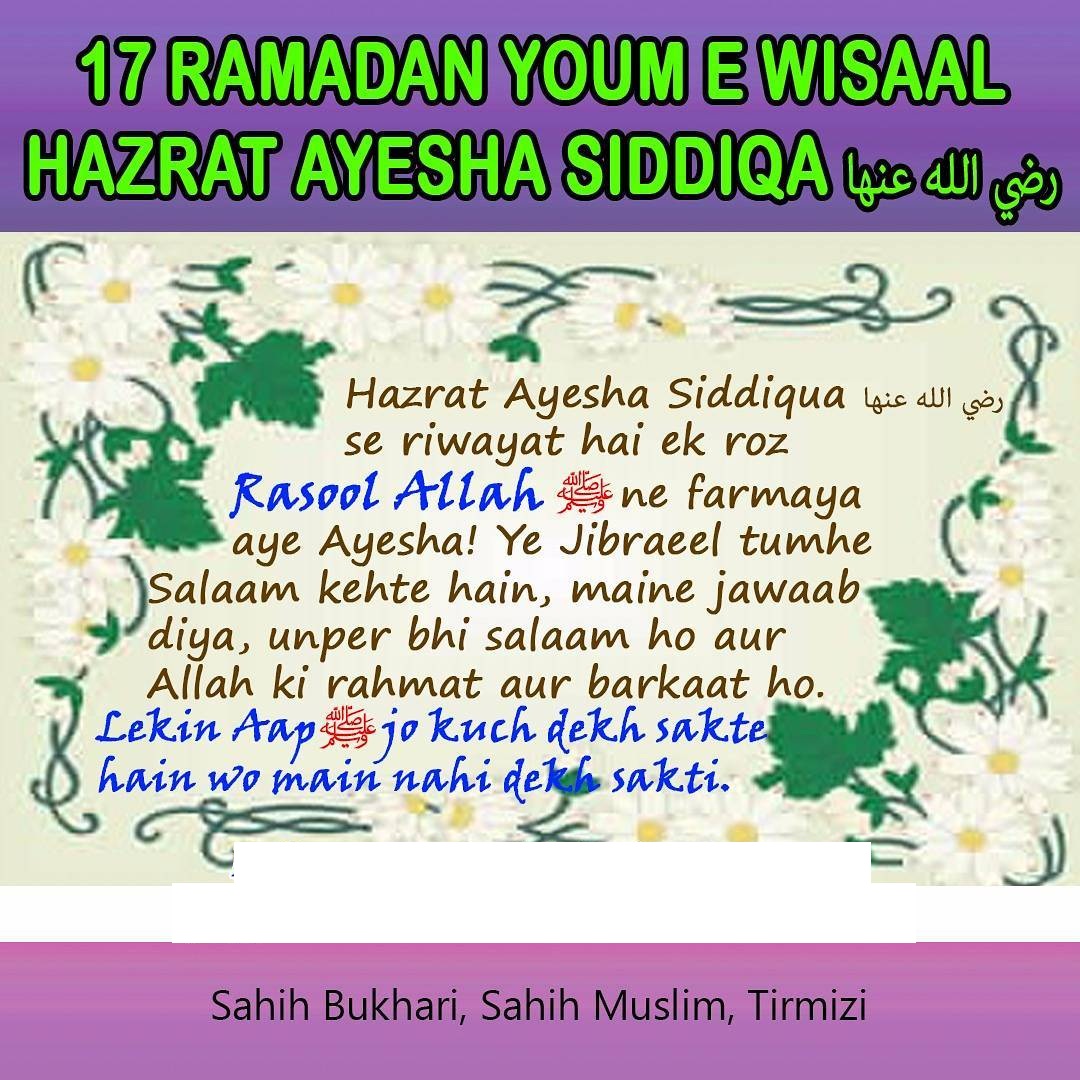
Youm e Wisal Ummul Mumineen Hazrat Aisha bint Abu Bakr رضئ اللہ تعالی عنہ


19050487_1215050435291094_5216015288801165312_n

hazrat bibi ayesha siddiqa grave, medina munawwara, jannat ul baqi, ummul mu'aminin mazar, prophet muhammad wives, short biography, history

Ummul Mu’aminin Hazrat Sayyeda Aayesha Siddiqa Radiallahu Ta’ala Anhu – Short Biography Hindi, Urdu

Ummul Mominin Hazrat Sayyeda Aaisha Siddiqa رضی اللہ عنہا Amirul Mominin Hazrat Sayyedna Abu Baqr Siddiq رضی اللہ عنہ Ki Sahabzadi He. Inki Walida Ka Naam ‘Umme Rooman’ He . Aapka Nikah Huzur E Aqdas صلی اللہ علیہ و سلم Se Hijrat Se Pehle Makka Mukarrama Me Hua Tha Lekin Kashana E Nubuwwat Me Ye Madina Munavvara Ke Andar Hijri 2 Me Aai . Aap Sarkar E Madina صلی اللہ علیہ و سلم Ki Mehbooba Aur Chahiti Biwi He .
Huzur E Sarvar E Qayenat صلی اللہ علیہ و سلم Ne Ummul Mominin Hazrat Sayyeda Aaisha Siddiqa رضی اللہ عنہا Ke Bare Me Irshad Farmaya Ke “Ae Umme Salma ! (رضی اللہ عنہا ) Mujhe Aaisha (رضی اللہ عنہا ) Ke Bare Me Koi Taklif Na Do . Allah Ki Qasam ! Mujh Par Aaisha (رضی اللہ عنہا ) Ke Siva Tum Me Se Kisi Biwi Ke Lihaaf Me Vahi Nazil Nahi Hui ”
Fiqah Va Hadees Ke Uloom Me Huzur صلی اللہ علیہ و سلم Ki Azvaaj Ke Darmiyan Sayyedna Aaisha Siddiqa رضی اللہ عنہا Ka Darja Bahot Uncha He . Bade Bade Sahaba E Kiram Aapse Masaail Pucha Karte The . Aapke Fazail O Manaqib Me Bahot Si Hadees e Aayi He .
Aapka Visal E Paak 17 Ramzan Ul Mubarak Ko Madina Munawara Me Hua . Hazrat Sayyedna Abu Huraira رضی اللہ عنہ Ne Aapki Namaz E Janaza Padhayi Aur Aapki Wasiyat Ke Mutabiq Raat Me Logo Ne Aapko Jannat Ul Baqi Sharif Ke Qabrastan Me Dusri Azvaaj E Mutahharat Ke Pehlu Me Dafn Kiya .
[Hawala Kitab – Faizane Aayesha Siddiqa]