
Month: October 2021

The Lion Heart Lady of Karbala:SHADOWS OF SORROW AND AGONY IN CRADLES.
“The birth of Zainab took place in the sixth year of Hijrat. It was the year in which the peace treaty of Hudaibia had been signed and the period of travails and unrest had come to an end and the treaty had consolidated the roots of Islam. Friends and companions of the Prophet PBUH felicitated him on the occasion of Zainab’s birth. The birth of a veritable flower imbibed and reflected the fragrance, manners and appearance of her mother, father and grandfather. Her birth had illuminated the hearts of the family and brought cheers and delight to the entirecommunity, but alas!, it was not destined to be so for long. A prophecy by the Prophet brought sorrow and dejection in the entire community and grief and lamentation engulfed the Ahl Bait.
Historians have recorded that at the time of birth of Zainab the heart breaking tale of Karbala and the news of the calamity that was to follow the event had been conveyed to the people by the Prophet PBUH.
The family of the Prophet was well acquainted with the tragedy yet to unfold at Karbala, fifty years before the
event. Ahmadbin Hambal in his book, Sunan Vol-I page-85 records that angel Jibreel had foretold the Prophet about the martyrdom of Hussain and Ibne Kaseer in Tarikhe Kamil narrates that the Prophet PBUH had given a handful of soil from the place of martyrdom of Hussain to Ummul Momineen Janabe Umme Salma, and had informed Hazrat Umme Salma that when this earth turns into blood it will indicate that Hussain has been martyred, Ummul Momineen had preserved that clay in a glass bottle. Later on in 61 Hijri when Hussain was martyred on the 10th of Moharrum this clay turned into blood. In this manner, people of Medina were informed about the martyrdom of Hussain.

In the same manner we learn from eminent historians about the events of 60-61 Hijri. Zuhair Ibne Qain who belonged to the sect of Usman, after completion of Haj, was heading towards Iraq. By chance, Husain and Zubair were travelling in the same direction. But at every destination he used to camp at a distance from the camp of Hussain. One day Hussain invited him for a talk. Zuhair was not pleased with the suggestion but was compelled by his wife Dilhan to go and meet him. When he returned after meeting Hussain, he told his companions that he has to part company with them, because from now onwards he was in the camp of Hussain and if any of his companions willingly wants to come with him he was welcome. He took leave of his family members and divorced his wife so that she may not face hardships and oppression after his martyrdom. He accepted the leadership and guidance of Imam Hussain and was martyred on Ashura in Karbala.
The historians have related that Hussain himself was well aware about his martyrdom, accompanying hardships and adversities right from his childhood. The tradition repeats the
same story about Janabe Zainab, Hussain’s sister also. It is recounted that when Salman Farsi visited Ali Ibne Abi Talib to congratulate the birth of Zainab, he saw that Ali was very mournful and sad. He recounted the calamity and tragedy which the new born baby will have to suffer. This brave regal warrior, the victorious standard bearer and Lion of God was crying inconsolably on the prophesied misfortune of the baby. Could this be the work of narrators who fabricate events? Can these traditions which were divine inspirations and miracles be considered a figment of imagination?
Famous European historian Donaldson in his book Aqeedatu Shia and Lance in his Fatima and daughters of Mohammed by observing afore mentioned traditions express their lack of faith and are unconvinced on the authority of tradition. They are entitled to their opinion. But majority of Muslim Historians have faith in these traditions and for them there is no possibility of doubt about them. These are not the only historians who have unswerving faith in those traditions. Our contemporary historians and authors believe in the authenticity of the narratives.
Contemporary Indian writer Mohammed Alhaj Salimeen too has written a book, Syeda Zainab. In the first part of the book he has described the event and says that it was with the tremendous grief and sorrow and with profusely weeping eyes that the new born baby was welcomed. In the beginning, he has related the prophecy of the Prophet PBUH in which he had foretold the calamities and atrocities which would befall on Zainab, then he diverts the attention of the readers towards the scene in which the Prophet was leaning his body towards his grand daughter and crying inconsolably in anticipation of the misfortune that was destined to afflict Zainab in Karbala.
How terrible would have been his distress and anxiety. How profound would be his grief on actual event?
I do not consider these traditions to be seemingly untenable. Earlier, these narrations were not fully revealed, but now when all these prophecies have been fully revealed they add poignancy and pathos to the tragic events. The shadows of grief and anguish which had cloaked the cradle gave rise to tremendous affection and sympathy for the baby.
Hazrat Zainab spent her childhood in the illustrious household under the protection of her grandfather. She was the centre of affection of her relatives, she was immersed in their love. She was the apple of their eye. When she began talking sweetly she learnt the lessons of life from her gracious, affectionate mother. When the period of her infancy came to end then she learnt the lessons of life from a pre-eminent group of counselors of whom the entire peninsula was proud
of – her grandfather, Messenger of God PBUH and her father, renowned scholar and chief of nobles and lord of exposition. Besides there were other masters of knowledge and learned Muslim jurisprudent, who were the companions of the Prophet.
We do not find any contemporaries of Janabe Zainab who had such an illustrious and pious environment for their upbringing and none who had the sublime advantage of such constant influence of learned discourse and piety. She indeed had an exalted upbringing.
It would be natural to assume that the result of such agreeable surrounding and congenial environment would have resulted in happiness. But it was not to be so as knowledge of the soul tormenting events that were to unfold later in life would sadden and distress her.
It is related that one day while she was reciting the verses of Quran she inquired about the commentary from her gracious father. After doing that, Hazrat Ali referred to the tormenting tragedy of Karbala. He was amazed when Zainab replied, “Baba Jaan I know. My mother had informed me about the event so that I may prepare for the tragic event.”
Hazrat Ali fell silent upon hearing her answer. He was terribly shaken and his heart was a flutter with overflowing love and affection for his daughter.
I have started the narrative from the period of Zainab’s infancy relating the predestined tragedy which shadowed her life right from her cradle and lasted till her death. I may now make attentive inquiry into her life.
Mardan e Haq Kaun hai??..

The Life of Imam Hasan AlahisSalam part-2
Genius
Without doubt, righteous education plays an important role in forming the child and in developing
his or her mental faculties. Likewise, the parents’ conduct has a great effect on developing their
children’s cleverness and general behavior. All these vital elements were available to al‐Hasan
(a.s) during his childhood. The Prophet (ﷺ) took great care of educating his grandson and gave
him his noble qualities. Imam Ali, the Commander of the faithful (a.s) supplied him with his wise
maxims and ideals. Fatima, the principal of all women, planted in her son virtue and perfection.
Accordingly, al‐Hasan’s childhood was high and a model of human perfection, a title of highness
and education, a symbol of genius.
Imam al‐Hasan (a.s) was the first person in his mental and moral
qualities, for he grew up in the House of the Revelation and was brought up in the School of the
monotheism. Moreover, he saw his grandfather, who was the most perfect person in the world,
always build an edifice for justice, virtue, and perfection. He encompassed people with his noble
moral traits, gathered them around the word of Oneness (of Allah). That impressed al‐Hasan, the
Prophet’s grandson, and he followed the deeds of his grandfather in advising and guiding the
people.
During their childhood, al‐Hasan and al‐Husayn (a.s) passed by an old man. The old man
could not perform the ritual ablution well. So their high soul and their kindness did not let them
leave the old man ignorant of performing the ritual ablution well. They made an informal dispute
and they said to each other: “You do not perform the ritual ablution well!” Then they calmly
turned to the old man and appointed him as an arbitrator between them. They said to him: “O
Sheikh
(i.e., an old man), each of us will perform the ritual ablution before you, and you decide which of
the two ablutions is better.” They performed the ablution before him, and he carefully considered
it. Accordingly, the old man paid attention to his mistake without any disdain, and then he said to
them: “My masters, you both perform the ritual ablution well. However, I am an ignorant old
man. I do not perform the ablution well. I have learned it from you and repented at your
hands!”
This deed clearly shows us that the Prophet (ﷺ) guided the people through sound ways and
noble moral traits. This way impressed al‐Hasan (a.s) during his childhood, to the extent that it
became among his qualities and natures.
Some psychologists believe that individual manner is inherited, that it has an important effect on
forming man’s ethics, and that it is not less in importance than imitation. Heksil says: “All effects
and qualities of the organic being belong to heredity or to environment. Hereditary formation
determines the bounds of that which is possible. And the environment decides that this possibility
will be achieved. Therefore, the hereditary formation is mere the ability to react with any
environment through a special way.”
Jinjiz has confirmed this theory, saying: “Everyone has hidden hereditary forces, but the
appearance of each of them depends on the circumstances surrounding these forces during their
growth.”
The rule of heredity decides that Imam al‐Hasan (a.s) was on top of those who got this
phenomenon. He inherited the spiritual forces and the great, reformative wealth of his
grandfather (a.s). Besides, the righteous environment his family and the good, righteous Muslims
created had an influence on him.
Due to his heredity, Imam al‐Hasan (a.s) got genius and high reflection that none had got. The
narrators have reported traditions on his early genius, saying: “Al‐Hasan memorized all things he
read. He attended the meetings of his grandfather (a.s) and memorized the Revelation. Then he
went to his mother and told her about it. She told Imam Ali (a.s) and he admired that and asked
her:
“From where have you brought this (revelation)?”
“From your son, al‐Hasan!’”
His Memorizing of Traditions
Though al‐Hasan (a.s) was four years old, he memorized many traditions he heard from his
grandfather (ﷺ) . We will mention some traditions he narrated from his grandfather:
1. He (a.s) has said: “Allah’s Apostle (ﷺ) taught me some words to say during the (prayer of al‐
Witr): ‘O Allah, guide me through him whom You guided! Make me well through him You made
well! Look after me through him after whom You looked! Bless that which You have given to me!
Protect me from the evil of that which You have decreed! You decree, and none decrees against
You. (The one) whom You support is not abased, Blessed and Most High You are, O Lord!”
2.Umar bin Ma’mun narrated, saying: “I have heard al‐Hasan, son of Ali (a.s) say: ‘Whoever offers
the morning prayer and sits in his place of praying until the sun rises shall have a veil from the
Fire.” Or he said: “A curtain from the Fire.”
3. A companion of his asked him: “What do you remember of Allah’s Apostle (ﷺ) ?” He (a.s)
replied: “I took one of the dates given as zakat. I put it into my mouth. He (the Prophet) took it out
(of my mouth). So I asked him: ‘What is the matter with this date?’ ‘It is not lawful for us,
Muhammad’s family, to take something given as zakat.”
4. He (a.s) was asked about what he heard from Allah’s Apostle (ﷺ) and he replied: “I heard him
saying to some man: “Leave that which fills you with doubt for that which does not fill you with
doubt. That is because evil is
[1] Ibn Shahrashub, al‐Manaqib, vol. 2, p. 148. Bihar al‐Anwar, vol. 10, p. 93.
[2] Al‐Turmidhi, Saheeh, vol. 1, p. 93. Ibn ‘Asakir, Tarikh, vol. 1, p. 20. Al‐Hakim, Mustadrak, vol. 3,
p. 172.
[3] Usd al‐Ghaba, vol. 2, p. 11.
[4] Ibid.
5. He (a.s) related to his companions about the ethics and behavior of his grandfather, the
Prophet (ﷺ) . He said to them: “When someone asked Allah’s Apostle (ﷺ) to grant his need, he
responded to him with nothing except through granting it or through some soft words.”
6. He (a.s) has said: “I heard Allah’s Apostle (ﷺ) saying, “Call out the master of the Arabs (Imam
Ali).” So A’isha asked him: “Are you not the master of the Arabs?” “I am the master of Adam’s
children,” he replied, “and Ali is the master of the Arabs.” Imam Ali was summoned. When he was
before him, he sent for the Ansar. When they stood before him, he said to them: “O people of
Ansar, shall I show you a thing, if you keep to it, you will never go astray?” “Yes, O Allah’s Apostle
(ﷺ) ” they replied. So he said: “This is Ali; therefore, love him for the sake of the love for me, and
honor him for the sake of honoring me. It is Gabriel that has told me from Allah, the great and
Almighty, about what I told you.”
[1] Al‐Ya‘qubi, Tarikh, vol. 2, p. 20. In his book al‐Musnad, vol. 1, p. 200, Ahmed has mentioned:
“He (al‐Hasan), peace be on him, said: ‘I heard Allah’s Apostle (a.s.) say: ‘Leave that which fills you
with doubt for that which does not fill you with doubt. That is because truthfulness is tranquility;
and lying is suspicion.’”
Hasan bin Ali narrated on the authority of the Prophet (ﷺ) who said:
‘Call out the master of the Arabs.’ He meant Ali. So Aa’isha asked him: ‘Are you not the master of
the Arabs.’ And he replied: ‘I am the master of Adam’s children, and Ali is the master of the
Arabs.’

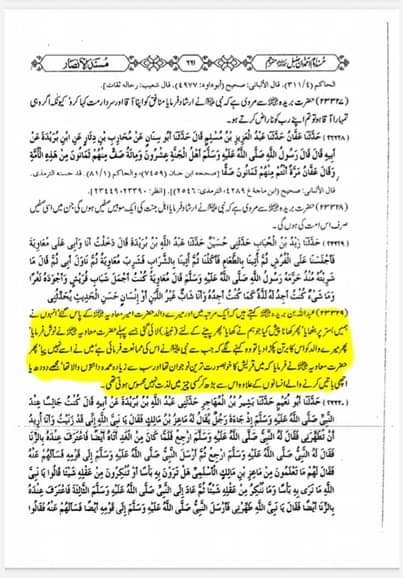
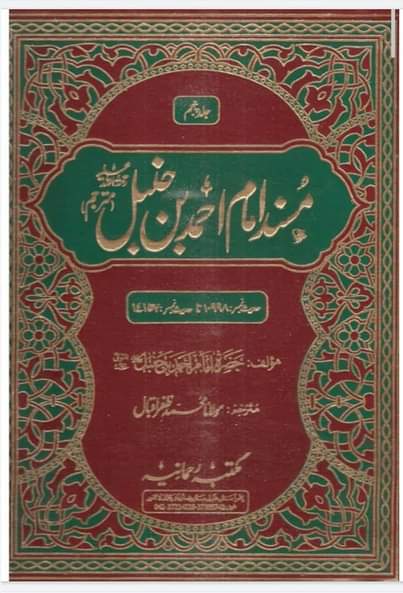
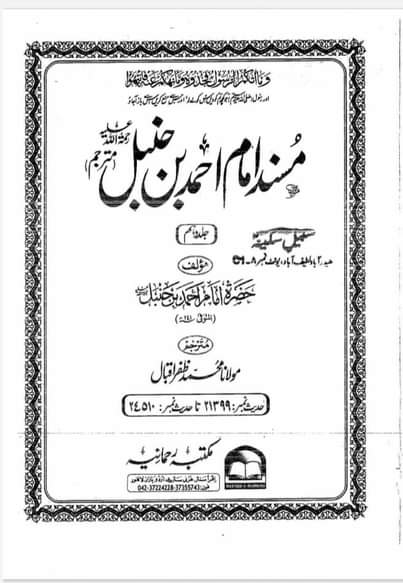
इब्ने हम्बल कहते है मुआविया शराब पीता था।
हम सब ने ये तो सुना और जाना है की यज़ीद लानती शराबी था पर शराब पीना कहा से सिखा ये मैं आज बताता हूँ।
इमाम अहमद इब्ने हम्बल लिखते है की अपने दौर ऐ हुकूमत में मुआविया शराब पीता था।
जब हम कहते है तो हम को राफ़जी, गुमराह, क़ाफ़िर, सहाबा का गुस्ताख़, ख़ारजी जैसे लफ़्ज़ों से नवाजा जाता है, वही मोलवी अब इब्ने हम्बल के बारे में क्या कहेगा???!!
सहाबी वो हैं जो ईमान की हालत मैं मौत पाये, ये कैसा सहाबी जो शराब पीता था और इमान में मरा???!!!
अगर अब भी मुआविया को इमान में माना तो मतलब शराब को हराम नहीं समझा।
हवाला
– मुसनद अहमद बीन हम्बल, जिल्द 10, हदीस न. 23329, सफ़ा न. 661
 Aal-e-Qutub Aal-e-Syed Abdullah Shah Ghazi