


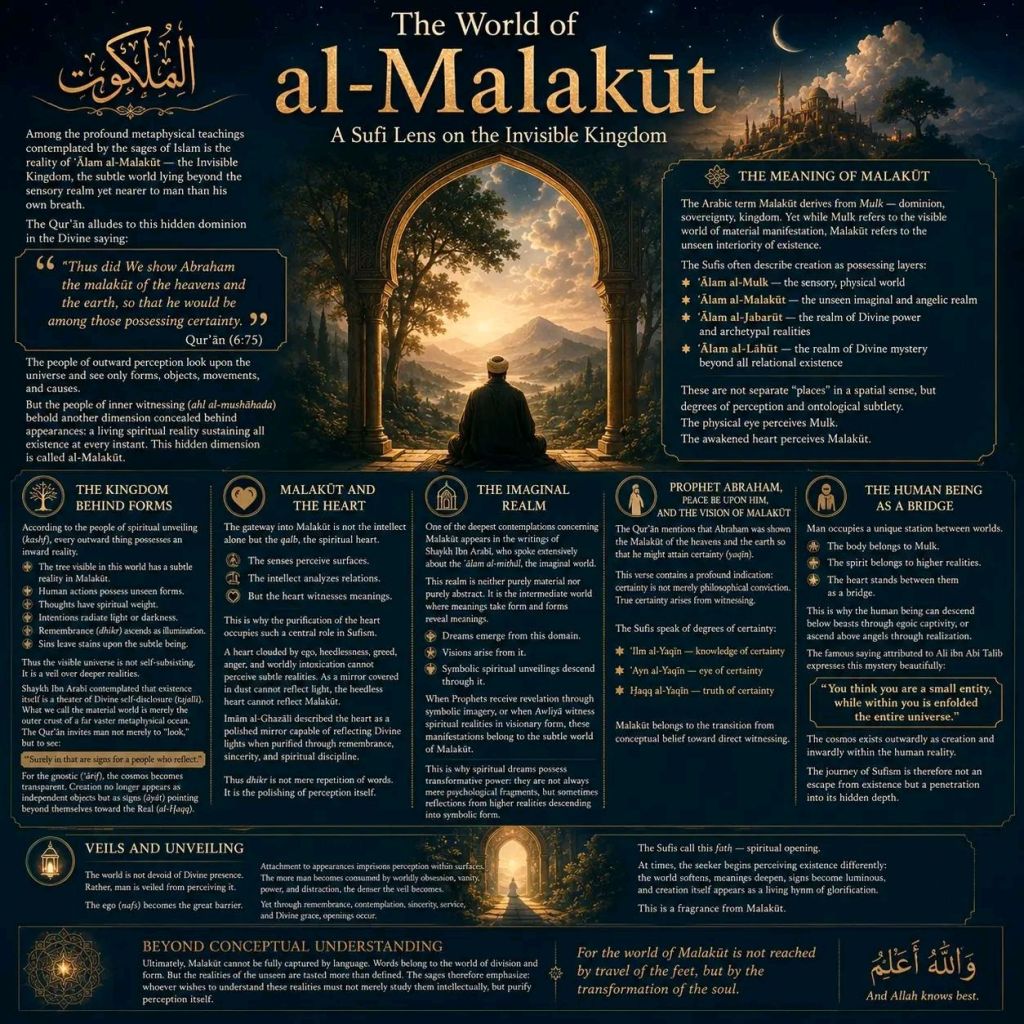
■ The World of al-Malakūt: A Sufi Lens on the Invisible Kingdom.
Among the profound metaphysical teachings contemplated by the sages of Islam is the reality of ʿĀlam al-Malakūt the Invisible Kingdom, the subtle world lying beyond the sensory realm yet nearer to man than his own breath.
The Qur’ān alludes to this hidden dominion in the Divine saying:
“Thus did We show Abraham the malakūt of the heavens and the earth, so that he would be among those possessing certainty.”
Qurʾān (6:75)
The people of outward perception look upon the universe and see only forms, objects, movements, and causes.
But the people of inner witnessing (ahl al-mushāhada) behold another dimension concealed behind appearances: a living spiritual reality sustaining all existence at
every instant. This hidden dimension is called al-Malakūt.
■ The Meaning of Malakūt
The Arabic term Malakūt derives from Mulk dominion, sovereignty, kingdom.
Yet while Mulk refers to the visible world of material manifestation, Malakūt refers to the unseen interiority of existence.
▪︎ The Sufis often describe creation as possessing layers:
ʿ▪︎ Ālam al-Mulk — the sensory, physical world
ʿ▪︎ Ālam al-Malakūt — the unseen imaginal and angelic realm
ʿ▪︎ Ālam al-Jabarūt — the realm of Divine power and archetypal realities
▪︎ ʿĀlam al-Lāhūt — the realm of Divine mystery beyond all relational existence
These are not separate “places” in a spatial sense, but degrees of perception and ontological subtlety. The physical eye perceives Mulk. The awakened heart perceives Malakūt.
■ The Kingdom Behind Forms
According to the people of spiritual unveiling (kashf), every outward thing possesses an inward reality.
The tree visible in this world has a subtle reality in Malakūt. Human actions possess unseen forms. Thoughts have spiritual weight.
Intentions radiate light or darkness.
Remembrance (dhikr) ascends as illumination.
Sins leave stains upon the subtle being.
Thus the visible universe is not self-subsisting. It is a veil over deeper realities.
Shaykh Ibn Arabī, may Almighty Allāh sanctify his secret, contemplated that existence itself is a theater of Divine self-disclosure (tajallī). What we call the material world is merely the outer crust of a far vaster metaphysical ocean.
The Qurʾān repeatedly invites man not merely to “look,” but to see:
“Surely in that are signs for a people who reflect.”
For the gnostic (ʿārif), the cosmos becomes transparent. Creation no longer appears as independent objects but as signs (āyāt) pointing beyond themselves toward the Real (al-Ḥaqq).
■ Malakūt and the Heart
The gateway into Malakūt is not the intellect alone but the qalb, the spiritual heart.
The senses perceive surfaces.
The intellect analyzes relations.
But the heart witnesses meanings.
This is why the purification of the heart occupies such a central role in Sufism.
A heart clouded by ego, heedlessness,
greed, anger, and worldly intoxication
cannot perceive subtle realities.
As a mirror covered in dust cannot reflect light, the heedless heart cannot reflect Malakūt.
Imām Abu Hamid al-Ghazāli, may Almighty Allāh sanctify his secret, described the heart
as a polished mirror capable of reflecting Divine lights when purified through remembrance, sincerity, and spiritual discipline.
Thus dhikr is not mere repetition of words.
It is the polishing of perception itself.
■ The Imaginal Realm
One of the deepest contemplations concerning Malakūt appears in the writings of Shaykh Ibn Arabī, who spoke extensively about the ʿālam al-mithāl, the imaginal world.
This realm is neither purely material nor purely abstract. It is the intermediate world where meanings take form and forms reveal meanings.
Dreams emerge from this domain. Visions arise from it. Symbolic spiritual unveilings descend through it.
When Prophets receive revelation through symbolic imagery, or when Awliyā witness spiritual realities in visionary form, these manifestations belong to the subtle worldof Malakūt.
This is why spiritual dreams possess transformative power: they are not always mere psychological fragments, but sometimes reflections from higher realities descending into symbolic form.
■ Prophet Abraham, peace be upon him, and the Vision of Malakūt
The Qur’ān specifically mentions that Abraham was shown the Malakūt of the heavens and the earth so that he might attain certainty (yaqīn).
This verse contains a profound indication: certainty is not merely philosophical conviction. True certainty arises from witnessing.
▪︎ The Sufis speak of degrees of certainty:
ʿIlm al-Yaqīn — knowledge of certainty
‘Ayn al-Yaqīn — eye of certainty
Ḥaqq al-Yaqīn — truth of certainty
Malakūt belongs to the transition from conceptual belief toward direct witnessing.
■ The Human Being as a Bridge
Man occupies a unique station between worlds.
The body belongs to Mulk.
The spirit belongs to higher realities.
The heart stands between them as a bridge.
This is why the human being can descend below beasts through egoic captivity, or ascend above angels through realization.
The famous saying attributed to Sayyidīnā Imām ibn Abi Talib, may Almighty Allāh enoble his blessed face, expresses this mystery beautifully:
“You think you are a small entity, while within you is enfolded the entire universe.” Dīwān
The cosmos exists outwardly as creation
and inwardly within the human reality.
The journey of Sufism is therefore not an escape from existence but a penetration into its hidden depth.
■ Veils and Unveiling
The world is not devoid of Divine presence. Rather, man is veiled from perceiving it.
The ego (nafs) becomes the great barrier.
Attachment to appearances imprisons perception within surfaces. The more man becomes consumed by worldly obsession, vanity, power, and distraction, the denser the veil becomes.
Yet through remembrance, contemplation, sincerity, service, and Divine grace, openings occur. The Sufis call this fatḥ, spiritual opening.
At times, the seeker begins perceiving existence differently: the world softens, meanings deepen, signs become luminous, and creation itself appears as a living hymn of glorification. This is a fragrance from Malakūt.
■ Beyond Conceptual Understanding
Ultimately, Malakūt cannot be fully captured by language. Words belong to the world of division and form. But the realities of the unseen are tasted more than defined.
The sages therefore emphasize: whoever wishes to understand these realities must not merely study them intellectually, but purify perception itself.
For the world of Malakūt is not reached by travel of the feet, but by the transformation of the soul.
And Allāh knows best.


