


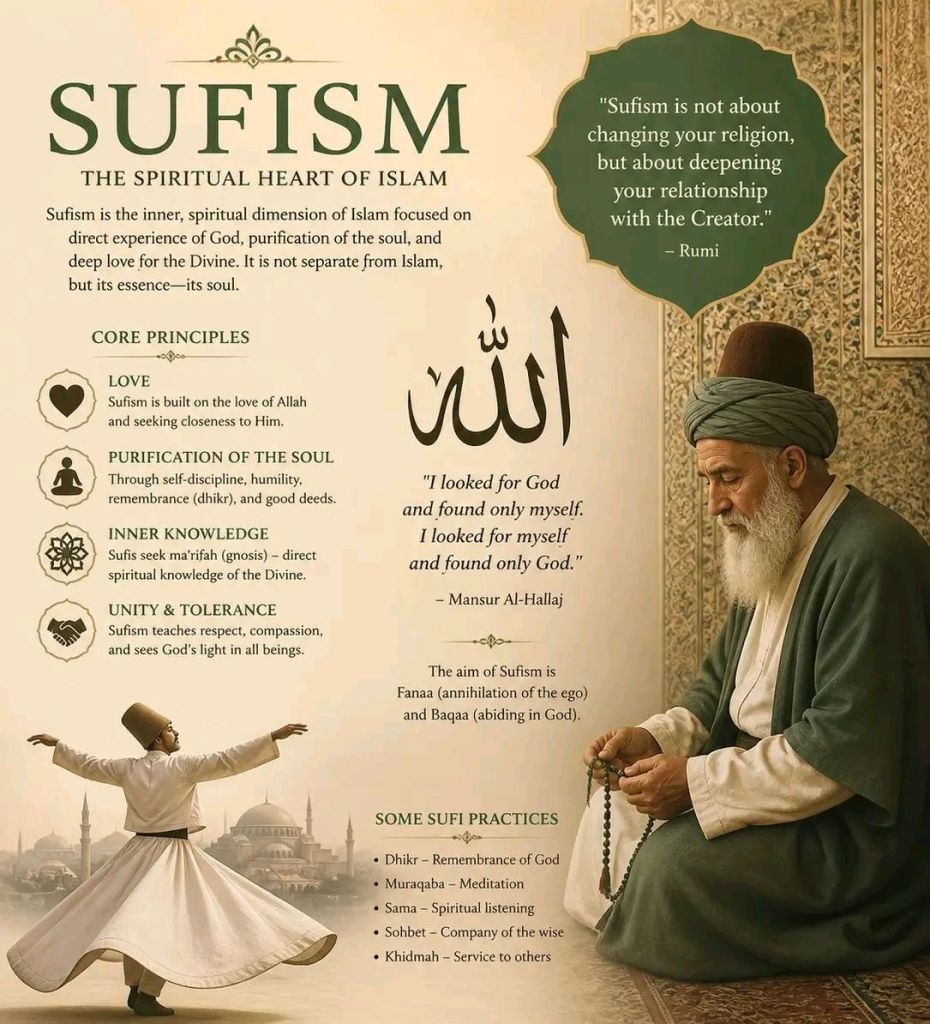
■ Sufism: A Reality With No Name.
At the time of the Messenger of Allāh ﷺ,
what we now call Tasawwuf had no formal title, no structured terminology, and no separate identity as a “science.”
Yet its essence permeated everything. It was not an added layer to Islām it was the inner life of Islām itself.
“It was a reality without a name.”
This reality was embodied perfectly in the
life of the Prophet ﷺ the one whom Allāh describes in the Qur’an as:
“Indeed, in the Messenger of Allāh
you have an excellent model…” (33:21)
He ﷺ was not only the conveyor of revelation, but the living manifestation of its inward meanings.
His nights in prayer, his tears in supplication, his constant remembrance, and his humility
all of this formed the foundation of what would later be called Sufism.
▪︎ The Companions: The First People of the Path
The Companions, may Allāh be pleased with them did not study spirituality as a subject they lived it.
Their purification came through direct companionship with the Prophet ﷺ.
They learned sincerity, reliance on Allāh, love, and the discipline of the ego not from books, but from witnessing the one whose character was the Qur’ān.
Among them were those who embodied deep spiritual realization, such as Abū Bakr al-Ṣiddīq, may Allāh be pleased with him, in his complete truthfulness and surrender.
Sayyidunā ‘Ali ibn Abi Tālib, may Allāh be pleased with him, whose words later became oceans of spiritual wisdom for seekers of the path.
There were also the People of the Bench,
a group of devoted companions who lived in the mosque of the Prophet ﷺ, detached from worldly concerns, immersed in remembrance, poverty, and presence with Allāh.
They represent one of the earliest visible expressions of ascetic spirituality within Islam.
▪︎ Remembrance: The Lifeblood of the Heart
Gatherings of remembrance were a natural expression of the Qurʾānic command to remember Allāh abundantly.
The companions would sit together, invoking Allāh, reflecting on His signs, and softening their hearts.
This is why the verse you cited from Al-Kahf (18:28) is central to the Sufi understanding:
“Restrain yourself with those who call upon their Lord morning and evening, seeking His Face…”
▪︎ This verse highlights three essential foundations of the path:
▪︎ Companionship with people of remembrance
▪︎ Sincerity in seeking only Allāh
▪︎ Detachment from worldly distractions
▪︎ From Reality to Name
As time passed and hearts became more occupied with worldly life, scholars began to formalize this inner dimension to preserve it.
Thus the term Tasawwuf emerged, not to introduce something new, but to protect something ancient.
▪︎ Great masters like Shaykh Al-Junāyd of Baghdad, may Allāh sanctify his secret,
defined it as:
“That Allāh causes you to die to yourself and live in Him.”
Imām Abu Hāmid al-Ghazāli, may Allāh sanctify his secret, later revived its sciences, showing that without purification of the heart, outward knowledge remains incomplete.
From Egypt, many knowers of Allāh carried
this same reality and expressed it in words that reflect the depth of this path:
• Shaykh Aḥmad al-Badawī, may Allāh sanctify his secret, said:
“Your distance from Allāh is only the distance of your heart from remembrance. So return, and you will find Him near.”
• Shaykh Ibrāhīm al-Desoukī, may Allāh sanctify his secret, said:
“The one who knows Allāh is never alone,
and the one who is distracted from Him is never at rest.”
• Shaykh Abū al-Ḥasan al-Shādhili, may Allāh sanctify his secret, said:
“Do not move your feet except where you hope for reward, and do not sit except where you are safe from disobedience.”
• Shaykh Ahmad al-Dardir, may Allāh sanctify his secret, said:
“The path is not in the quantity of actions, but in the truthfulness within them. A small deed with presence outweighs mountains without it.”
These are not new teachings, they are echoes of the same light that was present in the time of the Prophet ﷺ, preserved in the hearts of those who followed his way with sincerity.
▪︎ The Essence Remains
Sufism is not in the name, nor in outward appearance, nor in claims. It is:
A heart emptied of all but Allāh
A soul illuminated by remembrance
An inner state of constant awareness of Him
It is Islam lived with depth.
It is spiritual excellence to worship Allāh as though you see Him.
And so, even today, the reality remains what it always was:
A path of presence.
A journey of return.
A secret between the servant and his Lord.
“It was a reality without a name and it remains a reality beyond names.”
■ Teachings Of The Heart.







 Aal-e-Qutub Aal-e-Syed Abdullah Shah Ghazi