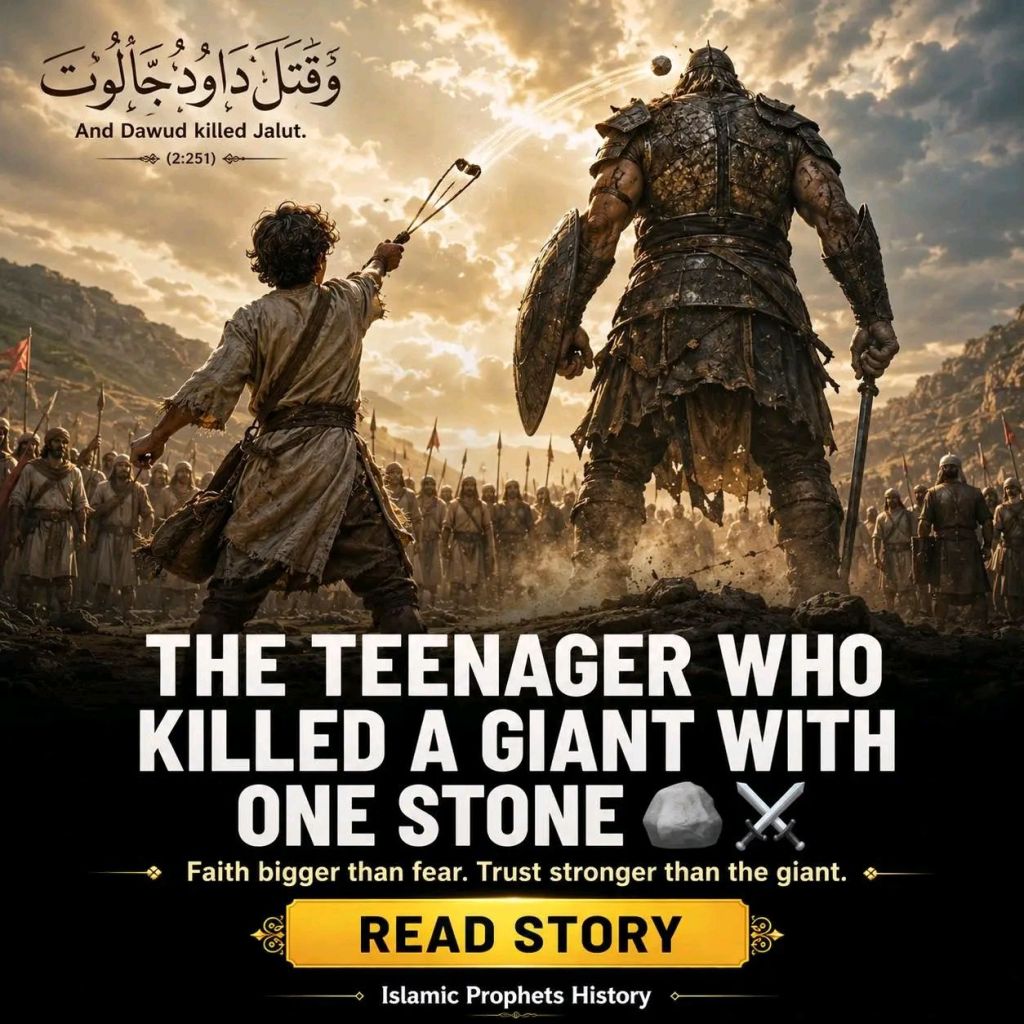
Dawud Alaihissalam And Jalut

We noticed how hungry people are to learn about banu israil , insha Allah pending tge moment we would start the series , we would be dropping some valuable contents about them , now here is another must read story of about the  isrelites , read till end

🔥The teenager who killed a giant with one stone and became a king

Many of us know this story as “David and Goliath.” Islam calls them Dawud and Jalut. And the lesson is even more powerful when you understand the full context.

Now lets begin

Long time ago Bani Israel had a king named Talut (Saul). They were facing an enemy army led by a GIANT warrior named Jalut (Goliath).

This man was massive. Skilled fighter. Undefeated. And completely Terrifying.

Jalut’s army sent a challenge: “Send your best warrior to fight me one-on-one. If he wins, we retreat. If I win, you surrender.”

Talut’s entire army was SCARED. Grown men. Trained soldiers. All of them looked at this giant and said “Not me.”

Then a young shepherd boy stepped forward. Prophet Dawud. Who was Then a Teenager. No military training. Just a slingshot and complete trust in Allah.

The Quran says “So they defeated them by permission of Allah, and Dawud killed Jalut, and Allah gave him the kingship and wisdom and taught him from that which He willed.” (Quran 2:251)

Let me paint the picture of what actually happened.
Dawud walked onto the battlefield. Jalut looked down at him and LAUGHED. “They sent a CHILD? This is an insult!”

Dawud didn’t respond to the mockery. He just picked up smooth stones from the ground. Put one in his slingshot. Aimed. And made dua.

Some narrations mention he said “Bismillah” before releasing. Others say he asked Allah for victory. What we know for certain: he relied completely on Allah, not on his own strength.

He released the stone. It flew through the air. Hit Jalut directly in the forehead. The giant fell. Dead instantly.

One stone. One shot. One dead giant.

The entire enemy army saw their champion fall and RAN. Bani Israel won the battle without even fighting.

Because one teenager had more faith than an entire army of grown men.

But here’s what most people miss about this story. The victory wasn’t the END of Dawud’s story. It was the BEGINNING.

After killing Jalut, Allah gave Dawud three things:

1. The Kingship – He became the king of Bani Israel after Talut

2. Wisdom – Allah made him wise beyond his years

3. Knowledge – Allah taught him the Zabur (Psalms) and gave him a beautiful voice

The Quran says Allah also gave him a special miracle: He could SOFTEN IRON with his bare hands. He’d mold it like clay and make armor. (Quran 34:10-11)

So a shepherd boy who killed a giant with a slingshot became a king, a prophet, a judge, and a master craftsman. All because he had faith when everyone else had fear.

The lesson isn’t just “believe in yourself.” The lesson is “believe in ALLAH and He’ll use you in ways you never imagined.”

Dawud didn’t train for that fight. He didn’t prepare for years. He just trusted Allah and stepped forward when everyone else stepped back.

And that one act of faith changed his entire destiny.
How many “giants” are YOU facing right now? How many impossible situations make you want to run?
What if all you need is one “stone” – one moment of complete tawakkul – and Allah will handle the rest?
Dawud teaches us: You don’t need to be the biggest, strongest, or most qualified. You just need to trust Allah more than you fear the giant in front of you.

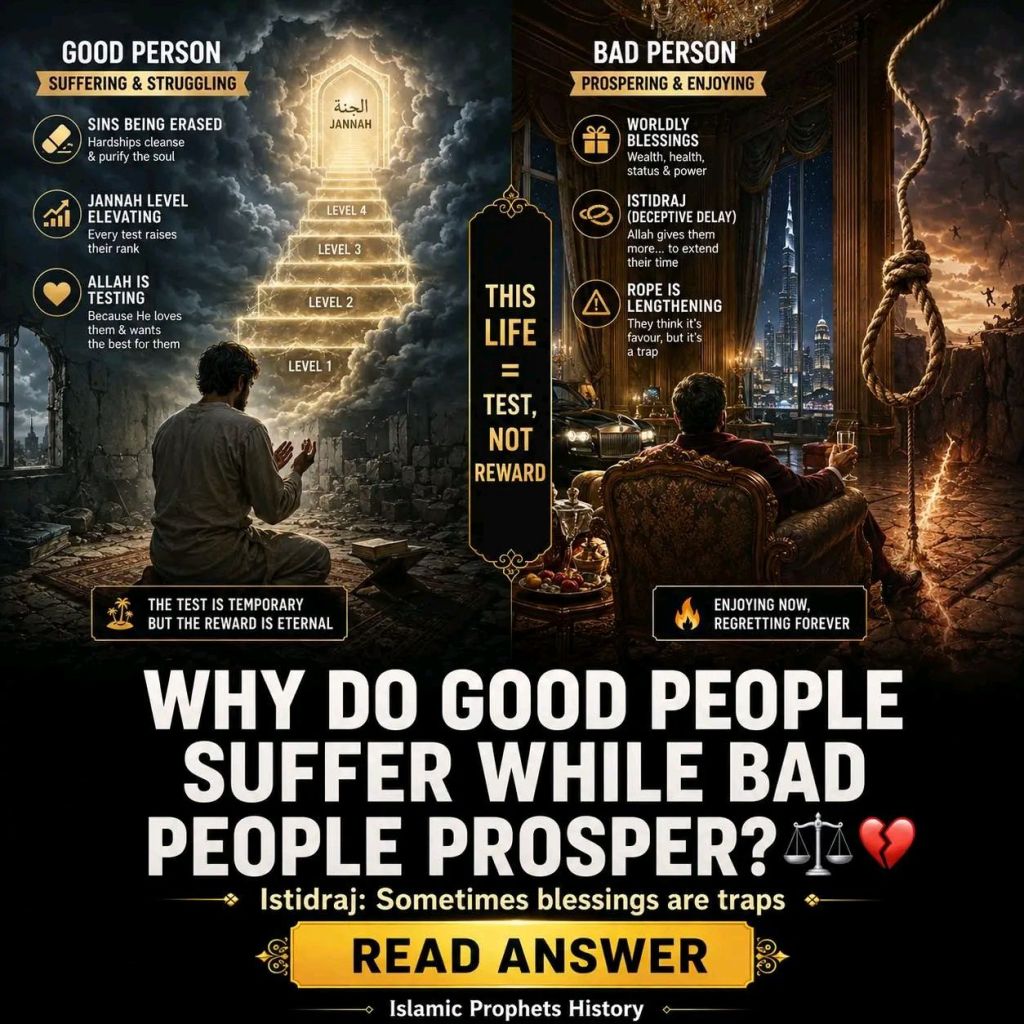
Why do good people suffer while bad people prosper?

Why do good people suffer while bad people prosper?

(The answer most people don’t want to hear)

This is the question that shakes people’s faith more than anything else.

“If Allah is just, why is that corrupt politician living in luxury while the honest imam struggles to feed his family?”

“Why did my righteous mother die of cancer while that evil neighbor is perfectly healthy?”

“Why do I pray five times a day and still struggle financially while people who don’t even believe in Allah are millionaires?”

Fair questions. Hard questions. Questions that deserve real answers, not fake comfort.

Here’s the truth the Quran gives us, and it’s not what most people want to hear:

This Life Isn’t the Reward System. It’s the TEST.
Allah says in the Quran “Do people think they will be left alone because they say ‘We believe’ and they will not be TESTED?” (Quran 29:2)

Read that again. Just saying “I believe” doesn’t exempt you from tests. Actually, it GUARANTEES you’ll be tested.

The Prophet ﷺ said “The people most severely tested are the prophets, then the next best, then the next best.” (Sunan al-Tirmidhi 2398 – Sahih)

Translation: The MORE righteous you are, the HARDER your test will be.

Why? Because this life isn’t Jannah. This is the examination hall. Jannah is where you get rewarded.

Confusing this life with the reward is like a student complaining “I studied so hard for the exam, why is the test still difficult?” Because the test BEING difficult is the POINT.

The Concept of “Istidraj” – When Allah Gives the Wicked Rope to Hang Themselves
Here’s what most people don’t know. When you see bad people living amazing lives, that’s not always a blessing. Sometimes it’s a TRAP.
The Quran introduces a concept called “istidraj” – gradually leading someone to destruction through blessings.

Allah says “So leave Me with whoever denies this statement. We will progressively lead them to destruction from where they do not know. And I will give them time. Indeed, My plan is firm.” (Quran 68:44-45)

You see that corrupt politician getting richer? That might not be Allah blessing him. That might be Allah giving him MORE rope before He holds him accountable.

Every blessing he gets while doing evil is ADDING to his punishment. Because on Judgment Day, Allah will say “I gave you wealth, health, power, time – and you used ALL of it to disobey Me? Now face the consequences.”

The Prophet ﷺ said “When you see Allah giving someone what they want while they’re sinning, know that it’s istidraj.” (Musnad Ahmad – Sahih)
So that person you’re jealous of? The one living in luxury despite being corrupt? They might be in the WORST situation, they just don’t know it yet.
What About Good People Suffering?

When good people suffer, it’s DIFFERENT. It’s not punishment. It’s purification.

The Prophet ﷺ said “No fatigue, disease, sorrow, sadness, hurt, or distress befalls a Muslim – not even the prick of a thorn – except that Allah removes some of his sins because of it.” (Sahih Bukhari 5641, Sahih Muslim 2573)

Every hardship a believer faces ERASES sins. Elevates their rank. Prepares them for higher levels of Jannah.

So when you’re struggling while the wicked prosper, you’re actually being CLEANSED while they’re being SET UP for destruction.
Your poverty might be erasing sins that would have sent you to hellfire.

Your illness might be elevating you to levels of Jannah you couldn’t reach through worship alone.
Your heartbreak might be protecting you from something worse.
You just can’t see it yet.
The Real Answer
The real answer to “why do good people suffer” is this:

Because this life isn’t ABOUT comfort. It’s about WHO YOU BECOME through the struggle.
Jannah isn’t cheap. You don’t walk in because you prayed sometimes and avoided major sins. You walk in because you were TESTED and you PASSED.

And the harder your test, the higher your rank when you pass it.

So stop comparing your struggle to someone else’s ease. You don’t know what Allah is preparing you for. And you don’t know what punishment He’s delaying for them.

Trust Allah’s plan. Even when it hurts. Especially when it hurts.

COMMENT “I TRUST ALLAH’S PLAN” if this  –
changed your perspective!  already


The Hidden Language of Ṣalāh (Prayer)

■ The Hidden Language of Ṣalāh (Prayer):
The Sacred Postures and the Secrets of the Arabic Letters.

Ṣalāh is not merely a sequence of physical movements. It is a celestial language written by the body, a sacred choreography through which the servant speaks to Allāh without words.

Every posture is a symbol, every movement a spiritual unveiling, and every stillness a hidden remembrance.

The masters of spiritual insight reflected deeply upon the relationship between the postures of prayer and the forms of the Arabic letters.

For the Arabic letters are not simply sounds or symbols; they are containers of divine wisdom, mirrors of cosmic realities, and signs placed within creation by Allāh.

Thus the believer in prayer becomes like living calligraphy, the body itself tracing meanings known to the hearts of the people of remembrance.

■ Qiyām: The Standing and the Secret of
Alif (ا)

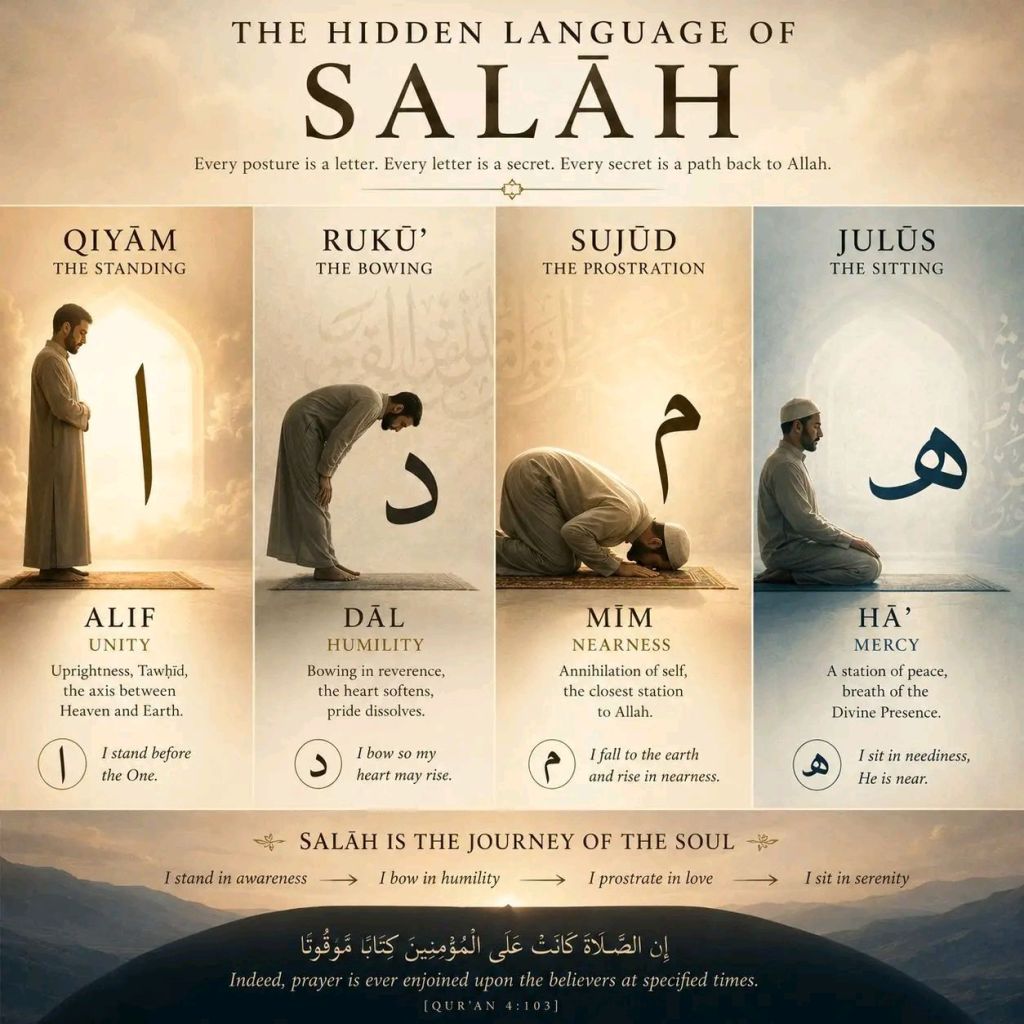
When the servant stands before Almighty Allāh in qiyām, the body resembles the majestic Alif upright, singular, and direct. The Alif is the first of the letters. It symbolizes:

▪︎ Divine Unity
▪︎ Uprightness
▪︎ Origin

The axis connecting Heaven and Earth,
It stands alone, without curvature or deviation, just as the servant is called to stand before Allāh with sincerity and inward straightness.

The people of maʿrifah saw in the Alif the secret of tawḥīd itself. All letters emerge from it just as multiplicity emerges from Divine Oneness.

In qiyām the servant abandons distraction and stands in the presence of the Real. The spine straightens because the soul seeks alignment with truth.

Shaykh Ibn Arabī, may Almighty Allāh sanctify his secret, alluded to the Alif as the hidden root of the letters, the silent pillar from which meanings unfold.

Thus standing in prayer is not merely physical standing, it is the soul standing before its Origin.

■ Rukūʿ: The Bowing and the Secret of Dāl (د)

When the servant bows in rukūʿ, the form resembles the curved shape of the letter Dāl.
Dāl carries the secret of humility, surrender,
and reverence.

The ego naturally seeks elevation, but the spirit seeks lowering before Divine Majesty. In rukūʿ the intellect itself bows before the greatness of Allāh.

The outward bending of the body reflects the inward breaking of pride. The scholars of the inward path said:

“The back bends so the heart may rise.”

Rukūʿ is therefore the station where self-importance begins to dissolve.
The servant glorifies Allāh while physically lowering himself, teaching the soul that true elevation is found only through humility.

The curved nature of Dāl resembles the softened heart, no longer hardened by arrogance, but bent by awe.

■ Sujūd:  The Prostration and the Secret of Mīm (م)

In sujūd the servant folds into the earth, resembling the hidden enclosure and inward depth of the letter Mīm. Among the spiritual meanings associated with Mīm are:

▪︎Maḥabbāh (Divine Love)
▪︎Maʿrifāh (Gnosis)
▪︎ Mālik and Mūlk (Sovereignty and Kingdom)
▪︎ The Muhammadan Reality

Sujūd is the deepest station of intimacy in prayer. It is the moment when the servant becomes nearest to Almighty Allāh.
The forehead touches the earth because the soul remembers its origin from dust.

Yet paradoxically, this lowest physical posture becomes the highest spiritual station. This is one of the great mysteries of the path: the one who lowers himself for Allāh is raised by Allāh.

The circular inwardness of Mīm symbolizes return,  the soul returning to its Source after wandering through the distractions of the world.

Many of the people of unveiling connected the secret of Mīm to the name of Muḥammad ﷺ, whose blessed name begins and ends with this letter, as though the spiritual journey begins and ends in Muhammadan light.

Sujūd is annihilation of pride, but birth of nearness.

■ Julūs: The Sitting and the Secret of Hā’ (هـ)

The sitting posture between the prostrations carries the subtle softness of the letter Hā’.
Hā’ is associated with breath, hidden presence, gentleness, and spiritual openness.

After the intensity of prostration comes stillness, a station of mercy between two
acts of surrender.

The servant sits in neediness before Allāh, asking forgiveness and mercy. The posture itself reflects receptivity and inward quietness.

The people of spiritual reflection often associated Hā’ with the Divine Name:

“Hūwā” (He).

For Hā’ contains the breath-like mystery of Divine Nearness that cannot fully be spoken.

The shape of the letter carries an inward opening, resembling the heart opening after being softened in sujūd. Thus the sitting posture becomes a silent witnessing of mercy after annihilation.

■ Ṣalāh as a Spiritual Journey

The movements of prayer are not random motions. They form a sacred progression through the stations of the soul.

The servant begins standing in awareness, bows in humility, falls into annihilation, then returns into serenity and intimate presence.

▪︎ This is why the Prophet ﷺ described prayer
   as the ascension of the believer.
▪︎ The body descends while the spirit rises.
▪︎ Each posture teaches a hidden wisdom:
▪︎ Standing teaches uprightness
▪︎ Bowing teaches humility
▪︎ Prostration teaches nearness
▪︎ Sitting teaches tranquility and mercy

The one who understands only the outward form sees movement. But the one whose heart awakens witnesses meanings hidden beneath every gesture.

■ The Worshipping Body as Sacred Script

The Arabic letters are woven into revelation, into creation, and into the human being himself. The cosmos is written in letters.

The Qur’ān descends in letters.
And the praying servant becomes letters.
In ṣalāh:

▪︎ The spine becomes an Alif,
▪︎ Humility curves into Dāl,
▪︎ Love folds into Mīm,
▪︎ Stillness breathes through Hā’.

Thus prayer becomes a living manuscript written upon the earth before Allah.

▪︎ Imām Al-Junāyd al-Baghdādī, may Almighty Allāh sanctify his secret, said:

“The path is built upon presence with Allāh.”

And nowhere is that presence more complete than in prayer performed with heart, humility, and witnessing.

Every posture is a letter. Every letter is a secret.
And every secret is an invitation to return to Almighty Allāh.

And Almighty Allāh knows best.