

■ The Hidden Language of Ṣalāh (Prayer):
The Sacred Postures and the Secrets of the Arabic Letters.
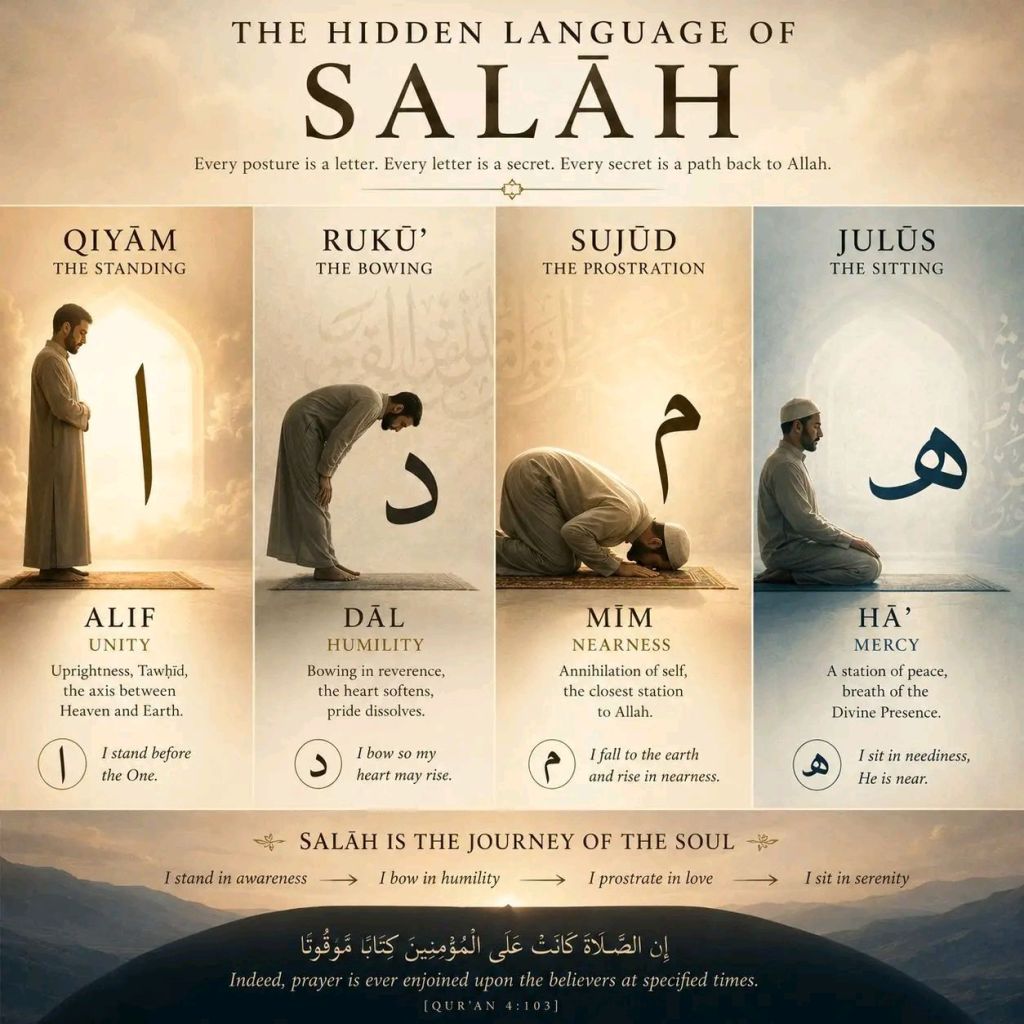
Ṣalāh is not merely a sequence of physical movements. It is a celestial language written by the body, a sacred choreography through which the servant speaks to Allāh without words.
Every posture is a symbol, every movement a spiritual unveiling, and every stillness a hidden remembrance.
The masters of spiritual insight reflected deeply upon the relationship between the postures of prayer and the forms of the Arabic letters.
For the Arabic letters are not simply sounds or symbols; they are containers of divine wisdom, mirrors of cosmic realities, and signs placed within creation by Allāh.
Thus the believer in prayer becomes like living calligraphy, the body itself tracing meanings known to the hearts of the people of remembrance.
■ Qiyām: The Standing and the Secret of
Alif (ا)
When the servant stands before Almighty Allāh in qiyām, the body resembles the majestic Alif upright, singular, and direct. The Alif is the first of the letters. It symbolizes:
▪︎ Divine Unity
▪︎ Uprightness
▪︎ Origin
The axis connecting Heaven and Earth,
It stands alone, without curvature or deviation, just as the servant is called to stand before Allāh with sincerity and inward straightness.
The people of maʿrifah saw in the Alif the secret of tawḥīd itself. All letters emerge from it just as multiplicity emerges from Divine Oneness.
In qiyām the servant abandons distraction and stands in the presence of the Real. The spine straightens because the soul seeks alignment with truth.
Shaykh Ibn Arabī, may Almighty Allāh sanctify his secret, alluded to the Alif as the hidden root of the letters, the silent pillar from which meanings unfold.
Thus standing in prayer is not merely physical standing, it is the soul standing before its Origin.
■ Rukūʿ: The Bowing and the Secret of Dāl (د)
When the servant bows in rukūʿ, the form resembles the curved shape of the letter Dāl.
Dāl carries the secret of humility, surrender,
and reverence.
The ego naturally seeks elevation, but the spirit seeks lowering before Divine Majesty. In rukūʿ the intellect itself bows before the greatness of Allāh.
The outward bending of the body reflects the inward breaking of pride. The scholars of the inward path said:
“The back bends so the heart may rise.”
Rukūʿ is therefore the station where self-importance begins to dissolve.
The servant glorifies Allāh while physically lowering himself, teaching the soul that true elevation is found only through humility.
The curved nature of Dāl resembles the softened heart, no longer hardened by arrogance, but bent by awe.
■ Sujūd: The Prostration and the Secret of Mīm (م)
In sujūd the servant folds into the earth, resembling the hidden enclosure and inward depth of the letter Mīm. Among the spiritual meanings associated with Mīm are:
▪︎Maḥabbāh (Divine Love)
▪︎Maʿrifāh (Gnosis)
▪︎ Mālik and Mūlk (Sovereignty and Kingdom)
▪︎ The Muhammadan Reality
Sujūd is the deepest station of intimacy in prayer. It is the moment when the servant becomes nearest to Almighty Allāh.
The forehead touches the earth because the soul remembers its origin from dust.
Yet paradoxically, this lowest physical posture becomes the highest spiritual station. This is one of the great mysteries of the path: the one who lowers himself for Allāh is raised by Allāh.
The circular inwardness of Mīm symbolizes return, the soul returning to its Source after wandering through the distractions of the world.
Many of the people of unveiling connected the secret of Mīm to the name of Muḥammad ﷺ, whose blessed name begins and ends with this letter, as though the spiritual journey begins and ends in Muhammadan light.
Sujūd is annihilation of pride, but birth of nearness.
■ Julūs: The Sitting and the Secret of Hā’ (هـ)
The sitting posture between the prostrations carries the subtle softness of the letter Hā’.
Hā’ is associated with breath, hidden presence, gentleness, and spiritual openness.
After the intensity of prostration comes stillness, a station of mercy between two
acts of surrender.
The servant sits in neediness before Allāh, asking forgiveness and mercy. The posture itself reflects receptivity and inward quietness.
The people of spiritual reflection often associated Hā’ with the Divine Name:
“Hūwā” (He).
For Hā’ contains the breath-like mystery of Divine Nearness that cannot fully be spoken.
The shape of the letter carries an inward opening, resembling the heart opening after being softened in sujūd. Thus the sitting posture becomes a silent witnessing of mercy after annihilation.
■ Ṣalāh as a Spiritual Journey
The movements of prayer are not random motions. They form a sacred progression through the stations of the soul.
The servant begins standing in awareness, bows in humility, falls into annihilation, then returns into serenity and intimate presence.
▪︎ This is why the Prophet ﷺ described prayer
as the ascension of the believer.
▪︎ The body descends while the spirit rises.
▪︎ Each posture teaches a hidden wisdom:
▪︎ Standing teaches uprightness
▪︎ Bowing teaches humility
▪︎ Prostration teaches nearness
▪︎ Sitting teaches tranquility and mercy
The one who understands only the outward form sees movement. But the one whose heart awakens witnesses meanings hidden beneath every gesture.
■ The Worshipping Body as Sacred Script
The Arabic letters are woven into revelation, into creation, and into the human being himself. The cosmos is written in letters.
The Qur’ān descends in letters.
And the praying servant becomes letters.
In ṣalāh:
▪︎ The spine becomes an Alif,
▪︎ Humility curves into Dāl,
▪︎ Love folds into Mīm,
▪︎ Stillness breathes through Hā’.
Thus prayer becomes a living manuscript written upon the earth before Allah.
▪︎ Imām Al-Junāyd al-Baghdādī, may Almighty Allāh sanctify his secret, said:
“The path is built upon presence with Allāh.”
And nowhere is that presence more complete than in prayer performed with heart, humility, and witnessing.
Every posture is a letter. Every letter is a secret.
And every secret is an invitation to return to Almighty Allāh.
And Almighty Allāh knows best.


