

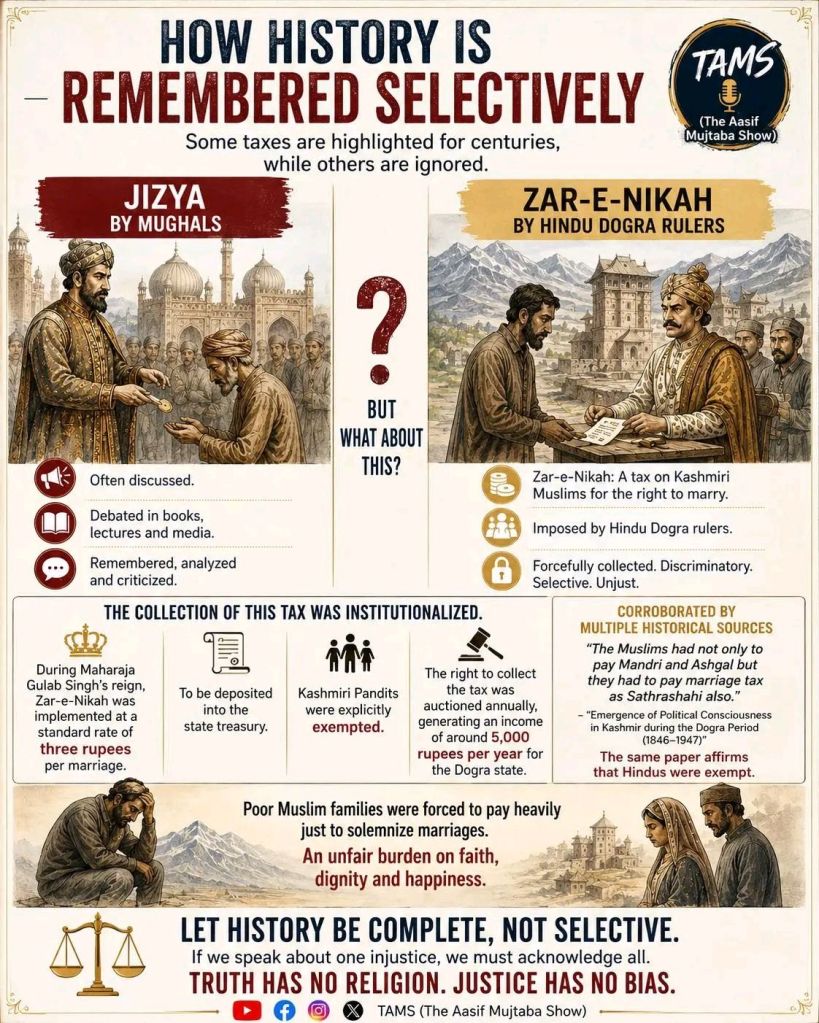
History is often remembered selectively. While discussions about Jizya frequently dominate public discourse, far less attention is given to Zar-e-Nikah, a discriminatory marriage tax imposed on Kashmiri Muslims during Dogra rule (1846–1947).
This tax was not merely a financial burden; it represented state intrusion into one of the most sacred aspects of Muslim life—marriage. Under Maharaja Gulab Singh, every Muslim marriage was taxed at a fixed rate of three rupees, payable to the state treasury, while Kashmiri Pandits were explicitly exempt. The right to collect the tax was even auctioned annually, generating significant revenue for the Dogra administration.
Historical records confirm that Muslims were subjected to multiple taxes, including marriage taxes known as Sathrashahi, from which Hindus were exempt. For a population already struggling under heavy taxation and economic hardship, Zar-e-Nikah became a symbol of institutionalized discrimination.


