Three incidents. Three times Hazrat Musa Alaihissalam couldn’t stay silent.

Three incidents. Three times Musa couldn’t stay silent.
Three times Khidr said: this is where we part.

If you want to understand Islamic knowledge, divine wisdom, and what it means to trust something you don’t understand yet, this story is the one.

Musa (AS)was told there was a man who knew something
he didn’t know. And Musa – one of the greatest
prophets in history – traveled to find him.

That detail alone should stop us. A prophet of
Allah traveling to learn from someone else.

He eventually found Khidr. He asked to accompany him and learn from him. Khidr agreed but with one condition:

“Do not ask me about anything until I mention it
to you myself.” (Quran 18:70)

One condition. Don’t ask. Just observe. Trust.

And Musa agreed.

Then the first thing happened.

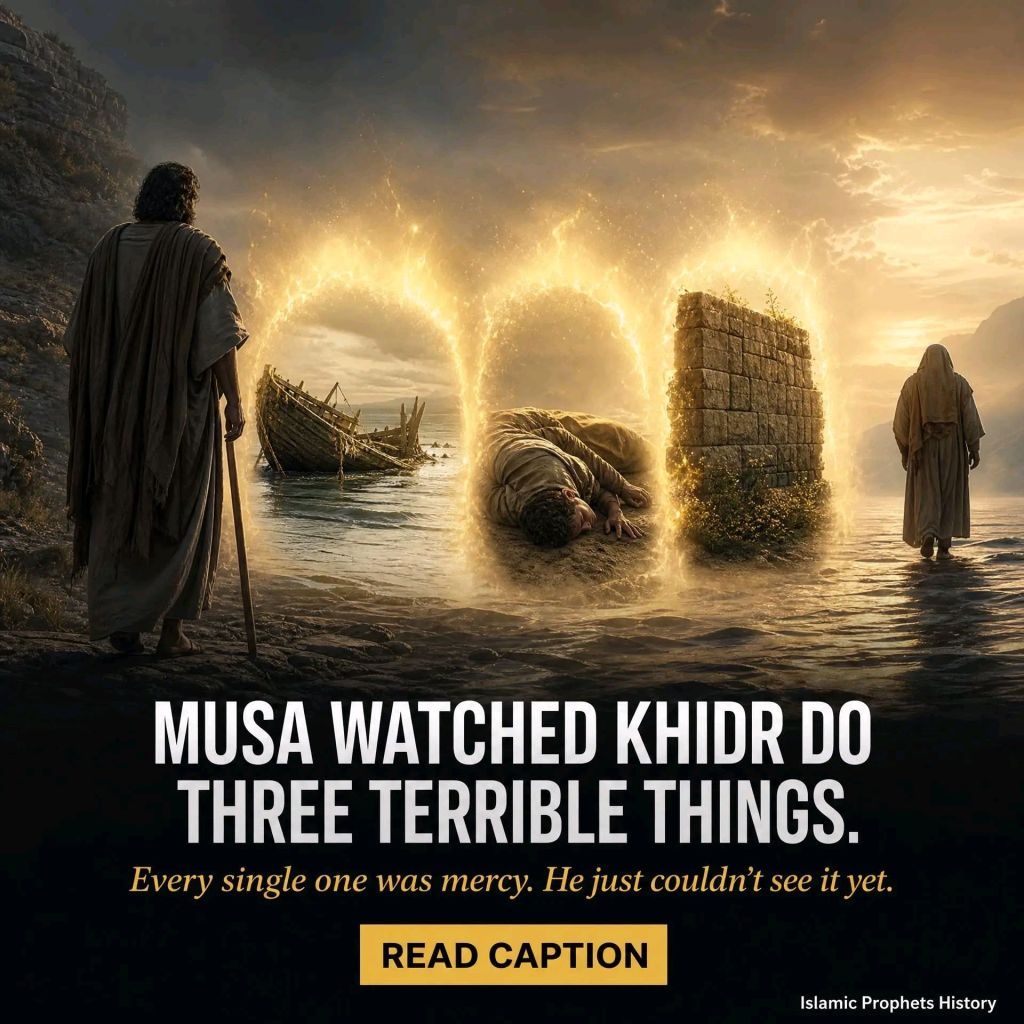
They boarded a boat. And Khidr made a hole in it.

Musa couldn’t hold himself. “You made a hole in it
to drown the people? This is a terrible thing.”
(Quran 18:71)

Khidr reminded him of the condition. Musa apologized.
He said don’t punish me for forgetting.

Then the second thing happened.

Khidr found a young boy and killed him.

This time Musa’s words were stronger. “You killed
a pure soul for no reason? This is a grave thing.”
(Quran 18:74)

Khidr reminded him again. One more chance.

Then the third thing happened.

They came to a town that refused them hospitality.
And Khidr found a wall about to collapse and
rebuilt it. For free. For people who had just
turned them away.

And this time Musa said something practical rather
than moral: “If you wished, you could have taken
a payment for it.” (Quran 18:77)

Three strikes. Khidr said: this is where we part.

But before leaving, he explained everything.

The boat: a king was coming who would seize every
functioning boat by force. The hole made it
undesirable. It saved the owners from losing it.

The boy: He was going to grow up to cause his
believing parents tremendous harm. Allah replaced
him with someone better. This was mercy, not cruelty.

The wall: It belonged to two orphan boys. Beneath
it was buried treasure left by their righteous father.
If the wall had fallen before they were old enough
to claim it, others would have taken it. Rebuilding
the wall protected their inheritance until they
were ready.

Then Khidr said the line that should stay
with you for the rest of your life:

“I did not do it of my own accord.” (Quran 18:82)

Everything that looked like damage, violence,
and ingratitude was none of those things.
It was divine wisdom moving through apparently
terrible actions to produce outcomes that
were completely impossible to see at the time.

Here is what this means for you.

There are things happening in your life right now
that look like holes in the boat. Like something
good being killed. Like effort poured out for
people who don’t deserve it.

And from where you are standing, you cannot see
what Khidr could see.

You cannot see the king that was coming for the boat.
You cannot see what that child would have become.
You cannot see whose inheritance is buried under
the wall you’ve been asked to rebuild for free.

Musa couldn’t see it either. And he was a prophet.

The difference between the outcome being wisdom and the outcome being tragedy is often just the information you don’t have yet.

Three incidents. Three times Hazrat Musa Alaihissalam couldn’t stay silent.

Three incidents. Three times Musa couldn’t stay silent.
Three times Khidr said: this is where we part.

If you want to understand Islamic knowledge, divine wisdom, and what it means to trust something you don’t understand yet, this story is the one.

Musa (AS)was told there was a man who knew something
he didn’t know. And Musa – one of the greatest
prophets in history – traveled to find him.

That detail alone should stop us. A prophet of
Allah traveling to learn from someone else.

He eventually found Khidr. He asked to accompany him and learn from him. Khidr agreed but with one condition:

“Do not ask me about anything until I mention it
to you myself.” (Quran 18:70)

One condition. Don’t ask. Just observe. Trust.

And Musa agreed.

Then the first thing happened.

They boarded a boat. And Khidr made a hole in it.

Musa couldn’t hold himself. “You made a hole in it
to drown the people? This is a terrible thing.”
(Quran 18:71)

Khidr reminded him of the condition. Musa apologized.
He said don’t punish me for forgetting.

Then the second thing happened.

Khidr found a young boy and killed him.

This time Musa’s words were stronger. “You killed
a pure soul for no reason? This is a grave thing.”
(Quran 18:74)

Khidr reminded him again. One more chance.

Then the third thing happened.

They came to a town that refused them hospitality.
And Khidr found a wall about to collapse and
rebuilt it. For free. For people who had just
turned them away.

And this time Musa said something practical rather
than moral: “If you wished, you could have taken
a payment for it.” (Quran 18:77)

Three strikes. Khidr said: this is where we part.

But before leaving, he explained everything.

The boat: a king was coming who would seize every
functioning boat by force. The hole made it
undesirable. It saved the owners from losing it.

The boy: He was going to grow up to cause his
believing parents tremendous harm. Allah replaced
him with someone better. This was mercy, not cruelty.

The wall: It belonged to two orphan boys. Beneath
it was buried treasure left by their righteous father.
If the wall had fallen before they were old enough
to claim it, others would have taken it. Rebuilding
the wall protected their inheritance until they
were ready.

Then Khidr said the line that should stay
with you for the rest of your life:

“I did not do it of my own accord.” (Quran 18:82)

Everything that looked like damage, violence,
and ingratitude was none of those things.
It was divine wisdom moving through apparently
terrible actions to produce outcomes that
were completely impossible to see at the time.

Here is what this means for you.

There are things happening in your life right now
that look like holes in the boat. Like something
good being killed. Like effort poured out for
people who don’t deserve it.

And from where you are standing, you cannot see
what Khidr could see.

You cannot see the king that was coming for the boat.
You cannot see what that child would have become.
You cannot see whose inheritance is buried under
the wall you’ve been asked to rebuild for free.

Musa couldn’t see it either. And he was a prophet.

The difference between the outcome being wisdom and the outcome being tragedy is often just the information you don’t have yet.

Light and Darkness: The Battle Within.

■ Light and Darkness: The Battle Within.

Light is the army of the heart, and darkness
is the army of the lower self (nafs).

Between them unfolds a silent jihad that no
eye sees, yet every soul lives within its arena.

The heart was created for illumination (nūr), and the nafs was veiled in inclination toward the earth.

When the heart is awakened, it becomes a battlefield where divine light descends as waridāt, gentle arrivals from the unseen, while the nafs gathers its forces from desire, heedlessness, and attachment to the transient world.

▪︎ Imām al-Ghazālī, may Almighty Allāh sanctify his secret, writes in Iḥyā’ ʿUlūm al-Dīn:

“The heart was not created except for the remembrance of Allāh, and its life is only in that remembrance; if it is deprived of it, it becomes darkened and dies.”

Thus, light is not merely clarity of thought, it is life itself.

■ The Two Armies

Imām Ibn ʿAṭā’ Allāh al-Iskandarī, may Almighty Allāh sanctify his secret, indicates this inner struggle in his Ḥikam:

“How can the heart be illuminated while the forms of creation are engraved upon its mirror?”

The engraving of creation upon the heart is the dominance of darkness, when the nafs turns lawful desires into its soldiers, beautifying heedlessness and dressing appetite in the garments of necessity.

And yet, the heart is not left abandoned.
When Allāh intends good for a servant,
He strengthens the heart with reinforcements of light, and strips the nafs of its deceptive supports.

▪︎ Shaykh Ibn ʿAṭā’ Allāh also says:

“When Allāh opens for you the door of understanding, the harms of creation become
a means to Him.”

Even the struggle itself becomes light when the heart is guided.

■ The Struggle of Return

The soul (nafs) clings to its homeland: darkness familiar, comforting in its repetition, heavy with desire yet convincing in its illusion of safety.

It descends toward forgetfulness (ghaflah), while the heart calls it upward toward its original covenant of nearness.

▪︎ Imām al-Junayd al-Baghdādī, may Almighty Allāh sanctify his secret, said:

“The path to Allāh is closed to all creation except those whom He has chosen through sincerity.”

Sincerity becomes the sword of light in this struggle cutting through illusion, exposing the deception of desire.

▪︎ Shaykh al-Tustarī, may Allāh sanctify his secret, said:

“The heart does not become pure until it is emptied of everything other than Allāh.”

Thus, purification is not addition, but removal of darkness.

■ The Overwhelming of Light

When the servant turns sincerely toward Allāh, the Divine Mercy intervenes. The heart is strengthened with divine waridāt, and the supports of darkness are withdrawn from the nafs.

At that moment, light confronts darkness until it is subdued, not by force of the servant, but by the decree of the Lord of the worlds.

▪︎  Imām Ibn al-Qayyim, may Allāh have mercy upon him, explains in Madarij al-Salikin:

“When the light of faith enters the heart, the armies of falsehood retreat, for falsehood cannot remain where truth is established.”

Then the soul is humbled not destroyed, but disciplined until it learns that its life is not in desire, but in surrender.

This inner war is not a sign of distance from Allāh, but a sign of the journey toward Him.
For He only tests the heart He intends to purify.

When Allāh wills good for a servant, He does not leave him to his own darkness; He sends light after light until the heart recognizes its Lord.

May Almighty Allāh clothe our hearts in His light, subdue our lower selves with His mercy, and make us among those who witness truth within and without.

“O Allāh, do not leave us to ourselves
even for the blink of an eye.”

And Almighty Allāh knows best.

■ Teachings Of The Heart.