

Three incidents. Three times Musa couldn’t stay silent.
Three times Khidr said: this is where we part.
If you want to understand Islamic knowledge, divine wisdom, and what it means to trust something you don’t understand yet, this story is the one.
Musa (AS)was told there was a man who knew something
he didn’t know. And Musa – one of the greatest
prophets in history – traveled to find him.
That detail alone should stop us. A prophet of
Allah traveling to learn from someone else.
He eventually found Khidr. He asked to accompany him and learn from him. Khidr agreed but with one condition:
“Do not ask me about anything until I mention it
to you myself.” (Quran 18:70)
One condition. Don’t ask. Just observe. Trust.
And Musa agreed.
Then the first thing happened.
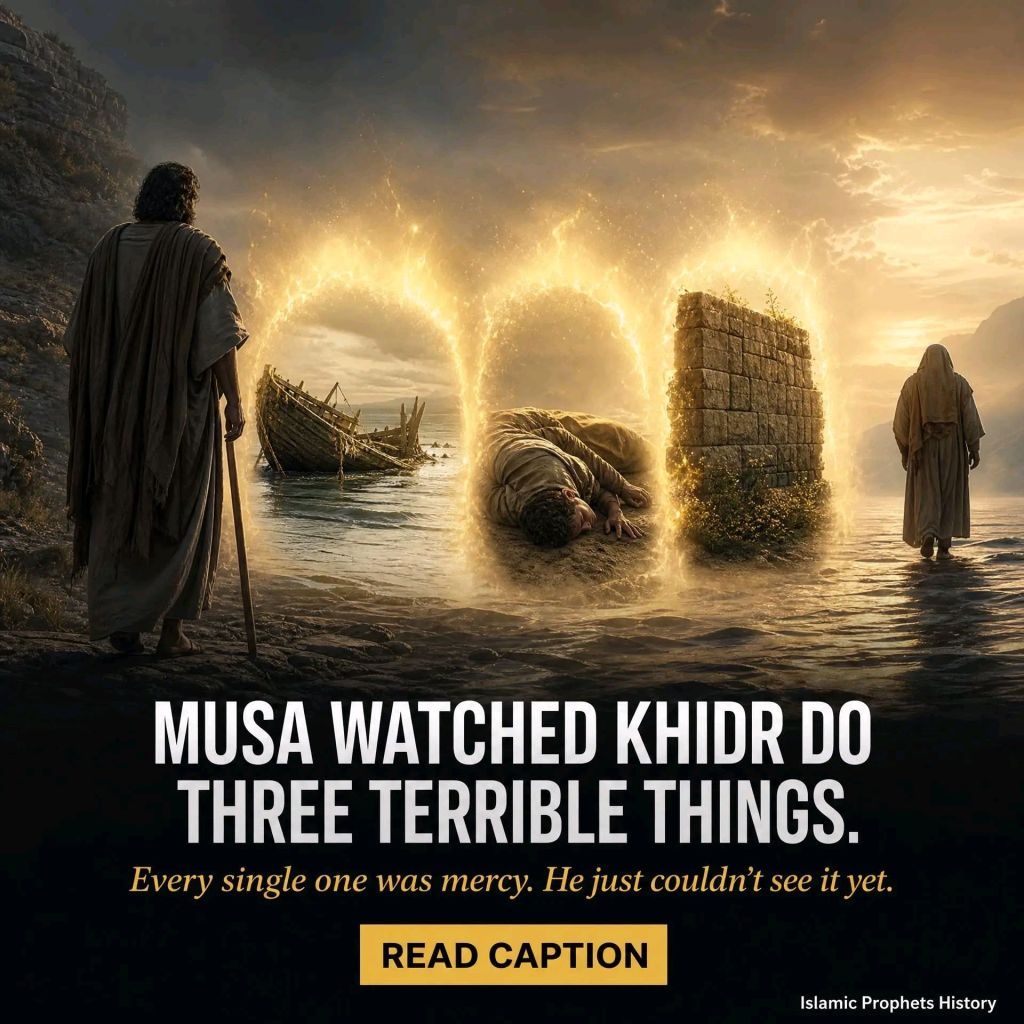
They boarded a boat. And Khidr made a hole in it.
Musa couldn’t hold himself. “You made a hole in it
to drown the people? This is a terrible thing.”
(Quran 18:71)
Khidr reminded him of the condition. Musa apologized.
He said don’t punish me for forgetting.
Then the second thing happened.
Khidr found a young boy and killed him.
This time Musa’s words were stronger. “You killed
a pure soul for no reason? This is a grave thing.”
(Quran 18:74)
Khidr reminded him again. One more chance.
Then the third thing happened.
They came to a town that refused them hospitality.
And Khidr found a wall about to collapse and
rebuilt it. For free. For people who had just
turned them away.
And this time Musa said something practical rather
than moral: “If you wished, you could have taken
a payment for it.” (Quran 18:77)
Three strikes. Khidr said: this is where we part.
But before leaving, he explained everything.
The boat: a king was coming who would seize every
functioning boat by force. The hole made it
undesirable. It saved the owners from losing it.
The boy: He was going to grow up to cause his
believing parents tremendous harm. Allah replaced
him with someone better. This was mercy, not cruelty.
The wall: It belonged to two orphan boys. Beneath
it was buried treasure left by their righteous father.
If the wall had fallen before they were old enough
to claim it, others would have taken it. Rebuilding
the wall protected their inheritance until they
were ready.
Then Khidr said the line that should stay
with you for the rest of your life:
“I did not do it of my own accord.” (Quran 18:82)
Everything that looked like damage, violence,
and ingratitude was none of those things.
It was divine wisdom moving through apparently
terrible actions to produce outcomes that
were completely impossible to see at the time.
Here is what this means for you.
There are things happening in your life right now
that look like holes in the boat. Like something
good being killed. Like effort poured out for
people who don’t deserve it.
And from where you are standing, you cannot see
what Khidr could see.
You cannot see the king that was coming for the boat.
You cannot see what that child would have become.
You cannot see whose inheritance is buried under
the wall you’ve been asked to rebuild for free.
Musa couldn’t see it either. And he was a prophet.
The difference between the outcome being wisdom and the outcome being tragedy is often just the information you don’t have yet.


