

■ Ṣalāh and the Child’s Pose:
The Meeting of Devotion and Stillness
Among the many ways the human body expresses reverence and surrender, few are
as profound as the act of prostration. In Islam, Ṣalāh the daily ritual prayer is both a physical and spiritual alignment with the Divine.
In yoga, the Child’s Pose (Balāsana) serves as a posture of rest, humility, and inward renewal. Though their origins differ, both gestures spring from the same universal language of the soul: the body’s yearning to bow before peace.
1. The Body in Reverence
In Ṣalāh, the believer’s entire body participates in dhikr the remembrance of God.
From standing in qiyām (upright posture) to bowing in rukū‘, and then descending into sujūd (prostration), each movement symbolizes a stage of surrender.
The forehead touching the earth is not only an act of worship but a declaration that
“Nothing remains of me before You.”
The physical act becomes the mirror of the inner state.
Similarly, the Child’s Pose in yoga invites the body into a gentle surrender.
By folding forward and resting the forehead upon the ground, one experiences a return to innocence a symbolic return to the “child state” of pure trust and dependency.
The spine curves inward, the Heart softens toward the earth, and the mind quiets. Just as sujūd reminds the Muslim of divine nearness
“And prostrate and draw near” (Qur’an 96:19)
The Child’s Pose reminds the practitioner that stillness itself is a form of closeness to the essence of life.
2. Stillness as Medicine
Both Ṣalāh and Balasana hold a profound healing potential. In the stillness of prayer,
the believer’s nervous system slows, the
breath deepens, and the Heart synchronizes with a rhythm of divine remembrance.
It is said that the Prophet ﷺ would find
rest in prayer, declaring,
“The coolness of my eyes is in Ṣalāh.”
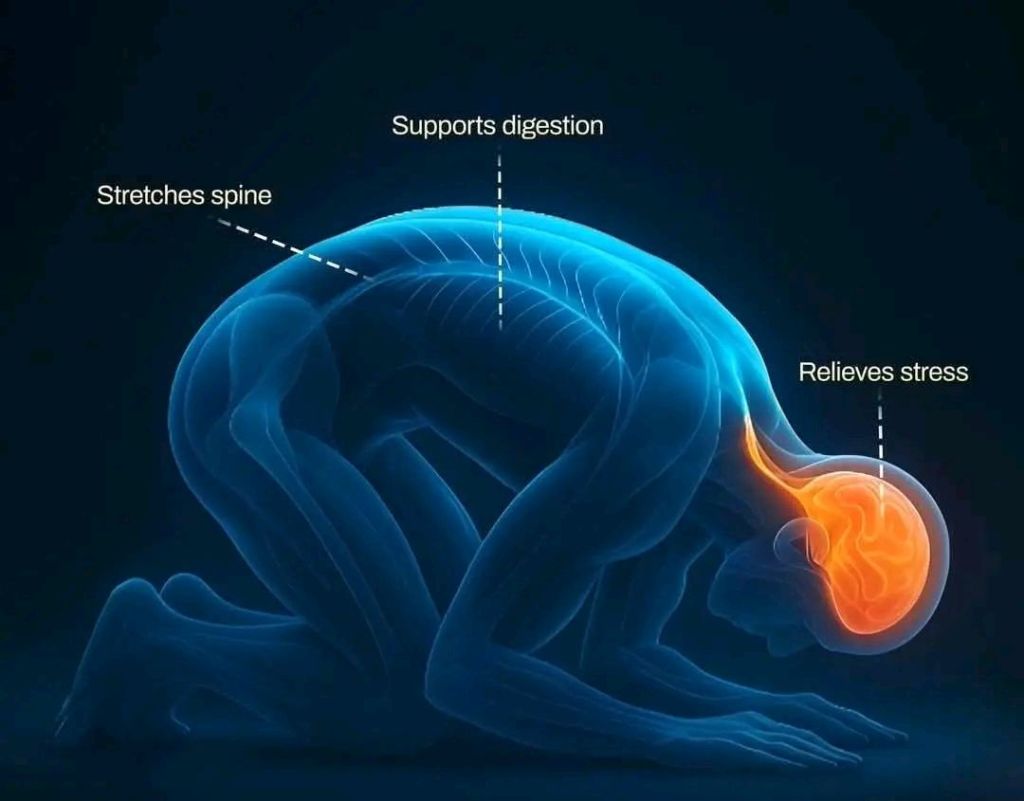
The Child’s Pose mirrors this same tranquility Resting in this posture for a few minutes daily releases tension from the back and hips the very regions where humans store emotional stress.
The compression of the abdomen gently massages the inner organs, fostering digestion and inner calm. In both practices, stillness becomes a form of movement, and silence a form of speech.
3. The Meeting of Body and Spirit
When seen through the eye of the Heart, both Ṣalāh and Balāsana dissolve the boundary between physical posture and spiritual meaning. In prostration, the Muslim’s body becomes a vessel for Divine remembrance a harmony of breath, motion, and intention.
In Child’s Pose, the yogi’s body becomes a sanctuary of release, a place where the burdens of the day melt into the ground.
The similarity is not coincidental but speaks
to a universal wisdom written in the body:
that humility, breath, and stillness are doorways to transcendence.
When the forehead touches the earth
whether in sujūd or in Balāsana the illusion of separateness softens, and one feels the pulse of life shared by all creation.
4. The Return to the Heart
At its essence, both acts are reminders to return to the Heart. Ṣalāh is not merely a ritual; it is a rhythmic purification of the Heart’s mirror, polishing it through repetition and sincerity.
Likewise, the Child’s Pose invites a return to
the child-like Heart free of pretension, soft,
and open to divine presence.
In a world driven by speed and noise, these moments of stillness are sacred. They whisper the same truth in different tongues: that peace is not found in external attainment but in the inward bow the turning of the soul toward its Source.
Whether through the divine choreography of Ṣalāh or the restorative posture of Balasana, the body becomes an instrument of spiritual remembrance. Each bow, each breath, carries
a silent message:
“I am not separate. I am in surrender.”
In this shared gesture of humility forehead to earth, Heart open the Seeker discovers that prayer and yoga, though born in different lands, lead to the same horizon of peace: the stillness where the soul meets the Divine.

 Aal-e-Qutub Aal-e-Syed Abdullah Shah Ghazi