Ibn Yunus and The Pendulum: A History of Errors

In this article, Professor David A. King explores the authenticity of the statement that tenth-century Egyptian astronomer Ibn Yūnus was the first person to use a pendulum to measure time. After examining evidence originating from medieval sources along with a series of statements made by historians and orientalists, Professor David A. King challenges common misconceptions and reveals that the association of the pendulum with Ibn Yūnus is a history of errors. This revelation by no means lessens the scientific contribution of Ibn Yūnus, who was perhaps the greatest astronomer in Islamic history. In 1970, whilst preparing his doctoral dissertation on the astronomical handbook of Ibn Yūnus, the Hākimī Zīj, Prof. King discovered the corpus of 200 pages of tables for astronomical timekeeping by the sun and regulating the times of Muslim prayer for Cairo associated with the Egyptian astronomer; these were described in a study published in 1973. In Professor King’s Magnum Opus, entitled In Synchrony with the Heavens and published in 2004, he describes dozens of such tables for different localities all over the Islamic world, based on hundreds of previously unstudied medieval manuscripts. Ibn Yūnus was largely responsible for this remarkable development in Islamic astronomy.

70589378_68a6939551_b
Foucault’s Pendulum, Leonardo da Vinci National Museum of Science and Technology, Milan, Italy
***

Note of the Editor: This article was originally published as: David A. King, “Ibn Yūnus and the Pendulum: A History of Errors” in “Archives Internationales D’Histoire Des Sciences, vol. 29, no. 104 (1979)”. We are grateful to Professor David King for permitting republishing on the Muslim Heritage website. Some images added as indicated in their captions.

***

In the popular literature on Islamic science one often meets the statement that the tenth-century Egyptian astronomer Ibn Yūnus was the first person to use a pendulum to measure time. The purpose of this note is firstly to state that there is no evidence whatsoever in the known medieval sources that Ibn Yūnus used a pendulum, and secondly to document a series of statements by historians and orientalists that have led to this association of the pendulum with Ibn Yūnus
muslim_heritage_mechanics_01

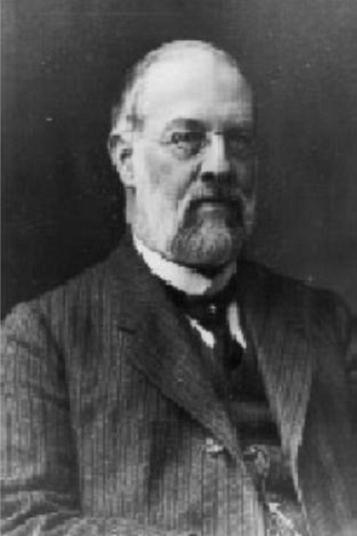
Eilhard Wiedemann (1852-1928) 

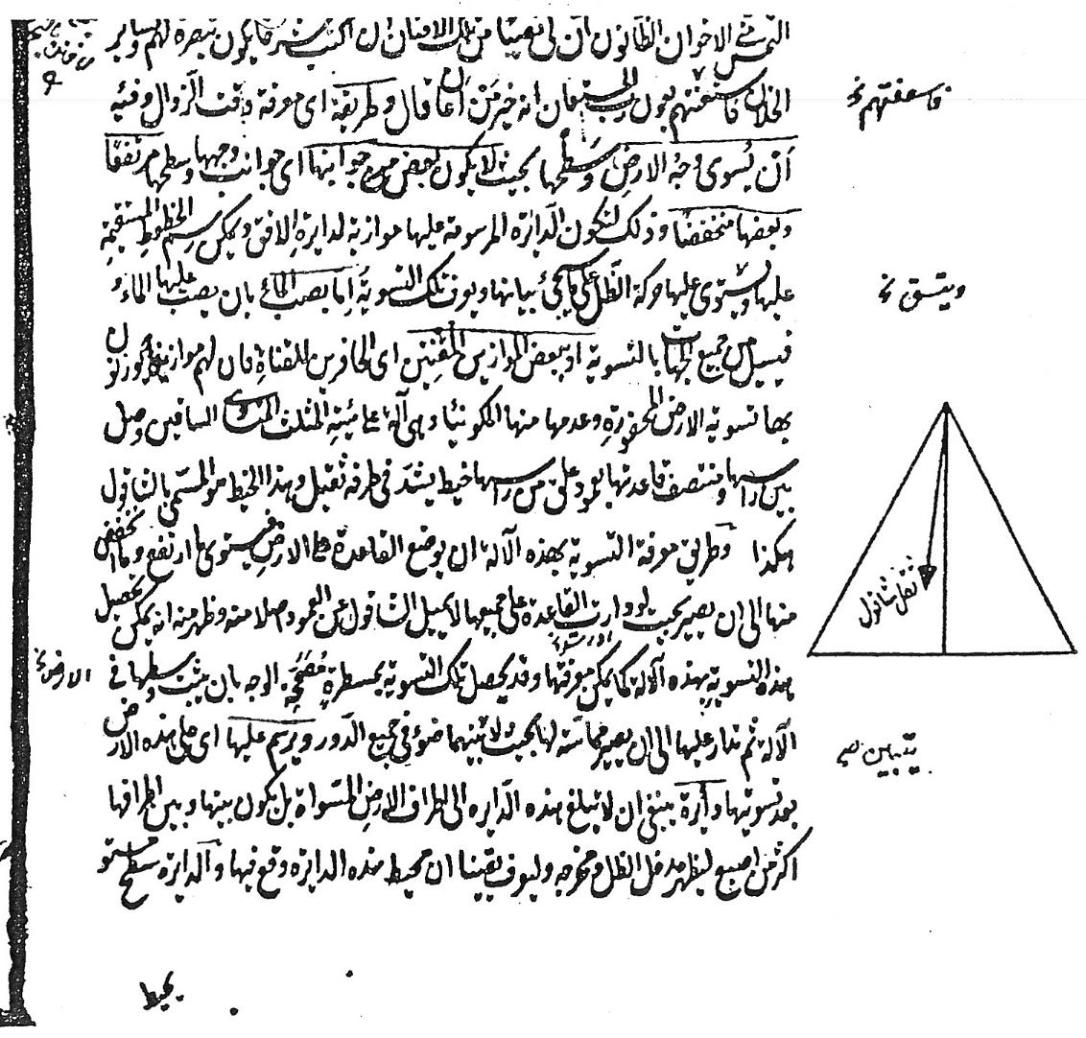
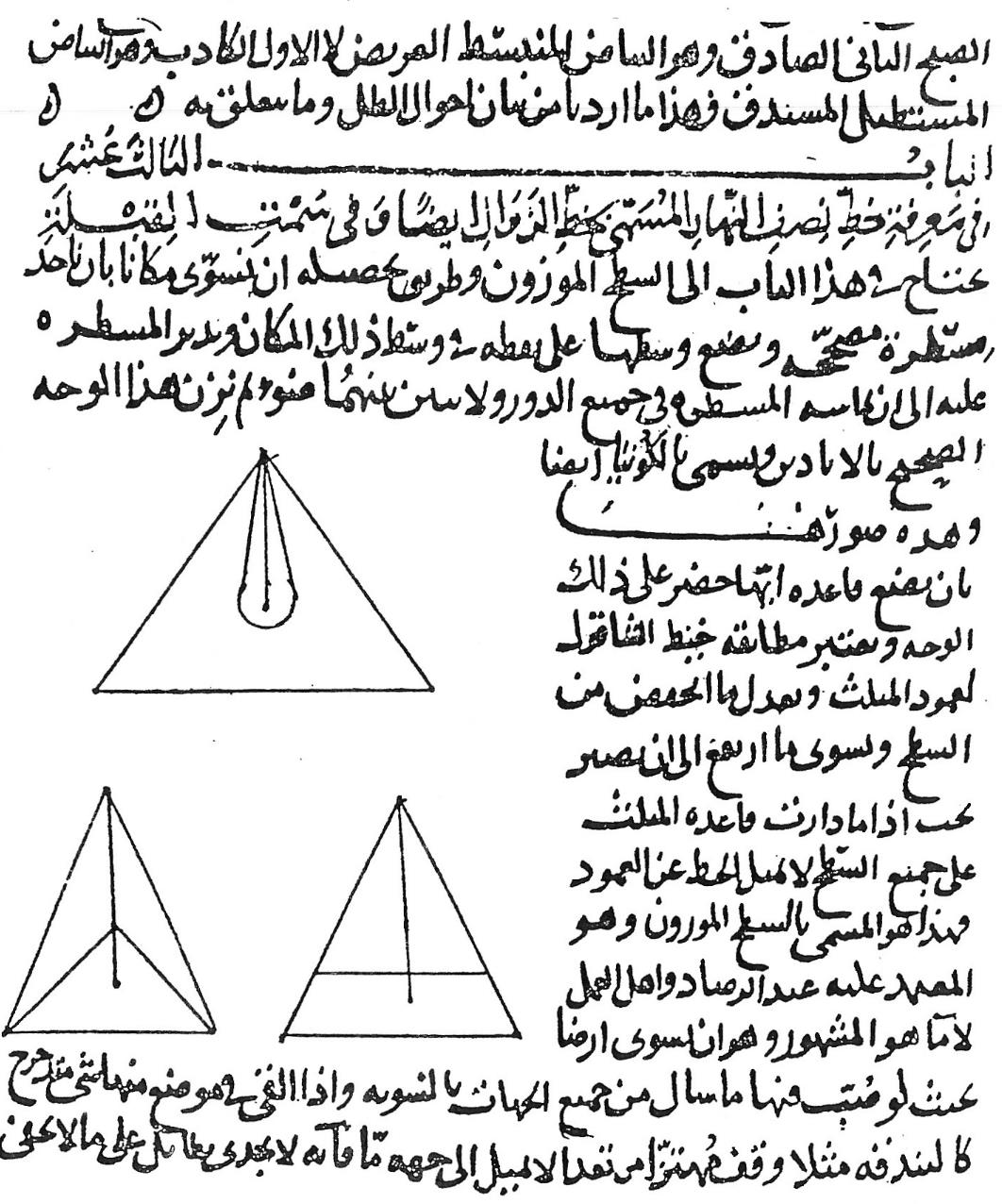
The distinguished German historian of Islamic science Eilhard Wiedemann made two separate attempts in 1919 and 1922 to kill the myth, but, judging by the frequency of its recurrence in the modern literature, he was unsuccessful Wiedemann pointed out that drawings of plumb-lines in Islamic sources might have led to the idea that Muslim scholars were already acquainted with the pendulum. I doubt that this was the case, because such plumb-lines are illustrated only in sections of Islamic treatises on levelling. Plates I and II show two such illustrations, taken respectively from the treatise on theoretical astronomy entitled Nihāyat al-idrāk by the celebrated thirteenth-century scholar Quṭb al-Dīn al-Shīrazī, and from the treatise on the use of the Indian circle for determining the meridian by the late-sixteenth-century writer al-Khalkhāli. These plumb-lines need concern us no further in the present study: they have been adequately discussed by Wiedemann. As presented in the Islamic treatises, they are unrelated to the pendulum as a means of reckoning time.

Wiedemann was not familiar with the Arabic manuscripts of Ibn Yūnus’ works which survive in various libraries in Europe and the Near East, so that he was unable to seek the origin of the myth about Ibn Yūnus and the pendulum in the primary sources. In the past few years I have examined several dozen manuscripts of the various astronomical works compiled by and attributed to Ibn Yūnus
pendulum01 pendulum02

Plate I: Illustrations of plumb-lines in Quṭb al-Dīn al-Shīrāzī’s Nihāyat al-idrāk, reproduced from MS Cairo Ṭal’at haya 45, foL 145r, with kind permission of the Egyptian National Library.

Plate II: Illustration of a plumb-line in al-Khalkhāli’s treatise on the Indian circle, reproduced from MS Cairo Ṭal’at majāmī’ fārisī 26, fol. 172v, with kind permission of the Egyptian National Library.

B0100
Imaginery sketch of Ibn Yunus 

These include manuscripts of the remaining parts of his major work, the Hākimī Zīj; fragments of other zījes which I think are also due to him; a corpus of tables for timekeeping by the sun and regulating the astronomically-defined times of prayer; extensive solar and lunar equation tables; trigonometric tables with entries for each minute of argument; an astrological treatise; and a poem on the times of prayer. In none of these is there any mention of the measurement of time using a pendulum.

Wiedemann located the origin of the myth in the secondary sources but did not trace its subsequent development. Besides, some of the most fantastic claims about the invention of the pendulum by Ibn Yūnus have been made since Wiedemann’s time. I therefore present a series of quotations from the secondary literature on

Islamic science to document the colorful history of this myth. In view of the diverse nature of the source material I shall include many direct quotations, with translations into English where necessary.

***

The association of the pendulum with the Arabs began a few decades after the European discovery of the use of the pendulum. In 1684 the English historian Edward Bernard wrote a letter concerning various medieval star catalogs to the Provost of Trinity College near Dublin in which he stated:

“… quam illi sollicite temporis minutias per aquarum guttulas, immanibus Schitheris, imo (mirabile) fill penduli vibrationibus jam pridem distinxerint et mensurarint . . .”

Translation: “… when long ago they (the Arabs) have distinguished and measured with the same care the divisions of time by drops of water, and by enormous sundials, and marvellously, by the vibrations of a hanging string.”

A more extensive quote from Bernard’s letter is recorded in translation below. No evidence whatsoever is presented for Bernard’s assertion, but he was an Arabist and had familiarity with some of the Arabic manuscripts in Oxford. However, the catalogs of the Arabic manuscripts in Oxford published in 1787 (by J. Uri) and 1821-35 (by A. Nicoll) do not mention any treatises on the pendulum. One might speculate that Bernard would probably have left some note in any Arabic manuscript in which he had discovered some reference to the pendulum. But, as far as we know, he did not.

In 1804 the French historian J. F. Montucla published an account of Bernard’s statement in his Histoire des Mathematiques He wrote:

“… (M. Edouard Bernard) nous apprend que la seule bibliothèque d’Oxford possède plus de 400 manuscrits Arabes sur l’astronomie, et si l’on veut y ajouter ceux que pourrait encore fournir la bibliothèque orientale de M. Herbelot, celles d’Hottinger, du père Labbe, et divers catalogues de biblio-thèques riches en manuscrits orientaux le nombre en parâitra très consider-able. Le même M. Bernard, qui avait parcouru une grande partie de ces manuscrits, donne une idée fort avantageuse de l’astronomie arabe. Je vais rapporter ses paroles mêmes, qui sont remarquables. Plusieurs avantages, dit il, rendent recommandable l’astronomie des Orientaux, comme la sérénité des régions où ils ont observé, la grandeur et l’exactitude des instrumens qu’ils y ont employes, et qui sont tels que l’on aurait de la peine a le croire; la multitude dés observateurs et des écrivains, dix fois plus grande que chez les Grecs et les Latins; le nombre enfin des princes puissans, qui l’ont aidée par leur protection et leur magnificence. Une lettre ne suffit pas pour faire connaître ce que les astronomes Arabes ont trouvé à réformer dans Ptolémée, et leurs efforts pour le corriger; quel soin ils ont pris pour mesurer le temps par des clepsidres à eau, par d’immenses cadrans solaires, et même, ce qui surprendra, par les vibrations du pendule; avec quelle industrie enfin et quelle exactitude ils se sont portés dans ces tentatives délicates, et qui font tant d’honneur l’esprit humain; savoir, de mesurer les distances des astres et la grandeur de la terre.”
european_muslim_heritage_10

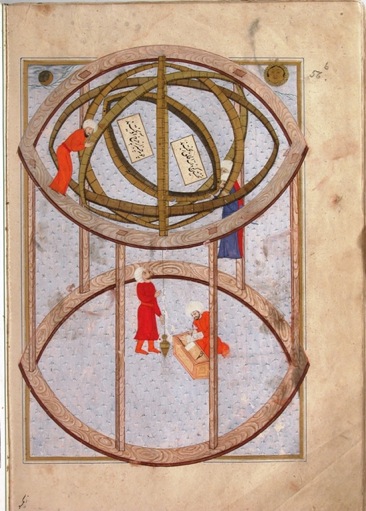
The manuscript shows a huge metal skeletal structure, called the armillary, from the centre of which hangs a pendulum. An armillary sphere structure for monitoring the location of stars. From Taqi al-Din ibn Ma’ruf’s Al-ālāt al-rasadiya li-zīj al-shāhinshāhiyya, Library of the Topkapi Palace Museum, MS Hazine 452. 

Elsewhere in his book Montucla writes of the achievements of Ibn Yūnus, without mentioning the pendulum He was aware of the observation accounts in the Leiden manuscript of the Ḥākimī Zīj.

A few years later the French astronomer P. S. Laplace in his Précis de I’ Histoire de I’Astronomie, published in 1821, made the same claim as Montucla about the Arab astronomers using the pendulum but did not mention Ibn Yūnus in this connection. Writing of the interest of the Arab astronomers in astronomical instruments, he stated:

“Ils donnèrent encore une attention particulière à la mesure du temps, par des clepsydres, par d’immenses cadrans solaires, et même par les vibrations du pendule.”

The first reference to the use of the pendulum specifically by Ibn. Yūnus occurs in the Course of Lectures on Natural Philosophy and the Mechanical Arts by the English scientist Thomas Young, which was published in 1809. Without citing any authority whatsoever, Young wrote:

“But for the general purposes of timekeepers, all other inventions have been almost universally superseded by the pendulum and the balance spring, or pendulum spring. About the year 1000, Ibn Junis, and the other Arabian astronomers were in the habit of measuring time, during their observations, by the vibrations of pendulums; but they never connected them with machinery. The equality of the times occupied by theses vibrations, whether larger or smaller, was known to Galileo in 1600, and some time before 1633, he proposed that they should be applied to the regulation of clocks.”

Where did Young pick up this specific reference to Ibn Yūnus? The spelling Junis might indicate a German influence. However, I think it is more significant that Young thought that not only Ibn Yūnus but also “the other Arabian astronomers” used the pendulum for measuring time during observations. Given the assertion of Bernhard that the Arabs used the pendulum to measure time, and the fact that Ibn Yūnus was celebrated for his observations, Young put two and two together and made five.

The first serious studies of the unique manuscript of Ibn Yūnus’ Ḥākimī Zīj preserved in Leiden were conducted in Paris in the early nineteenth century. In 1804 Caussin de Perceval published the text and translation of the introductory chapters of the zīj dealing with observation accounts. Not long thereafter J.-J. Sedillot prepared a translation of the entire manuscript which he intended to publish. A summary was prepared by J. B. Delambre in his Histoire de l’Astronomie au Mayen Age published in 1820, but Sédillot’s work on Ibn Yūnus was never published, and the fate of his own papers relating to Ibn Yūnus is uncertain. It is significant that neither J. J. Sédillot nor Delambre made reference to the use of the pendulum by Ibn Yūnus. Sédillot’s work on Islamic astronomy was continued by his son L. A. Sédillot, and before the work of the Italian Arabist C. A. Nallino and the Swiss historian of science H. Suter at the end of the nineteenth century, the researches of Sédillots père et fils constituted the first serious studies on major Islamic astronomical works which had not been transmitted to Europe, such as those of Ibn Yūnus, al-Marrākushi, and Ulugh Beg. However, Sédillot-fils had a tendency to get carried away with certain erroneous ideas, the most notable and controversial example of which was the alleged discovery of the lunar variation by the tenth-century Arab astronomer Abu l-Wafā’
european_muslim_heritage_11

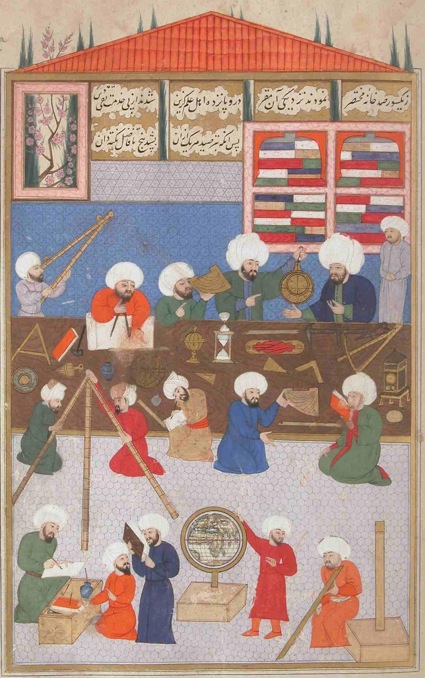
Ottoman astronomers at work around Taqī al-Dīn at the Istanbul Observatory. Source: Istanbul University Library, MS F 1404, fol. 57a. 

In 1844 L. A. M. Sédillot wrote in his summary of the treatise on astronomical instruments by the thirteenth-century astronomer Abū `Alī al-Marrākushī:

“Connaissaient-ils le pendule, comme l’a prétendu E. Bernard, de l’université d’Oxford? c’est ce que nos recherches ne nous ont pas encore appris.”

Elsewhere in the same study he wrote:

“On a prétendu que les Arabes connaissaient le pendule; c’est une question encore en litige, main que des recherches ultérieures pourront résoudre affirmativement.”

At this point Sédillot refers to the passage of Bernard which we have already quoted above. In a letter to the German historian Alexander von Humboldt published in 1853 Sédillot wrote[[14]]:

“Dès les premiers temps de cette belle période, d’importantes corrections sont apportees aux Tables des Grecs, dont les livres sont traduits; les instruments nécessaires sont construits par d’habiles artistes; des observatoires s’élevent de tous cotes: le mural, le gnomon à trou, le pendule même, sont employés.”

In his Histoire des Arabes published in Paris in 1854[[15]], L. A. Sédillot wrote of Ibn Yūnus as “… inventeur du pendule et du gnomon à trou …”, that is “… inventor of the pendulum and the aperture gnomon …” and stated as one of the achievements of the Arab scientists that “… le pendule même était connu des Arabes …”, that is, “… even the pendulum was known to the Arabs …” No references are given for either of these assertions. However, in none of the manuscripts of works associated with Ibn Yūnus is there any mention of an aperture gnomon. Sédillot’s statement that Ibn Yūnus invented the aperture gnomon has fortunately not been repeated, apparently because his Arab translators did not know what a gnomon à trou was. In `Alī Mubārak’s Arabic version of Sédillot’s work printed in Cairo in 1891/92 this first quotation was translated as:  … ikhtara’a l-rub’ dha l-thaqb (or thuqab) wa-bandūl al-sā`a al-daqqāqa … which means “… he invented the quadrant with hole(s?) and the pendulum of the ticking clock …” In the Arabic translation published in Cairo in 1948 by Adel Zuaitar it is translated:  … wa-khtara`a Ibn Yūnus al-raqqāş wa-mayl al-sā`a al-shamsīya dha l-thaqb (or thuqab) which means “… Ibn Yūnus invented the pendulum and the inclination of the sundial with hole(s?) …”

Thus von Humboldt was able to write in his universal history entitled Kosmos (English translation by E. C. Otté, 1859-61), citing Laplace, Young, and Sédillot:

“Amongst the advances which science owes to the Arabs, it will be sufficient to mention Alhazen’s work on Refraction, partly borrowed, perhaps, from Ptolemy’s Optics, and the knowledge and first application of the pendulum as a means of measuring time, due to the great astronomer Ebn-Junis.”
muslim_science_15

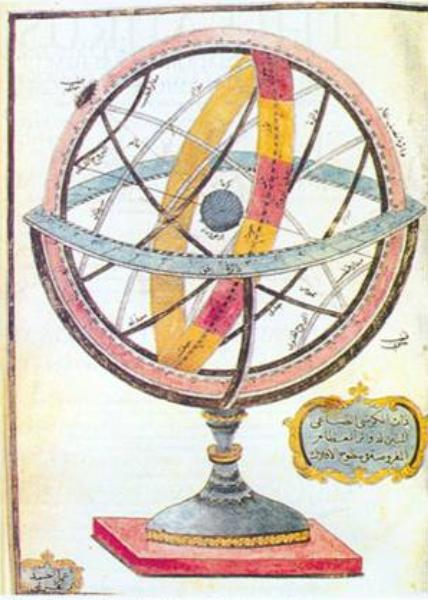
Kâtib Çelebi, Kitâb-i Cihânnümâ, Istanbul: Ibrahim Müteferrika, 1732. 

The French scholar Gustav Lebon, in his La Civilisation des Arabes, published in Paris in 1884, was the only author in the nineteenth century to express any scepticism about the use of the pendulum by the Muslims. He wrote:

“Les Arabes ne connurent que les cadrans solaires comme moyen de mesurer le temps avec précision. Le pendule n’ayant pas encore été de leur temps appliqué aux horloges, ces dernières ne pouvaient posséder la précision nécessaire aux recherches astronomiques …”

“…Le docteur E. Bernard, d’Oxford, a soutenu que les Arabes ont découvert l’application du pendule aux horloges; mais ses raisons ne semblent pas suffisantes pour permettre de leur attribuer une invention aussi capitale …”

In 1919 the celebrated historian of Islamic physics E. Wiedemann published an article entitled Über die angebliche Verivenclung des Pendels zur Zeitmessung bei den Arabern, “On the supposed use of the pendulum for time-keeping amongst the Arabs”. This short article begins as follows:

“Immer von neuem taucht die Ansicht auf, daß die Araber schon um 1000 n. Chr. das Pendel zur Zeitmessung benutzt haben. Als einer, der es verwendet hat, wird z.B. der größte Astronom des Orientes Ibn Junus/Junis genannt, der in Kairo die nach dem damaligen Sultan al-Hakim benannten großen hakimitischen Tafeln verfaßte. Die Angaben stiitzen sich wohl alle auf eine recht vage Bemerkung von Ed. Bernard, für die schon L. Sédillot eine Nach-prüfung für wünschenswert erachtete. Ed. Bernard rühmt bei der Besprechung von Handschriften im Merton College in Oxford die Tätigkeit der arabischen Gelehrten and bemerkt dabei:

“quam illi sollicite temporis minutias per aquarum guttulas, immanibus Sciotheris (Gnomone), imo (mirabile) fill penduli vibrationibus jam pridem distinxerint et mensurarint.”

Bei umfangreichen Studien, die ich teils allein, teils gemeinsam mit Prof. Dr. Hauser über arabische Uhren usw. angestellt habe, ist mir aber nie die geringste Andeutung einer Verwendung des Pendels begegnet.”

Wiedemann went on to point out that drawings of plumb-lines in medieval Arabic manuscripts might have led to the notion that the Muslims were familiar with the pendulum. He presented illustrations from three Islamic works, one anonymous and the others by al-Khalkhālī (fl. ca. 1600) and al-Isfazārī (fl. ca. 1100).

In 1922 Wiedemann published another article on the same subject[[21]]. The article begins:

“In einer früheren Veröffentlichung habe ich Abbildungen von Senkeln mit-geteilt, die meiner Ansicht nach zu der irrigen Annahme führen konnten, daß die Araber bereits Pendel zur Zeitmessung benutzt haben. Einige andere interessante derartige Zeichnungen von Setzwagen, die zum Nivellieren von Flächen dienen, finden sich auf fol. 16b einer Leidener Handschrift (Gol. 192, Nr. 1105). Sie sind enthalten in dem Werk Das königliche Geschenk über die Astronomic von Quṭb al Din al Schîrâzî (d. 1311). An der betreffenden Stelle handelt es sich um die Bestimmung der Meridianlinie …”
pendulum03

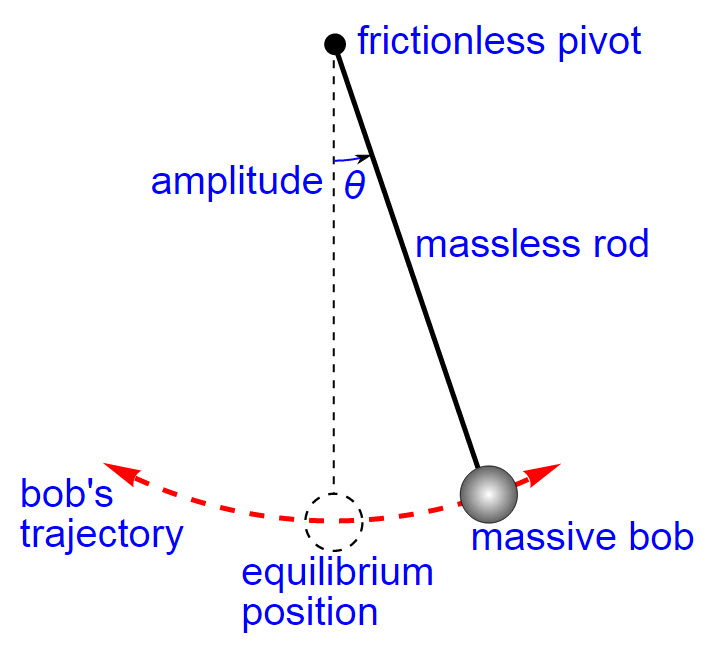
“Simple gravity pendulum” model assumes no friction or air resistance. 

Wiedemann then presented a diagram copied from the manuscript of al-Shīrāzī’s work and a translation of his instructions on the use of the plumb-line. He concluded his short paper with these words:

“Eingefügt sind die folgenden Figuren, von denen bei der ersten die Anbringung des Senkels an diejenige bei einem von Ibn Jûnus beschriebenen Gnomon erinnert und bei der das Senkel bei einiger Phantasie als ein Pendel aufgefaßt werden kann.”

I personally doubt that Sédillot confused Ibn Yūnus’ gnomon with a pendulum, since Ibn Yūnus’ description of it occurs in the middle of a section on tests for levelling.

Wiedemann gave no further reference to Ibn Yūnus’ gnomon, although he discussed it elsewhere, namely, in the article Mīzān (balance) in the Encyclopaedia of Islam (1st ed.), where he listed as one of the tests used by Muslim scholars to see whether an object was standing vertically, the following:

“In the side of the gnomon, a perpendicular rod, often with a cone-shaped top, Ibn Yūnus cut out a groove which ended in a hemi-spherical cavity. In the groove a thread is hung from the top of the gnomon with a ball shaped weight. If this comes to rest in the hollow, the gnomon is perpendicular.”

The reference cited for this is C. Schoy’s Die Gnomonik der Araber, the basic work on Islamic sundial theory, published in 1923, where Schoy translated the section of Ibn Yūnus’ Ḥākimi Zīj dealing with gnomons. One method of ensuring that a gnomon is vertical is translated as follows:

“Man kann auch in dem Gnomon selbst einen Spalt und einen Faden [unter diesem Faden ist wohl ein Senkel zu verstehen] anbringen und erkennt mittels dieser beiden, daß der Gnomon senkrecht steht.”

If we go back to the text of Ibn Yūnus’ Zīj, partially extant in the precious MS Leiden Universiteitsbibliotheek Or. 143, we find the original passage on p. 240, line 2: … wa qad yuj`alu fi l-shakhş nafsihi kharq wa-khatt yu`lamu bi-hā waznuhu … which translates : “… a hole and a line may be made in/on the gnomon itself, and its alignment be known by them …”. It is difficult to be sure what was originally intended by Ibn Yūnus in this passage. The word kharq means “hole”, not “groove”. Schoy read khaṭṭ as khayṭ, “thread”, which may indeed have been intended.

Nowhere does Ibn Yūnus describe the shape of the gnomon, but the above passage is of interest to the present study because it illuminates the origin of another myth about. Ibn Yūnus. L. A. Sédillot (fils) wrote in his notes to his translation of the introduction of the Zīj of Ulugh Beg:

“(Ebn Jounis) employait déjà le gnomon à trou.”

Sédillot refers the reader to an earlier work of his, in which there is, however, no reference whatsoever to a gnomon à trou. Ibn Yūnus did indeed observe that the end of the shadow of a gnomon corresponds to the lower limb of the sun rather than the center of the sun, but nowhere does he mention an aperture gnomon. On the other hand, as we have seen, he does mention a gnomon with a hole in it, which would also be a gnomon à trou. We should remember that Sédillot’s father translated the entire text of the Leiden manuscript of the Ḥākimī Zīj, and so may have told his son that Ibn Yūnus had a gnomon à trou. But we have strayed from our main theme.

Not long after the publication of Wiedemann’s articles the American historian of science D. E. Smith, in his widely-read History of Mathematics first published in 1923 and since reprinted, repeated the myth of Ibn Yūnus’ invention of the pendulum. He also misdated Ibn Yūnus by two centuries. Without mentioning any sources, he wrote:

“The pendulum clock was introduced about 1657 and seems chiefly due to Huygens. The principle of the pendulum, properly attributed to Galileo, has been observed as early as the 12th century by Ibn Yūnis (c. 1200), and had been employed by astronomers to estimate intervals of time elapsing during an observation, but it had not been applied to a clock …”
Carpet_trail_2
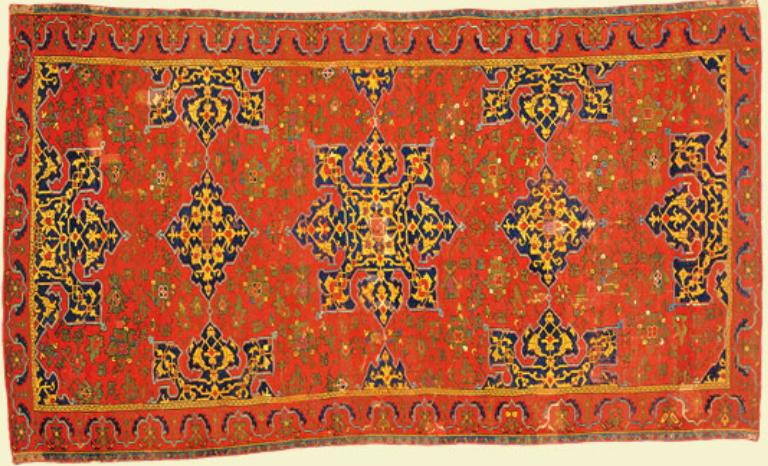
“The niche carpets were mainly rugs destined for Muslim prayers, which explains the inclusion of the directional niche (mihrab) in their centre sometimes with a pendulum of light hanging from its arch. This development is a clear sign that the Muslim artist develops his themes from religious as well as natural sources.” 
Image: A star-Ushak carpet from west-central Anatolia, dated to the late 16th century. 

In another popular book on the history of science published in the United States in the early twentieth century W. T. Sedgwick and H. W. Tyler stated simply that “the Arabs employed the pendulum for time measurement, and tabulated specific gravities of metals, etc.”, again without citing any sources.

As far as I am aware the only other person to associate Ibn Yūnus with the pendulum in the first fifty years of this century was H. Leon, author of a non-scholarly article on the astrology of Ibn Yūnus published in 1931. Leon described Ibn Yūnus as “the inventor of the pendulum and the measurement of time by its oscillations”.

The myth of Ibn Yūnus’ invention of the pendulum might have been forgotten for all time had it not been for the publication of an Arabic book entitled Turāth al-`Arab al-`ilmi fi l-riyaḍiyāt wa-l-falak (The Scientific Heritage of the Arabs in Mathematics and Astronomy), first published in 1941 and reprinted several times since. The author, Q. H. Tuqan, presented an uncritical summary of earlier Western writings on Islamic science. The quality of the books as a whole is reflected by Tuqan’s entry on Ibn Yūnus, which translates as follows:

“Ibn Yūnus Inventor of the Pendulum

Many people think that the pendulum is an invention of the famous Italian scholar Galileo (1564-1642), and that he was the first to use it. These people would be surprised if they were told that this is not correct, and that the credit for the invention of the pendulum goes to a Muslim Arab scholar who lived in Egypt and grew up by the banks of the Nile. He used the pendulum before anyone else in striking clocks, and thus preceded Galileo in this invention by six centuries.

We should not dare to attribute this important invention to the Arabs if it were not for the acceptance of it by certain foreign scholars. If we read the History of the Arabs by the famous French scholar Sédillot we find un-equivocal evidence about the priority of the Arabs in inventing the pendulum … Likewise Taylor and Sedgwick state that the Arabs used the pendulum for measuring time. From this it is clear that the Arabs preceded Galileo in the invention of the pendulum and in using it in striking clocks.

I do not say that the Arabs formulated the laws governing the pendulum or that they expressed this in mathematical terms in the form which we know now, but I do say that they preceded Galileo in inventing and using the pendulum.

Smith says in his History of Mathematics that although the principle of the pendulum was formulated by Galileo, Kamāl al-Dīn ibn Yūnus noticed it and preceded him in knowing something about it, and that the astronomers used the pendulum for measuring time intervals during observations …”

Enough of this. Tuqan takes Smith’s Ibn Yūnus of circa 1200 and turns him into Kamāl al-Dīn Ibn Yūnus, the celebrated scholar of Baghdad (died 1242),30a but still writes of him here as the Fatimid astronomer Ibn Yūnus. However, to be on the safe side, Tuqan included the quotes about the pendulum in his article on Kamāl al-Dīn Ibn Yūnus. My translation of the relevant passage is as follows:

“Kamāl al-Dīn preceded Galileo in the knowledge of some of the laws concerning the pendulum. Smith says [sic]: “Even thought the law of the pendulum was formulated by Galileo, Kamāl al-Dīn b. Yūnus noticed something about it and preceded (Galileo). Astronomers used it to calculate time intervals during observations.”

Hence it is clear that the Arabs knew something about the laws governing the pendulum. Galileo came after them and after numerous experiments was able to discover its laws, insofar as he found that the period of oscillation depended on the length of the pendulum, and the value of the acceleration due to gravity. He formulated this in mathematical terms in an unprecedented way which widened the scope of its use and he derived therefrom significant information.”

Unfortunately several writers since Tuqan have reiterated the nonsense of Ibn Yūnus’ invention of the pendulum. For example, Dr. A. Zaki, in his book Turāth al-Qāhira al-`ilmī wa-l-fannī (Medieval Legacy of Cairo), published in Cairo in 1969, wrote (my translation):

“Ibn Yūnus preceded the Italian Galileo in the invention of the pendulum and in its use in ticking clocks.”

Likewise Dr. A. Muntasir in his book Ta’rikh al-`ilm wa-dawr al-`ulemā’ al-`Arab fī taqaddumihi (The History of Science and the Role of the Arabs in its Develop-ment), published in Cairo in 1973, wrote (my translation):

“It was he (that is, Ibn Yūnus) who invented the pendulum, thus preceding Galileo by several centuries. It (that is, the pendulum) was used to calculate time intervals during observations, as it was used in ticking clocks.”
3120787_36dd01ee

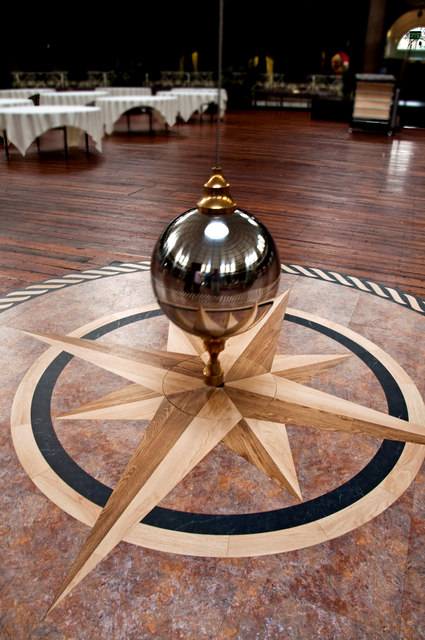
Foucalt Pendulum – Buxton

The same author made an even bolder claim in a chapter on science in a UNESCO – sponsored volume Athar al-`Arab wa-l-Islām fi l-nahḍa al-Ūrūbīya (The Influence of the Arabs and Islam on the European Renaissance) (my translation):

“Ibn Yūnus invented the pendulum and the Arabs used it in their calculations and astronomical experiments. Ibn Yūnus and Ibn Hamza take the credit for their studies of arithmetical and geometrical series: their studies had the greatest influence in laying the foundations on which were built differential and integral calculus and tables of logarithms.”

At least Ibn Yūnus wrote nothing on mathematical series. What Ibn Ḥamza (fl. Mecca, ca. 1590) wrote on series and algebraic notation was of interest but with-out any influence on the development of mathematics in the West.

Again, Dr. S. Maher, in her book on navigation in medieval Egypt published in Cairo in 1968(?), wrote (my translation):

“Enough glory to Ibn Yūnus that it was he who invented the pendulum and thus preceded Glileo in this invention by six centuries (Tuqan, p. 275).”

Tuqan’s claims for Ibn Yūnus have been repeated more recently by Dr. G. Shawqi in an article on ideas of motion in medieval Arabic sources published in 1975. Quoting in full from Tuqan the “evidence” of Sédillot, and Tyler and Sedgwick, he writes (my translation):

“The Arab scholar … Ibn Yūnus . . . is considered the inventor of the pendulum. The attribution of this invention to Ibn Yūnus … occurred in the writings of the equitable French orientalist Sedillot . . . Likewise two other orientalists (I) Tyler and Sedgwick refer to the priority of the Arabs in (the invention of) the pendulum . . . These sources show that the credit for in-venting the pendulum and using it to calculate time intervals during observations is due to the Arabs. Consequently it is inevitable that they were aware of the relations pertaining to the duration of the oscillation of the pendulum, and this was before the Italian scholar Galileo Galilei by more than six centuries.”

In a book on the Arab contribution to mechanics published just two years earlier—Shawqi made no reference whatsoever to either Ibn Yūnus or the pendulum.

In his book Science and Civilization in Islam, published in 1968, S. H. Nasr stated:

“(Ibn Yūnus) was probably the first to study the isometric oscillatory motion of a pendulum — an investigation which later led to the construction of mechanical clocks.”

In his new book, Islamic Science: an Illustrated Study, published in 1976 on the occasion of the Festival of the World of Islam in London, Nasr was able to writes:

“Ibn Yūnus was also the first person to make a serious study of the oscillatory motion of a pendulum, which finally led to the invention of the mechanical clock.”

He gives no reference for the statement, and it is sad indeed to see inaccuracies of this kind throughout a book which is likely to be widely considered as an authoritative general work on Islamic sciences.

Whilst all of these authors since Tuqan associate the invention of the pendulum with the Egyptian astronomer Ibn Yūnus, the association with the Baghdad scholar Ibn Yūnus is recorded for posterity in the article “Pendulum” by F. J. Wood in the International Edition of the Encyclopedia Americana, where we read:

“The periodic, oscillatory motion of a pendulum provides an example of the kinetic state known in physics as simple harmonic motion. This property of a pendulum, while known to the Arab Ibn Yûnis (ca. 1200), was rediscovered by Galileo …”

In 1962 there appeared in a Beirut newspaper an article about the invention of the pendulum by the scholar Kamāl al-Dīn ibn Yūnus. I have not seen this article, but following its publication the author Usama Anuti, then lecturer at the Lebanese University, decided to pursue the evidence for the invention more carefully, and in 1964 published a booklet in Arabic entitled Hal iktashafa I-‘Arab raqqāş al-sā`a? (Did the Arabs Discover the Pendulum?).

The paper consists mainly of a carefully documented account of the statements of Sédillot, Smith, and Tuqan, and includes two citations from modern popular works in which the discovery by Ibn Yūnus is stated as if it were a fact. Anuti noted that three scholars who might have been expected to know something about Ibn Yūnus, namely, Caussin de Perceval (who in 1804 published part of the introduction to Ibn Yūnus’ major work), H. Suter (who in 1900 published a list of over five hundred Muslim scientists and their works and all available manuscripts), and G. Sarton (whose monumental bibliographical work on the history of science published in 1927-48 is thought by the misinformed to be the last word on Islamic science), all made no mention of Ibn Yūnus and the pendulum. However, weighing the “evidence” presented by Sédillot, Smith, and Tuqan, Anuti came to five conclusions, of which three are relevant to the present study. A translation follows:

“Firstly, the Arabs participated in this scientific discovery, and they knew some of the laws of the pendulum and they used them in the mathematical field but not in the instrumental.

Secondly, the credit for finding its laws goes back, apparently, to Ibn Yūnus the Egyptian, not to (the Ibn Yūnus) from Mosul.
hariri-01
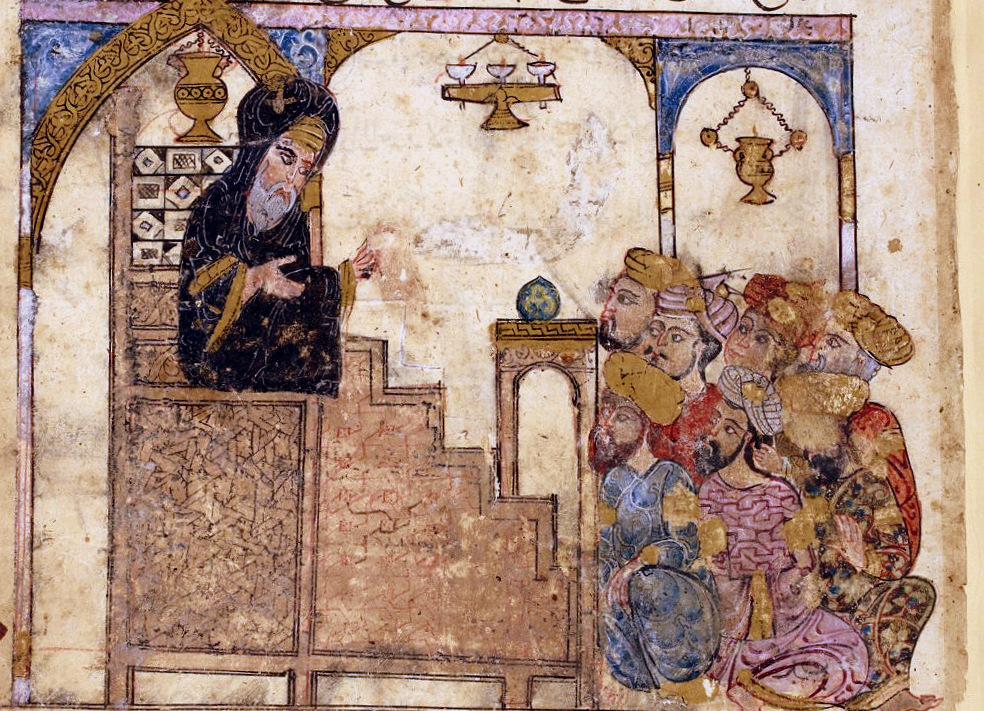
13th century illustration of a sermon in a mosque from the assemblies of Harîrî. 

Fourthly, it appears that the ancient authors of biographies attributed something due to the Egyptian to the scholar of Mosul …”

Anuti had enough of the necessary modern sources at his disposal to realise that the attribution of the discovery of the pendulum to Ibn Yūnus stood on rather insecure foundations, but at least he sorted out the problem of Kamāl al -Dīn Ibn Yūnus.

Anuti’s work has, as far as I know, been cited only once in the more recent literature. In the introduction of the photo-offset edition of the treatise on mechanical devices by the twelfth -century engineer al-Jazari published in 1977 by the Centre for the Revival of the Arab Scientific Heritage at the University of Baghdad, mention is made of the discovery of the pendulum by the Arabs47a. The editor, M. A. Shams, asserts that “the sources” state that Abū Sa`īd `Abd al-Raḥmān ibn Yūnus al-Miṣri discovered the pendulum (hereby confusing the astronomer ‘Alī ibn `Abd al-Raḥmān ibn Yūnus with his father, who was also called Ibn Yūnus!) and, quoting Anuti’s second article, not his first one (!), adds that the scholar of Mosul, Yūnus ibn Muḥammad ibn Man`a (hereby confusing Kamāl al-Din Ibn Yūnus with his father!), also “knew many things about the laws governing the oscillation of the pendulum.” Now we have three Ibn Yūnus’es and one Yūnus who are associated with the discovery of the pendulum!

After the completion of this paper Prof. Bert S. Hall of the University of Toronto showed me the proofs of a paper of his on the early history of the pendulum in Europeo[47b]. In this study Prof. Hall has devoted a paragraph to the false attribution of the invention of the pendulum to Ibn Yūnus, and has refered to the origin of the myth in the writings of Bernard, its recurrence in later European sources, and its confutation in the two articles by Wiedemann.

***

When did the pendulum became known in the Islamic world? We cannot do better than read what has been written by O. Kurz in his European Clocks and Watches in the Near East, published in 1975, on this very subject:

“Watches were not the only line English craftsmen had to offer; pendulum clocks too found a ready market in Turkey, although only at a slightly later date. With the invention of the pendulum clock in the seventeenth century precise time-keeping had at last become possible. While Europe was still discussing this amazing new invention and arguing whether the priority belonged to Galilei or to Huygens, somebody came forward with the surprising claim that the real inventors of the pendulum clock were the Arabs [footnote referring to Bernard]. The extraordinary idea that medieval Arabic clocks could have been regulated by a pendulum was widely believed [foot-note referring to von Humboldt]. E. Wiedemann has shown how the misunderstanding came about: what looked like a pendulum in the illustrations of medieval Arabic  manuscripts was in reality a plumb-line [footnote referring to Wiedemann 1 and 2].

Bringing pendulum clocks to Turkey was not as easy as it might appear. In the year 1680, not so long after the new invention had been made, the English ambassador to the Sublime Porte, Sir John Finch, thought of modernizing the traditional “gifts” by including among them a telescope and a “rare pendulum”, but as the Grand Vizier expected a large sum of money, the gifts were refused [footnote]. In 1699 a new French ambassador arrived in Istanbul. He brought with him a magnificent pendule with a dial marked à la turque destined for the Grand Vizier, and an even more magnificent one for the Sultan. But when he was about to enter the audience chamber, the proud ambassador of Louis XIV refused to give up his sword. The audience never took place, and the presents were returned to the ambassador [footnote]. In spite of these initial setbacks pendulum clocks did eventually arrive in the Saray. When a new French ambassador arrived in Turkey in 1716, he successfully delivered at the Sublime Porte une magnifique pendule for the Grand Vizier and deux magnifiques pendules for the Sultan himself [footnote].”
3831748031_9b23bf0828_z
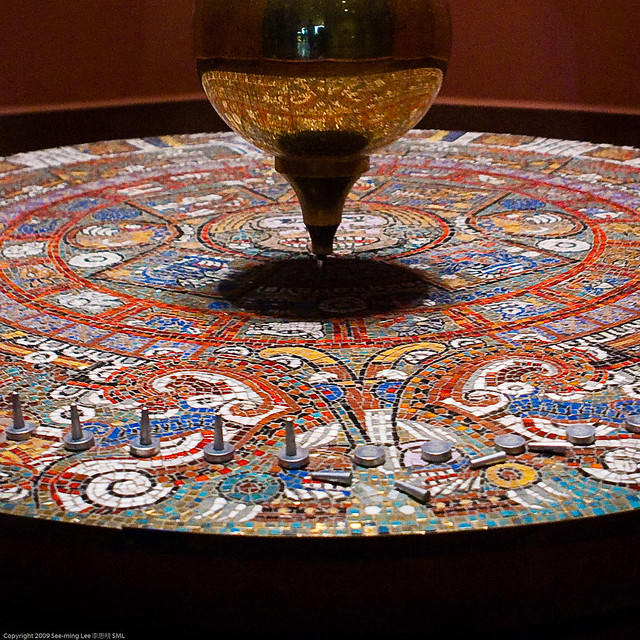
Foucault’s Pendulum + Aztec Calendar Stone.

Conclusions

In order that no confusion may arise about my own conclusions I shall summarize them as follows:

  1. The statement that the pendulum was used by the Arabs was first made by Edward Bernard (1684). It was repeated by Montucla (1804) and Laplace (1821), but Thomas Young (1809) introduced the additional fiction that Ibn Yūnus and “the other Arabian astronomers” used the pendulum. The distinguished historian of Islamic science L. A. Sédillot (1853-54) convinced himself that this was indeed the case. The American historian of mathematics Eugene Smith (1923) mentioned the attribution of the discovery to Ibn Yūnus but made a mistake about the date of Ibn Yūnus, which enabled Qadri Tuqan (1941) to introduce Kamāl al-Dīn Ibn Yūnus into the picture as well.
  2. No author from Bernard (1684) to Nasr (1976) has adduced a shred of evidence to support the claim that the pendulum was used by Ibn Yūnus or any other Muslim scholar.

***
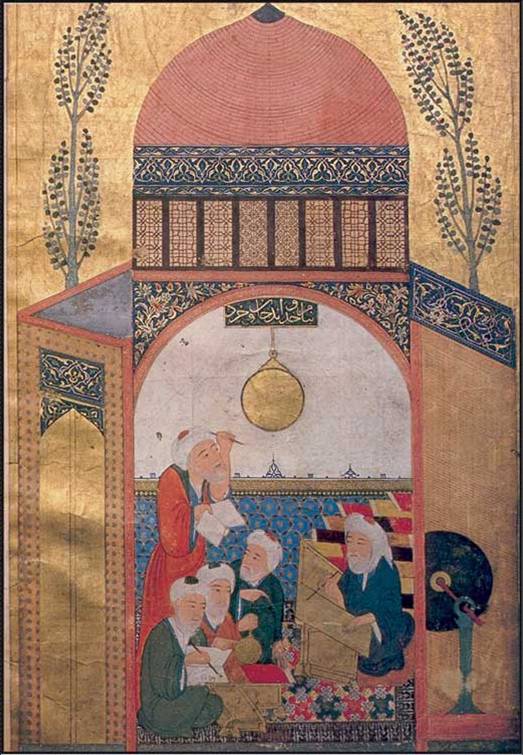
muslim_science_04

15th-century Persian miniature showing students studying astronomy with their teacher, reading measurements from an astrolabe. MS 1418, Istanbul University Library. 

The sources cited above illustrate the way in which the myth of Ibn Yūnus’ invention of the pendulum has gained acceptance in the popular literature on Islamic science. When deprived of this distinction Ibn Yūnus still ranks as one of the leading astronomers of the medieval period, and is appreciated as such by no one more than by myself.

Is there any evidence whatsoever in the manuscript sources that any medieval Muslim scholar might have been familiar with the principle of the pendulum? I have wondered for some time about the meaning of a title of a work written by the early-eleventh-century scientist al-Bīrūnī, which is listed by al-Bīrūnī in his own bibliography, published by the German orientalist C. E. Sachau in 1878 In a section on the works that he wrote specifically on timekeeping and chronology al-Bīrūnī mentions a treatise entitled Maqāla fi ta`bīr al-mīzān li-taqdīr al-azmān, literally, “Treatise describing (?) the balance for measuring the times”. The only additional information that he gives is that the treatise comprised fifteen folios. This treatise is, as far as I know, not contained in any of the several thousand Islamic scientific manuscripts preserved in the libraries of the Near East, Europe, and North America. However, in his treatise On Shadows, published in Hyderabad in 1948, al-Biruni mentions a “balance” (mīzān) for reckoning the times of the two day -time prayers, the ẓuhr and the `aṣr, which are defined in terms of shadow lengths. E. S. Kennedy, in his translation and penetrating study of this work, has reconstructed the instrument, which is simply a device for observing shadows. Also, the thirteenth-century Yemeni scholar Ibrāhīm ibn `Alī al-Aṣbahī, author of a treatise on folk astronomy and timekeeping, describes an instrument for reckoning the hours called a mīzān, which he attributes to an individual named Yaḥyā ibn Sa`īd al-Zubayrī, On whom I have no further information. The instrument is simply a gnomon divided into either six and a half or twelve units on a horizontal base on which the shadow can be measured. This mīzān also serves to regulate the ẓuhr and `aṣr prayers. Yet another example of the use of the term mīzān to refer to a device for reckoning time is the mīzān al-Fazārī, perhaps dating back to the eighth -century Baghdad astronomer al-Fazari, and known to us from a description by the thirteenth-century astronomer Abū `Alī al-Marrākushī. This instrument is an unusual variety of sundial.

Thus, in all probability, the mīzān described by al-Bīrūnī was an instrument for reckoning time by shadows, hence having nothing to do with the pendulum. In view of the lack of any evidence to the contrary, we conclude that the principle of the pendulum was unknown to the scientists of medieval Islam.

Following his unguarded remark about the invention of the pendulum, L. A. Sédillot, whose privilege it was to have access to the rich collection of Arabic scientific manuscripts in the Bibliothèque Nationale in Paris, declared53:

“Chaque jour amène quelque découverte nouvelle et vient démontrer l’extrème importance d’un examen approfondi des manuscrits de l’Orient.”

This assertion of Sédillot’s I do not contest.

The Completion of Ethics: Self-Annihilation (Fanā) Through the Lens of ʿAṭṭār

The Completion of Ethics: Self-Annihilation (Fanā) Through the Lens of ʿAṭṭār

In this chapter, using mainly a narrative poem by Farīd al-Dīn ʿAṭṭār in light of writings by other Sufi authors, we will address a concluding question: Where does virtue ethics end? From the perspective of political science, ethics begins with the individual but extends to the management and wellbeing of groups of people. It ends in a virtuous nation composed on the model of the “virtuous city” (al-madīna al-fāḍila), a community al-Fārābī tells us will best nurture virtue and ultimately true happiness in its populace.1 Muslim thinkers have had a very rich intellectual history in the contemplation of politics and social justice, so rich, in fact, that inclusion within the purview of this book would be unfeasible. From an individual’s perspective, however, the authors hitherto mentioned have indicated varying ends for their soul-perfecting programs, ends that do share at least one trait: a distancing of oneself from the body’s lower forces. Many authors we have read would take things a step further and establish as a common end a relinquishing of notions of selfhood.

  • PLOTINUS ON THE END OF ETHICS: A COMPARISON

A brief consideration of the views of the philosopher Plotinus (d. 270) on the end of ethics will help frame this discussion in a comparative context. Sufi theories of self-annihilation should not be conflated with Neoplatonism, of course. In that regard, ʿAṭṭār (like many other Sufis) could not be clearer about his disavowal of ancient philosophy as reinterpreted in Arabic:

Once the candle-of-religion has incinerated Greek wisdom

the candle-of-the-heart cannot light from such learning.

The wisdom of Medina suffices for you, o man of religion.

Cast dirt upon Greece in your care for religion.2

From ʿAṭṭār’s perspective, Greek philosophy and prophetic scriptural wisdom were at odds. In his presentation of spiritual perfection, ʿAṭṭār, like Abū Ḥāmid Ghazālī, advocated an interior journey modeled on the wisdom of Sufi masters. This was a purification of the heart, rather than learning terms and concepts that busied the mind and created doubt or false certitude without leading to the nullification of ego necessary for direct vision. Religion, in its scripture, practice, injunctions, and divine aid, gave a person all he or she would need to polish the heart’s mirror. For ʿAṭṭār, it was not cultivated reason that helped procure self-loss, but a sort of enamored “insanity.”3

Yet from the perspective of intellectual history, all branches of learning (even Sufism) were in conversation with one another. A modified version of Plotinus’s view circulated widely among Arabic-reading philosophers. Historical relevance aside, this comparison highlights resemblances between self-loss in Sufism and the ultimate aims or “ends” of Islamic philosophy, despite very significant incongruities. For Anṣārī or Rūmī, rational contemplation is an impediment; the rational soul must give way to a completely receptive, higher faculty of vision. For Avicenna, rational contemplation is the end of the soul; the soul must become an acquired intellect. Nevertheless, even for Avicenna, a person moves beyond the self and allows the soul to mirror a higher intelligence. Both frameworks might be described as sharing some similarities with Plotinus’s pattern of ascent. That pattern continues to provoke interest today, in no small part on account of a study of Plotinus by Pierre Hadot. Hadot, much like ʿAṭṭār, argues for the practicality of reorienting oneself toward a “true self,” a divinity that is both origin and aim.

Plotinus in the Enneads describes two types of virtue: civic virtues and purifications.4 As civic virtues, wisdom, courage, temperance, and justice make us reasonable and upright in our interactions with one another. As purifications, these same virtues facilitate disassociation from the body and alignment with intellect, which makes us god-like.5 The soul’s opinions become independent of those of the body. This is wisdom. The soul refuses to indulge in the body’s experiences. This is temperance. The soul loses its fear of separation from the body. This is courage. Finally, with the body’s drives neutralized, the soul is ruled by reason. This is justice.6 In presenting this model, Plotinus expands on the comments of Plato in the Theaetetus, according to which evil must always “prowl about this earth” and a person must escape it to become “as like God as possible.”7

The soul’s becoming purified means, for Plotinus, a “stripping of everything alien,” in other words, losing everything that makes a soul somehow different from the intellect, in order to allow godliness to prevail upon it.8 To achieve conformity with the intellect, a person must also become absorbed in contemplation, and not simply maintain a nullification of bodily forces.9 Ultimately, by these means, the soul loses itself in “mystical union” (henōsis) with the perfect One, although scholars of Plotinus still debate whether this means an absolute loss of identity, or some preservation of selfhood as the soul becomes lost in God.10 Plotinus describes this contact as a direct vision that transcends reason. Contact comes and goes throughout one’s life, only to become permanent when one has ceased to inhabit a body through the body’s death.11

When brought into Arabic, Plotinus’s Enneads became misattributed to Aristotle on account of a scribal misreading, as well as a tendency to imagine Platonic thought as the completion of Aristotelian thought—a tendency that Arabic-writing philosophers inherited from others.12 Yet the text received great attention. Generations of philosophers and critics of philosophy read and reinterpreted each other’s Neoplatonic thoughts, from al-Kindī, to al-Fārābī, to the Brethren of Purity, to Avicenna, to Abū Ḥāmid Ghazālī, to Ibn ʿArabī, and on and on. That which we might call “Neoplatonism” has been rethought and reconfigured so often, in fact, that concepts from it have become a thoroughly integrated “Islamic” way of thinking about the cosmos, the soul, and existence—one sometimes only faintly resembling the Plotinus strain in its DNA, especially when that strain is found in Sufism.13

  • SELF-LOSS IN A NAMED GOD

The lasting impact of the Arabic translation of Plotinus was, it seems, the fulfillment of its translator’s hopes. Peter Adamson displays the careful decisions the anonymous translator made to forge an Islamically viable Neoplatonism. Perhaps most significant for this chapter, the translator or “adaptor” of the Enneads into Arabic presents all virtue as pertaining to the intellect, for the intellect is always virtuous. Moreover, according to that translation, God is the source of virtue. This contradicts Plotinus’s clear assertion that virtues do not pertain to the intellect or that which is beyond it, since “the principles There have no need of harmony or order or arrangement.”14 Virtue is a means to achieving such harmony and hence applies only to souls in need of ordering. It is not for the intellect and that beyond it, which are undifferentiated perfection.15 In Islamic theology, however, God does indeed have attributes, which can be likened to virtues. In a sense, then, the adaptor creates an “Islamic” hierarchy of virtue, in which God’s attributes become manifest by intellect and, following that, by human imitators.16 This change is critical to the success of Neoplatonism in an Islamic theological context. It also resembles a key difference between Plotinus’s self-loss and that which will be discussed here: Many Sufi texts describe the loss of one’s attributes of selfhood not in an utterly ineffable One, but in God, that is, in the absolute whose essence is ineffable, but who becomes manifest through named attributes.

Plotinus’s higher ethics is “cathartic” because all human attributes must be lost. In becoming purified of such attributes, humans strive to become like the ultimate Good, which is undifferentiated and undefined. The Good has no attributes other than being the Good. This does have a place in Sufi thought: For a thinker such as Ibn ʿArabī (and many others), even the divine attributes are multiple and various refractions of one undifferentiated divine essence. When an attribute (such as mercy) becomes realized through that divine essence, it becomes a divine name (such as the All-Merciful). When that name becomes realized through a human servant, it becomes a virtue (human mercy, or compassion). Ultimately, a human loses qualities of human selfhood to reflect God’s names, and those names are ways in which God has disclosed His perfect undifferentiated being. In order to become truly compassionate, for example, a person must lose tendencies to be spiteful or indifferent (which result from human bodily existence). Being compassionate is not an acquisition of virtue, but a subtraction of human tendencies. This model holds true for Ibn ʿArabī, Abū Ḥāmid Ghazālī, and Najm al-Dīn Kubrā, as well as for ʿAṭṭār and other Sufi thinkers.

Yet—unlike with Plotinus—we can say that God has attributes, which are acquired by human beings. Why the difference? It would seem that, at least according to Ibn ʿArabī, the difference lies in revelation:

If we were left only the intellectual proofs used by rationalists in knowing the divine essence—that it is not such-and-such and not such-and-such—no created thing would love him. But when the divine reports came, in the languages of religious law, telling us that he is such-and-such and is such-and-such, in matters the outer senses of which contradict rational proofs, we loved him for the sake of these positive attributes.17

God does not only have negative attributes (al-ṣifāt al-salbiyya), such as incorporeality and dissimilarity to all things, but also positive ones (al-ṣifāt al-thubūtiyya), such as life, knowledge, power, will, sight, hearing, and speech.18 Reason knows that God must be above all things, even attributes, and so tells us of a deity of transcendence (tanzīh). Conversely, the heart—emboldened by God’s own words in revelation—loves a deity of immanence (tashbīh). Can God be All-Seeing, when sight as we know it utilizes eyes? Reason immediately enters the scene and begins to negate: God’s seeing does not make use of eyes, nor does it involve the reflection of light, nor is it separate from the very existence of all things. And yet I know that the deity I love can see me. Moreover, when, having traversed stage after stage and practice after practice, I lose myself in constant remembrance of God, I know—according to a hadith—that God becomes my sight.19

This emphasis on knowing and personifying God’s names permeates Sufi ethical writings. In the context of Ibn ʿArabī, for example, William Chittick has discussed ways in which such a “theomorphic ethics,” one “identical with the spiritual path of the Sufis,” encourages the aspirant to assume the character traits of God (takhalluq bi-akhlāq Allāh), or, in different terms, “[to] assum[e] the traits of God’s names.”20 I have kept this discussion of assuming the traits of God’s names brief, in fear of veering into engrossingly complex theological issues, but one example from the writings of Ghazālī merits mention. Abū Ḥāmid Ghazālī frequently champions a theomorphic ethics of God’s names throughout his writings, but undoubtedly the clearest case is The Most Resplendent Objective in Explanation of the Meanings of God’s Most Beautiful Names (al-Maqṣad al-Asnā  Sharḥ Maʿānī Asmāʾ Allah al-Ḥusnā), which has been translated into English.21

Here Ghazālī describes how a person might realize—in a human, servant-like, and imperfect way—each of God’s ninety-nine names listed as an elaboration of a famous hadith.22 Some, such as “the Gracious” (al-Laṭīf), seem straightforward enough: A person should be kind and accommodating in his or her inviting others to God, just as God brings out beauty and order in a cosmos inclined toward decay, from which humans benefit and should be guided to Him.23 Others, such as “the Subduer” (al-Qahhār), need more thought before they can be applied to human actions. This name indicates the power that God has over all things, which becomes especially evident when arrogant humans oppose him. A human makes manifest this attribute when he or she subdues the human being’s foremost enemy, which is the lower soul (nafs) and its concomitant desires that lead to sin; this should be followed by subduing the body entirely to bring the spirit to life.24 To give one last example, “the One” (al-Wāḥid) points to God’s unity, indivisibility, and dissimilarity to all things. This name applies to a human who excels all other humans in some desirable trait (khaṣla), in some form of knowledge, or virtue, even though human preeminence is entirely relative. That is, a person is not absolutely preeminent for being good, virtuous, or knowledgeable in the sense that these things emanate from her, but instead preeminent relative to those in her species and the time in which she lives.25

When seen in this way, a person acquires a series of virtues reflective of God’s names. But, from another perspective, that person does not acquire attributes but negates his or her own, learning to see the falsity of his or her own selfhood. Ghazālī clarifies this in his analysis of the name Allāh, the name of God that comprehends not only all of His beautiful names, but also all things in existence:

It befits the servant for his portion of this name [Allāh] to become God-like (al-taʾalluh). I mean that one’s heart and determination become drowned in Allah, Exalted and Glorified, so that one sees none other than Him, pays attention to none other than Him, hopes in none other than Him, and fears none other than Him. How could it be otherwise when this name brings us to understand that He is the one true and real existent, and all other than Him is undergoing annihilation, perishing, and false—except through Him? Thus, to begin with, [the aspirant] sees his own soul as that which is the foremost of all that is perishing and false.26

Ghazālī is careful not to delve too deeply into this matter in his treatise. Its depths point to “secrets” like “an abyss in an ocean without shore,” secrets that begin by knowing that God knows Himself through our knowing Him, that God is the real Actor behind everything.27 It is for this reason, Ghazālī implies, that God declares to Muhammad in the Qurʾan that “you did not throw when you threw, but God threw” (Q 8:17). If one comes to realize this and to perceive that the self lacks actuality, and if that realization becomes so constant that a person’s sense of selfhood disappears, then that is annihilation (fanāʾ).

  • ANNIHILATION IN GOD AND SUBSISTENCE THROUGH GOD

Self-annihilation or simply “annihilation” (or “annihilation in God”) is a specific and technical term in Sufism, at variance with simply a general sense of losing one’s attributes of selfhood, which I have been calling “self-loss.” While self-loss might be applied to all the ways in which a person loses his or her own traits and sense of self in approaching God through His attributes, annihilation marks some completion of this process. It can be not only a stage in the path, but also a matter of perception, a realization. Complementary to annihilation is the phenomenon of “subsistence (baqāʾ) through God.” Subsistence occurs after annihilation. Through subsistence, the self-annihilated person engages with creation, living among others and interacting with them. He or she does so through acquired divine attributes, even as if through God, now that his or her “blameworthy attributes” have passed away.28 For most Sufi writers, this process means leaving behind states and stations.29 Beyond this, a person becomes annihilated from his or her own annihilation, inattentive even to her own situation as one annihilated and as close to projecting God’s own actions as a human being can be.30

allah-the-generous-oneEven though subsistence is the completion of annihilation, Sufi writings often refer to the entire process as “annihilation,” a practice that I have taken up in this chapter. In a technical sense, annihilation and subsistence are indeed separate, and subsistence is the superior achievement. Nevertheless, these two modes of being and awareness come as a pair. Although they often (but not always) occur in succession, they are always complementary—two sides of one coin, so to speak. ʿAṭṭār, for example, describes subsistence (baqā) as the completion of self-annihilation, or becoming “annihilated from annihilation” (fanā az fanā).31 Once one loses one’s awareness of being annihilated, then one has achieved subsistence. Some sayings describe the relationship between subsistence and annihilation as a matter of perspective. “Subsistence belongs to the Real,” al-Junayd says (according to ʿAṭṭār), “and annihilation belongs to other-than-the-Real.”32 As the servant disappears, the Real takes the servant’s place. Annihilation means that the servant’s illusion of identity is effaced, while the servant’s subsistence through God means that the Real’s presence is affirmed.
It would be simplistic to suppose that self-annihilation and subsistence through God are the “end” for all Sufi ethicists. Anṣārī, for example, includes seven waystations after annihilation and subsistence. Despite this, the concluding waystations share qualities of self-loss with annihilation, in that they are increasingly complete realizations of self-nothingness and God-everythingness that culminate in a realization of divine unity (tawḥīd), the final waystation. For Najm al-Dīn Kubrā, the tenth and final “principle” of spiritual perfection is complete satisfaction (al-riḍā) with God. This means satisfaction with His determinations and decrees, with intimacy with Him as well as the distance He might take from His lovers, and with all that which comes from Him, which is everything. Yet satisfaction—along with his other ten principles of seeking nearness to God—is but one facet of a comprehensive virtue, the virtue of all virtues, something Kubrā and others have labeled “volitional death” (al-mawt bi-l-irāda). Kubrā himself draws a parallel between volitional death and annihilation (fanāʾ).33 The terminus of the path for Kubrā is for a person to “die” from human attributes only to be given life through divine attributes.34 Thus, even if in a technical sense self-annihilation is not always the final virtuous achievement, the phenomenon of self-loss certainly informs the final stages of most Sufi progressions of virtue. The overarching and broader topic of “self-loss” will allow us to explore annihilation in the context of other related endings for the soul, namely love, unification, and the oneness of God.

  • ʿAṬṬĀR AND THE LANGUAGE OF THE BIRDS TOPOS

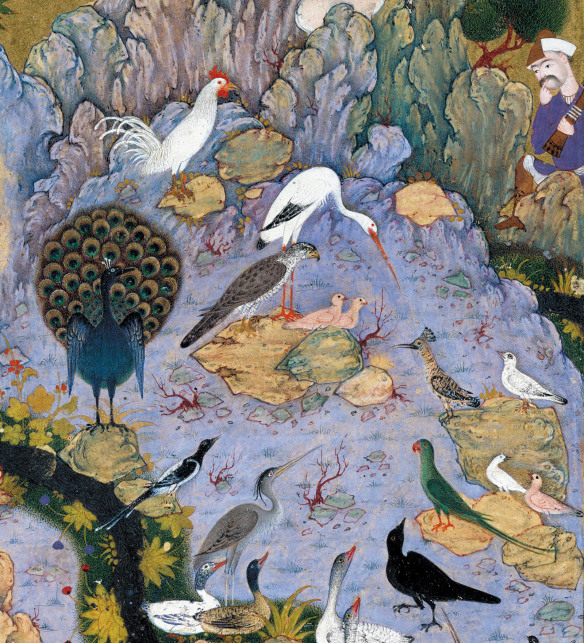
‘The Conference of the Birds’; detail of an illustration by Habiballah of Sava from a Persian manuscript of the poem by Farid ud-Din Attar, circa 1600

I have cast a net throughout this chapter wider than in previous chapters, allowing numerous Sufi voices to define the themes and terms that surround the concept of self-annihilation. This is because self-annihilation, as a concept, eludes definition. To get even a somewhat satisfactory picture, it helps to approach the concept from many perspectives. Nevertheless, the unifying text in this chapter is Farīd al-Dīn Muḥammad ibn Ibrāhīm ʿAṭṭār’s (d. 1221) long narrative poem, The Language of the Birds (Manṭiq al-Ṭayr), also titled The Stations of the Birds (Maqāmāt al-Ṭuyūr). From an allegorical perspective, arguably no other work better captures the trials, pains, and ultimate fulfillment involved in annihilating one’s ego-self.

Very little is known of ʿAṭṭār’s biography. ʿAṭṭār was his penname and he was an apothecary. No one can be certain that ʿAṭṭār even had a Sufi master, although he has been spuriously associated with the “saint-maker” Najm al-Dīn Kubrā and, more possibly, with Kubrā’s student, Majd al-Dīn al-Baghdādī (d. 1219).35 ʿAṭṭār spent his long life in the vicinity of Nishapur, in the northeast of modern Iran, which meant that his homeland was in the first wave of Muslim-ruled cities to be ravaged by the invading Mongols, who took the poet’s life.36 He does not feature in any Sufi initiatic lines, leaving instead a legacy of influence in the development of Sufi Persian poetry and Sufi symbols that is perhaps unmatched by any. Indeed, throughout his life, ʿAṭṭār seems to have been especially drawn to books by and about Sufis, as well as poetry with Sufi themes.37

His interest in what might be called “literary Sufism” resulted in several long, didactic, narrative poems, as well as a dīwān or collection of mostly love poems, a collection of four-line (rubāʿī) poems called The Book of Selections (Mukhtār-nāma), and The Memorial of the Saints (Tadhkirat al-Awliyāʾ), an account in prose of the lives of Sufi predecessors. A number of works are falsely attributed to him. The four longer narrative poetic works that are verified as his are The Divine Book (Ilāhī-nāma), a book about renunciation, in which a king asks his six sons about their deepest desires, in order to teach them the shortsighted folly of longing for worldly pleasures or power;38 The Language of the Birds, discussed here; The Book of Affliction (Muṣībat-nāma), in which a wayfarer led by his master seeks deliverance from the suffering within himself by interviewing all the major entities in creation, including the angels, the divine throne, hell, humans, animals, and the inner psychological faculties, until he discovers that the answer lies in the ocean of his own spirit; and The Book of Secrets (Asrār-nāma), which is a collection of stories on Sufi themes not held together by any ostensible frame narrative.

The Language of the Birds is ʿAṭṭār’s most treasured contribution to world literature. It not only left an enduring mark on Rūmī and other Persian poets, but became a valued text in the Ottoman and Mughal courts, and was translated into Turkish and Dakkani, eventually making its way into European languages as well.39 The text has received the attention of a number of English translators, most recently Peter Avery.40 Other works of ʿAṭṭār also display his masterful poetic abilities of narrative and dialogue. Two have frame-tale structures, a trend that began in Persian literature after exposure to the Indian frame-tale, via Kalīla and Dimna, as mentioned earlier. Yet The Language of the Birds enjoys a certain frame-tale structure that harmonizes perfectly with the central theme of ʿAṭṭār’s writings, the plight of the soul to find union with God and achieve self-realization in self-annihilation. The framing narrative (a flight of birds resembling the Prophet Muhammad’s heavenly ascent) was not new, despite ʿAṭṭār’s ingenuous use of it.41

  • THE NARRATIVE OF THE LANGUAGE OF THE BIRDS: FINDING THE SĪMURGH WITHIN

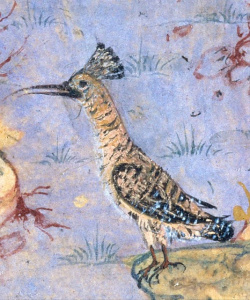
Like many before him who told this story, ʿAṭṭār begins the narrative with the problem of birds in need of a king. One bird, the hoopoe (hudhud), enters the congregation to announce a resolution: There is a monarch of a bird who is eternal, light-giving, omnipresent, and the source of all other beings and traces. That bird is the Sīmurgh, a colossal bird with feathers of restorative power. The hoopoe declares this with authority because he has—according to the Qurʾan—spoken with King Solomon and served him (Q 27:20–8), and is thus initiated into the divine secrets and able to serve as a guide to others. The Sīmurgh’s habitation is dauntingly far. He lives upon Mount Qāf, which, according to medieval Islamic geographical accounts, surrounds the oceans and the earth. It is made of emerald, or at least situated upon emerald, and it gives stability to the earth it encompasses. Inaccessibility is this mountain’s identifying trait.42

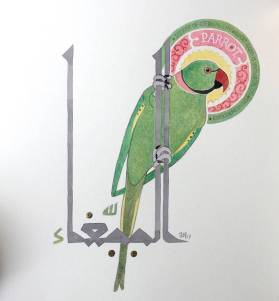
The birds meet to head out. The uninitiated birds are of manifold types, representing the varieties of souls, each with his or her own peculiar set of strengths and weaknesses, weaknesses that affect adversely the bird-soul’s ability to set out toward the king. The nightingale has a beautiful song, through which he expresses his undying love for the rose. Yet his fixation with the rose’s beauty—a metaphor for those absorbed in beautiful forms who do not proceed to meaning—keeps him from redirecting his attention to the Sīmurgh. The parrot’s fixation is on eternal life, and thus he suffers from the cowardice of all those afraid to lose their lives, whether on a journey or in other domains of risk. The peacock was once a bird of heavenly paradise, and his sole occupation now is a desire to return. Like those who see religion as a business transaction through which they can acquire otherworldly rewards, the peacock directs his concern toward paradise and not God, the source of paradise. The duck is obsessed with washing, much like those pietistic Muslims often consumed by the formalities of ritual, including ablutions. The partridge represents those who love wealth, on account of the bird’s association with colorful jewel-like stones.43 According to Persian legend, the humāy-bird’s shadow indicated that someone would become a ruler; thus, the humāy—here a self-absorbed ascetic—imagines that the Sīmurgh should come to him for investiture of the crown, a case of arrogance. The falcon represents the love of rank, since he has ready access to the arm of the king, who uses the bird to hunt. The heron, whose name ( tīmār) can mean “father of sadness,” suffers from melancholy. He cannot fathom anything but wallowing in his sadness by the sea, staring out into the dark water which—the heron fears—will lessen and lose its grandeur if he were to drink any, keeping him thirsty.44 The owl’s love of wealth, unlike the more mercantile partridge who traverses mountain tops for gems, resembles that of misers and hoarders; he occupies the ruins guarding treasure, unable to progress out of fear of losing what he has.45 The frail sparrow asks to be excused on account of his weakness, representing all those of insufficient spiritual ambition, those who cannot see the capacity for knowing God within themselves and deem themselves morally weak.

ca247d8add96f3e3193f29f3c3035fffThe hoopoe kindles their aspirations by telling them about a revered elderly Sufi master, the Shaykh of Ṣanʿān, who fell madly in love with a young Christian. For her, he was willing to lose his saintly reputation, religion, friends, and salvation in the afterlife. He came back to God with an awareness that only the lover—willing to sacrifice everything and claiming nothing for himself—has the sincerity needed to escape the fetters of selfhood and know God. Thus inspired, the birds set out. Story after story ensues, as the hoopoe leads them along the arduous journey to the Sīmurgh. As doubts and confessions of ethical shortcomings arise, the hoopoe uses storytelling as counsel. The group must make it past seven valleys before arriving: the valley of seeking (ṭalab), the valley of passionate love (ʿishq), the valley of intimate knowledge (maʿrifat), the valley of independence (istighnā), the valley of declaring oneness (tawḥīd), the valley of perplexity (ḥayrat), and lastly the valley of poverty and annihilation (faqr and fanā). Few make it. Some drown, others die of thirst, or of exposure to the elements, predators, or each other; others become too tired or distracted to continue. In the end, only “one out of every thousand arrives,” that is, only “thirty individuals, no wing or feather, suffering and enfeebled / broken of heart, nothing left but soul, infirm of body.”46
The thirty remaining birds finally catch a glimpse of the Sīmurgh, “surpassing the perception of intellect or intimate knowing,” which causes them to become paralyzed in bewilderment.47 At first, they are rejected—a theme encountered in Aḥmad Ghazālī’s (d. 1126) version of this tale as well. The herald of arms (chāwush) advises them to return from whence they came, since the king does not need them, and their pursuit will only bring them pain. They become despondent, but then present a tale they had heard earlier, one of the moth’s willful annihilation in the flames of its beloved candle. While everyone had deemed the moth too weak, it had no choice but to throw itself into the flame. This realization changes things: Curtains of separation are lifted, and they see the world unveiled and illuminated. They are presented with a written statement that describes their every living deed, so that they realize the treacheries they used to commit against their own souls. The shame and agitation they undergo on account of this document finishes things off for them. Freed from life and body, they are “purified from the all of the all.”48 They regain life through the light of the Presence and encounter the Sīmurgh.

ʿAṭṭār describes meeting the Sīmurgh as a vision of mirror-like reflection, imagery that we have come upon throughout this book. The birds look closer at this “reflection of the face of the Sīmurgh of the world” and notice that the Sīmurgh is none other than themselves.49 ʿAṭṭār accomplishes this mirroring through language, in one of the most celebrated puns in Persian literary history: The Sīmurgh is really  murgh, since  means “thirty” and murgh means “birds.”50 This identification of the thirty birds with Sīmurgh causes the birds to “drown in bewilderment” so that “without the ability to contemplate they remained in contemplation.”51 Confused, they ask about this mystery:

Since their state was that they knew nothing from nothing

they asked, without verbal utterance, a question of that Presence.

They sought unveiling for this mighty enigma

a solution for this problem of we-ness and you-ness.

Without verbal utterance came speech from that Presence:

“This Presence so like the sun’s rays is a mirror;

anyone who approaches sees himself in it,

soul-and-body one comes to see soul and body in it.

Since you arrived at this place as thirty birds

you became manifest as thirty in this mirror.

If you were to come back as forty or fifty birds

in similar fashion you’d lift the curtain from yourselves.”52

For the birds, their annihilation bestows on them eternal greatness and the qualities of the Sīmurgh: “Erased in Him, in the end, they became forever— / shadow was lost in sun, and so in peace goodbye.”53 Having no identities of their own, they then acquire a new sort of identity. After the completion of their annihilation, a process that is both instantaneous and takes one hundred thousand centuries, the birds “regain selfhood” in that they find themselves in subsistence (baqā).54 In other words, they find new existence in the king, after having lost their own existence. The story then ends with ʿAṭṭār’s final thoughts on self-annihilation, authorship, and ethical injunctions for undertaking such changes within oneself.

additional_b5376acf03ef954ef692edf9f3f6caea99822648-8


  • LOVE, SELF-ANNIHILATION, AND THE PAINS OF SEPARATION

At a point before the birds’ complete annihilation in the Sīmurgh, ʿAṭṭār describes self-annihilation in terms of love. The poet calls his audience to become lovers who have no concern with their own wellbeing or with matters of good and evil. “Annihilation in passionate love” is to be so absorbed in the beloved that everything else falls away:

Once your interior becomes unified in self-loss (bī-khudī)

you’ll relinquish determinations of “good” and “bad.”

Once good and bad do not remain, you’ll be a lover—

then you’ll be worthy of annihilation in passionate love (fanā-yi ʿishq).55

ʿAṭṭār is not advocating the abandonment of all morality, or even the abandonment of religion—not necessarily. Rather, the true lover has no regard for social reputation or otherworldly reward. The lover’s only care is the beloved. This might indeed involve a disregard for determinations of right and wrong or good and bad, but not a disregard for the will of the beloved. When the beloved is God, and God commands righteous action, the lover will not become a wrongdoer. ʿAṭṭār’s point is that annihilation occurs in love, and absolute love is no holds barred. A lover must be willing to risk all in order to reach union with and annihilation in the beloved.

ʿAṭṭār illustrates this by describing a tale of moths and a candle, a common metaphor for self-annihilation in Sufi literature that can be traced to Ḥusayn ibn Manṣūr al-Ḥallāj.56 Moths, drawn to sources of light, try to learn about a candle; one moth is willing to look from a distance, while another is willing to get closer. Neither of them hits the mark. Only the moth intoxicated in love, willing to risk all and burn in the flame of the beloved candle “from head to toe,” exemplifies the perfected knower.57

Here we have reached a very fine distinction. Complete self-annihilation would not best be described in terms of a suffering sort of love. The seeker and the sought are so united in complete self-annihilation that any distinction between them that would cause longing or pain has disappeared. Yet annihilation in the Real need not always be so complete or so perpetual. A person can claim annihilation of selfhood but still be an afflicted lover, yearning and suffering for the divine beloved or perhaps for the completion of his annihilation. In his extensive study of love in early Islamic texts, Divine Love, William Chittick considers the problem of unification and love, a problem also debated by those who study the ambiguous writings of Plotinus.58 As Chittick indicates, in the Islamic context, complexities surrounding identity, love, and pain undergo commentary in the Epiphanies (Sawāniḥ) of the great Sufi theorist on love in Persian, Aḥmad Ghazālī, brother to the Ghazālī of Chapter Three. Aḥmad proclaims that the entire purpose of stripping down one’s identity is to arrive at the purest form of love.59 Suffering is part of the process: It makes one’s ego as emaciated as a hair, until the lover disappears and becomes a hair in the beloved’s tress.60 Love wears away at duality until there is no lover and beloved left—only love itself.61 Thus, if the essence of the Real is Love, then annihilation in love is indeed annihilation in the Real. Chittick considers this as a topic under the rubric of asserting God’s unity (tawḥīd), which I will address in the next segment. His own discussion of the lover’s “nonbeing in tawḥīd,” however, indicates that—upon whichever term one chooses to focus—the ends of love in Islamic thought, which are also the ends of Sufi virtue ethics, concern self-loss.62

Not all forms of love in Islamic thought require self-loss. The Qurʾan describes healthy love between individuals and selfless altruism inspired by love (Q 30:21, 76:8, and 59:9). The theme of a more sober sort of love for God can be found in the Qurʾan too (Q 3:31 and 2:165). Yet these are preliminary sorts of love in the model offered by ʿAṭṭār and others. A poem attributed to one of the most revered figures in ʿAṭṭār’s thought—al-Ḥallāj—illustrates the annihilating sort of love, the same love described by ʿAṭṭār and Aḥmad Ghazālī. It begins with a call the pilgrim makes on the Hajj, a visitation to Mecca and its environs accompanied by certain rites. The call, labbayk, means something like “Here I am, at your service.” Labbayk is a testimony to the pilgrim’s abandoning absolutely everything in the service of God, who called out to the pilgrim’s soul long before he could respond to the invitation:

LabbaykLabbayk! O my secret and my secret conversation!

LabbaykLabbayk! O my intention and my meaning!

I called on you, no, you called me to you; so did

I cry out to you, or did you cry out to me?

O source of the source of my being, o utmost of my endeavors!

O my speech! My expressions! and my gestures!

O all of all of me and o my hearing! and o my sight!

O my whole and my divisions and the parts that make me up.

O all of all of me, and all of the all is perplexing,

and all of all of you is worn garb-like in my meaning.

O you to whom my spirit was bound and became destroyed

in ecstasy, such that I am hostage to my desires.

I weep out of grief for my disunion from my homeland

undertaken voluntarily. Even my enemies are wailing in sympathy with me.

I draw near, but my fear banishes me;

and a yearning that has settled in the hidden depths of my stomach disturbs me.

So what should I do in a vast expanse to which I’ve been consigned?

My master, the doctors have grown weary of my sickness!

They say: Cure him of it. I say to them,

People! Will you treat this disease with a disease?!

My love for my master weakens me and makes me sick,

So how can I complain to my master? My master!

Truly I look at him and the heart knows him.

So what can interpret him other than my gesticulations?

Woe unto my spirit for my spirit and what a pity for me

about me, for I am the source of my own calamity.

It is as if I am drowning, when his fingertips appear

to come to my aid, while he too is in an ocean of water.

There is no one who knows what I’ve endured

except for the one who alighted from me in my heart’s innermost blood.

That is the one who knows the prolonged illness I’ve undergone.

And in his wish is my death and my revival.

O extremity of what is sought! and what is hoped for! o my haven!

o life of my spirit and o my religion and my worldliness!

Say to me: I have freed you by ransom. O my hearing and sight!

Why be so obstinate in my distance and remoteness?

Even if you are hidden from my eye, enveloped in veils,

the heart will guard over you when in exile and far away.63

malhallaj_1422704466_280By beginning his poem with the famous pilgrimage cry, al-Ḥallāj might be said to interpret it; it is as if the word labbayk really means all that is said in this poem. Yet this interpretation goes so far beyond mere submission to God and so far beyond a healthy love for God that it becomes almost blasphemous. God constitutes the lover in all the lover’s divisions as well as the lover’s whole—God and al-Ḥallāj are seemingly one. This claim has led to some controversy and even, according to narratives surrounding the poet, to al-Ḥallāj’s execution. While historical evidence suggests otherwise, al-Ḥallāj became renowned in Sufi literature for having blasphemously proclaimed, “I am the Real.”64 Were this poem alone to be used as evidence, there might be some indication of heresy, particularly in the line “except for the one who alighted from me in my heart’s innermost blood.” The word that the poet uses (ḥalla, “to alight”) can mean “incarnation” (usually in the gerund form ḥulūl), in which divinity enters one body or person to the exclusion of others. In prevailing Islamic theological views, since God is self-sufficient, He cannot occupy a space, person, essence, or soul as opposed to another—since such would mean having a relationship of reliance on that entity. ʿAṭṭār and other Sufi writers have read al-Ḥallāj not as an advocate of ḥulūl or another heresy called “union” (ittiḥād), but rather self-annihilation. Unlike those concepts, self-annihilation is complete immersion in the realization that when “all” becomes purified of otherness, then God is all.65 The poet, in such a reading, sees that the barriers that create his identity—the barriers between God and other-than-God—are illusory. That does not mean that he limits God to one particular body, namely, his own.
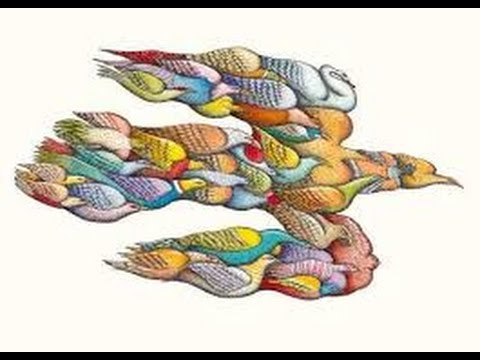

The lover cries out on account of two things: his absolute absorption in the love of God, and a complementary sense of distance that causes pain and crying out. Annihilation in love is, therefore, both a state of self-loss and an agonizing process of further self-loss. Of course, the doctors—who represent rational individuals with tempered devotion to God—see al-Ḥallāj’s illness as an illness. The only way to cure the speaker of this poem would be to bring him out of this state of total absorption in the love of God, to have him accept the lie that there is something else out there worthy of attention. Then he would become “sick” like everyone else. His sickness is awareness. How could one trade in awareness for ignorance? Only lovers understand what it means to be trapped between torture and desire, between unity and separation. Others do not. The American songwriter Prince (d. 2016) has the lover say of the doctor trying to cure his lovesickness, “but he’s a fool.”66 Were Prince’s words to be applied to the source of beauty and perfection, instead of merely a human beloved, they would befit the knower of God.

The speaker describes, moreover, a love that seems to preexist him. He wonders who called out to whom: Did he cast the first glance, or had the beloved peeked coyly at him before he realized it? The speaker describes a homeland from which he has wandered and become lost, and his longing for return causes him to weep. That homeland is a knowledge of God that preexisted earthly life, a knowledge so intimate that one might call it a union with God that every soul enjoyed before coming into creation. This tells us something else of great importance regarding love of God, namely that it is innate and eternal, preceding the soul’s existence on earth. God, for al-Ḥallāj and many other Muslim thinkers, is to be remembered and rediscovered as God, not learned about anew. In this too there is a resemblance to Plotinus’s thought.67 According to a common reading of a Qurʾanic verse (Q 30:30), God created humans with an innate knowledge of Him (fiṭra), a knowledge that was instilled permanently within our souls—according to Abū Ḥāmid Ghazālī, to give one example—when we took a pre-eternal covenant mentioned in the Qurʾan (Q 7:172).68 In terms of love, this means that we are destined to yearn constantly, to long for somewhere we vaguely remember. The more we remember, the more nostalgic we become, and the more such longing hurts. Another Sufi poet, ʿUmar ibn al-Fārid. (d. 1235), proclaims his longing candidly:

O garden from which the soul separated under duress!

Were it not for the solace of the eternal realm, I’d die from grief.69

In other words, were it not for the fact that I will be reunited with You after death, this pain of separation would be unbearable, even deadly. This love is not only intense, it is haunting, like a remembered experience so simple and idealized, yet distant. Like bonds formed in childhood, this love calls a person back to his or her origins, erasing everything acquired since those origins. Thus the movement toward self-annihilation often involves a realization that God is the one original source of perfection and the one true object of love. If “there is no god but God,” then in fact “there is no beloved but God.” Being occupied with this divine beloved brings one to the peaks of ethical perfection, because one’s many lower desires become replaced by a singular desire to return to Him.

As one can see from al-Ḥallāj’s poem, the central problem in loving God is that the process of absorption in the divine beloved lacks absolute completion. The lover draws near, seems to disappear, but then reappears and suffers because of the distance involved. This causes pain. The metaphor of the moth consumed by flame conveys the pains involved in the process of annihilation in love; the moth suffers, burns, and disappears, but is still not one with the candle. Yet the most pervasive metaphor in Sufi literature (Persian and Arabic alike) for the pains of losing oneself in an unreachable divinity is the love of one human for another. A human beloved can be coy, uninterested, capricious, and yet the uniqueness of that beautiful beloved keeps the lover entranced. Analogously, the Real can hide from His lovers, cause hearts to be deprived of a sense of proximity, and seem infinitely distant even to those who have spent a lifetime drawing near to Him. It is for this reason that ʿAṭṭār follows the story of the incinerated moth with a story about a beggar who is tortured by inverted hanging for his infatuation with a beautiful prince. Even when faced with execution, he only desires to gaze upon the prince’s face. After being pardoned, the beggar beholds the prince one last time and gives up his life:

Once union with his darling became a fact,

he became completely annihilated and nonexistent.

The wayfarers know, while on the battlefield of pain,

that which annihilation-in-love has done to men.70

There is a sense of shared suffering in ʿAṭṭār’s phrase “wayfarers know.” Only wayfarers and lovers can understand this peculiar agony. Reflection upon the pains of separation is supposed to create this sense of empathy and even ecstasy within the reader, one objective of Sufi recitals of erotic poetry. Reciting and commenting on erotic poetry or love poetry—far from being a pastime or a form of expression—was and still is a self-perfecting practice in Sufi circles.71 For many this is because one type of love (human-to-human) resembles the other (human-to-divine) so perfectly. Yet for ʿAṭṭār and other Sufi thinkers, it is not merely a matter of resemblance: Losing oneself in human-to-human love could also be a mode of preparation or even a means for losing oneself in the love of God.72

  • A RETURN TO THE BEGINNING OF THINGS: TAWḤĪD AND SELF-ANNIHILATION

Among the valleys that the birds must traverse to reach the final valley of “poverty and annihilation” is that of tawḥīd, which means “to make one,” or, in this case, “to declare or recognize God’s oneness.” It is Islam’s central belief. While one might suppose that tawḥīd is a precursor to self-annihilation, it is more accurate to consider it a quality, a composite quality, needed for one to annihilate the self and subsist in the Real. Tawḥīd is, then, not only among the final stages of the soul’s perfection, but also a necessary and inherent part of self-annihilation.

hqdefault

To some readers, this might seem strange, since tawḥīd seems to be a rather basic theological doctrine. It is the most initial declaration of God’s oneness one makes as a Muslim: There is no god but God. Yet this is the ironic discovery of the journey exemplified in ʿAṭṭār’s “thirty birds” pun. One arrives at the place where one began. For ʿAṭṭār that place of arrival is the spirit, from which human existence begins and to which the wayfarer returns. ʿAbdallāh Anṣārī spells this out even more explicitly in the final waystation of the Waystations, wherein everything ends at the very beginning: The hundredth waystation is tawḥīd, namely, declaring God’s oneness. While tawḥīd has profound implications for the spiritual elite, for “the common”—says Anṣārī—tawḥīd means simply rejecting all forms of idolatry, polytheism, and false notions about God, such as the possibility of God’s having children.

In the beginnings of Islam, by calling his followers to the worship of the god worshipped by Biblical prophets, Muhammad was also calling his people toward the self-restraint, mercy, justice, and consistency of those who observed God’s revealed law, namely, the Jews and Christians. In this way, the theological declaration of tawḥīd had ethical dimensions. The ethical implications of the statement “there is no god but God” become fully realized in the many waystations and virtues leading to self-annihilation. Tawḥīd begins with obedience, but becomes realized as a constant inner state that affects all of one’s actions. In terms of basic obedience, the Qurʾan mentions that a hazardous object of worship is one’s own desire: “Have you seen the one who has taken his whimsical desire as his god? Will you be an advocate for such a person?” (Q 25:43). The person who follows his or her desires becomes progressively engulfed by those desires. Then, that person cannot think rationally about his or her long-term wellbeing or about the intangible meanings behind creation. The call of the Prophet seems nonsensical to such a person, like the call of a concerned loved one to an adolescent experimenting with drugs, unable to imagine addiction and a decline in health. Instead, their slave-like absorption in desires makes them incognizant of everything that should matter (Q 45:23).

Yet the implications of God’s oneness and recognition of it go far beyond this, and the highest achievements of vision and perfection are inseparable from this most basic theological doctrine. For example, two different discussions of tawḥīd unfold in one of the most famous manuals on Sufism, that written by Abū al-Qāsim al-Qushayrī. The author first establishes that the masters of this path have proper beliefs about God’s essence and attributes: God is unlike anything in creation; He precedes time itself, and no word can describe Him, since He Himself created words.73 People of the path, however, have a secondary sort of tawḥīd, one to which al-Qushayrī refers much later in his book, when discussing tawḥīd among various terms used by the Sufis. Tawḥīd has become a way of speaking, behaving, deciding, and thinking in which the human self has vanished. This sort of tawḥīd, as al-Qushayrī describes it, quoting an unnamed author, is “the extirpation of all ‘me’s, so do not say, ‘of me,’ and ‘by me,’ and ‘from me,’ and ‘to me.’”74

To see God as the only beginning and end of all actions and aims, and to see beyond the illusion that you independently have the power to make things happen, that is tawḥīd. Or, paralleling this observation, as al-Qushayrī quotes from Ruwaym ibn Aḥmad (d. 915–16), “Tawḥīd is the erasure of human traces, and the isolation of divinity.”75 Ruwaym’s proclamation is perhaps best understood by considering the most famous Sufi description of tawḥīd, one that comes from al-Junayd, who said that tawḥīd is “the segregation of the eternal from the temporal.”76 It means that one looks beyond creation, attributing all that is perfect and undying to God. All imperfections, all that is temporal, have nothing to do with God. This easily applies to human action as well: While your lower and vicious actions are yours, the good you do is Godly, and in fact God’s action. Indeed, the Qurʾan attributes Muhammad’s praiseworthy actions and speech to God in at least two places, according to some interpretations (Q 8:17 and 9:6). To isolate that which is eternal in the human self and erase that which is temporal would lead to a sense of God-resemblance similar to Plotinus’s description of “stripping of everything alien.”

Pierre Hadot’s argument that Plotinus presented not only a philosophy but also a “way of life” to his students, one that brought them progressively nearer to the Good through body and soul, has pertinence here.77 As described by Plotinus, a person reaches a state so purified of everything alien to the true self that all of his or her actions are “right action.” There is no likelihood of sin, although “our concern,” Plotinus says, “is not to be out of sin, but to be god.”78 Just as Plotinus practiced a way of engaging with the world around him that favored an association with one’s “true self,” that self which was the source of all things, including the body, so too does tawḥīd involve a spectrum of practices.79 At its most basic level, according to the ethical vision of Sufism, tawḥīd requires obedience to engage in a program (regular prayer, avoiding forbidden actions, performing charity and kindness) that counteracts those human attributes distant from God’s attributes. Yet in addition to these actions, one performs regular and supererogatory remembrance of God (dhikr), renunciation of all that causes forgetfulness, and a selfless attitude of absolute humility toward others. This, along with awareness of the realities one seeks, leads to the highest achievements of tawḥīd, in which the self becomes nullified.

For ʿAṭṭār, tawḥīd is a realization of God’s absolute oneness, in His essence and attributes, that is mirrored within the human spirit. Thus, the wayfarer in ʿAṭṭār’s Book of Affliction, in the completion of his journey, addresses “the final waystation for the wayfarers,” namely, meeting his own spirit:

[The wayfarer] said [to his own spirit], O reflection of the majestic sun,

o beam from the never-dying sunlight,

whatever results from absolute tawḥīd,

all of it has become realized in you.

Since you’re beyond intellect and intimate knowing,

you won’t fit into any explanation or attribute.

Since you’re without essence or attribute perpetually,

your attribute and eternal essence are perfected.

Tracelessness pure and namelessness are yours alone;

“Hidden of the Hidden” indeed suits your stature.

There is no created thing higher than you,

no beloved exists other than you.

In the ray of intimate knowledge’s sunlight

who can describe a mere [outshined] lamp?

Erased in erasure and lost in lost you are,

and it’s in your “lost” that a human can be found.80

The spirit is an endless sea of perfection because it is, in a sense, nothing of its own. It is a conduit for all things divine, for it negates everything except one Reality. This is the essence of tawḥīd. By turning toward this spirit—this ray of divinity—inside oneself, a human finds his or her true self. The true self is only that part of oneself that mirrors God with the minimal amount of interference possible for a created entity (which describes the spirit). Therefore tawḥīd in its deepest sense means to recognize that nothing exists but the Real, including one’s own traits. It is for this reason that, in order to be annihilated, the birds had to become “purified from the all of the all.”81

In The Book of Affliction, the spirit replies to the wayfarer. The spirit makes clear the nature of self-annihilation: It is a matter of sacrificing the selfhood of the soul (nafs) for the infinite divine Selfhood within the spirit, which ʿAṭṭār likens to drowning:

Now that you’ve arrived here, be a man.

Become drowned in my ocean—be singular!

Since I appear like an infinite ocean

I’ll be forever without limit and without end.

Here at the shore of my sea walk away from separations (farq);

Throw aside your love of life and drown yourself.82

When one loses all qualities of selfhood, becoming “poor” in having lost attributes of the ego-self, then one becomes drowned in self-annihilation. It is for this reason that the final valley for the birds is one of both “poverty and annihilation.” Poverty here means having nothing of oneself. Poverty, then, is akin to human majesty; it allows a person to claim nothing, so that that person must wear the king’s robes.

NOTES

1 Al-Fārābī, The Political Writings, p. 41, no. 61.

2 ʿAṭṭār, Manṭiq al-Ṭayr, p. 439, ll. 4566–7. Medina is the city in which the Prophet Muhammad established and taught a community of believers.

3 “My entire dīwān is insanity; / this speech is strange to the intellect. / The soul does not become purified through estrangement / until it has discovered the scent of this insanity.” See ʿAṭṭār, Manṭiq al-Ṭayr, p. 440, ll. 4579–80.

4 Plotinus, Enneads, I.2.1, pp. 1:127–9. See also Remes, Neoplatonism, p. 183.

5 See Plotinus, Enneads, I.2.1, pp. 1:127–9; I.2.3, p. 1:135.

6 Ibid., I.2.3, p. 1:135.

7 Burnyeat, The Theaetetus of Plato, p. 304.

8 Plotinus, Enneads, I.2.4, p. 1:137.

9 Stern-Gillet, “When Virtue Bids Us Abandon Life,” p. 189. See also Plotinus, Enneads, III.8.8, p. 3:385.

10 See Arp, “Plotinus, Mysticism, and Mediation”; Stace, Mysticism and Philosophy, pp. 104–5.

11 Plotinus, Enneads, VI.9.10, p. 7:339.

12 Those who held this view include Porphyry, Alexandrian commentators, and Christian philosophers writing in Syriac. Adamson, The Arabic Plotinus, p. 42; D’Ancona, “Greek into Arabic,” pp. 19–20.

13 While Louis Massignon and Paul Nwyia have demonstrated the Qurʾanic origins of many Sufi terms, Nile Green argues against a linear progression from Qurʾan to conceptual development devoid of impressions from surrounding intellectual and religious settings. See Massignon, Essay on the Origins of the Technical Language of Islamic Mysticism; Nwyia, Exégèse coranique et langage mystique. See also Green, Sufism, pp. 25–29.

14 Plotinus, Enneads, I.2.1, p. 1:131.

15 Ibid., I.2.3, p. 1:137; I.2.2, p. 1:131.

16 Adamson, The Arabic Plotinus, pp. 72–5.

17 Ibn ʿArabī, al-Futūḥāt al-Makkīyya, p. 2:326, ch. 178.

18 An excellent discussion of the divine attributes can be found in El-Bizri, “God: essence and attributes.” For a brief discussion in the context of Ibn ʿArabī, see Chittick, Sufi Path of Knowledge, pp. 8–11, as well as Ibn ʿArabī, al-Futūḥāt al-Makkīyya, pp. 2:159–160, ch. 85.

19 The hadith is known as “the Hadith of Supererogatory Deeds” and was quoted in Chapter Seven. See al-Bukhārī, Ṣaḥīḥ, p. 1617, no. 6502.

20 Chittick, Sufi Path of Knowledge, p. 22.

21 See Ghazālī, The Ninety-Nine Beautiful Names of God. The Arabic word maqṣid in this title has become pronounced as maqṣad, although technically this is incorrect according to its morphological pattern.

22 al-Naysābūrī, Ṣaḥīḥ Muslim, pp. 1439–40, no. 2677, Book 48.

23 Ghazālī, al-Maqṣad al-Asnā, p. 111.

24 Ibid., pp. 86–7.

25 Ibid., p. 144.

26 Ibid., p. 65.

27 Ibid., p. 59.

28 See al-Qushayrī, al-Risāla, p. 67. Here annihilation is the passing away of “blameworthy attributes,” while subsistence is the shining forth of “praiseworthy attributes.”

29 See ibid., p. 69. See also Mojaddedi, “Annihilation and Abiding in God.” Also useful is the translation of this portion of al-Qushayrī’s treatise in al-Qushayrī, al-Qushayri’s Epistle on Sufism, pp. 89–91.

30 Mojaddedi, “Annihilation and Abiding in God.”

31 See ʿAṭṭār, Manṭiq al-Ṭayr, p. 415, l. 3999; ʿAṭṭār, Dīwān, p. 25, Ghazal no. 37.

32 ʿAṭṭār, Tadhkirat al-Awliyāʾ, p. 390.

33 Zargar, “The Ten Principles,” p. 125.

34 Ibid., p. 130.

35 Reinert, “ʿAṭṭār, Farīd-al-Dīn.”

36 Muḥammad-Riḍā Shafīʿī-Kadkanī makes a strong case that ʿAṭṭār’s place of origin was Kadkan, a village in the jurisdiction of Nishapur. See Shafīʿī-Kadkanī, Zabūr-i Pārsī, pp. 35–6. Jāmī reports that ʿAṭṭār “became a martyr at the hands of the disbelievers, and his age at the time—they say—was 114 years.” See Jāmī, Nafaḥāt, p. 598.

37 Lewisohn and Shackle, ʿAṭṭār and the Persian Sufi Tradition, pp. xvii–xviii.

38 Shafīʿī-Kadkanī argues that this text has been mistakenly called Ilāhī-nāma, when its title is Khusraw-nāma. On the other hand, a different Khusraw-nāma that has circulated as having been written by this poet belongs to a different author. See Shafīʿī-Kadkanī, Zabūr-i Pārsī, pp. 38–9.

39 Shackle, “Representations of ʿAṭṭār in the West and in the East,” pp. 176–7.

40 Aside from Avery’s translation (1998), there are those of Afkham Darbandi and Dick Davis (1984), Margaret Smith (1932), R. P. Masani (1924), and C. S. Nott (1954, using Garcin de Tassy’s translation into French from 1863). See Lewisohn and Shackle, ʿAṭṭār and the Persian Sufi Tradition, pp. 344–5.

41 For the history of the bird-treatise topos in Persian literature, see Shafīʿī-Kadkanī’s essays in his introduction to ʿAṭṭār, Manṭiq al-Ṭayr, pp. 102–69.

42 Streck, “Ḳāf.” See also Peter Avery’s note in ʿAṭṭār, The Speech of the Birds, p. 470, n. 36.

43 Ritter, The Ocean of the Soul, p. 12, n. 8.

44 See Avery’s note in ʿAṭṭār, The Speech of the Birds, p. 478, n. 86.

45 In this way, the owl might resemble those ascetic hermits who hoard their spiritual discoveries and make those gains their occupation, instead of concern with reaching the Real. For the association of ascetics with owls, see ʿAṭṭār, Manṭiq al-Ṭayr, p. 179 (Shafīʿī-Kadkanī’s introduction).

46 ʿAṭṭār, Manṭiq al-Ṭayr, p. 422, ll. 4168, 4181.

47 Ibid., p. 423, l. 4182.

48 Ibid., p. 426, l. 4258.

49 Ibid., p. 426, l. 4262.

50 Hellmut Ritter comments on this tajnīs-i murakkab (which might be translated as “compound paronomasia”) in The Ocean of the Soul, p. 10.

51 ʿAṭṭār, Manṭiq al-Ṭayr, p. 426, l. 4270.

52 Ibid., pp. 426–7, ll. 4271–7.

53 Ibid., p. 427, l. 4286.

54 Ibid., p. 428, l. 4299.

55 Ibid., p. 417, ll. 4046–7.

56 See the Ṭāsīn al-Fahm (no. 2), in al-Ḥallāj, Majmūʿa-yi Āthār, p. 40. See also Massignon, La Passion d’al-Hosayn-ibn-Mansour al-Hallaj, pp. 2:840–1.

57 ʿAṭṭār, Manṭiq al-Ṭayr, p. 416, l. 4025.

58 Emilsson, Plotinus on Intellect, pp. 101–103.

59 Chittick, Divine Love, p. 420. See also Ghazālī, Majmūʿa-yi Āthār, p. 116, ch. 4. This is my own loose paraphrase of tajrīd-i kamāl bar tafrīd-i ʿishq mītābad. Chittick translates this as “Perfect disengagement shines on the solitariness of love.”

60 Chittick, Divine Love, p. 421.

61 Ibid., p. 422.

62 Ibid., pp. 423–37.

63 Al-Ḥallāj, Dīwān al-Ḥallāj, pp. 118–9.

64 Karamustafa, Sufism, pp. 25–6.

65 For an explanation using the writings of ʿAṭṭār, see Ritter, The Ocean of the Soul, pp. 609–12, 463–72.

66 Prince, “Nothing Compares 2 U.”

67 “The soul loves the Good because, from the beginning, she has been incited by the Good to love him,” Plotinus says. See Hadot, Plotinus, p. 54; Plotinus, Enneads, VI.7.31, p. 7:183.

68 This is Ghazālī’s reading of Q 30:30 in Iḥyāʾ, pp. 1:86.18–23. See also al-Junayd, Rasāʾil al-Junayd, p. 140.

69 Ibn al-Fārid., Dīwān, p. 133.

70 ʿAṭṭār, Manṭiq al-Ṭayr, pp. 420–1, ll. 4135–6.

71 Thus, Ibn ʿArabī encouraged his students to reflect upon his own collection of erotic poems. See Sells, Stations of Desire, p. 37; Elmore, “Ṣadr al-Dīn al-Qūnawī’s Personal Study List,” pp. 175, 179.

72 See Zargar, Sufi Aesthetics, pp. 85–112.

73 Al-Qushayrī, al-Risāla al-Qushayriyya, pp. 41–3.

74 Ibid., p. 302.

75 Ibid., p. 302.

76 Ibid., p. 41. See also al-Kalābādhī, al-Taʿarruf li-Madhhab Ahl al-Taṣawwuf, p. 153. The ethical stages of tawḥīd (and its counterpart shirk or “associating partners with God”) appear in one of Twelver Shiʿi Islam’s most popular ethical manuals, Aḥmad Narāqī’s (d. 1829–30) Miʿrāj al-Saʿāda, pp. 91–5.

77 Hadot, Plotinus, p. 75; see also pp. 78, 88.

78 Plotinus, Enneads, I.2.6, p. 1:141–2.

79 Hadot presents the argument throughout Plotinus, but see, for example, pp. 35, 74–96.

80 ʿAṭṭār, Muṣībat-nāma, pp. 437–8, ll. 6878–85. The phrase “the final waystation for the wayfarers” comes from p. 438, l. 6888.

81 ʿAṭṭār, Manṭiq al-Ṭayr, p. 426, l. 4258.

82 ʿAṭṭār, Muṣībat-nāma, p. 438, ll. 6901–3.

Ittehaad (Unity) me kaamyaabi hai.

35634141_1297878073680047_5086410488821055488_n

Ittehaad (Unity) me kaamyaabi hai.

Qur’an :
8 Surah al-Anfaal, Aayat 46 :

وَأَطِيعُوا اللَّهَ وَرَسُولَهُ وَلَا تَنَازَعُوا فَتَفْشَلُوا وَتَذْهَبَ رِيحُكُمْوَاصْبِرُوا ۚ إِنَّ اللَّهَ مَعَ الصَّابِرِينَ

Aur ALLĀH ki aur us ke Rasool ki Ita’at karo aur aapas me jhagda mat karo warna (mutafarriq hokar) buzdil (aur kamzor) ho jaaoge aur (dushmano ke saamne) tumhari hawa ukhad jaayegi aur sabr karo, Beshak ALLĀH sabr karne waalo ke saath hai.

Hadees e Nabawi :
Huzoor Rasool-Allāh sallallāhu alaihi wa sallam ne farmaaya :
‘Narmi baratna, Dushwaari paida na karna, Khushkhabari sunaana, Nafrat-angezi na karna, Muttahid rehna aur Ikhtilaaf me na padna.’
(Mishkaat shareef)

**********************
HIQAAYAT :
‾‾‾‾‾‾‾‾‾‾‾‾‾‾‾‾
Ek baar Ustaad ne apne shaagirdo ko lakadiyo ki ek gathri di aur kaha ‘Ise todo.’ Shaagirdo ne bahot koshish ki. Magar us gathri ko tod nahi paaye. Phir unho ne us gathri ko khol diya aur sab ko ek ek lakdi di aur kaha ‘Ise todo.’ Sab ne zara sa zor lagaaya to aasaani se apni apni lakdi tod di.
Ustaad ne kaha ‘Is se hume ye sabaq sikhne milta hai ke Jis tarah lakdiya gathri ki soorat me thi koi ise tod nahi saka aur jab alag alag kar di gai to aasaani se toot gai. Isi tarah hum bhi agar muttahid hokar rahenge to hume koi tod nahi sakega aur nuqsaan nahi pahuncha sakega lekin agar hum mutaffarriq ho gaye to humare dushman hume aasaani se tod denge aur hum un ka saamna nahi kar sakenge.’

****************
ALLĀH ke hukm se Huzoor Rasool-Allāh sallallāhu alaihi wa sallam ne musalman mardo ko masjid me namaaz padhne ka hukm farmaaya aur ba-jama’at namaaz ka sawaab 27 guna ata farmaaya.
Aur 5 waqt ki namaz apne muhalle me padhne ka hukm diya take roz muhalle ke log aapas me ek dusre milen aur Salaam Dua karen aur ek dusre ka haal jaan saken.
Is tarah Jum’aa ki namaaz Jaam e Masjid me ada karne ka hukm diya taake har hafte pure ilaake ke log aapas me ek dusre milen aur Salaam Dua karen aur ek dusre ka haal jaan saken.
Aur Eid ki namaaz Eidgaah me ada karne ka hukm diya taake Eid ke khushi ke mauqe par tamaam log aapas me ek dusre mulaaqat aur Salaam Dua karen aur ek dusre ka haal jaan saken.
Aur isi tarah Hajj ke mauqe par puri dunya ke Haaji Haram shareef me jama ho.
Aur is tarah Ittehad e millat ka muzaahira hota rahe.

****************
Makka se hijrat karke Madeena tashreef laane ke baad Huzoor sallallāhu alaihi wa sallam ne Muhaajireen aur Ansaar Mawaakhaat qaa’im ki ya’ani Ansaar aur Muhaajireen ko ek doosre ka bhaai banaaye.
Is ke baad Ansaar sahaaba ne mohabbat ka saboot dete hue muhaajir bhai ko rehne ke liye ghar diye, un ke nikaah karaaye, kaarobaar me shareek kiya, apne maal wa milkiyat me aur har cheez me hissa diya.

****************
Hazrat Ali radiy-Allāhu ta’ala nahu ke khalifa banne ke baad Hazrat Ameer Muawiyah se kuchh ikhtelaaf ki wajah se Jung ke haalat paida hue. Ye baat jab ek Eisaai baadshaah ko pata chali to us ne Muawiyah ko khat likhkar kaha ‘Agar aap chaaho to hum dono saath milkar Ali se jang karen aur Ali ko har den.’
Hazrate Muawiyah ne use jawaab diya ‘Ye humara aapasi muamala hai. Agar tum is me dakhal karoge to Ali aur main saath milkar tumhe mita denge.’

****************
Aaj humare haalaat aise hain ki
Musalman ko masjid me aane ka aur ba-jama’at namaaz ada karne ka shauq aur aadat nahi aur fursat bhi nahi aur namaaz ke liye waqt na milne ke bahaane banaate hain.
Aur agar masjid me aate hain tab bhi namaaz padhkar bhaag jaate hain, kisi se Salaam Dua ke liye waqt nahi.
Agar koi pareshaan dikhe to us ka haal puchhne ka ya use madad karne ka ya tasalli dene ka ya us ke liye dua e khair karne ka waqt nahi.

Agar kisi ne bahot hi adna sa bhi nuqsaan kar diya ho to bhi us se jhagda karte rehte hain, Sabr nahi kar sakte, Muaf nahi kar sakte.
Khud ka faa’ide hona chaahiye, bhale dusro ka nuqsaan ho jaaye.
Dusro ke faaide ke baare me sochne ki fursat nahi.

Musalman hone ka daawa karte rehte hain,
Magar sahi aqeede ke saath sahi ilme deen sikhna aur dusro ko sikhaana aur sahi nek amal karna zaroori nahi lagta.

****************
Mo’mino, muttahid aur muttafiq ho jaao,
Ek ho jaao, nek ho jaao.
In sha’ Allāh ALLĀH ta’ala kaamyaabi aur izzat ata farmaega.

****************
Yaha mo’mino ke aapasi Ittehaad ki baat hai. Munaafiq wa Bad-mazhab (jin ka Aqeeda sahi nahi hai) ya Faasiq wa Faajir (jin ke khilaafe shariat amal karte hain aur gunaah ki aadat ho gai hai aur gunaah karke fakhr karte hain) se mo’mino ka Ittehaad munaasib aur mumkin nahi hai.

‘Mo’min’ wo hai jo eimaan laakar tasdeeq wa Iqraar karke sahi aqeede ke saath ALLĀH ta’ala ki raza ke liye Ishq e rasool ke saath ta’azeem wa tauqeer e Rasool aur Ita’at wa Itteba e Rasool karte hue nek amal kare aur gunaah se bachne ki koshish kare.

Mo’mino ko chaahiye ke muttahid aur muttafiq rahen, chaahe kisi bhi gaanv ya shaher me rehte ho, kisi bhi Imaam ke mazhab ki taqleed karte ho, ya kisi bhi silsile ke mureed ho, apne mo’min bhai ki har mumkin madad karen, sahi ilme deen sikhaakar, hunnar ya kaarobaar sikhaakar, us ki pareshaani ya museebat me tasalli dekar, khairaat ya qarz dekar, use nuqsaan se bachaakar, use salaam karke ya us ki khairiyat ka haal puchhkar use khush karke.

*************

ALLĀH ta’ala us ke Habeeb sallallāhu alaihi wa sallam ke sadqe me
Sab ko mukammal ishq e Rasool ata farmae aur Sab ko hidaayat ata farmae aur Sab ke Eimaan ki hifaazat farmae aur Musalmano ko ek aur nek banne ki taufiq ata farmae aur Islaam ka bolbala ata farmae aur Musalmano ki hifaazat farmae aur Hamare nek amal qubool farmae.
Aur Sab ko dunya wa aakhirat me kaamyaabi aur izzat ata farmae aur Sab ki nek jaa’iz murado ko puri farmae.
Aameen.

Hadith of the day

allah-04

It was narrated from ‘Umar, meaning, from his father, his grandfather ‘Umar, that: He gave a horse in charity at the time of the Messenger of Allah (peace be upon him), then he saw its owner selling it for a low price. He went to the Prophet (peace be upon him) and asked him about that, and he said: “Do not buy what you gave in charity.” (Sunan Ibn Majah , Vol. 3, Book 15, Hadith 2392)