Youm e Wisal Sayyeda e Kainat Syyeda Fatimat uz Zahra Salamullahi Alaiha

471c0652-ddfe-4098-87e2-44f3f520a3b8

WhatsApp Image 2019-05-09 at 1.42.19 PM

“Quran-e-Mustafa Ki Haqeeqat Hai Fatima

Mai’raj Me Jo Utri, Wo Ayat Hai Fatima

Hai A’alameen Ke Liye Rehmat Rasool-e-Paak

Aur Khud Rasool Ke Liye Rehmat Hai Fatima

Hasnain Maa Ke Qadmo Me Baithe Hai is Liye

Jannat Ke Shaahzadon Ki Jannat Hai Fatima
WhatsApp Image 2019-05-09 at 10.45.41 AM

Hazrate Sayyeda Faatima Zahra radiy-Allāhu ta’ala anha :
Alqaab :
¯¯¯¯¯¯
Khaatoon-e-Jannat, Khair-un-nisaa, Sayyedat-un-nisaa, Umm-ul-Saadaat, Tayyeba, Taahira, Zahra, Batul, Raadiyah.
***** ***
Aap ki wilaadat 20 Jamaadi uṡ ṡaani, Elaan e Nabuwwat ke 4 baras pehle 605 A.D. me Makka me hui.
Aap ke waalid Hazrat Mohammad Mustafa Rasool-Allāh sallallāhu alaihi wa sallam aur waalida Hazrate Khadeejatul Kubra binte Khuwaylid radiy-Allāhu ta’ala anha hain.
Hazrate Khadeejatul Kubra radiy-Allāhu ta’ala anha farmaati hain ke “Jab Faatima mere shikam me thi, qasam Khuda ki meri saanso se khushboo aati aur mere shikam se ALLĀH ta’ala ke zikr ki aawaaze aati.”
***** ***
10 Ramazaan 10 Nabawi (619 A.D.) ko jab Aap ki umr 14 saal ki thi tab Aap ki waalida Hazrate Khadeejatul Kubra radiy-Allāhu ta’ala anha ka wisaal hua.
***** ***
Aap ka nikaah Hazrate Ali al-Murtaza radiy-Allāhu ta’ala anhu ke saath 1 Zil Hijjah 2 Hijri (623 A.D.) ko hua.
Jab Huzoor Sarwar e kaa’inat Rasool-Allāh sallallāhu alaihi wa sallam ne Hazrate Faatima radiy-Allāhu ta’ala anha se farmaaya ke ‘Aye beti Faatima! ALLĀH ta’ala ke hukm se tumhara aqd (nikaah) Hazrate Ali se 200 miskaal chaandi mehar ke saath tay kiya hai, tumhe manzoor hai?’ Sayyeda Faatima ne farmaaya ke ‘Ali manzoor hai, magar ye mehar manzoor nahi. Tab Hazrate Jibr’eel alaihis salaam ne aakar kaha ke ‘Ya Rasool-Allāh sallallāhu alaihi wa sallam! Faatima se farma dijiye ke ALLĀH unke mehar me saari jannat de raha hai.’ Sayyeda Faatima ne ye sunkar kaha ke ‘Yeh mehar bhi mujhe manzoor nahi hai.’ Huzoor sallallāhu alaihi wa sallam ne farmaaya ke ‘Aye beti Faatima! To phir tumhari kya marzi hai?’ Hazrate Faatima radiy-Allāhu ta’ala anha ne farmaaya ke ‘Mujhe mehar me ummate Mustafa ki maghfirat chaahiye.’ Itne me Hazrate Jibr’eel alaihis salaam ne phir se aakar ek jannati kaagaz ka tukda diya aur farmaaya ke ‘ALLĀH ta’ala ne Faatima ke mehar me ummate Mustafa ki maghfirat ata kar di hai.’
Jab Hazrate Faatima ne ye suna to nikaah ke liye raazi hue.
Huzoore akram sallallāhu alaihi wa sallam ke farmaan par Hazrat Ali radiy-Allāhu ta’ala anhu ne jung e Badr me jo girah mili thi use 480 dirham me bechkar us me se aadhi raqam se mehar ada kiya.
Aur baaqi raqam se Huzoore akram sallallāhu alaihi wa sallam ne kuchh saamaan khareeda aur Aap ko bidaai ke waqt ek lihaaf, ek chamde ka gadda jis ke andar khajoor ke patte bhare hue the, ek rangi hui khaal, do chakkiya, ek mashk, do mitti ke ghade, ek piyaala aur ek tasbeeh diye aur Is tarah ye paighaam diya ke Aurat ALLĀH ta’ala ki Ibaadat kare aur Apne shohar aur us ke ghar waalo ki khidmat kare aur apni aulaad ko sahi tarbiyat wa ta’aleem de to wo Jannati hai.
****
Aap ke 3 bete aur 2 betiya hain :
Saahabzaade – Hazrat Hasan, Husain aur Mohsin radiy-Allāhu ta’ala anhuma,
Saahabzaadiya – Hazrat Zainab Aur Umme Kulṡum radiy-AllĀhu ta’ala anhuma.
Aap ki aulaad aur nasl ‘Aale Rasool’ aur ‘Saadaat’ kehlaate hain.
***** ***
Ek bar kuchh yahudi aurto ne Huzoore akram sallallāhu alaihi wa sallam ke paas aakar kaha ke ‘Hum aap ki beti Faatima ko humare yaha shaadi me aane ke liye dawat dene aaye hain.’ Aap sallallāhu alaihi wa sallam ne kaha ‘Theek hai, Faatima aap ke yaha zaroor aayegi.’
Jab Faatima ne ye baat suni to aankho me aansu aa gaye. Pyaare Aaqa sallallāhu alaihi wa sallam ne puchha to bataaya ke ‘Mere paas achhe kapde nahi hai jise pehankar main un yahudiyo ke yaha jaau. Agar mere puraane kapde pehankar jaaugi to wo sab ye kehkar mazzaaq udayenge ke musalmano ke nabi ki beti ke paas achhe kapde bhi nahi. Main aap ki tauhin bardaasht nahi kar sakti.’
Itne me Hazrate Jibr’eel alaihis salaam jannti libaas ka ek joda lekar aaye aur farmaaya ‘Ya rasool-Allāh sallallāhu alaihi wa sallam! Ye kapde Faatima ko de dijiye aur ise pehankar wo un yahudiyo ke yaha daawat me jaaye.’
Jab Sayyeda Faatima radiy-Allahu ta’la anha wo kapde pehankar yahudiyo ke yaha pahunchi to un aurto ne us noorani kapdo ko dekhkar hairaan hokar puchha ke ‘Aye Faatima! Ye kapde tumhe kisne diye?’ Sayyeda Faatima ne farmaaya ki ‘Mere baaba jaan Rasool-Allāh sallallāhu alaihi wa sallam ne.’ Un aurto ne puchha ‘Unhe kis ne diye?’ To Faatima ne farmaaya ‘ALLĀH ta’ala ke hukm se Jibr’eel alaihis salaam ne jannat se laakar diye.’
Ye sunkar wo sab aurte foran kalma padhkar musalman ho gai.
***** ***
Huzoore akram sallallāhu alaihi wa sallam apni beti Faatima ke sar ko sungha karte the.
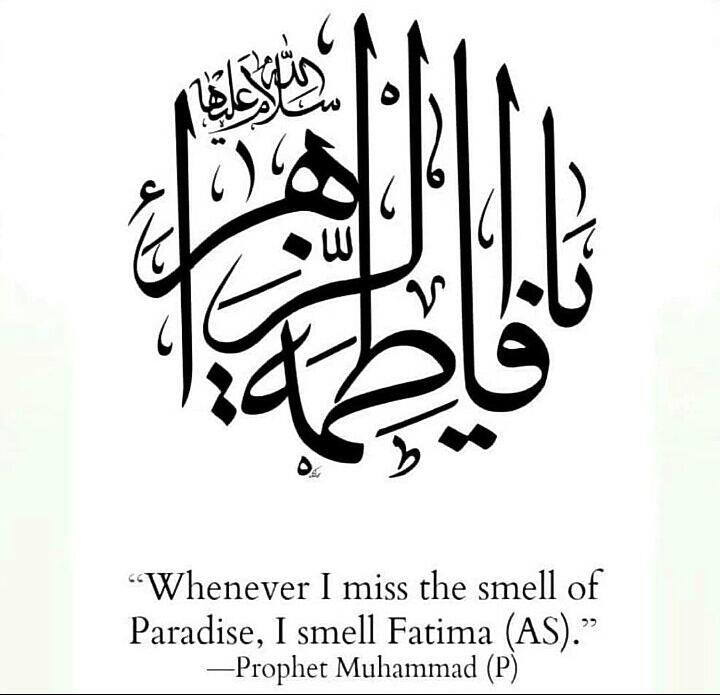
Ashaaba ne puchha ki ‘Ya Rasool-Allāh sallallāhu alaihi wa sallam chumne ki baat to samajh me aati hai, ye sunghne ki kya wajah hai?’ tab aap ne farmaaya ‘Mujhe Faatima me se jannat ki khushboo aati hai.’
Huzoor sallallāhu alaihi wa sallam ne farmaaya ‘Mujhe apne Ahle Bait me se sab se pyaari Faatima hai.’
***** ***
Aap ke baare me Huzoor sallallāhu alaihi wa sallam ne farmaaya hai :
(1) Meri beti Faatima insaani hoor hai. ALLĀH ta’ala ne use haiz o nifaas se paak rakha hai.
(2) Faatima mere jigar ka tukda hai. Jis ne use naraaz kiya us ne mujhe na-raaz kiya.
(3) Jannat me daakhil hone waali aurto me sab se pehle meri beti Faatima hogi.
Qayaamat ke din ghaib se ek nida (aawaaz) aayegi ki ‘Aye hashr ke maidaan me jama hone waalo! apni nigaahen jhuka lo yaha tak ke Faatima binte Muhammad sallallāhu alaihi wa sallam guzar jaayen. Aur Aap 70,000 hooro ke saath bijli ki tarah guzar jaayengi.
(4) ALLĀH ne Faatima Zahra aur us ki aulaad par Jahannam ko haraam farma diya hai.
******
Aqwaal :
¯¯¯¯¯¯
(1) Apni betiyo ko bachpan se hi parda karna sikhaao.
Jis tarah Moti ke liye sadaf aur Jawahiraat ke liye sandooq zaroori hai usi tarah Aurat ke liye parda zaroori hai.
Aurat me sab se behtar woh hai jo na kisi ghair-meharam ko dekhe aur na koi ghair-mehram us ko dekhne paaye.
(2) Jab aurat ghar ka kaam aur bacho ki tarbiyat kar rahi ho,
Us waqt woh ALLĀH ta’ala ke sab se zyada qareeb hoti hai.
******
Ek martaba Huzoor sallallāhu alaihi wa sallam ne Sahaaba-e-kiraam se farmaaya ‘Bataao! Aurat ke liye kaun si cheez behtar hai?’ Tamaami ashaaba khaamosh rahe, kisi ne koi jawaab na diya.
Hazrate Ali radiy-Allāhu anhu foran ghar gaye aur Shehzaadi e Rasool Sayyeda Faatima Zahra radiy-Allāhu anha se kaha ke ‘Aaj ALLĀH ke Habeeb sallallāhu alaihi wa sallam ne ye sawaal kiya hai. Aap bata’iye ke kya jawaab du?’
Sayyeda Faatima Zahra radiy-Allāhu anha ne farmaaya ‘Na Aurat ajnabi mard ko dekhe, Na ajnabi mard use dekhe.’
Hazrate Ali radiy-Allāhu anhu farmaete hain ke ‘Maine jab jaakar ye Huzoor sallallāhu alaihi wa sallam ko pesh kiya to Aap sallallāhu alaihi wa sallam ne farmaya ke :- Faatima mere jigar ka tukda hai.’
********
Ek martaba Hazrate Ali radiy-Allāhu anhu ne dekha ki Ghar ka kaam karte karte Sayyeda Faatima ke haatho me chhale pad gaye hain. Unho ne farmaaya “Aap Huzoor sallallāhu alaihi wa sallam ki khidmat me jaao aur un se baat karo. Agar Huzoor sallallāhu alaihi wa sallam jo kaneeze aai hain un me se ek ata kar de to woh tumhare kaam me madad karegi.” Aap Huzoor sallallāhu alaihi wa sallam ki khidmat me tashreef le gai magar Huzoor sallallāhu alaihi wa sallam se kuchh kehne ki himmat na hui. Kuchh der baithkar Aap waapas aa gai. Hazrat Ali samajh gaye. Phir wo khud Huzoor sallallāhu alaihi wa sallam ki khidmat me haazir hue. Huzoor sallallāhu alaihi wa sallam ne daryaaft kiya “Ali! Kuchh der pehle Faatima aai thi. Kuchh der baithkar chali gai. Kya kuchh kaam tha?” Hazrat Ali ne arz kiya “Ya Rasool-Allāh sallallāhu alaihi wa sallam! Faatima tanha ghar ka saara kaam kaaj karti hain. Is liye thak jaati hain. Agar Aap ek londi ataa kar den to woh us ke kaam me madad kar degi.” Huzoor sallallāhu alaihi wa sallam ne farmaaya “Ali! Main tumhe is se behtar raasta bataata hu. Faatima se kehna ki har farz namaaz ke baad 33 martaba Sub’hān Allāh, 33 martaba Alhamdulillāh aur 34 martaba Allāhu akbar padhkar badan par dam kar le. Is se us ki saari thakaan door ho jaayegi.”
********
Ek martaba Hazrat Ali radiy-Allāhu ta’ala anhu ghar tashreef laaye to kuchh ranjeeda lag rahe the. Aap ne puchha to Hazrat Ali ne bataaya “Aaj Hazrat Uṡmaan Ghani radiy-Allāhu ta’ala anhu ne Huzoor Rasool-Allāh sallallāhu alaihi wa sallam ko ashaaba ke saath apne yaha shaandaar daawat ki aur un ke ghar tak Huzoor sallallāhu alaihi wa sallam ke jitne qadam pade utne ghulaam Hazrat Uṡmaan Ghani ne aazaad kiye.” Aap ne kaha “Aap bhi Huzoor Rasool-Allāh sallallāhu alaihi wa sallam ko daawat den.” Hazrat Ali ne farmaaya “Daawat kar to len lekin hamare paas itna maal kaha hain ke hum ghulaamo ko aazaad karaayen?” Aap ne farmaaya “Aap daawat ki tayyaari kijiye.”
Hazrat Ali ne Huzoor Rasool-Allāh sallallāhu alaihi wa sallam ki khidmat me daawat ke liye arz ki. Huzoor Rasool-Allāh sallallāhu alaihi wa sallam apne ashaaba ke saath Hazrat Ali ke ghar par tashreef laaye. Khaana khilaane ke baad Sayyeda Faatima musalla bichhaakar sajde me jaakar dua me mashgool ho gaye. Jab Aap faarigh hui to Hazrate Ali ne puchha to Aap ne bataaya ke “Maine Rabb ta’ala ki baargaah me arz karke Huzoor Rasool-Allāh sallallāhu alaihi wa sallam ke qadamo ke barabar ummatiyo ko jahannam se aazaad karwaaya.”
********
Ek baar Huzoor Nabi e kareem sallallāhu alaihi wa sallam beemaar hue to Sayyeda Faatima radiy-Allāhu ta’ala anha tashreef laai. Aap sallallāhu alaihi wa sallam ne dekha to farmaaya “Marhaba Aye meri beti!” Aur mohabbat se apne paas bithakar aahista aahista un se kuchh baaten ki, jis se Aap rone lagi. Huzoor sallallahu alaihi wa sallam ne un ke malaal ko dekha to phir aahista aahista kuchh baaten ki, jis se wo muskuraane lagi.
Ummul mo’mineen Hazrate Aa’isha Siddeeqa radiy-Allāhu ta’ala anha ne Sayyeda Faatima se puchha ki “Nabi e kareem sallallāhu alaihi wa sallam ne aap se kya guftgu farmai hi jis se pehle aap rone lagi aur phir muskurane lagi?’ To aap ne farmaaya ‘Main Huzoor sallallāhu alaihi wa sallam ke raaz ko zaahir nahi karna chaahti.”
Huzoor sallallāhu alaihi wa sallam ka wisaal ke baad Hazrate Aa’isha Siddeeqa radiy-Allāhu ta’ala anha ne Sayyeda Faatima se kaha “Main tumhe qasam deti hu aur is haq ka waasta deti hu jo mera tum par hai ab mujhe us raaz se aagah karo.” To Aap ne farmaaya “Ab is raaz ko zaahir karne me koi harz nahi hai. Baat ye hai ki mujhe pehli martaba Huzoor Rasool-Allāh sallallahu alaihi wa sallam ne farmaaya tha ki ‘Aye Faatima! Har Saal Jibr’eel mere saath Qur’an ka daura kiya karte the. Is saal us ne do dafa daura kiya hai. Ma’aloom hota hai ki mere wisaal ka waqt qareeb aa gaya hai aur main tujh se juda hone waala hu, Pus tum ALLĀH se darti rehna aur sabr karti rehna.’ Ye sunkar main rone lagi thi aur jab Huzoor sallallāhu alaihi wa sallam ne mujh ko zyada ghamgeen dekha to mujh se farmaaya ki ‘Kya tum is par raazi nahi ki tum saare jahaan ki aur jannat ki aurton ki sardaar bano? Aur mere ahle bait me sab se pehe tum hi mujh se milogi.’ Yeh sunkar main khush ho gai aur muskuraane lagi.”
Huzoor sallallāhu alaihi wa sallam ke wisaal ke 6 mahine baad Sayyeda Bibi Faatima ka intiqaal hua.
********
Aap ke wisaal ke din jab Hazrate Ali radiy-Allāhu ta’ala anhu ghar me tashreef laaye to dekha ke Hazrate Faatima kaam me masroof hain.
Aap ne puchha ke “Aye Faatima! Kya wajah hai ke aaj kuchh zyada masroof lagti hain?”
Aap ne farmaaya ke “Aap logo se rukhsat hone ka waqt qareeb hai. Is liye main Aap ke kapde dhokar rakh dena chaahti hu aur Aap sab ke liye khaana banaakar rakh dena chaahti hu taaki mere jaane ke baad aap ko pareshaani na ho.”
Yeh sunkar Hazrate Ali ki aankho me aansoo aa gaye to Aap ne farmaaya ke “Aap ko har haal me sabr karna hai aur hamare bacho ka khayaal rakhna hai.”
Phir Aap ne Hazrate Ali se kuchh wasiyaten ki, jin me se ek yeh thi ke “Mere janaaze ko raat ke waqt andhere me nikaala jaaye aur ghar ke log hi us me shaamil ho. Jis se Faatima ka parda rahe.”
Aur us kaagaz ko qabr me rakhne ke liye farmaaya jis me ALLĀH ta’ala ne Aap ke mehar me ummate Mustafa ki maghfirat likhkar bheja thi.
********
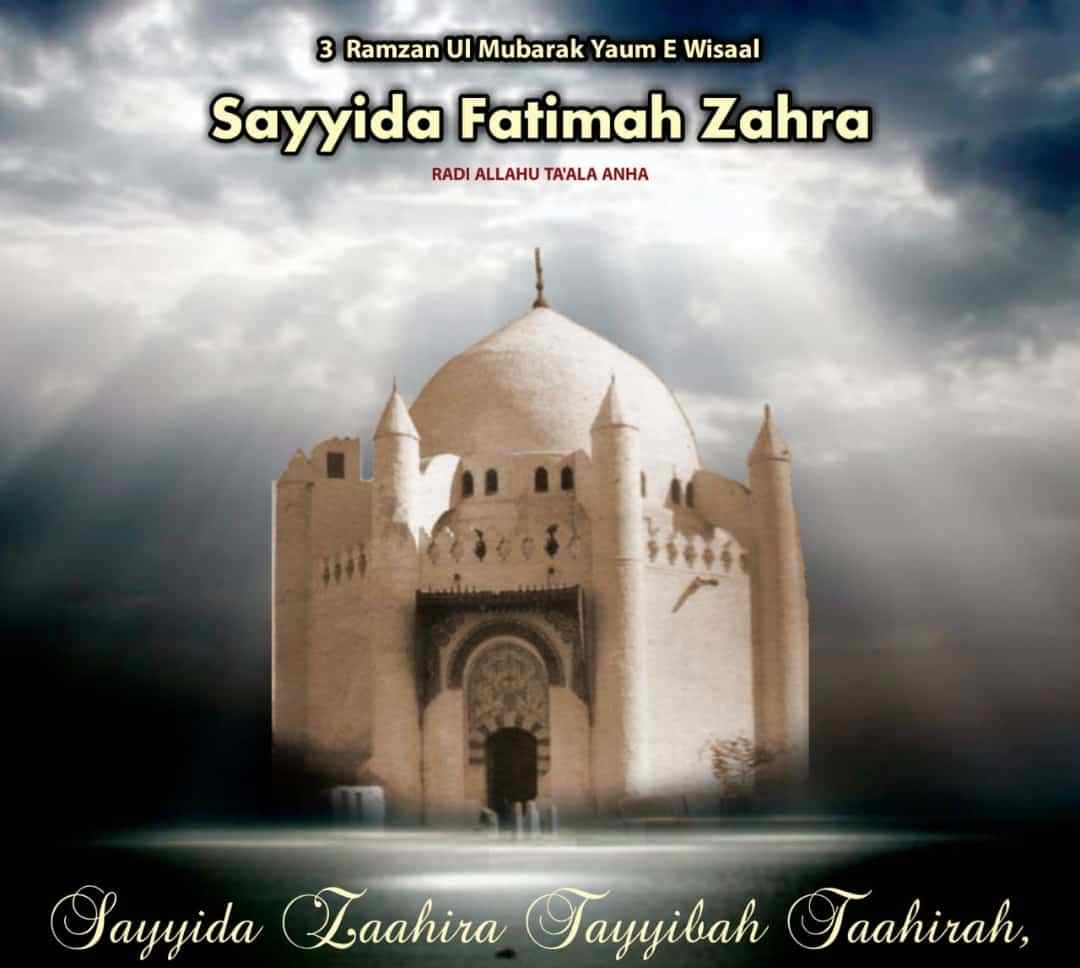
Aap ka wisaal 3 Ramazaan 11 Hijri (632 A.D.) ko hua.
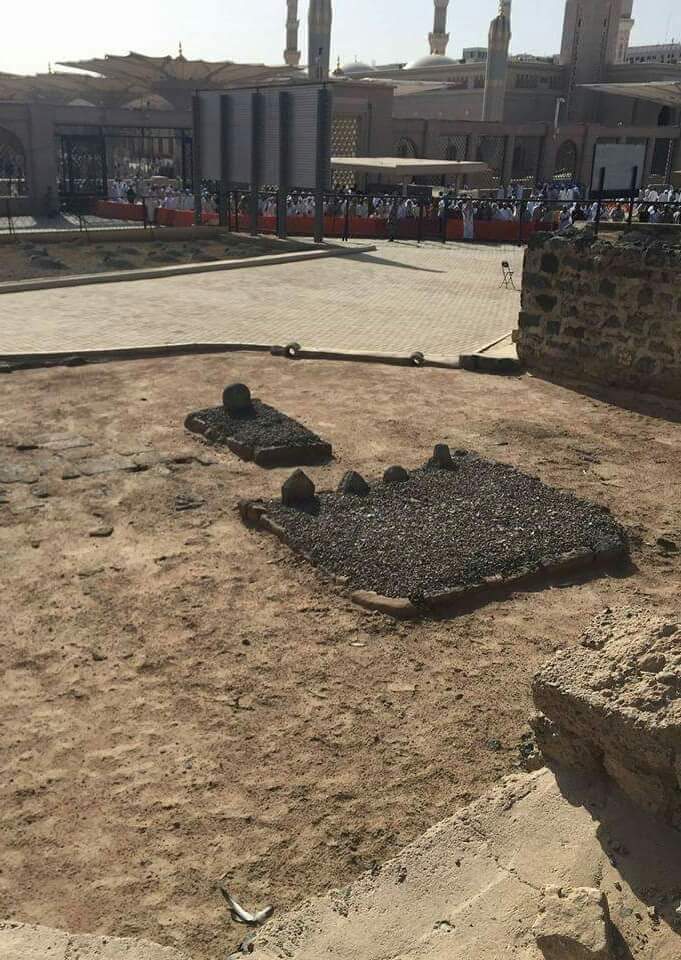
Aap ka mazaar Jannatul Baqi, Madeena munawwara me hai.
********
Yeh hai Hazrate Faatima radiy-Allāhu ta’ala ka martaba.
Aap ke Waalid Sarwar e kaa’inat, Khair ul Bashar, aur Ashraf ul Ambiya hain.
Aap ke Shohar Sher e khuda, Maula e kaa’inat aur Faatih e wilaayat hain.
Aap ke Saahabzaade Jannati jawaano ke sardaar hain.
Aap Sayyedat-un-nisaa (Jannati aurto ki sardaar) aur Khair-un-nisaa (Tamaam aurto me behtar) hain.
Jab maa ka martaba itna buland ho aur woh neki wa parhezgaari aur sabr me bemiṡaal ho to Bete bhi Shaheed e Abraar aur Shaheed e Moazzam hote hain aur Beti bhi Siddeeqa-e-Sughra hoti hain aur neki wa parhezgari aur sabr me bemiṡaal hote hain.
***** ***
ALLĀH ta’ala us ke Habeeb sallallāhu alaihi wa sallam ke sadqe me
Aur Sayyeda Faatima Zahra radiy-Allāhu ta’ala anha aur Ahle bait ke waseele se
Sab ko mukammal ishq e Rasool ata farmae aur Sab ke Eimaan ki hifaazat farmae aur Sab ko nek amal karne ki taufiq ata farmae.
Aur Sab ko dunya wa aakhirat me kaamyaabi ata farmae aur Sab ki nek jaa’iz muraado ko puri farmae.
Aameen.
 

WhatsApp Image 2019-05-09 at 4.49.08 AM

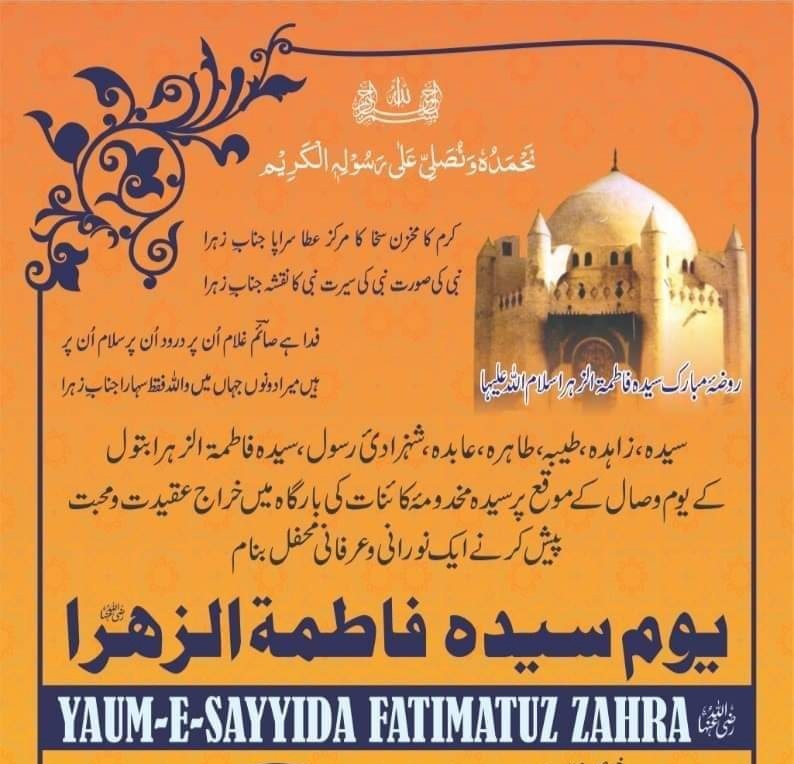
3rd Ramzan ul Mubarak
1429th Urs Mubarak:-
Aabida,Aadila,Aalia,Aalima,Aamila,Aziza,Basita,Batina,Fazia,Habiba,Hakima,Halima,Hujjata,Jaleela,Jamila,Karima,Masuma,Mastura,Mehrusa,Mosufa,Mubarakah,Muhadisa,Makhduma,Murshida,Mukrima,Muqdra,Musliya,Muthara,Najiba,Naseeba,Nasiha,Nasiya,Nooriya,Nusbiha,Qahira,Qaima,Rafia,Rakiya,Razia,Sabeea,Sabeeha,Sadiqa,Saima,Sajida,Saliha,Salima,Sania,Shafia,Shafeqa,Shafia,Siddiqa,Tahira,Wafiya,Waliya,Waziha,Zahida,Afzalun Naas Ba’ad Az Ambiya Sayyeda-e-Kainat Syyeda Fatima tuz Zahra (Salamullahi Alaiha)
WhatsApp Image 2019-05-09 at 4.49.09 AM

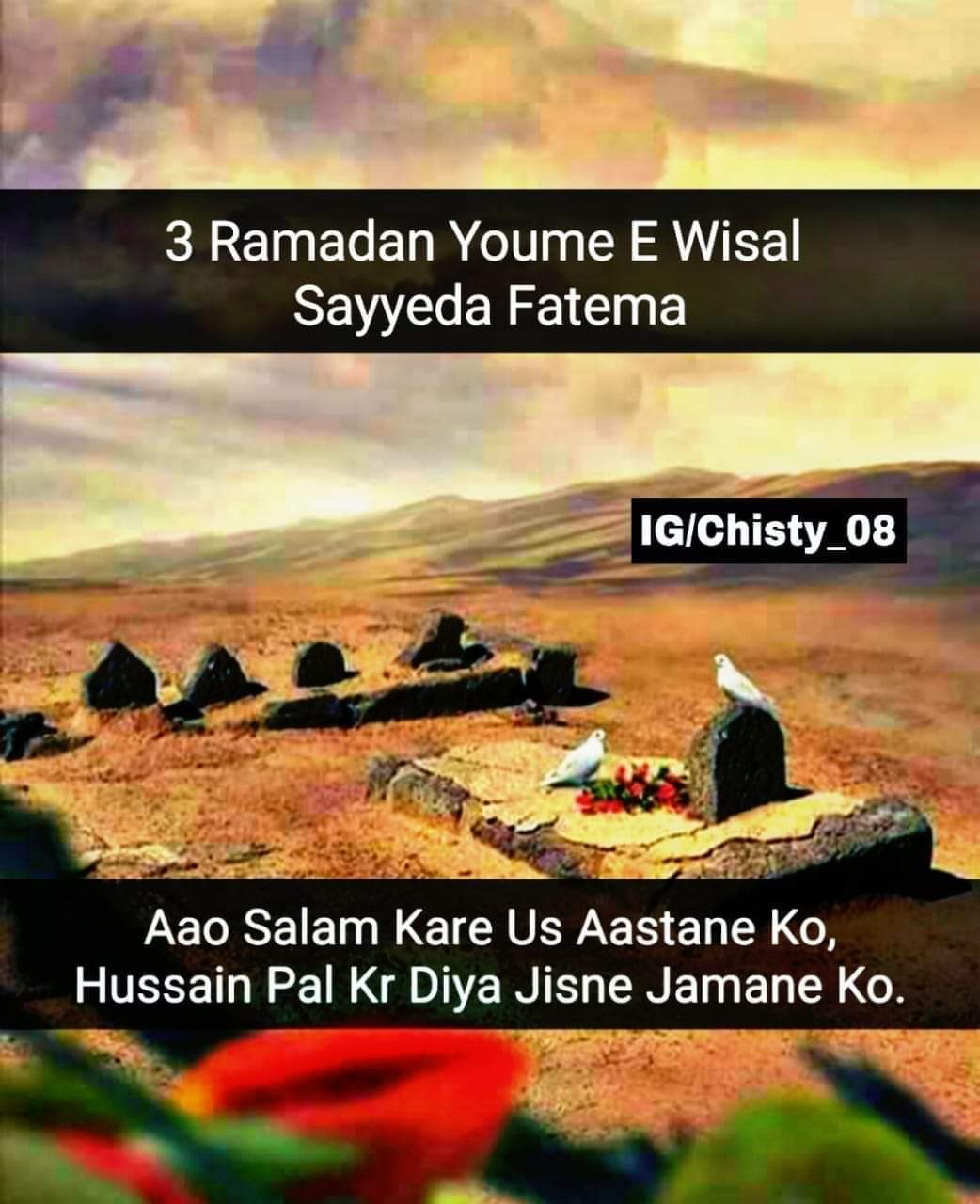
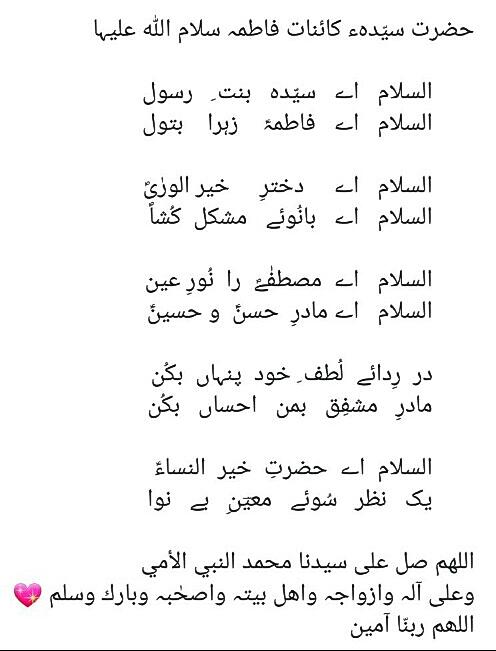
 طیبہ طاہرہ سیدہ فاطمۃ الزہراء سلام اللہ علیہا*

پڑا ہوں در پہ تیرے مثلِ کاہ یا زہرا​
ملے فقیر کو خیراتِ جاہ یا زہرا​

ہے مرتضی تیرے شوہر، تو مصطفی بابا​
زہے یہ اوج و شرف ،عز و جاہ یا زہرا​

ملے جو اسکی اجازت مجھے شریعت سے​
تو تیرا در ہو میری سجدہ گاہ یا زہرا​

خدا کو میں نے سدا لا شریک مانا ہے​
خدا کے سامنے رہنا گواہ یا زہرا​

ہیں جن کے نور سے امت کے روزو شب روشن​
حسن حسین تیرے مہر و ماہ یا زہرا​

*تیرے حسین کا کردار دیکھ کر اب تک​
پکارتے ہیں ملک واہ واہ یا زہرا​

درود تجھ پہ ہو مصداقِ بضعۃ منی​
سلام تجھ پہ ہو گیتی پناہ یا زہرا​

ہیں تیری آل سے پیرانِ پیر محی الدین​
جو اولیاء کے ہوئے سربراہ یا زہرا​

بھروں تو کیسے بھروں دم تیری غلامی کا​
بہت بڑی ہے تیری بارگاہ یا زہرا​

کہاں تو ایک نجیبہ عفیفہ پاک نظر​
کہاں میں ایک اسیرِ گناہ یا زہرا​

تو بادشاہِ دو عالم کی ایک شہزادی​
میں اک غریب تیری گرد راہ یا زہرا​

اجڑ چکا ہوں غم زندگی کے ہاتھوں سے​
کھڑا ہوں در پہ بحالِ تباہ یا زہرا​

ہوں معصیت کی سیاہی ملے ہوے منہ پر​
کسےدکھاؤں یہ روئے سیاہ یا زہرا​

میں گو بُرا ہوں مگر تیرا وہ گھرانہ ہے​
کیا بُروں سے بھی جس نے نباہ یا زہرا​

بھری ہیں در سے ہزاروں نے جھولیاں اپنی​
میری طرف بھی کرم کی نگاہ یا زہرا​

نہ پھیر آج مجھے اپنے در سے تو خالی​
کہ تیرے بابا ہیں شاہوں کے شاہ یا زہرا​

جیوں تو لے کے جیوں تیری دولتِ نسبت​
مروں تو لے کے مروں تیری چاہ یا زہرا​

بروز حشر نہ پرسا ہو جب کوئی اسکا​
ملے نصیر کو تیری پناہ یا زہرا
 از کلام
امامِ اہلسنّت مولانا شاہ احمد رضا نصاحب محدث بریلی رحمۃ اللہ علیہ
۔پارہائے صُحف غنچہ ہائے قُدُس
اہلِ بیتِ نبوت پہ لاکھوں سلام
۔آبِ تطہیر سے جس میں پودے جمے
اُس ریاضِ نجابت پہ لاکھوں سلام
۔خونِ خیرُالرُّسل سے ہے جن کا خمیر
اُن کی بے لوث طینت پہ لاکھوں سلام
۔اُس بتولِ جگر پارۂ مصطفی
حجلہ آرائے عِفّت پہ لاکھوں سلام
۔جس کا آنچل نہ دیکھا مہ و مِہر نے
اُس رِدائے نَزاہت پہ لاکھوں سلام
۔سیّدہ زاہرہ طیّبہ طاہرہ
جانِ احمد کی راحت پہ لاکھوں سلام
WhatsApp Image 2019-05-09 at 9.52.14 AM

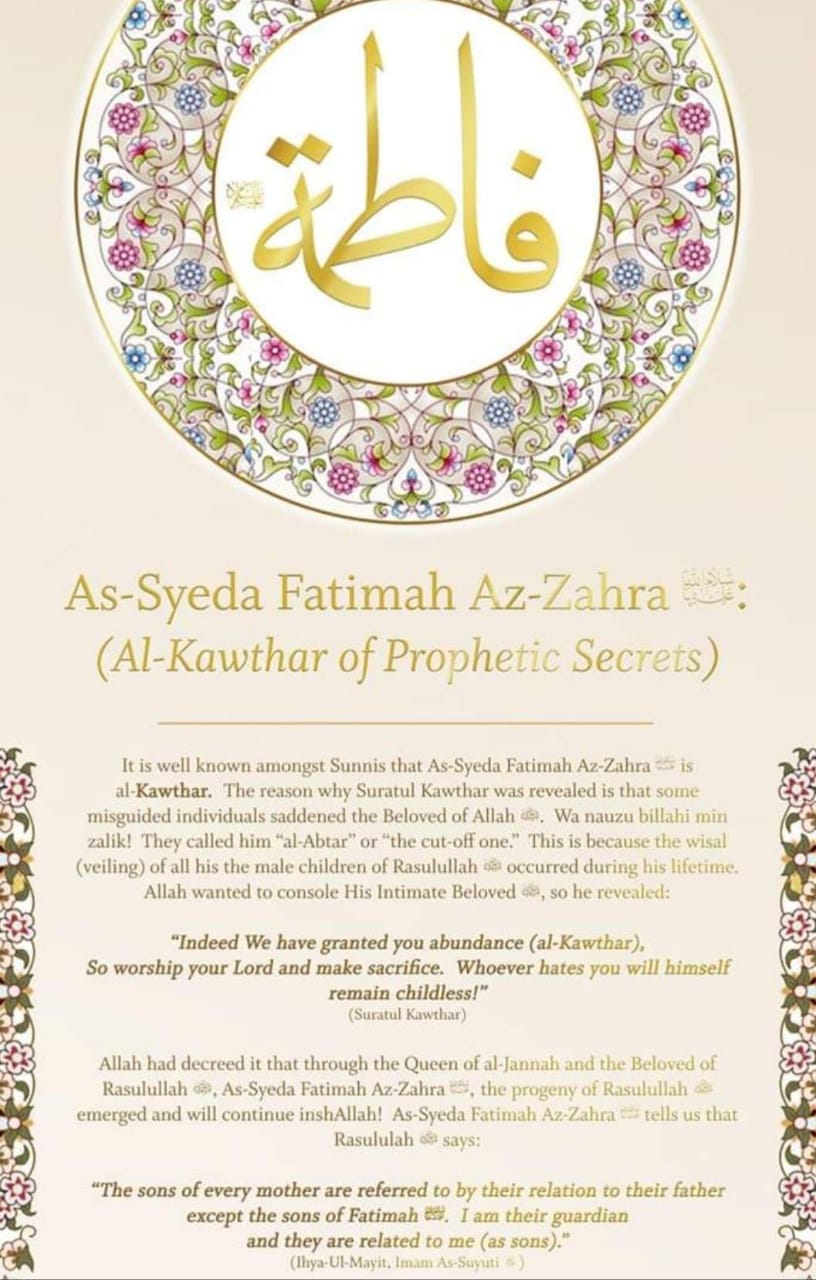
Kon Fatima Zehra
(Salam un Aleha):-Jiski Raza Hai Ajar e Risalat wo Fatima,Palti Hai Jiske Ghar Me Imamat Wo Fatima,Tahir Hue Hai Jisse Taharat Wo Fatima,Jis Par Darood Parhti Hai Asmat wo Fatima,Samjega Koi Kis Tarha Unke Maqam Ko,Udhte Hai Khud Rasool e Khuda Jinke Ahtaram Ko
Afzalun Naas Ba’ad Az Anbiya: Sayyeda-e-Kainat Fatima tuz Zahra (Salamullahi Alaiha)

Ummul Momineen Sayyeda Aayesha Siddiqa Salamullahi Alaiha farmati hain:

“Maine Sayyeda Fatimah se Afzal Unke Baba (SallAllahu Alaihi wa Aalihi wa Sallam) ke alawa kisi shakhs ko nahi dekha.”

Salamullahi Alaiha wa Ala Abeeha wa Ummiha wa Ba’aleeha wa Ahle Baytiha

1. Tabarani, al -Majma-ul-awsat (3:137#2721)
2. Haythami ne Majma-uz-zawaid (19:201) me kaha ke isey
Tabarani aur Abu Ya’ala ne riwayat kiya hai aur iske rijaal Sahih hain
3. Shawkani, Darr-us-sahabah fi -manaqib al -qarabah wassahabah (p.277#24)
101.
Ad-Durratul Baida fee Manaqib Sayyeda Fatimah tuz Zahra Salawatullahi Alaiha.

Allahumma Salle Ala Sayyedatina Fatimah wa Ala Abeeha wa Ummiha wa Ba’aleeha wa Aaliha wa Ahle Baytiha wa Baarik wa Sallim
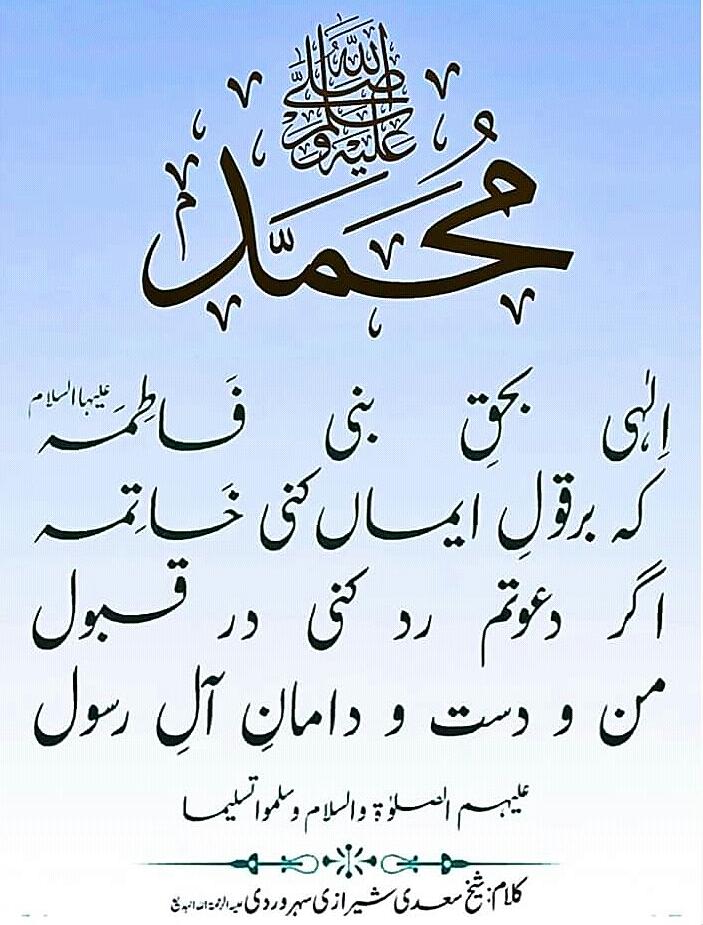
WhatsApp Image 2019-05-09 at 10.45.37 AM

It was on 3rd Ramadan that Sayyidah Fatimah Al-Zahra left this world. She is the pure one who was born in a purified land (Makkah), to the purest of parents, and then grew up to marry the man who was purified from prostrating to anything except Allah (Sayyiduna ‘Ali). The Lord granted her pure children (Sayyiduna Hasan and Husayn) whose purity has been declared in the Purest Book (Qur’an). Her family are the Pure Household (Ahl Al-Bayt) and they are guides to everything that is pure. She passed away in the purest month (Ramadan) and now rests in the purest of all cities (Madinah). رضي الله عنهم

May Allah allow our women folk to embody her noble way and grant us all her intercession on the Last Day.
WhatsApp Image 2019-05-09 at 10.45.39 AM


Things That Men Need to Pay Attention to in the Family

Supporting the religious and moral growth of women and children, assisting their education in the ways that will bring them eternal happiness, are among the most significant duties of men.

The happiness of a family depends on a righteous father’s strength of will. To be a righteous father means to be a father who provides his family with sustenance, discipline and protection. All these require a man to be intelligent, experienced, skilled and especially to have strong faith and good morals.

muslim-family-happy-traditional-costume-51959654

To support the religious and moral growth of women and children, assisting their education in the ways that will bring them eternal happiness, are among the most significant duties of men. The Qur’an states:

O you who believe! Save yourselves and your fam- ilies from a fire whose fuel is men and stones … (66:6)

The full scope of this task encompasses the members of our families, our relatives, our neighbors and ultimately everybody in the country according to their positions and potentials; because just as families shape their greater environment, so also does the greater environment shape our families.

A father should pay attention to his family’s Qur’anic education and Sunnah of the Holy Prophet (Peace and blessings be upon him) and inspire them with a love for Allah and the beloved Prophet Muhammad (Peace and blessings be upon him). At the same time, it is necessary for him to teach his family the manners and customs of society.

A man has to protect his family from all kinds of negative influences. A father should keep children away from friends and places that may spoil their religion and morality, from the immoral shows on television, from vicious and worthless books and magazines. In short, protecting the family from attacks arriving both inside and outside the home is the responsibility of men.

A husband should speak pleasantly and gently with his wife; he should not alienate her by approaching her rudely and harshly. The Messenger of Allah (peace and blessings be upon him) says:

The best of you is the one who is best in his treatment of women. (Tirmidhi, Rada, 11. See also Abu Dawud, Sunna, 15; Ibn Maja, Nikah, 50).

A wise man leaves his business life out of his home. He does not bring his problems home.

An intelligent and insightful man forgives his family members’ worldly mistakes and approaches them with mercy and compassion. He keeps his wife’s secrets and deficiencies from everybody.

However, he does not ignore his family’s faults in religious matters. He seriously confronts errors when they occur and heads off in advance mistakes that might be committed because of laziness or ig- norance. He meticulously does everything possible to support the religious education of his family. He teaches his children himself as much as he can and when necessary, he also gets professional help from effective scholars. These things, too, are among the responsibilities of the father.

A man should consult with his wife in family matters and should not give her responsibilities heavier than she can handle. He should help his wife with child care and discipline, because both child care and housework may exhaust her. Helping women in their work will increase mutual love and strengthen family ties.

A husband should pray for the welfare of his wife. He should not go on long trips without telling her in advance. He should also not bring guests home without getting her consent first. He should never insist that his wife go out in front of strangers to serve them. He should keep his family away from mixed environments as much as possible.

A father is like the sun in the sky of a family; a mother is like the moon, covered with veils of chastity; and the children are like the stars.

-An Excerpt from the book, “Peaceful Home: Paradise on Earth”

Vision

Microgravity affects vision. 

A mysterious syndrome has been impairing astronauts’ vision on the International Space Station, causing untreatable nearsightedness that lingers for months even after they’ve returned to Earth. The problem is so bad that two-thirds of astronauts report having deteriorated eyesight after spending time in orbit. Now scientists say they finally have some answers – and it’s not looking good for our prospects of getting to Mars. “Nobody’s gone two years with exposure to this, and the concern is that we’d have loss of vision,” Dorit Donoviel from the US National Space Biomedical Research Institute told The Guardian. “That is catastrophic for an astronaut.” 

Earlier this year, NASA reported that something in space has been messing with its astronauts’ perfect eyesight, causing long-term impairment to their quality of vision. Astronaut Scott Kelly, whose exceptional vision was part of the reason he was selected to be America’s first astronaut to spend a full year in space, says he’s been forced to wear reading glasses since coming home. John Phillips, who spent time on the International Space Station (ISS) in 2005, brought his sudden bouts of blurry vision home with him, and during his post-flight physical, NASA confirmed that his vision had gone from 20/20 to 20/100 in just six months. NASA suspected that the condition – called visual impairment inter cranial pressure syndrome, or VIIP – was caused by the lack of gravity in space. 
Science Alert, Space Could Leave You Blind, And Scientists Say They’ve Finally Figured Out Why, 2016

Most astronauts feel dizziness and nausea in the first few days in space but blurred vision seems to be more lasting.

But 1400 years ago the Quran said that if Allah opens a wormhole for you in space you will think your vision is intoxicated:

[Quran 15.14-15] Even if We [Allah] opened upon them from the heaven a door and they continued passing through it they would say ‘Our sights were intoxicated (سُكِّرَتْ ), rather we were bewitched‘.

Sukkirat in Arabic “سُكِّرَتْ ” means gotten drunk. Dizziness, nausea and blurred vision are common symptoms of getting drunk. Today we know that astronauts experience dizziness, nausea and blurred vision.

Importance of Three Ashra’s of Ramadan with their Duas

ramadan ashras and duas

Ramadan is the 9th and one of the most blessed months of Islamic Calendar. The blessed month of Ramadan is observed by Muslims worldwide as an act of fasting to commemorate the revelation of the Quran on Hazrat Muhammad (PBUH) as per Islamic dogmas. The ritual of fasting among Muslims redirects the heart away from worldly activities to purify the soul by freeing it from negative and harmful activities. Ramadan is the best practice for self-improvement, self-control, discipline, and empathy to encourage charity towards the less fortunate ones.

The rewards that a Muslim can reap in the blessed month of Ramadan are diversified and the chance to commit a sin decreased because no barriers can exist between man and his Lord in the holy month of Ramadan. The blessings of this holy month are countless and it is divided into three stages i.e. Ashra (ten days each). The word Ashra is an Arabic word which means “ten”.  Our beloved Prophet Muhammad (SAW) said: “It (Ramadan) is the month, whose beginning is mercy, its middle, forgiveness, and its end, release from the fire of hell.” Below we will discuss the importance of each Ashra with their Duas related to them.

Three Ashra’s of Ramadan

Ramadan has three parts and each part is for ten days, making it a month of three Ashra’s.

  1. First Ashra (Mercy): First, ten days of Ramadan are the days of Mercy. Every Muslim must seek the mercy of Almighty Allah in these days. There is a special verse that usually recites Muslims in the first ten days.  The Dua for the first Ashra is, Translation: “O! My Lord forgive and have Mercy and You are the Best of Merciful.” The objective of first Ashra is practising being merciful to other fellow beings by giving charity; the act that Allah loves the most. Treat fellow Muslims well by controlling your temper.
  2. Second Ashra (Forgiveness): Second Ashra of Ramadan consists of the next ten days; it is the time of forgiveness. These are the days of forgiveness and a Muslim must seek forgiveness from Almighty Allah and repent for all his sins. There is a special verse that usually recites Muslims in the next ten days. The Dua for the second Ashra is, Translation: I ask forgiveness of my sins from Allah who is my Lord and I turn towards Him.” It’s the time where the forgiveness of Almighty Allah is at its peak, and this is the best time for asking about forgiveness for all the sins from Almighty Allah. Always ask for forgiveness from Almighty Allah in all these days. Do make sure to not repeat the sins after you seek forgiveness.
  3. Third Ashra (Nijat): Third Ashra of Ramadan starts from 21st and ends on 29th or 30th of Ramadan according to the moon. Third Ashra is known as Safety from the Hell which means Nijat. At the end of Ramadan is about seeking in Allah Almighty from Hellfire. Every Muslim must pray for the safety of Hellfire. Last Ashra is very important and superior. In this Ashra Lailatul Qadar also falls which is better than the nights of thousand months. Many Muslims also practice Aitkaf in and try to maximize their prayers. Allah Almighty stated in the Holy Quran about Lailatul Qadar: “We sent it (Quran) down on a blessed Night. Verily, We are ever warning. Therein (in that Night) is decreed every matter of ordainment. Amran (i.e. a command or this Quran or His Decree of every matter) from Us. Verily, We are ever sending (the Messenger) (As) a Mercy from your Lord” (Quran, 44: 3-6). Dua for third Ashra is, Translation: “O Allah! Save me from Hell – Fire.” 

May Allah Almighty give us the strength to seek Allah’s mercy, forgiveness, and Nijat from Hellfire in this Ramadan! Ameen

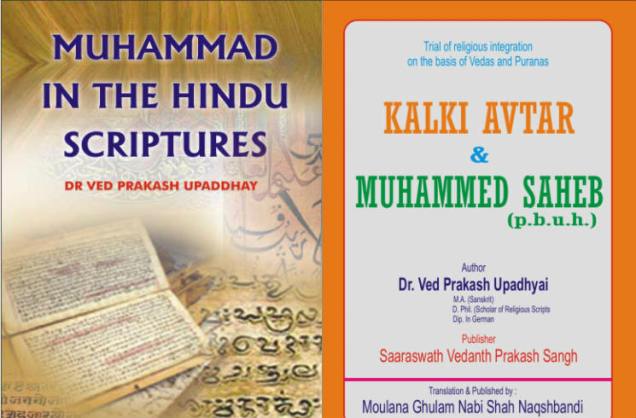
PROPHET MUHAMMAD IN VEDAS, UPNISHADS AND PURANS

Muhammad in Hindu Religion

Fundamental Knowledge 

Islam doesn’t require support from books of other religions for its truthfulness and veracity. Indeed Quran is the truth from Almighty Allah and Prophet Muhammad is the final Prophet to mankind from among the multitudes of Prophet sent by Allah. All Prophets brought the same essential guidance from Allah and they preached the same message to people about Belief in Oneness of God (Tauheed), Belief in the Prophet (Risaalat) and the Belief in Hereafter (Qiyamah). All the Prophets before Muhammad gave news to their people about the coming of the last and greatest Prophet of Allah (Prophet Muhammad) and greatly emphasized the importance of obeying and following of Prophet Muhammad.

Allah has sent prophets to people of all communities to deliver His message to humanity who delivered the same essential message and this is why we find the mention of Prophet Muhammad in all religions of the world, though most of the messages contained in earlier scriptures have been distorted by their followers as time passed and people changed scriptures to suit their desires and demands. Quran is the only scripture in the world which is free from any kind of alteration, corruption, distortion, interpolation, excess etc since its first day of revelation to Prophet Muhammad.

The purpose of this article is only to show that prophecy about prophet Muhammad is present in scriptures of all religions who claim to have Divine origins. This doesn’t entail in any sense that these scriptures are to be followed after coming of Quran and Prophet Muhammad. The Quran is the Last Message of Allah and belief in its truthfulness is essential for salvation in this world and hereafter.

Now let us examine the Hindu Scriptures:

Numerous prophecies of the advent of the Holy Prophet are found in the sacred books of the Hindus. There are three divisions of these books—the Vedas, the Upanishadsand the Puranas. The Brahmanas are nothing but a commentary of the Vedas, still it is included in the revealed books (Shruti). There are four principal divisions of the Vedas, although according to their number, they amount to 1131 out of which only about a dozen are available.1

The Rig Veda, the Yajur Veda and the Sam Veda are considered to be the more ancient books, the Rig Veda being the oldest. The Rig Veda was compiled in three long and different periods of time.According to Manu, the above mentioned are the three old Vedas  which are also known as ‘Trai Vidya’ or the Triple Sciences.3 The fourth one, Atharva Veda is of a later date.

Opinions greatly differ as to the date of compilation or revelation of the four Vedas. European Orientalists, however, are more or less unanimous in their research; but there is an unbridgeable gulf of difference between various Hindu sects and scholars. One scholar holds that the Vedas were revealed one thousand three hundred and ten millions of years ago,4 and according to others they are not more than four thousand years old.5 Similarly, a great difference is found in the various accounts about the places where these books were revealed and the Rishis (Holy Saints) to whom these scriptures were given. Notwithstanding these differences, the Vedas are the most authentic scriptures of the Hindus and the real foundation of the Hindu Dharma.

UPNISHADS AND PURANAS

Next in order of superiority and authenticity to the Vedas are the Upanishads. Some Pandits, however, consider the Upanishads to be superior to the Vedas.6,7,8,9 The Hindus are proud of these philosophic treatises and in the Upanishads as well, we find a claim to superiority over the Vedas.10

The next authentic books after the Upanishads and the most widely read of all are the Puranas. These books are easily intelligible and available at every place, as the Vedas are difficult to understand and rarely found. The Hindus show great reverence to these books and read them with much interest and faith. The Puranas comprise of the history of the creation of this universe, the history of the early Aryan tribes, and life stories of the divines and deities of the Hindus. Maha Rishi Vyasa has divided these books into eighteen voluminous parts. The majority of the Hindu people believes that the Vedas too attest the truth of the Puranas, which shows that the Puranas are more authentic and more ancient.

In the Atharva Veda we find: “Verses and songs and magic hymns, Purana, sacrificial text—All the celestial Gods Whose home is heaven, sprang from the residue”.11

Again we find: “He went away to the great region. Itihasa and Purana and Gathas and Narashansis followed him12

Similarly in the Rig Veda a mention is made of Puranas: “So by this knowledge (of) Puran Yajua our fathers raised up to Rishis”. 13  

A reference to Puranas is also found within Chhandogya Upanishad.14

UNFAIR ATTITUDE OF HINDU PANDITS (BRAHMANS)

All these references show that the Puranas are also revealed books like the Vedas, and as regards the age of revelation, they were either revealed simultaneously with the Vedas or some time before. In a word, the sanctity and reverence of the Puranas is admitted and recognized in all the authentic books of the Hindus. But in spite of all this, some Pandits have today begun to reject these collections simply because they find in them numerous prophecies and vivid signs of the truth of the Prophet Muhammad. Instead of having believed in the Prophet Muhammad and thus obeying their great and Holy Rishis and realizing the truth of their sayings, these Pandits have thought it best to totally refuse credence to what the Puranas contain. But the Vedas have clearly testified to the truth of the Puranas and it is recorded that just as the Vedas were revealed from God, in like manner, the Puranas too were revealed by Him.

ANSWERING OBJECTIONS

Sometimes however it is pleaded that the present Puranas are not the same collection of which the Vedas speak, the real books having been lost. But this contention is not correct. It is impossible and far from truth that all the Puranas which were so widely read and keenly studied, could have fallen in oblivion and totally wiped out from the surface of the earth, and the Vedas, which only a few could read and understand, remained intact up to this time.

It is further said that these prophecies were added to the Puranas at a later date. Even if this argument is accepted, then the million dollar question remains who has edited or changed the Puranas in favour of Islam and Prophet Muhammad? Obviously it cant be Muslims!! Muslims were nowhere in picture in ancient India!! Seeing clear prophecies of the Arabian Prophet in their books, the Pandits began to clamour that the Puranas were corrupted. Moreover, it is nonsensical to think that all the Pandits and the learned divines of the Hindus could have assembled at some place and added prophecies favoring Islam and Prophet Muhammad to the Puranas. There are at the same time, so many sects among the Brahmans and each sect is strongly opposed to the other, it was impossible for them to agree to such a change. Even if we assume that such an event has happened then such an event of so remarkable significance would have been deeply etched in memories of Hindu scholars.

A copy of a Puran will be found in almost every Brahman’s house, and it is really strange that so far the world has not seen any collection without these prophecies. And the most ridiculous thing is that corruption is said to have been made in favour of the Prophet Muhammad and against their own religion. It was very much possible that something could have been added against these prophecies about Prophet Muhammad or to change their text, but it is simply absurd to think that the Hindu Pandits added something against their own religion and conviction. Thus, we appeal to our Hindu brethren to give a serious consideration to this question. Every word of the Prophecy of Puranas is as genuine and revealed by God as that of the Vedas. Let them therefore, carefully study in their revealed scriptures, the glory of the Prophet Muhammad and let them declare their faith in him.

1. Ek shatam adhvaryo shakha, shasr vertama Sam Veda, ek vinshti dhava Richyam, navdha Atharvano Veda (There are 101 branches of Yajur Veda, 1000 of Sam Veda, 21 are of Rig Veda, and nine types of Atharva Veda, i.e. 1131). Maha-Bhashya of Patanjli.

2.Abhinash Chandra’s Rigvedic India, Intro, p. VIII.

3. Trayam Brahm sanatnam. Manu. 1.23. 2 : 76, 77, 118. 3 : 2. 9 : 188.

4. Dyanand’s Satyarth Parkasha.

5. Mahatma Tilak’s “Arctic Home in the Vedas”.

6. Pandit Radha Krishnan’s Philosophy of the Upanishads, p. 16.

7. Sacred Books of the East vol. I.

8. Introduction to the Upanishads, p. xiii.

9. Lectures by Raja Ram Mohan Roy.

10. Manduk Upanishud, 1. 1. 4-6. Chhandogya vii. 1-2. Shatpath Br. X 3.5-12

11. The Atharva Veda, XI: 7. 24.

12. Atharva Veda, XV : 6, 12.

13. Rig Veda, X : 130, 6.

14. Chhan. VII; 1-2.