
अर-रहीकुल मख़्तूम  पार्ट 93 Hajjat-ul-Wida (10 Hijri)


Rasool Allah ﷺ ka Aakhri Hajj, Khutba-e-Hajjat-ul-Wida, Ghadeer-e-Khum, Ahl-e-Baytؑ aur Ummat ke liye Aakhri Hidayaat

Hajjat-ul-Wida Seerat-e-Nabawi ﷺ ka nihayat aham aur tareekhi marhala hai. Yeh 10 Hijri mein pesh aaya, jab Rasool Allah ﷺ ne apni zindagi ka aakhri Hajj ada farmaya.

Is Hajj ki ahmiyat sirf ibadat tak mehdood nahi thi. Is mauqe par Aap ﷺ ne insani huqooq, jaan-o-maal ki hurmat, auraton ke huqooq, musalmanon ki bahami zimmedari, Qur’an ki hidayat aur apne baad ummat ke liye aham usool bayan farmaye.

Isi safar mein Ghadeer-e-Khum ka waqia bhi pesh aaya, jo Hazrat Aliؑ ke maqam aur Hadith-e-Wilayat ke hawale se Islami tareekh ka ek nihayat aham mauzu hai.

Is baab mein hum waqiat ko tareekhi tartib se samjhenge aur Qur’an, Sahih Hadith aur mukhtalif Islami maktab-e-fikr ke hawalon ko alag alag wazeh karenge.

1. Hajjat-ul-Wida ka pas-e-manzar

8 Hijri mein Fath-e-Makkah ke baad Islam poore Arab mein tezi se phaila.

9 Hijri mein Aam-ul-Wufood ke dauran mukhtalif Arab qabail ke wafd Madinah aaye aur Islam qabool kiya.

10 Hijri tak Islam Arab ke wasee ilaqon mein phail chuka tha.

Rasool Allah ﷺ ne logon ko Hajj ki tayyari ka elan farmaya.

Is khabar par Madinah aur uske aas paas ke ilaqon se hazaron Musalman Aap ﷺ ke saath Hajj ke liye rawana hue.

Tareekhi maloomat:

  • San: 10 Hijri

  • Mahina: Zil-Qa’dah mein rawangi

  • Hajj ke ahem ayaam: 8–13 Zil-Hijjah

  • Maqam: Makkah, Mina, Arafat aur Muzdalifah

  • Qafila: Taqreeban ek lakh se zyada afrad

Riwayaat mein Hajj mein shirkat karne walon ki tadaad ke bare mein ikhtilaf milta hai. Isliye ek lakh se zyada ka zikr mashhoor tareekhi andaza hai, qat’i census nahi.

2. Hajj ka safar aur Ihram

Rasool Allah ﷺ 25 Zil-Qa’dah 10 Hijri ke qareeb Madinah se rawana hue.

Aap ﷺ ke saath Azwaj-e-Mutahharat, Sahaba-e-Kiram aur bohot se Musalman the.

Aap ﷺ ne Miqat par ihram bandha aur Talbiyah padhna shuru farmaya:

لَبَّيْكَ اللَّهُمَّ لَبَّيْكَ، لَبَّيْكَ لَا شَرِيكَ لَكَ لَبَّيْكَ، إِنَّ الْحَمْدَ وَالنِّعْمَةَ لَكَ وَالْمُلْكَ، لَا شَرِيكَ لَكَ

Roman Urdu:

Labbaik Allahumma Labbaik, Labbaika la shareeka laka Labbaik. Innal hamda wan-ni’mata laka wal-mulk, la shareeka lak.

Tarjuma:

“Ae Allah! Main hazir hoon, main hazir hoon. Tera koi shareek nahi, main hazir hoon. Beshak tamam tareef, nemat aur badshahat Tere hi liye hai. Tera koi shareek nahi.”

Hawala: Sahih al-Bukhari, Kitab-ul-Hajj; Sahih Muslim, Kitab-ul-Hajj.

3. Makkah mein dakhla aur Hajj ke arkaan

Rasool Allah ﷺ Makkah pahunche aur Ka’bah ka tawaf farmaya.

Aap ﷺ ne Hajj ke arkaan aur manasik apne amal se ummat ko sikhaye.

Aap ﷺ ne farmaya:

خُذُوا عَنِّي مَنَاسِكَكُمْ

Roman Urdu:

Khuzu anni manasikakum.

Tarjuma:

“Apne Hajj ke tareeqe mujh se seekh lo.”

Hawala: Sahih Muslim 1297.

Is irshad ka matlab hai ke Hajj ke manasik ko Nabi ﷺ ke amal aur taleem ke mutabiq ada kiya jaye.

Rasool Allah ﷺ ne tawaf, sa’i, Arafat mein wuqoof, Muzdalifah mein qiyam aur Mina mein rami ke tareeqe ummat ko samjhaye.

4. 9 Zil-Hijjah: Maidan-e-Arafat aur azeem Khutba

9 Zil-Hijjah ko Rasool Allah ﷺ Arafat tashreef le gaye.

Yahan Aap ﷺ ne ek azeem khutba irshad farmaya jo Islami tareekh mein Khutba-e-Hajjat-ul-Wida ke naam se mashhoor hai.

Is khutbe mein insani jaan, maal aur izzat ki hurmat, jahiliyat ke khatme, auraton ke huqooq aur musalmanon ke aapas ke huqooq bayan hue.

Aap ﷺ ne khutbe ki ibtida Allah ki hamd-o-sana se farmayi.

5. Khutba-e-Hajjat-ul-Wida: Insani huqooq ka azeem elan

Rasool Allah ﷺ ne apne khutbe mein chand bunyadi usool bayan farmaye jo qayamat tak insaniyat ke liye rehnumai hain.

(A) Jaan, maal aur izzat ki hurmat

Aap ﷺ ne farmaya:

إِنَّ دِمَاءَكُمْ وَأَمْوَالَكُمْ وَأَعْرَاضَكُمْ عَلَيْكُمْ حَرَامٌ

Roman Urdu:

Inna dima’akum wa amwalakum wa a’radakum alaikum haram.

Tarjuma:

“Beshak tumhare khoon, tumhare maal aur tumhari izzatein ek doosre par haram hain.”

Aap ﷺ ne in huqooq ki hurmat ko us din, us mahine aur us muqaddas shehar ki hurmat ke barabar qarar diya.

Hawala: Sahih al-Bukhari 1739; Sahih Muslim 1679.

Sunnah.com

Is taleem ka matlab hai:

  • Kisi begunah insan ka qatl jaiz nahi.

  • Kisi ka maal na-haq lena haram hai.

  • Kisi ki izzat aur aabru ko nuqsan pahunchana mana hai.

  • Musalmanon ko ek doosre ke huqooq ka khayal rakhna chahiye.

(B) Jahiliyat ke nizaam ka khatma

Rasool Allah ﷺ ne jahiliyat ke daur ke khooni badlon aur soodi muamlaat ko khatam karne ka elan farmaya.

Aap ﷺ ne sab se pehle apne khandan ka purana khooni badla khatam karne ka elan kiya.

Is se Aap ﷺ ne yeh sabaq diya ke insaf ka aaghaz apne ghar aur apne khandan se hona chahiye.

Hawala: Sahih Muslim 1218; Khutba-e-Hajjat-ul-Wida ki riwayat.

(C) Auraton ke huqooq

Aap ﷺ ne farmaya:

فَاتَّقُوا اللَّهَ فِي النِّسَاءِ

Roman Urdu:

Fattaqullaha fin-nisa.

Tarjuma:

“Auraton ke maamle mein Allah se darte raho.”

Aap ﷺ ne shoharon ko auraton ke huqooq ada karne, unke saath achha sulook karne aur unki zimmedariyan samajhne ki talqeen farmayi.

Aap ﷺ ne yeh bhi wazeh kiya ke miyan-biwi dono ke ek doosre par huqooq aur zimmedariyan hain.

Hawala: Sahih Muslim 1218.

(D) Nasli aur qabaili bartari ka khatma

Islam ne rang, nasl, zaban aur qabeele ki bunyaad par takabbur ko rad kiya.

Quran mein Allah Ta’ala farmata hai:

يَا أَيُّهَا النَّاسُ إِنَّا خَلَقْنَاكُم مِّن ذَكَرٍ وَأُنثَىٰ وَجَعَلْنَاكُمْ شُعُوبًا وَقَبَائِلَ لِتَعَارَفُوا ۚ إِنَّ أَكْرَمَكُمْ عِندَ اللَّهِ أَتْقَاكُمْ

Roman Urdu tarjuma:

Ae logo! Humne tumhein ek mard aur ek aurat se paida kiya aur tumhein mukhtalif qaumon aur qabail mein banaya taa-ke tum ek doosre ko pehchano. Beshak Allah ke nazdeek tum mein sab se zyada izzat wala woh hai jo sab se zyada muttaqi hai.

(Surah Al-Hujurat 49:13)

Is ayat ka bunyadi paigham yeh hai ke Allah ke nazdeek fazilat ka mayar nasab ya daulat nahi, balke taqwa hai.

6. Arafat mein Ayat-e-Ikmal-e-Deen ka nazool

Hajjat-ul-Wida ka ek nihayat aham waqia Quran ki is ayat ka nazool hai.

Allah Ta’ala farmata hai:

الْيَوْمَ أَكْمَلْتُ لَكُمْ دِينَكُمْ وَأَتْمَمْتُ عَلَيْكُمْ نِعْمَتِي وَرَضِيتُ لَكُمُ الْإِسْلَامَ دِينًا

Roman Urdu:

Al-yawma akmaltu lakum deenakum wa atmamtu alaikum ni’mati wa razeetu lakumul-Islama deena.

Tarjuma:

“Aaj Maine tumhare liye tumhara deen mukammal kar diya, tum par apni nemat poori kar di aur tumhare liye Islam ko deen ke taur par pasand kar liya.”

(Surah Al-Ma’idah 5:3)

Yeh ayat kab nazil hui?

Is hawale se Sahih al-Bukhari mein Hazrat Umar ibn al-Khattabؓ ki riwayat maujood hai.

Ek Yahudi ne Hazrat Umarؓ se kaha ke agar yeh ayat un par nazil hoti to woh us din ko Eid qarar dete.

Hazrat Umarؓ ne jawab diya ke mujhe maloom hai ke yeh ayat kis din nazil hui thi: Jumu’ah ke din, jab Rasool Allah ﷺ Arafat mein maujood the.

Hawala: Sahih al-Bukhari 45 aur 7268; Sahih Muslim 3017.

Sunnah.com+1

Shia tafseer ka mauqif

Shia ulama is ayat ko Ghadeer-e-Khum ke waqiye aur Hazrat Aliؑ ki wilayat ke elan ke saath bhi jorte hain.

Unke nazdeek deen ki takmeel ka ek aham pehlu Rasool Allah ﷺ ke baad rehnumai aur Imamat ka nizam wazeh karna tha.

Yahan ek zaroori tareekhi farq samajhna chahiye:

  • Sahih Bukhari ki riwayat ayat 5:3 ke Arafat mein Jumu’ah ke din nazil hone ki tasdeeq karti hai.

  • Shia riwayat aur tafseer Ghadeer ke mauqe par deen ki takmeel aur wilayat ke elan ko khaas ahmiyat deti hain.

Dono maktab-e-fikr ke nazariyat ko samajhne ke liye unke daleel aur riwayat ko alag alag dekhna zaroori hai.

7. Ghadeer-e-Khum ka waqia (18 Zil-Hijjah 10 Hijri)

Hajjat-ul-Wida ke baad Rasool Allah ﷺ Makkah se Madinah wapas rawana hue.

Makkah aur Madinah ke darmiyan ek maqam hai jise Ghadeer-e-Khum kaha jata hai. Yeh Juhfah ke qareeb ek maqam tha jahan mukhtalif raaste milte the.

18 Zil-Hijjah ko Rasool Allah ﷺ yahan thehre aur logon ko jama kiya.

Is waqiye ka talluq Hazrat Ali ibn Abi Talibؑ ke fazail aur maqam se hai.

7.1 Ghadeer ka elan

Rasool Allah ﷺ ne farmaya:

مَنْ كُنْتُ مَوْلَاهُ فَعَلِيٌّ مَوْلَاهُ

Roman Urdu:

Man kuntu mawlahu fa Aliyyun mawlahu.

Tarjuma:

“Jis jis ka main Mawla hoon, Ali bhi uske Mawla hain.”

Yeh Hadith Jami’ al-Tirmidhi mein Hazrat Zaid ibn Arqamؓ ya Hazrat Abu Sarihahؓ ki riwayat se aayi hai.

Imam Tirmidhi ne is riwayat ko Hasan Gharib kaha hai; Darussalam ki tahqiq mein ise Sahih grade diya gaya hai.

Hawala: Jami’ al-Tirmidhi 3713.

Sunnah.com+1

7.2 Mawla ka kya matlab hai?

Arabic lafz Mawla ke mukhtalif ma’ani ho sakte hain, masalan:

  • Dost

  • Madadgar

  • Sarparast

  • Qareebi wali

  • Wali-e-amr ya authority rakhne wala

Shia nazariya: Shia ulama ke nazdeek is mauqe par Mawla ka matlab sirf dost nahi, balke Hazrat Aliؑ ki wilayat aur Rasool Allah ﷺ ke baad unki Imamat ka elan hai.

Sunni nazariya: Aksar Sunni ulama is Hadith ko Hazrat Aliؓ ki muhabbat, nusrat aur azeem fazilat ke bayan ke taur par samajhte hain. Unke nazdeek yeh Hadith apne aap mein siyasi khilafat ki wazeh ta’yin nahi karti.

Lekin dono taraf is baat ko tasleem kiya jata hai ke Hadith-e-Ghadeer Hazrat Aliؑ ke fazail ke hawale se ek aham riwayat hai.

7.3 Ghadeer ke waqiye ki tareekhi ahmiyat

Ghadeer-e-Khum ko samajhne ke liye teen cheezen alag rakhni chahiye:

  1. Rasool Allah ﷺ ka Ghadeer mein khutba dena.

  2. Hazrat Aliؑ ke bare mein Mawla ka elan.

  3. Is elan se Imamat aur khilafat ka kya ma’na nikalta hai.

Pehle do nuqaat Hadith literature mein riwayat hue hain. Teesre nuqte ki tafseer mein Sunni aur Shia ulama ke darmiyan ikhtilaf hai.

8. Hadith-e-Saqlain: Qur’an aur Ahl-e-Baytؑ

Hajjat-ul-Wida ke baad Ghadeer-e-Khum ke maqam par Rasool Allah ﷺ ke ek aur aham irshad ka zikr Sahih Muslim mein Hazrat Zaid ibn Arqamؓ ki riwayat se milta hai.

Aap ﷺ ne farmaya:

أَلَا وَإِنِّي تَارِكٌ فِيكُمْ ثَقَلَيْنِ أَوَّلُهُمَا كِتَابُ اللَّهِ فِيهِ الْهُدَى وَالنُّورُ فَخُذُوا بِكِتَابِ اللَّهِ وَاسْتَمْسِكُوا بِهِ وَأَهْلَ بَيْتِي أُذَكِّرُكُمُ اللَّهَ فِي أَهْلِ بَيْتِي

Roman Urdu:

Ala wa inni tarikun feekum saqalayn, awwaluhuma Kitabullah, feehi al-huda wan-noor, fakhuzu bi Kitabillah wastamsiku bih, wa Ahla Bayti, uzakkirukumullaha fi Ahli Bayti.

Tarjuma:

“Aagah ho jao! Main tumhare darmiyan do azeem cheezen chhode ja raha hoon. Un mein pehli Allah ki Kitab hai, jis mein hidayat aur noor hai. Allah ki Kitab ko mazbooti se pakadna. Aur mere Ahl-e-Bayt; main tumhein apne Ahl-e-Bayt ke bare mein Allah yaad dilata hoon.”

Hawala: Sahih Muslim 2408a–d.

Sunnah.com+1

8.1 Hadith-e-Saqlain ki tashreeh

Is Hadith mein do aham hidayaat hain:

Pehli: Qur’an se mazboot talluq

Qur’an Allah ki Kitab hai aur hidayat ka bunyadi zariya hai.

Doosri: Ahl-e-Baytؑ ke huqooq ka khayal

Rasool Allah ﷺ ne apne Ahl-e-Bayt ke huqooq aur unke saath achhe sulook ki khaas takeed farmayi.

Sahih Muslim ki isi riwayat mein Hazrat Zaid ibn Arqamؓ se Ahl-e-Bayt ke bare mein sawal kiya gaya. Unhon ne apni riwayat ke context mein un gharanon ka zikr kiya jin par sadaqah haram hai: Aal-e-Ali, Aal-e-Aqil, Aal-e-Ja’far aur Aal-e-Abbas.

Yeh wazahat bhi zaroori hai ke Hadith-e-Saqlain ke mukhtalif alfaaz mukhtalif kutub mein milte hain. Sahih Muslim ke matn mein Qur’an aur Ahl-e-Bayt ki naseehat maujood hai; kuch doosri riwayaat mein Qur’an aur Sunnat ka zikr bhi aata hai.

8.2 Qur’an mein Ahl-e-Baytؑ ka maqam

Allah Ta’ala farmata hai:

إِنَّمَا يُرِيدُ اللَّهُ لِيُذْهِبَ عَنكُمُ الرِّجْسَ أَهْلَ الْبَيْتِ وَيُطَهِّرَكُمْ تَطْهِيرًا

Roman Urdu:

Innama yureedullahu liyuzhiba ankumur-rijsa Ahlal-Bayti wa yutahhirakum tatheera.

Tarjuma:

“Allah to bas yeh chahta hai ke Ae Ahl-e-Bayt! Tum se har tarah ki napaki door kar de aur tumhein khoob paak-o-pakiza kar de.”

(Surah Al-Ahzab 33:33)

Hawala-e-Hadith: Sahih Muslim 2424, Hadith-e-Kisa ke hawale se Hazrat Aishaؓ ki riwayat.

Is riwayat mein Nabi ﷺ ne Hazrat Hasanؑ, Hazrat Husainؑ, Hazrat Fatimahؑ aur Hazrat Aliؑ ko apni chadar ke neeche jama farmaya.

Yeh Ahl-e-Baytؑ ke fazail ke silsile mein ek bunyadi Hadith hai.

9. Ghadeer-e-Khum aur Qur’an ki Ayat-e-Tabligh

Shia tafseer aur riwayaat mein Ghadeer ke waqiye ke saath Surah Al-Ma’idah ki ayat 67 ko bhi khaas taur par jora jata hai.

Allah Ta’ala farmata hai:

يَا أَيُّهَا الرَّسُولُ بَلِّغْ مَا أُنزِلَ إِلَيْكَ مِن رَّبِّكَ وَإِن لَّمْ تَفْعَلْ فَمَا بَلَّغْتَ رِسَالَتَهُ وَاللَّهُ يَعْصِمُكَ مِنَ النَّاسِ

Roman Urdu:

Ya ayyuhar-Rasoolu balligh ma unzila ilaika mir-Rabbika wa in lam taf’al fama ballaghta risalatahu wallahu ya’simuka minan-naas.

Tarjuma:

“Ae Rasool! Jo kuch aapke Rab ki taraf se aap par nazil kiya gaya hai, use pahuncha dijiye. Aur agar aapne aisa na kiya to goya aapne Uska paigham nahi pahunchaaya. Allah aapko logon se mehfooz rakhega.”

(Surah Al-Ma’idah 5:67)

Shia mauqif: Shia mufassireen is ayat ko Ghadeer-e-Khum mein Hazrat Aliؑ ki wilayat ke elan se jorte hain.

Sunni mauqif: Sunni mufassireen aam taur par is ayat ko Rasool Allah ﷺ ko poora paigham pahunchaane aur Allah ki hifazat ki basharat ke taur par samajhte hain. Is ayat ka Ghadeer ke saath khaas talluq Sunni tafseer mein muttفق alaih nahi hai.

Isliye ayat aur Ghadeer ki riwayat ko padhte waqt Quran ke matn, Hadith ki sanad aur mufassireen ki tashreeh mein farq rakhna zaroori hai.

10. Hajj ke baad Madinah wapsi

Hajjat-ul-Wida ke tamam arkaan ada karne ke baad Rasool Allah ﷺ Madinah wapas tashreef le gaye.

Aap ﷺ ne ummat ko Hajj ke tareeqe, ibadat ke usool aur insani huqooq ki aham taleemat de di thin.

Is safar ke baad Aap ﷺ ki zindagi ka aakhri marhala shuru hua.

Yeh Hajj is liye bhi yaadgar hai ke Aap ﷺ ne apni ummat ko deen ki bunyadi taleemat par mazbooti se qayam rehne ki hidayat di.

11. Rasool Allah ﷺ ki aakhri hidayaat

Hajjat-ul-Wida ke khutbe aur Aap ﷺ ki doosri sahih riwayaat ko mila kar chand bunyadi hidayaat samne aati hain.

1. Qur’an ki pairwi

Allah ki Kitab ko hidayat ka bunyadi zariya samajhna.

2. Ahl-e-Baytؑ ka ehtiram

Rasool Allah ﷺ ke gharane ke huqooq ka khayal rakhna.

3. Namaz ki pabandi

Namaz ko zindagi ka bunyadi hissa banana.

4. Kamzoron ke huqooq

Yateemon, ghareebon, auraton aur zaruratmandon ke saath insaf karna.

5. Musalmanon ke darmiyan ittehad

Ek doosre ke khoon, maal aur izzat ki hifazat karna.

6. Amanat aur zimmedari

Har shakhs ko apni zimmedari imandari se ada karni chahiye.

7. Deen ki taleem ko aage pahunchana

Jo shakhs kisi sahih deeni taleem ko samjhe, woh use doosron tak pahunchaye.

12. Hajjat-ul-Wida ke aham Quranic aur Hadith references

Waqia Hawala
Deen ki takmeel Surah Al-Ma’idah 5:3
Ayat-e-Tabligh Surah Al-Ma’idah 5:67
Insani barabari Surah Al-Hujurat 49:13
Ahl-e-Bayt ki taharat Surah Al-Ahzab 33:33
Khutba: jaan, maal aur izzat ki hurmat Sahih al-Bukhari 1739
Haj ke manasik Sahih Muslim 1297
Khutba-e-Hajjat-ul-Wida Sahih Muslim 1218
Hadith-e-Ghadeer Jami’ al-Tirmidhi 3713
Hadith-e-Saqlain Sahih Muslim 2408
Hadith-e-Kisa Sahih Muslim 2424
Ayat-e-Ikmal ka din Sahih al-Bukhari 7268

Asal kutub aur online references

Quran — Surah Al-Ma’idah 5:3

Quran — Surah Al-Ma’idah 5:67

Sahih al-Bukhari 1739

Jami’ al-Tirmidhi 3713

Sahih Muslim 2408

Sahih Muslim 2424

13. Hajjat-ul-Wida ki tareekhi ahmiyat

Hajjat-ul-Wida Islami tareekh ka ek aisa waqia hai jismein ibadat, insani huqooq, akhlaq, siyasi rehnumai aur Ahl-e-Baytؑ ke maqam se mutalliq aham taleemat milti hain.

Is waqiye se chand bunyadi nataij samne aate hain:

  1. Rasool Allah ﷺ ne Hajj ke tamam bunyadi arkaan apne amal se sikhaye.

  2. Insani jaan, maal aur izzat ki hurmat ko wazeh kiya.

  3. Auraton ke huqooq aur unke saath husn-e-sulook ki takeed farmayi.

  4. Nasli aur qabaili tafreeq ko rad kiya.

  5. Hazrat Aliؑ ke fazail ke silsile mein Hadith-e-Ghadeer riwayat hui.

  6. Ahl-e-Baytؑ ke huqooq aur unke ehtiram ki takeed Hadith-e-Saqlain mein hui.

  7. Ummat ko Allah ki Kitab aur Nabi ﷺ ki taleemat se wabasta rehne ki hidayat mili.

अर-रहीकुल मख़्तूम  पार्ट 92– Aam-ul-Wufood (9 Hijri)

1. Aam-ul-Wufood ka pas-e-manzar

9 Hijri ko Islami tareekh mein Aam-ul-Wufood kaha jata hai. Iska matlab hai “Wafud ka saal” ya “Delegations ka saal”.

8 Hijri mein Fath-e-Makkah ke baad Arab mein Islam ki quwwat aur paigham door door tak phail gaya tha. Ghazwa-e-Hunayn aur Ta’if ke waqiat ke baad bhi mukhtalif qabail Islam ke bare mein maloomat hasil karne lage.

9 Hijri mein Arab ke mukhtalif ilaqon se qabail ke numainde Madinah aane lage. Woh Rasool Allah ﷺ se mulaqat karte, Islam ke bare mein sawalat poochte aur apne qabail ki taraf se faisle karte.

Yeh daur Islami tareekh mein bohot aham tha, kyun ke Islam sirf ek shehar ya qabeele tak mehdood nahi raha tha, balke Arab ke wasee ilaqon mein ek deeni aur muashrati nizam ke taur par qaim ho raha tha.

2. Wafud ka Madinah aana

Mukhtalif qabail ke wafud Madinah Munawwarah aaye. In mein se kai wafud apne sardaron, buzurgon aur aham afrad par mushtamil the.

Unke aane ke chand bunyadi maqsad the:

  1. Rasool Allah ﷺ se mulaqat karna.

  2. Islam ki taleemat samajhna.

  3. Quran aur ibadat ke bare mein sawalat karna.

  4. Apne qabail ke liye Islami rehnumai hasil karna.

  5. Islam qabool karne ke baad apne ilaqon mein taleem-o-tabligh ka intezam karna.

Rasool Allah ﷺ un wafud ka istiqbal farmate, unki baat sunte aur unke sawalat ka jawab dete.

Aap ﷺ ki dawat mein hikmat, narmi aur daleel ko bunyadi ahmiyat hasil thi.

Allah Ta’ala farmata hai:

ادْعُ إِلَىٰ سَبِيلِ رَبِّكَ بِالْحِكْمَةِ وَالْمَوْعِظَةِ الْحَسَنَةِ وَجَادِلْهُم بِالَّتِي هِيَ أَحْسَنُ

Roman English:

Ud’u ila sabeeli Rabbika bil-hikmati wal-maw’izatil-hasanati wa jadilhum billati hiya ahsan.

Tarjuma:

“Apne Rab ke raaste ki taraf hikmat aur achhi naseehat ke saath dawat do aur unse behtareen tareeqe se guftagu karo.”

(Surah An-Nahl 16:125)

3. Wafd-e-Abdul Qays

Arab ke mashhoor qabail mein Abdul Qays ka qabeeila bhi tha. Is qabeele ke afrad Rasool Allah ﷺ ki khidmat mein hazir hue.

Unhon ne Islam ke bunyadi ahkaam ke bare mein sawalat kiye.

Unhon ne arz kiya ke hamare aur aapke darmiyan mushrikeen ke qabail hain, isliye hum sirf hurmat wale mahino mein aapki khidmat mein aa sakte hain. Hamein aise ahkaam bata dijiye jin par amal karke hum Jannat mein dakhil ho saken aur apne peeche reh jaane walon ko bhi unki taleem de saken.

Rasool Allah ﷺ ne unhein chand bunyadi aamaal ki taleem di:

  • Allah par iman lana.

  • Namaz qayam karna.

  • Zakat ada karna.

  • Ramazan ke roze rakhna.

  • Maal-e-ghaneemat ka khums ada karna.

Aap ﷺ ne unhein kuch mashroobat ke bartan istemal karne se bhi mana farmaya, kyun ke us zamane mein un bartanon mein nasha-awar mashroob tayyar ki jati thi.

Hawala: Sahih al-Bukhari, Kitab-ul-Iman; Sahih Muslim, Kitab-ul-Iman.

Is waqiye se maloom hota hai ke Rasool Allah ﷺ ne Islam ki taleem ko asaan aur amali andaaz mein samjhaya.

4. Wafd-e-Thaqif aur Islam qabool karna

Thaqif ka qabeeela Ta’if mein rehta tha. Ghazwa-e-Ta’if ke baad is qabeele ke logon ne kuch arsa tak Islam qabool nahi kiya tha.

Lekin 9 Hijri mein unke numainde Madinah aaye.

Unhon ne Rasool Allah ﷺ se guftagu ki aur Islam qabool karne par razamandi zahir ki.

Thaqif ke wafd ke saath kuch sharaait aur guzarishaat bhi mansub hain. Riwayaat mein unke but Laat ko kuch muddat tak baqi rakhne ki guzarish ka zikr milta hai, lekin Rasool Allah ﷺ ne shirk aur but-parasti ko baqi rakhne ki ijazat nahi di.

Baad mein Hazrat Abu Sufyan ibn Harb aur Hazrat al-Mughirah ibn Shu’bahؓ ko Laat ke but ko girane ke liye bheja gaya.

Hawala: Ibn Hisham, As-Seerah an-Nabawiyyah; Ibn Sa’d, At-Tabaqat al-Kubra.

Yeh waqia batata hai ke Islam mein tawheed bunyadi aqeeda hai aur kisi but ya mabood-e-batil ki ibadat ki gunjaish nahi.

5. Wafd-e-Najran aur Masihiyon se guftagu

9 Hijri ke aham waqiat mein Najran ke Isai wafd ki aamad bhi shamil hai.

Najran Yemen ke ilaqe mein ek mashhoor Christian markaz tha. Wahan ke Isai ulama aur numainde Madinah aaye aur Rasool Allah ﷺ se Hazrat Isaؑ ke bare mein guftagu ki.

Unka aqeeda tha ke Hazrat Isaؑ Allah ke bete hain ya unmein ilahi sifat maujood hain.

Rasool Allah ﷺ ne unhein samjhaya ke Hazrat Isaؑ Allah ke azeem Nabi aur Rasool hain, magar Allah ke bande aur uske paida kiye hue hain.

Quran mein Hazrat Isaؑ ki paidaish ki misaal Hazrat Adamؑ se di gayi hai.

Allah Ta’ala farmata hai:

إِنَّ مَثَلَ عِيسَىٰ عِندَ اللَّهِ كَمَثَلِ آدَمَ ۖ خَلَقَهُ مِن تُرَابٍ ثُمَّ قَالَ لَهُ كُن فَيَكُونُ

Roman English:

Inna masala Isa indallahi kamasali Adam, khalaqahu min turabin summa qala lahu kun fayakoon.

Tarjuma:

“Beshak Allah ke nazdeek Isa ki misaal Adam jaisi hai. Allah ne unhein mitti se paida kiya, phir farmaya: Ho ja, to woh ho gaye.”

(Surah Aal-e-Imran 3:59)

Is ayat mein Hazrat Isaؑ ki paidaish ko Allah ki qudrat ki nishani qarar diya gaya hai.

6. Mubahala ka waqia

Najran ke Isai wafd ke saath guftagu ke dauran jab Hazrat Isaؑ ki haqeeqat ke bare mein ikhtilaf baqi raha, to Quran mein Mubahala ka hukm nazil hua.

Allah Ta’ala farmata hai:

فَمَنْ حَاجَّكَ فِيهِ مِن بَعْدِ مَا جَاءَكَ مِنَ الْعِلْمِ فَقُلْ تَعَالَوْا نَدْعُ أَبْنَاءَنَا وَأَبْنَاءَكُمْ وَنِسَاءَنَا وَنِسَاءَكُمْ وَأَنفُسَنَا وَأَنفُسَكُمْ ثُمَّ نَبْتَهِلْ فَنَجْعَل لَّعْنَتَ اللَّهِ عَلَى الْكَاذِبِينَ

Roman English:

Faman hajaka feehi min ba’di ma ja’aka minal-ilmi faqul ta’alaw nad’u abna’ana wa abna’akum wa nisa’ana wa nisa’akum wa anfusana wa anfusakum summa nabtahil fanaj’al la’natallahi alal-kazibeen.

Tarjuma:

“Phir jo shakhs ilm aa jane ke baad bhi Isa ke maamle mein tumse jhagra kare, to keh do: Aao hum apne beton ko aur tum apne beton ko, hum apni auraton ko aur tum apni auraton ko, aur hum apne aap ko aur tum apne aap ko bula lein, phir dua karein aur jhooton par Allah ki laanat bhejein.”

(Surah Aal-e-Imran 3:61)

Mubahala ka matlab

Mubahala ka matlab hai ke jab do fareeq kisi deeni masle mein daleel ke bawajood ikhtilaf par qayam rahen, to woh Allah ke huzoor dua karein ke jo fareeq jhoota ho us par Allah ki laanat ho.

Rasool Allah ﷺ ne kin afrad ko saath liya?

Sahih Muslim mein Hazrat Sa’d ibn Abi Waqqasؓ se riwayat hai ke jab Surah Aal-e-Imran ki ayat 61 nazil hui to Rasool Allah ﷺ ne Hazrat Aliؑ, Hazrat Fatimahؑ, Hazrat Hasanؑ aur Hazrat Husainؑ ko bulaya aur farmaya:

اللَّهُمَّ هَؤُلَاءِ أَهْلِي

Roman English:

Allahumma ha’ula’i ahli.

Tarjuma:

“Ae Allah! Yeh mere Ahl-e-Bayt hain.”

Hawala: Sahih Muslim 2404.

Is riwayat mein Ahl-e-Baytؑ ki khaas fazilat aur maqam wazeh hota hai.

Sunni aur Shia dono maktab-e-fikr ke ulama is waqiye ko Ahl-e-Baytؑ ke fazail mein ek aham daleel ke taur par pesh karte hain.

Shia ulama is waqiye se Hazrat Aliؑ, Hazrat Fatimahؑ, Hazrat Hasanؑ aur Hazrat Husainؑ ke khaas maqam par istidlal karte hain.

Sunni ulama bhi is Hadith ko in buzurg hastiyon ki fazilat aur Rasool Allah ﷺ ke qareebi gharane ke maqam ki daleel mante hain.

Mubahala ka natija

Tareekhi riwayaat ke mutabiq Najran ke Isai wafd ne Mubahala karne ke bajaye sulah aur muahide ka raasta ikhtiyar kiya.

Unke aur Islami hukumat ke darmiyan muahida hua aur unhein apne mazhab par amal karne ki ijazat di gayi, muahide ki sharaait ke mutabiq.

Hawala: Ibn Hisham, As-Seerah an-Nabawiyyah; al-Tabari, Tarikh al-Rusul wal-Muluk.

7. Surah An-Nasr aur Islam ki kamyabi

Aam-ul-Wufood ke zamane mein Arab ke bohot se qabail Islam mein dakhil hue.

Surah An-Nasr mein Allah Ta’ala farmata hai:

إِذَا جَاءَ نَصْرُ اللَّهِ وَالْفَتْحُ ۝ وَرَأَيْتَ النَّاسَ يَدْخُلُونَ فِي دِينِ اللَّهِ أَفْوَاجًا ۝ فَسَبِّحْ بِحَمْدِ رَبِّكَ وَاسْتَغْفِرْهُ إِنَّهُ كَانَ تَوَّابًا

Roman English:

Iza ja’a nasrullahi wal-fath, wa ra’aytan-nasa yadkhuloona fee deenillahi afwaja, fasabbih bihamdi Rabbika wastaghfirhu innahu kana tawwaba.

Tarjuma:

“Jab Allah ki madad aur fatah aa jaye, aur tum logon ko Allah ke deen mein giroh dar giroh dakhil hote dekho, to apne Rab ki hamd ke saath tasbeeh karo aur Us se maghfirat mango. Beshak Woh bohot tauba qubool karne wala hai.”

(Surah An-Nasr 110:1–3)

Hazrat Ibn Abbasؓ ne is Surah ko Rasool Allah ﷺ ki wafat ke qareeb hone ki taraf ishara bhi qarar diya tha.

Hawala: Sahih al-Bukhari, Kitab-ut-Tafsir, Surah An-Nasr ki tafseer.

8. Aam-ul-Wufood ki deeni aur siyasi ahmiyat

Aam-ul-Wufood ke daur mein Islam ke phailao ke kai aham asraat samne aaye:

  1. Arab ke mukhtalif qabail ne Islam qabool kiya.

  2. Madinah Islami taleem aur rehnumai ka markaz bana.

  3. Qabail ke numaindon ko Quran aur Sunnat ki taleem di gayi.

  4. Islam ka paigham Arab ke door daraaz ilaqon tak pahuncha.

  5. Masihiyon aur doosre mazhabi girohon ke saath guftagu aur muahidon ki misaalein samne aayin.

  6. Ahl-e-Baytؑ ke fazail aur maqam ke hawale se Mubahala ka waqia Islami riwayat ka hissa bana.

9. Aham hawalay aur mutala’a

Mauzu Asal hawala
Wafd-e-Abdul Qays Sahih al-Bukhari, Kitab-ul-Iman
Thaqif ka Islam qabool karna Ibn Hisham, Seerah
Wafd-e-Najran Ibn Hisham, Seerah; al-Tabari
Mubahala ki ayat Surah Aal-e-Imran 3:61
Hadith-e-Mubahala Sahih Muslim 2404
Hazrat Isaؑ ki paidaish Surah Aal-e-Imran 3:59
Hikmat ke saath dawat Surah An-Nahl 16:125
Surah An-Nasr Sahih al-Bukhari, Kitab-ut-Tafsir

Online references:

  • Surah Aal-e-Imran 3:59

  • Surah Aal-e-Imran 3:61 — Ayat-e-Mubahala

  • Sahih Muslim 2404 — Hadith-e-Mubahala

  • Surah An-Nasr

10. Khulasa

Aam-ul-Wufood 9 Hijri Islam ki tareekh ka ek azeem daur tha. Fath-e-Makkah ke baad Arab ke mukhtalif qabail ne Rasool Allah ﷺ ki khidmat mein hazir hokar Islam ki taleemat hasil ki.

Wafd-e-Najran ka waqia khaas ahmiyat rakhta hai, kyun ke is mein Hazrat Isaؑ ke maqam par guftagu, Ayat-e-Mubahala ka nazool aur Hazrat Aliؑ, Hazrat Fatimahؑ, Hazrat Hasanؑ aur Hazrat Husainؑ ka Rasool Allah ﷺ ke saath Mubahala ke liye jana shamil hai.

Yeh waqia Ahl-e-Baytؑ ke maqam aur fazilat ko samajhne ke liye Quran aur Sahih Hadith ka ek bunyadi hawala hai.

More harmful than Dajjal

~ More harmful than Dajjal ~

Narrated that Imam Ali (عليه السلام) said,

“We were seated in the presence of the Prophet (صلى الله عليه وآله) and He was sleeping, and His head was in My lap.

We talked about Dajjal and the Prophet (صلى الله عليه وآله) woke up with his face red (with anger), and He said,

“What I fear for you more than the Dajjal are the misleading imams, and the shedding of the blood of my progeny after me.

I am at war against those who wage war against them, and peace against those who make peace with them.”

أَخْبَرَنَا جَمَاعَةٌ، عَنْ أَبِي الْمُفَضَّلِ، قَالَ: حَدَّثَنَا الْحَسَنُ بْنُ مُحَمَّدِ بْنِ شُعْبَةَ الْأَنْصَارِيُّ، قَالَ: حَدَّثَنَا أَبُو السَّائِبِ سَلْمُ بْنُ جُنَادَةَ، قَالَ: حَدَّثَنَا وَكِيعُ بْنُ الْجَرَّاحِ، قَالَ: حَدَّثَنَا سُفْيَانُ بْنُ سَعِيدٍ الثَّوْرِيُّ، عَنْ جَابِرِ بْنِ يَزِيدَ الْجُعْفِيِّ، عَنْ عَبْدِ اللَّهِ بْنِ يَحْيَى الْحَضْرَمِيِّ، قَالَ: سَمِعْتُ عَلِيّاً (عَلَيْهِ السَّلَامُ) يَقُولُ: كُنَّا جُلُوساً عِنْدَ النَّبِيِّ (صَلَّى اللَّهُ عَلَيْهِ وَ آلِهِ) وَ هُوَ نَائِمٌ وَ رَأْسُهُ فِي حَجْرِي، فَتَذَاكَرْنَا الدَّجَّالَ فَاسْتَيْقَظَ النَّبِيُّ (صَلَّى اللَّهُ عَلَيْهِ وَ آلِهِ) مُحْمَرّاً وَجْهُهُ فَقَالَ: لَغَيْرُ الدَّجَّالِ أَخْوَفُ عَلَيْكُمْ مِنَ الدَّجَّالِ الْأَئِمَّةُ الْمُضِلُّونَ، وَ سَفْكُ دِمَاءِ عِتْرَتِي مِنْ بَعْدِي، أَنَا حَرْبٌ لِمَنْ حَارَبَهُمْ، وَ سِلْمٌ لِمَنْ سَالَمَهُمْ

(Source: al-Amali, Shaikh Tusi, Pg. 512)

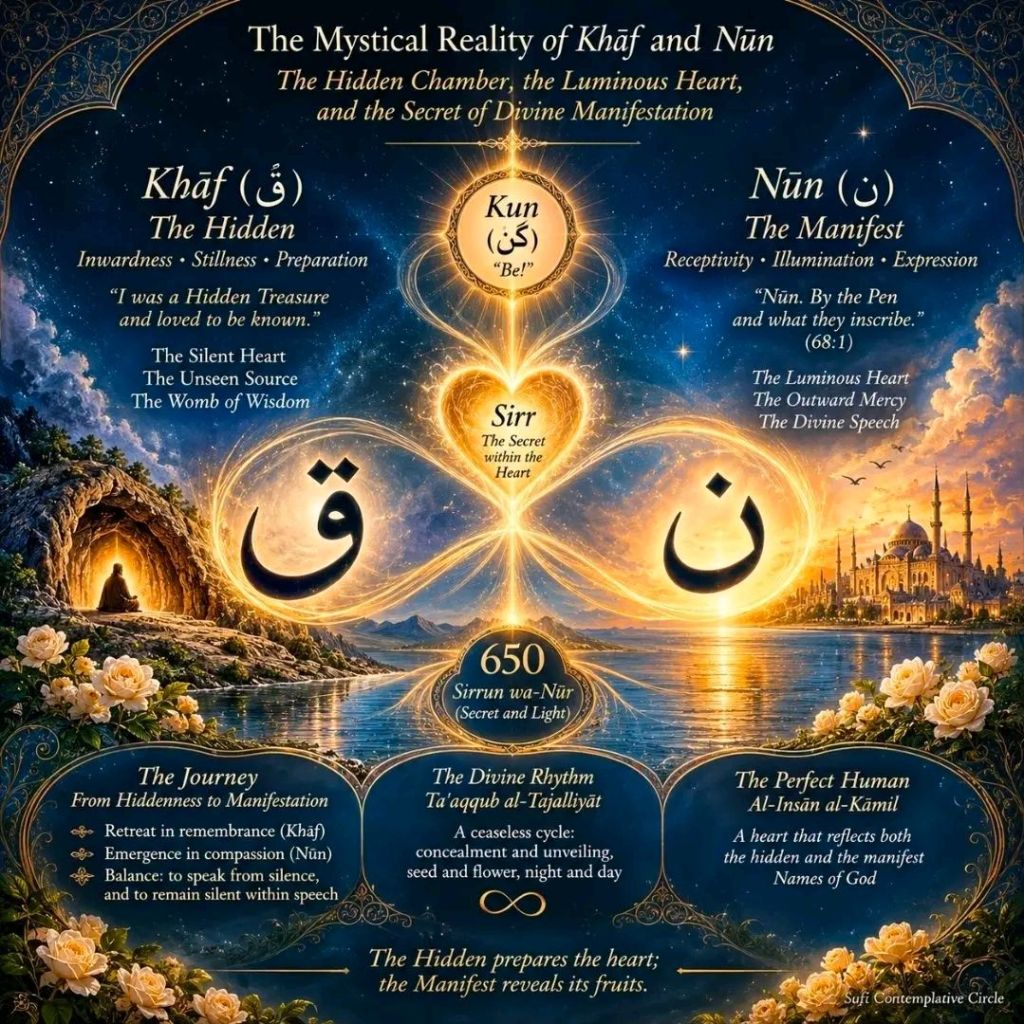
The Mystical Reality of Khāf and Nūn

■ The Mystical Reality of Khāf and Nūn

The Hidden Chamber, the Luminous Heart,
and the Secret of Divine Manifestation

In the contemplative tradition of ʿIlm al-Ḥurūf, the spiritual science of letters, the Arabic alphabet becomes a means through which seekers reflect upon the mysteries of existence, the human heart, and the relationship between the unseen and the manifest.

The letters are more than instruments of speech and written symbols. Their forms, sounds and numerical correspondences
invite contemplation of the deeper realities
of creation.

Among these letters, Khāf (خ) and Nūn (ن)
may be contemplated as two complementary symbols: Khāf representing hiddenness, inwardness and spiritual preparation; Nūn representing receptivity, illumination and manifestation.

Together, they offer a symbolic journey through the movement of the spiritual secret (sirr) from concealment into awareness, and from inward awareness into outward expression.

■ The Depth of Khāf: The Hidden Chamber
of the Spirit

Khāf represents the inward stillness of the spiritual heart, the hidden chamber in which
the seeker withdraws from worldly distractions and becomes receptive to the remembrance of Almighty Allāh.

It symbolises the condition of spiritual potential before expression, where the disturbances of the ego gradually become quiet and the heart learns the meaning of surrender.

The Sufi tradition frequently contemplates the mystery of the unseen through the imagery of the Hidden Treasure, associated with the narration:

“I was a Hidden Treasure and loved to be known, so I created creation that I might be known.”

Although its attribution as a Prophetic hadith
is not established, its meaning has profoundly influenced later Sufi metaphysical reflection.

In this contemplative interpretation, Khāf becomes an image of hidden potential: the unseen reality preceding outward manifestation, where the seeker discovers
that not everything precious must be displayed, and not everything known must be spoken.

This inward dimension is closely connected with dhikr al-khafī, the silent remembrance of the heart.

▪︎ In al-Risālah al-Qushayriyyah, Imām al-Qushayrī, relates the account of Shaykh
Sahl ibn ʿAbd Allāh al-Tustarī, may Almighty Allāh sanctify their secrets,who was instructed to remember:

“Allāh is with me, Allāh is watching me,
Allāh is witnessing me.”

Shaykh Sahl relates that he was instructed to repeat these words inwardly, without moving his tongue, until he experienced sweetness within his innermost being.

This illustrates the spiritual meaning of Khāf: remembrance becoming established within the heart, even when the tongue remains silent.

▪︎ Shaykh Ibn ʿAṭāʾ Allāh al-Iskandarī, may Almighty Allāh sanctify his secret, writes in al-Ḥikam:

“Bury your existence in the earth of obscurity, for whatever sprouts forth, without having first been buried, flowers imperfectly.”

This wisdom reflects the necessity of hidden spiritual cultivation. Just as a seed develops beneath the earth before emerging into the light, the heart requires inward preparation before its spiritual qualities become visible through character and conduct.

Khāf therefore symbolises the protection of sincerity, the discipline of the ego and the cultivation of remembrance away from the desire for recognition.

■ The Birth of Nūn: The Luminous Expansion

When the heart has been cultivated through inward remembrance, it becomes increasingly receptive to spiritual understanding.

Here we contemplate Nūn (ن), whose curved form resembles a vessel receiving something placed within it.

Its shape invites reflection upon receptivity, the receiving of wisdom and the transformation of inward awareness into outward expression.

▪︎ The Qur’ān opens Sūrah al-Qalam with the mysterious letter:

ن ۚ وَالْقَلَمِ وَمَا يَسْطُرُونَ

“Nūn. By the Pen and what they inscribe.”
(Qur’ān 68:1)

The letter Nūn stands at the threshold of a chapter that immediately invokes the Pen
and the act of inscription.

In contemplative Sufi reflection, this relationship invites consideration of the unseen decree and its manifestation within creation.

Where Khāf symbolises inward concealment, Nūn symbolises receptivity and the emergence of meaning into expression.

The seeker who emerges from Khāf into Nūn does not abandon silence. Rather, the remembrance cultivated within begins to influence everything expressed outwardly.

His words become more measured, his actions more compassionate, and his presence less concerned with recognition.

▪︎ Shaykh Ibn ʿAṭāʾ Allāh writes:

“Actions are lifeless forms, but the presence of an inner reality of sincerity (sirr al-ikhlāṣ) within them is what endows them with life-giving Spirit.” (Al-Ḥikam al-ʿAṭāʾiyyah)

This reveals an essential principle: outward actions acquire their spiritual worth through
the sincerity from which they emerge.

Nūn therefore becomes an image of inward remembrance taking form through compassion, knowledge, truthful speech and righteous conduct.

■ The Numerical Mysteries: 600 and 50

Within the traditional Abjad numerical system, Arabic letters possess corresponding numerical values.

Khāf (خ) carries the value of 600, while Nūn (ن) carries the value of 50.

Their combined numerical value is 650.

In contemplative interpretations of ʿIlm al-Ḥurūf, numbers may serve as symbolic instruments for reflection, although their spiritual meanings are not universally agreed upon and should not be confused with established Qur’anic teachings.

▪︎ Khāf — 600: The Hidden Totality

The numerical value of Khāf may be contemplated as an image of concealed completeness: the possibilities contained within the unseen before they become visible within creation.

It represents stillness before expression, inwardness before outward movement, and the spiritual secret protected from the distractions of recognition.

▪︎ Nūn — 50: The Receptive Manifestation

Nūn becomes a symbol of receptivity and the emergence of inward meaning.

Its curved form invites contemplation of the heart as a vessel capable of receiving wisdom and reflecting it through conduct.

Their combined value, 650, is the numerical sum of these two letters. Any additional spiritual significance attributed to this number belongs to symbolic interpretation rather than an established numerical doctrine.

The deeper lesson is the relationship between hidden potential and manifested expression.

■ The Subtle Energies: Khāf and the Laṭāʾif

In Sufi metaphysics, the human being possesses subtle spiritual centres known as the Laṭāʾif. Their descriptions and arrangements differ among the various spiritual traditions, particularly within the Naqshbandī-Mujaddidī and other schools.

For this contemplation, Khāf may be associated symbolically with the innermost dimension of hidden remembrance, while Nūn may be associated with the receptive heart.

■ The Hidden Subtlety of Khāf

Khāf draws the seeker inward, representing humility, concealment and freedom from the desire for recognition.

▪︎ Shaykh Ibn ʿAṭāʾ Allāh writes:

“Nothing benefits the heart more than a spiritual retreat wherein it enters the domain
of meditation.” (Al-Ḥikam al-ʿAṭāʾiyyah)

Retreat creates an inward space in which the heart can examine its attachments, become attentive to remembrance and recognise its dependence upon Almighty Allāh.

■ The Receptive Heart of Nūn

Nūn represents the heart becoming receptive to wisdom and illumination. It symbolises the transformation of inward remembrance into outward mercy.

▪︎ Shaykh Ibn ʿAṭāʾ Allāh also writes:

“How can the heart be illumined while the forms of creatures are reflected in its mirror? Or how can it journey to Allah while shackled by its passions?” (Al-Ḥikam al-ʿAṭāʾiyyah)

The heart cannot properly reflect illumination while remaining dominated by attachment, heedlessness and the demands of the lower self. The seeker must therefore pursue purification before expecting inward understanding to become sound outward expression.

Khāf draws inward; Nūn expresses outward.
Khāf protects sincerity; Nūn manifests its fruits.

■ The Union of Hiddenness and Manifestation

The relationship between Khāf and Nūn may be understood through two fundamental principles of Islamic metaphysics: Tanzīh and Tashbīh.

Tanzīh affirms the absolute transcendence of Almighty Allāh, beyond resemblance to creation.

Tashbīh concerns the signs of divine Names and Attributes as they become known through their effects within creation, without suggesting that Almighty Allāh resembles His creation or is contained within it.

▪︎ Shaykh Ibn ʿAṭāʾ Allāh offers a profound reflection:

“The entire cosmos is darkness; it is illumined only by the manifestation of the Real within it.”
(Al-Ḥikam al-ʿAṭāʾiyyah)

This wisdom illuminates the relationship between hiddenness and manifestation.
The created world does not possess independent power or existence apart from Almighty Allāh. Its signs invite contemplation of the One who brought it into existence.
Yet the seeker must never confuse the signs with the Divine Essence itself.

The inward symbolism of Khāf reminds the seeker that the Divine Reality cannot be encompassed by human understanding, while Nūn invites contemplation of the signs of divine wisdom throughout creation.

The heart that understands this balance becomes increasingly free from spiritual arrogance and negligence. Whatever goodness appears through the human being is a gift from Almighty Allāh, not an independent possession.

■ The Secret of Creation: Kun

The relationship between hiddenness and manifestation naturally leads to contemplation of the Divine Command:

كُنْ فَيَكُونُ

“Be! And it is.” (Qur’ān 2:117)

The command Kun expresses the absolute power of Almighty Allāh, whose will is never dependent upon created means.

Khāf and Nūn may be contemplated symbolically alongside this command, but they do not literally constitute the word Kun.

The kāf and nūn of Kun form the Qur’anic expression of the Divine Command, while
Khāf offers an additional symbolic image of hiddenness preceding manifestation..

Every moment of existence is dependent
upon Almighty Allāh. Nothing possesses independent power of creation, and nothing exists outside His knowledge and sovereignty.
The seeker who contemplates Kun begins to recognise the poverty of creation before its Creator.

This is the foundation of true faqr: the recognition that everything belongs to Almighty Allāh and that the human being possesses nothing independently of Him.

■ The Human Heart: The Meeting Point

Within the human being, the heart becomes
the meeting point of these two symbolic dimensions.

Khāf represents inward remembrance, while Nūn represents the expression of that remembrance through the tongue, the hands and the conduct of the individual.

When inward sincerity and outward righteousness become harmonised, the human being approaches the ideal of al-Insān al-Kāmil, the Perfect Human.

The Perfect Human is understood as a comprehensive mirror of the divine Names, within the limits of created servanthood.
The supreme example of human perfection is the Beloved Messenger of Almighty Allāh, Sayyidunā Muḥammad ﷺ.

His blessed life illustrates the harmony between inward devotion and outward responsibility. His retreat in the cave of Ḥirāʾ reminds us of the significance of solitude, contemplation and preparation.

His emergence with Revelation demonstrates the importance of conveying divine guidance to humanity. He did not remain in retreat from the world. He returned to guide, teach, serve, forgive and establish the way of Almighty Allāh.

The purpose of inward illumination is therefore not permanent withdrawal from humanity, but the emergence of a heart whose relationship with Almighty Allāh transforms its relationship with creation.

■ The Dance of Hiddenness and Manifestation

The movement between Khāf and Nūn is not simply a progression from one spiritual state into another. It is a recurring rhythm of inwardness and outward expression.

The seeker withdraws into remembrance, returns to the world through service, and then returns again to inward reflection. This rhythm may be contemplated through the relationship between:

▪︎ Silence and speech.
▪︎ Night and day.
▪︎ Concealment and revelation.
▪︎ Retreat and companionship.
▪︎ Reflection and action.

In Sufi metaphysical language, the successive manifestations of divine signs may be contemplated through the expression taʿāqub al-tajalliyāt, the succession of unveilings.

The heart of the ʿārif becomes receptive to these signs, recognising that every moment offers an opportunity for reflection and remembrance.

Yet the seeker must never mistake the manifestation of divine signs for the Divine Essence itself..Khāf protects the secret of inwardness, while Nūn symbolises the expression of its spiritual fruits.

The seeker learns to speak from silence without losing humility, and to remain inwardly attentive while engaged with the world.

■ Returning to the Hidden Ocean

Khāf and Nūn may finally be contemplated as two complementary dimensions of the same spiritual journey.

Khāf is the stillness; Nūn is the expression.
Khāf is the hidden seed; Nūn is the flowering.
Khāf is inward remembrance; Nūn is its outward manifestation.

The seeker who traverses between these dimensions learns the art of spiritual balance: to speak from silence, to act from sincerity, and to remain inwardly connected to Almighty Allāh while fulfilling the responsibilities of worldly existence.

Every outward action should return the heart to remembrance, and every inward remembrance should cultivate goodness in outward conduct.
This is not a journey towards becoming divine, nor a dissolution of the distinction between Creator and creation. It is a journey towards the perfection of servanthood, ʿubūdiyyah.

▪︎《The Qur’ān declares:

“He is the First and the Last, the Manifest and the Hidden, and He is Knowing of all things.”
(Qur’ān 57:3)

This verse brings the contemplation of Khāf and Nūn towards its deepest conclusion.
The hidden and the manifest are both within the sovereignty and knowledge of Almighty Allāh. The heart must therefore learn to recognise His signs without attempting to encompass His Essence.

The final station is not the acquisition of a secret, the possession of extraordinary knowledge, or the attainment of a spiritual identity. It is sincerity before Almighty Allāh, humility before His creation, and the fulfilment of servanthood through love, remembrance and obedience.

Khāf teaches the seeker to guard the secret.
Nūn teaches the seeker to express its fruits.

And the heart, suspended between silence and illumination, learns that the greatest unveiling is not to be seen by creation, but to become sincere before the Creator.

The Hidden prepares the heart; the Manifest reveals its fruits. And the heart that remembers Almighty Allāh in silence must also demonstrate that remembrance through mercy in the world.

And only with Almighty Allāh is true success.