

One evening in July 1400, the great Chishti master Sayyid Bande Nawaz Gesu Daraz related a curious story to his disciples. It concerned a journey to Karbala, an old woman, and a young man whose condition had left little room for hope. Gesu Daraz had heard the account several decades earlier from a friend, a resident of the Sultanate metropolis of Delhi named Maulana Hushamuddin.
After completing his Hajj pilgrimage, Maulana Hushamuddin had travelled to Karbala to pay his respects at the shrine of Imam Hussain. Among the pilgrims he encountered there was an old woman accompanied by her son, a young man who could neither see nor walk. His mother had brought him all the way to the shrine, perhaps having exhausted every other remedy available to her. There, she had him carried inside and laid across the tomb, following which they spread the sacred ghilaf, the cloth covering the grave, over his helpless body.
What happened next was nothing short of astonishing.
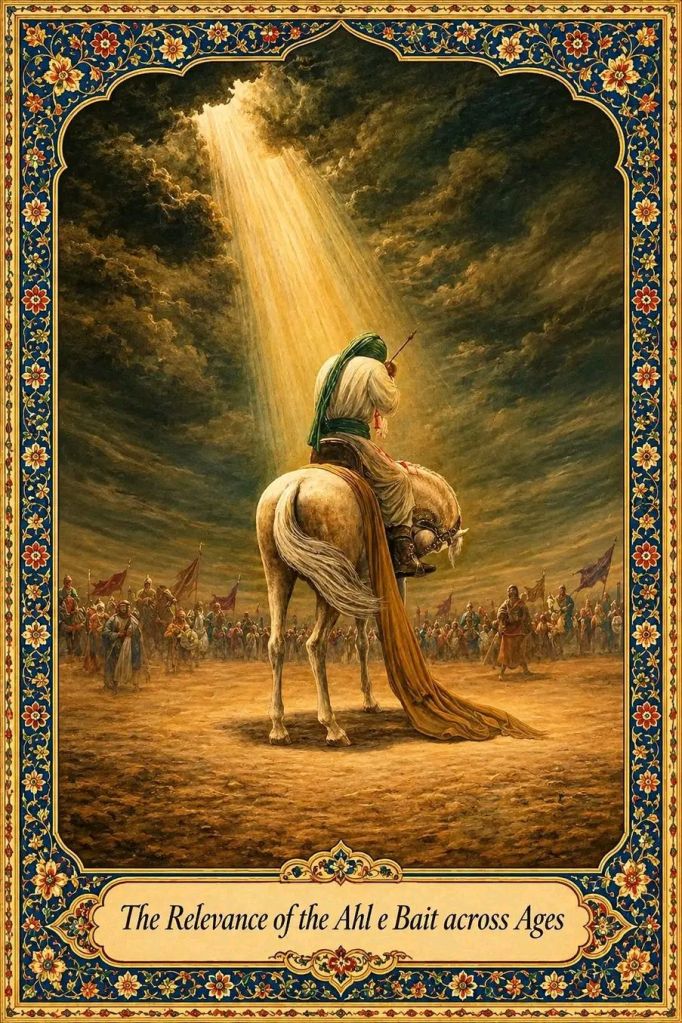
A little while later, the young man emerged from the shrine on his own feet. Not only could he walk, he could see. When the astonished onlookers asked him what had happened, he recounted that, while lying upon the tomb, he had seen Imam Hussain mounted upon a horse. Moved by his miserable condition, the Imam had passed his hand over the young man’s face and legs. His sight had returned, his limbs had been restored, and he had risen from the tomb completely cured.
The story, extraordinary as it sounds, was not without a parallel. Nearly a generation earlier, the great Moroccan traveller Ibn Battuta had recorded an account of remarkably similar happenings at another great shrine of the House of the Prophet.
During his visit to the shrine of Hazrat Ali in Najaf, Ibn Battuta heard of a custom associated with the 27th night of the Islamic month of Rajab. On that particular night, some 30-40 people suffering from paralysis and other afflictions were brought to the shrine and laid upon the tomb. Around them gathered the faithful, who occupied themselves with prayers, religious litanies, and Quranic recitations.
Then came the long vigil.
Before dawn, according to the account, the afflicted would rise from the tomb completely cured, their voices ringing out in praise of Hazrat Ali. Ibn Battuta, for his part, personally encountered three disabled men at the shrine. When he asked why they had not yet received their cure, they explained that they had missed the appointed night and were waiting for the following year.
The two accounts, separated by a generation and by the distance between Najaf and Karbala, belong to the same world of sacred expectation. At Najaf, it was Hazrat Ali; at Karbala, his son Imam Hussain. The afflicted came carrying the burdens that ordinary remedies had failed to lift, and placed their last hope in the intercession of the House of the Prophet.
And there, perhaps, lies a most delicious irony.
Nasibi sentiments might have been flourishing across much of the Islamic world, but the human body had its own politics, and suffering its own theology. When blindness, paralysis and other afflictions came knocking, doctrinal loyalties could suddenly become much more flexible. The Ahl-e-Bait, it seems, remained eminently useful, even in an age when their memory was not always treated with the reverence it deserved.
One could denounce them all they liked, but when the limbs failed and the eyes went dark, a little intercession from the family of the Prophet was definitely worth its weight in gold.


