
Khutbah 1 — Doosra hissa: Kainat ki takhleeq (The Creation of the Universe)

Khutbah 1 — Doosra hissa: Kainat ki takhleeq

Arabic matn:

أَنْشَأَ الْخَلْقَ إِنْشَاءً، وَابْتَدَأَهُ ابْتِدَاءً، بِلَا رَوِيَّةٍ أَجَالَهَا، وَلَا تَجْرِبَةٍ اسْتَفَادَهَا، وَلَا حَرَكَةٍ أَحْدَثَهَا، وَلَا هَمَامَةِ نَفْسٍ اضْطَرَبَ بِهَا.

أَحَالَ الْأَشْيَاءَ لِأَوْقَاتِهَا، وَلَأَمَ بَيْنَ مُخْتَلِفَاتِهَا، وَغَرَزَ غَرَائِزَهَا، وَأَلْزَمَهَا أَشْبَاحَهَا، عَالِمًا بِهَا قَبْلَ ابْتِدَائِهَا، مُحِيطًا بِحُدُودِهَا وَانْتِهَائِهَا، عَارِفًا بِقَرَائِنِهَا وَأَحْنَائِهَا.

Roman Urdu talafuz:

Ansha’al-khalqa inshaa’an, wabtada’ahu ibtidaa’an, bila rawiyyatin ajaalahaa, wa la tajribatin istafaadahaa, wa la harakatin ahdathahaa, wa la hamaamati nafsin idtaraba bihaa.

Ahaala al-ashyaa’a li-awqaatihaa, wa la’ama baina mukhtalifatihaa, wa gharaza gharaa’izahaa, wa alzamahaa ashbaahaa, ‘aaliman bihaa qabla ibtidaa’ihaa, muheetan bi-hudoodihaa wa intihaa’ihaa, ‘aarifan bi-qaraa’inihaa wa ahnaa’ihaa.

Roman Urdu tarjuma

Allah ne makhlooq ko paida kiya aur uski ibtida farmayi, baghair kisi pehle se soch-vichar ki zaroorat ke, baghair kisi tajrube se faida uthane ke, baghair kisi harkat ke jo usne pehle khud paida ki ho, aur baghair kisi zehni pareshani ya andarooni bechaini ke.

Usne har cheez ko uske muqarrar waqt ke mutabiq rakha, mukhtalif cheezon ke darmiyan munasibat paida ki, unki fitri khasusiyat muqarrar ki aur unhein unki munasib shaklein ata ki.

Woh in sab cheezon ko unki paidaish se pehle hi jaanta tha; unki hudood, unki inteha aur unke tamam pehluon ka ilm rakhta tha.

Tashreeh

1. Allah ko kisi planning ya tajrube ki zaroorat nahin

Insan koi kaam karne se pehle sochta hai, tajruba karta hai, ghalti karta hai aur phir apne tareeqe ko behtar banata hai. Allah ki zaat aisi nahin. Uska ilm aur qudrat kamil hai. Kainat ki takhleeq ke liye use kisi tajrube ya mashq ki zaroorat nahin.

2. Kainat mein nizam aur taqdeer

Imam Ali ؑ batate hain ke Allah ne har cheez ko ek muqarrar nizam ke tehat paida kiya. Kainat mein cheezon ka ek doosre se talluq aur unki fitri khasusiyat Allah ke ilm aur hikmat ke mutabiq hain.

3. Allah ka ilm takhleeq se pehle bhi tha

Allah kisi cheez ko paida karne ke baad uske bare mein ilm hasil nahin karta. Woh har cheez ko uske wajood mein aane se pehle bhi jaanta hai. Yeh Allah ke sifat-e-ilm aur kamil qudrat ka bayan hai.

Matn ke hawalay: Nahjul Balagha, Khutbah 1; Arabic aur tarjuma ke muqable ke liye Nahjul Balagha Reader aur Al-Islam.org ke matn dekhein. Nahj al-Balagha+2

Is hisse se hasil hone wale sabaq

  1. Allah ki hamd aur shukr insan ki bunyadi zimmedari hai.
  2. Allah ki zaat aur sifaat ko makhlooq ke paimane se nahin naapna chahiye.
  3. Kainat ka nizam Allah ke ilm, qudrat aur hikmat ka mazhar hai.
  4. Allah ka ilm azali hai; use kisi tajrube ya tajdeed-e-ilm ki zaroorat nahin.
  5. Insani aqal Allah ki makhlooq hai, is liye woh Khaliq ki zaat ka mukammal ihata nahin kar sakti.
The Creation of the Universe

خلق العالم

He initiated creation most initially and commenced it originally, without undergoing reflection, without making use of any experiment, without innovating any movement, and without experiencing any aspiration of mind. He allotted all things their times, put together their variations gave them their properties, and determined their features knowing them before creating them, realising fully their limits and confines and appreciating their propensities and intricacies.

أَنْشَأَ الخَلْقَ إنْشَاءً، وَابْتَدَأَهُ ابْتِدَاءً، بِلاَ رَوِيَّة أَجَالَهَا، وَلاَ تَجْرِبَة اسْتَفَادَهَا، وَلاَ حَرَكَة أَحْدَثَهَا، وَلاَ هَمَامَةِ نَفْس اضطَرَبَ فِيهَا. أَحَالَ الاْشياءَ لاِوْقَاتِهَا، وَلاَمَ بَيْنَ مُخْتَلِفَاتِهَا، وَغَرَّزَ غَرائِزَهَا، وَأَلزَمَهَا أشْبَاحَهَا، عَالِماً بِهَا قَبْلَ ابْتِدَائِهَا، مُحِيطاً بِحُدُودِها وَانْتِهَائِهَا، عَارفاً بِقَرَائِنِها وَأَحْنَائِهَا.

When Almighty created the openings of atmosphere, expanse of firmament and strata of winds, He flowed into it water whose waves were stormy and whose surges leapt one over the other. He loaded it on dashing wind and breaking typhoons, ordered them to shed it back (as rain), gave the wind control over the vigour of the rain, and acquainted it with its limitations. The wind blew under it while water flowed furiously over it.

ثُمَّ أَنْشَأَ ـ سُبْحَانَهُ ـ فَتْقَ الاْجْوَاءِ، وَشَقَّ الاْرْجَاءِ، وَسَكَائِكَ الَهوَاءِ، فأَجازَ فِيهَا مَاءً مُتَلاطِماً تَيَّارُهُ، مُتَراكِماً زَخَّارُهُ، حَمَلَهُ عَلَى مَتْنِ . الرِّيحِ الْعَاصِفَةِ، وَالزَّعْزَعِ الْقَاصِفَةِ، فَأَمَرَها بِرَدِّهِ، وَسَلَّطَهَا عَلَى شَدِّهِ، وَقَرنَهَا إِلَى حَدِّهِ، الهَوَاءُ مِنْ تَحْتِها فَتِيقٌ، وَالمَاءُ مِنْ فَوْقِهَا دَفِيقٌ.

Then Almighty created forth wind and made its movement sterile, perpetuated its position, intensified its motion and spread it far and wide. Then He ordered the wind to raise up deep waters and to intensify the waves of the oceans. So the wind churned it like the churning of curd and pushed it fiercely into the firmament throwing its front position on the rear and the stationary on the flowing till its level was raised and the surface was full of foam.

Then Almighty raised the foam on to the open wind and vast firmament and made there-from the seven skies and made the lower one as a stationary surge and the upper one as protective ceiling and a high edifice without any pole to support it or nail to hold it together.

Then He decorated them with stars and the light of meteors and hung in it the shining sun and effulgent moon under the revolving sky, moving ceiling and rotating firmament.

ثُمَّ أَنْشَأَ سُبْحَانَهُ رِيحاً اعْتَقَمَ مَهَبَّهَا، وَأَدَامَ مُرَبَّهَا، وَأَعْصَفَ مَجْرَاها، وَأَبْعَدَ مَنْشَاهَا، فَأَمَرَها بِتَصْفِيقِ المَاءِ الزَّخَّارِ، وَإِثَارَةِ مَوْجِ البِحَارِ، فَمَخَضَتْهُ مَخْضَ السِّقَاءِ، وَعَصَفَتْ بهِ عَصْفَهَا بِالفَضَاءِ، تَرُدُّ أَوَّلَهُ عَلَى آخِرِهِ، وَسَاجِيَهُ عَلَى مَائِرِهِ، حَتَّى عَبَّ عُبَابُهُ، وَرَمَى بِالزَّبَدِ رُكَامُهُ، فَرَفَعَهُ فِي هَوَاء مُنْفَتِق، وَجَوٍّ مُنْفَهِق، فَسَوَّى مِنْهُ سَبْعَ سَموَات، جَعَلَ سُفْلاَهُنَّ مَوْجاً مَكْفُوفاً، وَعُلْيَاهُنَّ سَقْفاً مَحْفُوظاً، وَسَمْكاً مَرْفُوعاً، بِغَيْر عَمَد يَدْعَمُهَا، وَلا دِسَار يَنْظِمُها.

ثُمَّ زَيَّنَهَا بِزينَةِ الكَوَاكِبِ، وَضِياءِ الثَّوَاقِبِ، وَأَجْرَى فِيها سِرَاجاً مُسْتَطِيراً، وَقَمَراً مُنِيراً: في فَلَك دَائِر، وَسَقْف سَائِر، وَرَقِيم مَائِر.

Khutbah 1 — Pehla hissa: Allah ki hamd aur uski ma‘rifat

Khutbah 1 — Pehla hissa: Allah ki hamd aur uski ma‘rifat

Arabic matn — Khutbah 1 ka ibtidai hissa

Arabic:

الْحَمْدُ لِلَّهِ الَّذِي لَا يَبْلُغُ مِدْحَتَهُ الْقَائِلُونَ، وَلَا يُحْصِي نَعْمَاءَهُ الْعَادُّونَ، وَلَا يُؤَدِّي حَقَّهُ الْمُجْتَهِدُونَ، الَّذِي لَا يُدْرِكُهُ بُعْدُ الْهِمَمِ، وَلَا يَنَالُهُ غَوْصُ الْفِطَنِ، الَّذِي لَيْسَ لِصِفَتِهِ حَدٌّ مَحْدُودٌ، وَلَا نَعْتٌ مَوْجُودٌ، وَلَا وَقْتٌ مَعْدُودٌ، وَلَا أَجَلٌ مَمْدُودٌ.

فَطَرَ الْخَلَائِقَ بِقُدْرَتِهِ، وَنَشَرَ الرِّيَاحَ بِرَحْمَتِهِ، وَوَتَّدَ بِالصُّخُورِ مَيَدَانَ أَرْضِهِ.

Roman Urdu talafuz:

Al-hamdu lillahil-lazi la yablughu mid-hatahul-qaa’iloon, wa la yuhsee na‘maa’ahul-‘aaddoon, wa la yu’addi haqqahul-mujtahidoon.

Allazi la yudrikuhu bu‘dul-himam, wa la yanaaluhu ghawsul-fitan. Allazi laisa li-sifatihi haddum mahdood, wa la na‘tum mawjood, wa la waqtum ma‘dood, wa la ajalum mamdood.

Fataral-khalaa’iqa bi-qudratihi, wa nasharar-riyaaha bi-rahmatihi, wa wattada bis-sukhoori mayadaana ardihi.

Roman Urdu tarjuma

Tamam tareef Allah hi ke liye hai, jis ki hamd-o-sana tak bolne walon ki zaban nahin pahunch sakti; jis ki ne‘maton ko ginne wale gin nahin sakte; aur jo koshish karne wale hain, woh bhi us ka poora haq ada nahin kar sakte.

Woh aisa hai ke buland se buland irade bhi uski haqeeqat tak nahin pahunch sakte aur gehri se gehri aqal-o-fahm bhi uski kunh ko nahin paa sakti.

Uski sifaat ke liye koi muqarrar had nahin, koi aisi ta‘reef nahin jo uska poora ihata kar sake; uske liye koi gina hua waqt nahin aur na hi koi aisi muddat hai jo uski hasti ko khatam kar sake.

Usne apni qudrat se makhlooq ko paida kiya, apni rehmat se hawaon ko chalaya aur mazboot paharon ke zariye zameen ke iztirab ko sambhala.

Tashreeh

1. Allah ki hamd ka ihata insani zaban nahin kar sakti

Imam Ali ؑ sab se pehle Allah ki hamd ke zariye khutbah ka aaghaz karte hain. Insan Allah ki jitni tareef kare, woh uski azmat ka mukammal ihata nahin kar sakta.

Iska matlab yeh nahin ke Allah ki tareef karna be-ma‘ni hai, balkeh iska matlab hai ke Allah ki azmat insani alfaaz aur ilm se kahin zyada wasee‘ hai.

2. Allah ki ne‘maton ka shumar mumkin nahin

Insan apni zindagi mein Allah ki di hui ne‘maton ka ek chhota sa hissa bhi poori tarah nahin gin sakta. Saans, zindagi, ilm, aqal, rizq aur kainat ka nizam — sab Allah ki ne‘matein hain.

Qur’an mein bhi farmaya gaya:

Surah Ibrahim 14:34

وَإِن تَعُدُّوا نِعْمَتَ اللَّهِ لَا تُحْصُوهَا

Roman Urdu: Wa in ta‘uddoo ni‘matallahi la tuhsooha.

Tarjuma: “Aur agar tum Allah ki ne‘maton ko ginne lago to unka poora shumar nahin kar sakoge.”

3. Allah ki zaat makhlooq ki hudood se bala-tar hai

Imam Ali ؑ ke alfaaz “laisa li-sifatihi haddum mahdood” ka mafhoom yeh hai ke Allah ki zaat ko makhlooq ki tarah kisi jism, jagah, waqt ya mehdood paimane mein nahin samjha ja sakta.

Yeh tauheed ka bunyadi aqeeda hai: Allah Khaliq hai aur baqi sab makhlooq.

4. Allah ki qudrat aur rehmat

Khutbah ke aakhri jumle mein Imam Ali ؑ kainat ke nizam ki taraf tawajjuh dilate hain: makhlooq Allah ki qudrat se paida hui, hawaon ka chalna uske nizam ke tehat hai aur paharon ka zameen ke nizam mein apna kirdar hai.

Sermon 1: Praise is due to Allah whose worth cannot be described

In this sermon he recalls the creation of Earth and Sky and the creation of Adam and in it he mentions the Hajj

ومن خطبة له (عليه السلام) يذكر فيها ابتداءَ خلق السماءِ والاَرض، وخلق آدم عليه الصلاة والسلام

(فيها ذكر الحج)

(وتحتوي على حمد الله، وخلق العالم، وخلق الملائكة، واختيار الانبياء، ومبعث النبي، والقرآن، والاحكام الشرعية)

Praise is due to Allah whose worth cannot be described by speakers, whose bounties cannot be counted by calculators and whose claim (to obedience) cannot be satisfied by those who attempt to do so, whom the height of intellectual courage cannot appreciate, and the divings of understanding cannot reach; He for whose description no limit has been laid down, no eulogy exists, no time is ordained and no duration is fixed. He brought forth creation through His Omnipotence, dispersed winds through His Compassion, and made firm the shaking earth with rocks.

الحَمْدُ للهِ الَّذَي لاَ يَبْلُغُ مِدْحَتَهُ القَائِلُونَ، وَلاِ يُحْصِي نَعْمَاءَهُ العَادُّونَ، ولاَ يُؤَدِّي حَقَّهُ الُمجْتَهِدُونَ، الَّذِي لاَ يُدْركُهُ بُعْدُ الهِمَمِ، وَلاَ يَنَالُهُ غَوْصُ الفِطَنِ، الَّذِي لَيْسَ لِصِفَتِهِ حَدٌّ مَحْدُودٌ، وَلاَ نَعْتٌ مَوْجُودٌ، وَلا وَقْتٌ مَعْدُودٌ، وَلا أَجَلٌ مَمْدُودٌ. فَطَرَ الخَلائِقَ بِقُدْرَتِهَ، وَنَشَرَ الرِّيَاحَ بِرَحْمَتِهِ، وَوَتَّدَ بِالصُّخُورِ مَيَدَانَ أَرْضِهِ.

The foremost in religion is the acknowledgement of Him, the perfection of acknowledging Him is to testify Him, the perfection of testifying Him is to believe in His Oneness, the perfection of believing in His Oneness is to regard Him Pure, and the perfection of His purity is to deny Him attributes, because every attribute is a proof that it is different from that to which it is attributed and everything to which something is attributed is different from the attribute.

Thus whoever attaches attributes to Allah recognises His like, and whoever recognises His like regards Him two; and whoever regards Him as two recognises parts for Him; and whoever recognises parts for Him mistook Him; and whoever mistook Him pointed at Him; and whoever pointed at Him admitted limitations for Him; and whoever admitted limitations for Him numbered Him. Whoever said: ‘In what is He?’, held that He is contained; and whoever said: ‘On what is He?’, held He is not on something else.

أَوَّلُ الدِّينِ مَعْرِفَتُهُ، وَكَمَالُ مَعْرِفَتِهِ التَّصْديقُ بِهِ، وَكَمَالُ التَّصْدِيقِ بِهِ تَوْحِيدُهُ، وَكَمَالُ تَوْحِيدِهِ الاخْلاصُ لَهُ، وَكَمَالُ الاخْلاصِ لَهُ نَفْيُ الصِّفَاتِ عَنْهُ، لِشَهَادَةِ كُلِّ صِفَة أَنَّها غَيْرُ المَوْصُوفِ، وَشَهَادَةِ كُلِّ مَوْصُوف أَنَّهُ غَيْرُ الصِّفَةِ، فَمَنْ وَصَفَ اللهَ سُبْحَانَهُ فَقَدْ قَرَنَهُ، وَمَنْ قَرَنَهُ فَقَدْ ثَنَّاهُ،وَمَنْ ثَنَّاهُ فَقَد جَزَّأَهُ، وَمَنْ جَزَّأَهُ فَقَدْ جَهِلَهُ، وَمَنْ جَهِلَهُ فَقَدْ أشَارَ إِلَيْهِ، وَمَنْ أشَارَ إِلَيْهِ فَقَدْ حَدَّهُ، وَمَنْ حَدَّهُ فَقَدْ عَدَّهُ، وَمَنْ قَالَ: «فِيمَ» فَقَدْ ضَمَّنَهُ، وَمَنْ قَالَ: «عَلاَمَ؟» فَقَدْ أَخْلَى مِنُهُ.

He is a Being, but not through phenomenon of coming into being. He exists but not from non-existence. He is with everything but not in physical nearness. He is different from everything but not in physical separation. He acts but without connotation of movements and instruments. He sees even when there is none to be looked at from among His creation. He is only One, such that there is none with whom He may keep company or whom He may miss in his absence.

كائِنٌ لاَ عَنْ حَدَث، مَوْجُودٌ لاَ عَنْ عَدَم، مَعَ كُلِّ شَيْء لاَ بِمُقَارَنَة، وَغَيْرُ كُلِّ شيء لا بِمُزَايَلَة، فَاعِلٌ لا بِمَعْنَى الْحَرَكَاتِ وَالاْلةِ، بَصِيرٌ إذْ لاَ مَنْظُورَ إلَيْهِ مِنْ خَلْقِهِ، مُتَوَحِّدٌ إذْ لاَ سَكَنَ يَسْتَأْنِسُ بهِ وَلاَ يَسْتوْحِشُ لِفَقْدِهِ.

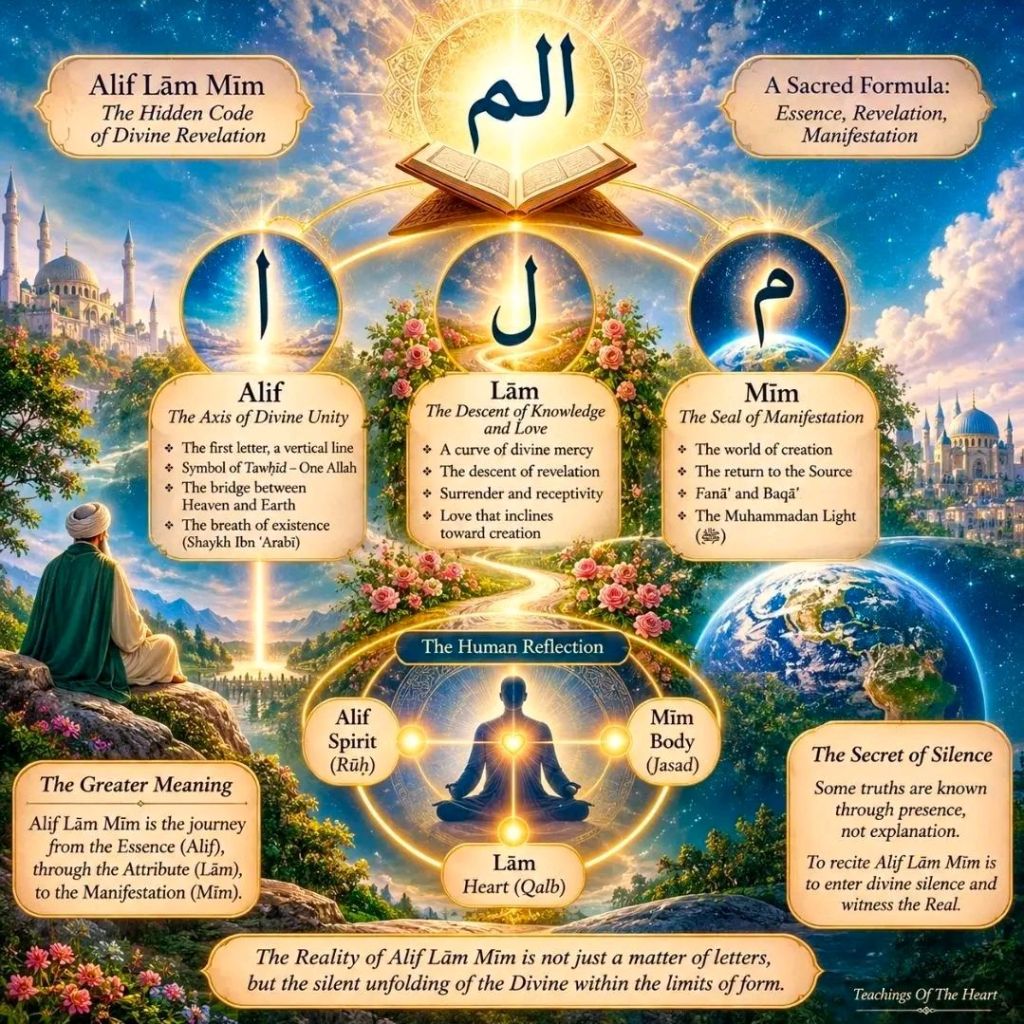
The Reality of Alif Lām Mīm

■ The Reality of Alif Lām Mīm (الم):
The Hidden Code of Divine Revelation

The mysterious opening of certain chapters
in the Qur’ān with disconnected letters such
as Alif Lām Mīm (الم) has puzzled minds and ignited hearts for centuries.

These letters, known as al-ḥurūf al-muqaṭṭaʿāt, are among the most profound veils of the Glorious Qur’ān.

To the Sufi masters and the people of
spiritual unveiling (ahl al-ishāra), they are
not meaningless symbols, but sacred codes breaths of the Divine Self, keys to the hidden structure of reality, and mirrors of the human soul.

■ The Language of the Unseen

When the Qur’ān begins with letters like Alif Lām Mīm, it is as if Allāh is speaking to His most intimate servants in the secret tongue
of eternity.

These letters, standing isolated yet radiant, mark the threshold between the seen and the unseen.

▪︎ Imām Muḥammad Mutawallī al-Shaʿrāwī,
may Almighty Allāh sanctify his secret, said:

“The Qur’ān, which is the miraculous speech of Allah, was revealed using letters like those you speak with, and words like those found in your language. But what makes it miraculous and distinguishes it from your speech? We say: Because it is the Speech of Allah. That is the difference; as for the letters, they are the same.” (Khawāṭir al-Shaʿrāwī)

The great mystics understood these letters
as vibrations of Being (anfaas al-wujūd).
Each letter carries a spiritual resonance that corresponds to a divine Name, an aspect of
the unfolding of creation.

When recited, they are not simply read they
are breathed. For the one whose Heart is open, these sounds awaken subtle currents of remembrance deep within the soul.

■  Alif: The Axis of Divine Unity

The letter Alif (ا) stands as the first letter of the Arabic alphabet, and symbolically, as the first manifestation of the Divine. It is a vertical line, simple and upright, representing the axis of unity (tawḥīd).

The Alif stands alone just as Allāh is One, incomparable, and without partner.

In its shape, one sees the bridge between Heaven and Earth the straight path that connects the Absolute to creation.

Sufi metaphysics describe Alif as the breath of existence itself the primordial line from which all other letters and forms emerge.

Just as every letter in Arabic is written upon the invisible base of the Alif, all creation rests upon the hidden support of the Divine Essence.

In human symbolism, the Alif corresponds to the spinal column and the upright posture of the human being the creature who stands erect before Almighty Allāh as His vicegerent (khalīfa).

It is the principle of divine consciousness awakened in the Heart.

■ Lām: The Descent of Knowledge and Love

The letter Lām (ل) is curved it descends from above and bends toward the earth, symbolizing the movement of divine mercy, knowledge, and love descending from the Infinite to the finite.

If Alif is the Essence, then Lām is the Attribute the bending of the Infinite toward manifestation.

It represents the moment when Allah reveals Himself to creation, when transcendence becomes immanence.

Sufi poets saw in Lām the curve of divine compassion the moment when Unity inclines toward multiplicity out of love.

The Heart of the Seeker, too, bends like Lām
in humility before the Truth, acknowledging that all knowledge and beauty are rays of
that single Light.

Thus, Lām teaches surrender and receptivity the spiritual posture of love.

■ Mīm: The Seal of Manifestation

The letter Mīm (م) completes the triad.
Its round form signifies the world of manifestation, the circle of creation,
and the veiling of the Divine within form.

The Mīm begins and ends at the same point symbolizing that all creation returns to its Source.

Within its enclosure lies the secret of fanāʾ (annihilation) and baqāʾ (subsistence in Allāh).
For many mystics, Mīm is also the symbol of Muhammad ﷺ, the perfected mirror of Divine Reality, the locus of the Muhammadan Light (Nūr Muḥammadī).

Through Mīm, the Infinite Alif reveals itself within the limits of creation.

Thus, Alif Lām Mīm becomes not just a combination of letters, but a sacred formula:
Essence, Revelation, Manifestation.

■ The Human Reflection of Alif Lām Mīm

On the microcosmic level, Alif Lām Mīm corresponds to the human being the mirror
of divine names.

• The Alif is the Spirit (Rūḥ), upright and luminous.

• The Lām is the Heart (Qalb), curved and receptive.

• The Mīm is the Body (Jasad), manifest and circular.

Together they form the perfect human the Insān al-Kāmil  who unites the vertical light of the Divine with the horizontal world of creation.

The Alif Lām Mīm within us is the alignment
of soul, Heart, and body in the remembrance
of Allāh.

■ The Secret of Silence

Ultimately, the meanings of Alif Lām Mīm
are beyond articulation.

The Beloved Prophet ﷺ himself did not publicly interpret these letters, and when questioned, the Companions remained silent.

This silence itself is the lesson  that some truths must be known through presence, not explanation.

To recite Alif Lām Mīm is to enter that silence, to allow the Heart to witness what the tongue cannot speak.

The Reality of Alif Lām Mīm is not a matter
of language alone but of being. It is the silent unfolding of the Divine within the limits of form, the descent of Unity into multiplicity,
and the reminder that the secret of all creation lies hidden in the Name of Almighty Allah.

To meditate upon these letters is to travel the entire arc of existence from the Essence (Alif), through the Attribute (Lām), to the Manifestation (Mīm).

Whoever witnesses this triad within themselves begins to read the true Qur’an not upon paper, but upon the illuminated tablet of the Heart.

And only with Almighty Allāh is true success.