


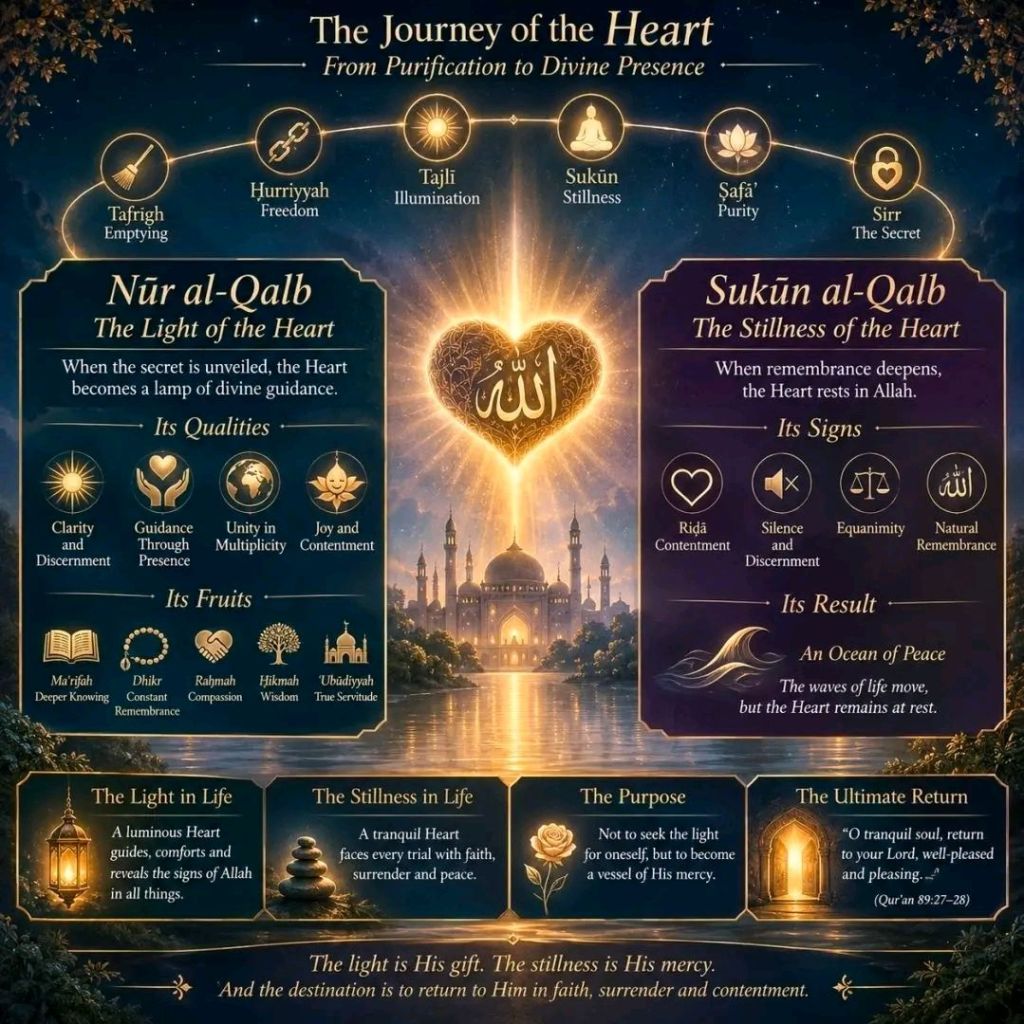
Nūr al-Qalb (The Light of the Heart):
From the Hidden Secret To Divine Illumination
This is the stage in which inward purification begins to manifest through perception, character, remembrance, and conduct.
The Heart, once obscured by heedlessness
and attachment, becomes receptive to divine guidance.
Like a polished mirror, it reflects the light bestowed by Almighty Allāh, not through its own power, but through His mercy.
▪︎ Almighty Allāh says:
“Allāh is the Light of the heavens and the
earth. The parable of His Light is as a niche within which is a lamp…” (Qur’ān 24:35)
The light belongs to Almighty Allāh;
the servant receives it through faith,
sincerity, and purification.
The Heart becomes illuminated as the veils
of ego, desire, and heedlessness are gradually removed.
■ The Preparation of the Heart
The preceding stations prepare the Heart for illumination:
▪︎ Tafrīgh — Emptying: releasing the Heart from ego and worldly preoccupation.
▪︎ Ḥurriyyah — Freedom: loosening attachment to that which distances the servant from Allah.
▪︎ Tajallī — Illumination: receiving clarity through divine guidance.
▪︎ Sukūn — Stillness: settling into tranquillity and trust.
▪︎ Ṣafāʾ — Purity: cleansing the Heart of spiritual obscuration.
▪︎ Sirr — The Secret: the innermost depth where subtle realities remain concealed.
Through these stations, the seeker is prepared for illumination. Yet the light is never an achievement of the ego; it is a gift from Allah.
■ The Qualities Of The Luminous Heart
▪︎ Clarity And Discernment
The illuminated Heart becomes less governed by desire, fear, and self-interest.
It begins to distinguish truth from illusion, sincerity from pretence, and the whisperings
of the ego from the demands of spiritual responsibility.
▪︎ Guidance Through Presence
Its influence is witnessed through humility, compassion, patience, and wisdom.
The seeker may benefit others not merely through words, but through sincerity of presence and the example of a life rooted in remembrance.
▪︎ Witnessing The Signs Of Almighty Allāh
Creation becomes a field of contemplation.
The diversity of existence reveals signs of divine wisdom, mercy, power, and majesty.
The seeker witnesses the signs of the One throughout creation, without confusing the Creator with what He has created.
▪︎ Joy And Contentment
The luminous Heart finds a joy that is not dependent upon worldly circumstances.
It may experience grief and hardship, yet beneath them remains a deeper reliance
upon Allāh, whose mercy is never absent.
■ The Fruits Of Illumination
▪︎ The light of the Heart manifests through:
▪︎ Maʿrifah: deeper recognition of one’s dependence upon Allah.
▪︎ Dhikr: remembrance becoming woven into daily life.
▪︎ Raḥmah: gentleness toward creation and compassion toward the afflicted.
▪︎ Ḥikmah: greater discernment in speech, action, and silence.
▪︎ ʿUbūdiyyah: an increasing awareness of servitude, humility, and obedience.
The true measure of illumination is not extraordinary experience, unveiling, or spiritual claims, but the transformation of character and steadfastness upon the Qur’ān and Sunnah.
■ The Heart As A Mirror
The Heart is polished through repentance, remembrance, sincerity, and the struggle against the nafs. As its obscurations diminish, it reflects more faithfully the signs of divine mercy.
The seeker begins to recognise blessings without becoming attached to them, to witness beauty without forgetting its Bestower, and to encounter creation without making it the ultimate object of the Heart.
The luminous Heart does not seek to be admired for its light. It directs attention
toward the One who grants illumination.
■ The Culmination Of Nūr
Nūr al-qalb is not the elevation of the self,
but the diminishing of its veils. The more the Heart is illuminated, the more it recognises
its poverty before Almighty Allāh.
The servant becomes a lamp only through
the light bestowed upon him; he guides only through what Allāh permits, and he remains ever in need of his Lord.
When the Heart is filled with light, it no longer seeks recognition for what it has received. It seeks sincerity, steadfastness, and closeness through servitude.
The light is His gift, the guidance is His, and
the Heart is but a servant receiving from its Lord.
■ Sukūn al-Qalb — The Stillness Of The Heart
When Remembrance Becomes Repose
After purification, freedom from attachment, and illumination, there unfolds sukūn al-qalb, the Stillness of the Heart.
It is the settling of inward turbulence through remembrance of Almighty Allāh. The Heart no longer allows every fear, desire, expectation,
or worldly disturbance to govern its state.
It may still grieve, rejoice, struggle, and love,
but beneath its changing emotions rests a deeper reliance upon its Lord. This is not withdrawal from life, but tranquillity within it.
■ The Meaning Of Sukūn
Sukūn derives from the Arabic root sakana, meaning to become still, settle, rest, or dwell. Its spiritual meaning is closely connected with sakīnah, the tranquillity bestowed by Allah upon the believers.
▪︎ Almighty Allāh says:
“He it is who sent down tranquillity (sakīnah) into the hearts of the believers, that they might increase in faith upon their faith.” (Qur’ān 48:4)
This tranquillity is not merely the absence of hardship. It is a mercy that may descend upon the servant even amid uncertainty, pain, and difficulty.
The Heart finds rest not because every circumstance has become favourable, but because it learns to entrust its affairs to Allah.
■ The Signs Of The Still Heart
▪︎ Riḍā — Contentment
The seeker strives through the means
Almighty Allāh has permitted, yet surrenders the outcome to Him.
In ease, he gives thanks; in hardship, he
seeks patience. Contentment does not mean passivity or abandoning responsibility, but accepting the decree while continuing to act with faith.
▪︎ Silence And Inward Attentiveness
The Heart becomes less reactive and more discerning. Silence is no longer merely the absence of speech, but a space for reflection, restraint, and wisdom. The seeker learns that not every provocation deserves a response.
▪︎ Equanimity
Praise and blame, gain and loss, honour and humiliation no longer possess the same power to disturb the Heart. The seeker still feels, but is no longer entirely governed by what he feels.
▪︎ Natural Remembrance
Dhikr becomes woven into daily life.
The servant remembers Almighty Allāh in prayer, work, solitude, service, and difficulty. Whenever heedlessness overtakes him, he returns to remembrance.
■ Stillness Within Movement
The perfection of stillness is not outward inactivity.
The Messenger of Allāh ﷺ was devoted in worship, active in service, compassionate toward creation, and steadfast in hardship,
yet his Heart was wholly devoted to Almighty Allāh.
The seeker therefore does not abandon
the world to attain stillness. He fulfils his obligations without allowing the world to become the master of his Heart.
He works without becoming enslaved to worldly gain, serves without demanding recognition, speaks when beneficial, and remains silent when wiser.
The outward and inward are brought into harmony through servitude.
■ The Ocean Of Peace
The still Heart resembles an ocean whose depths remain vast beneath the changing waves of its surface.
Joy and sorrow, nearness and distance, ease and hardship may pass through the servant’s life. The Heart may weep without losing faith, grieve without despair, and endure without becoming hardened.
Stillness is not the absence of emotion. It is the presence of reliance upon Allah beneath every emotion. The waves may move, but the Heart continually returns to its refuge.
■ The Still Heart And Divine Presence
▪︎ Almighty Allāh says:
“And He is with you wherever you are.”
(Qur’ān 57:4)
The still Heart lives with awareness of Almighty Allāh’s knowledge, mercy, and encompassing power. It does not imagine
that Almighty Allāh is contained within the Heart, but recognises that it is never beyond His knowledge or sustaining care.
This awareness accompanies the servant through every circumstance. In solitude, in company, in work, and in worship, the Heart returns to remembrance.
The still Heart is not one that never experiences heedlessness; it is one that continually returns whenever it forgets.
■ The Heart At Rest
▪︎ Almighty Allāh says:
“O tranquil soul, return to your Lord, well-pleased and pleasing. Enter among
My servants, and enter My Paradise.”
(Qur’ān 89:27–30)
The journey of the Heart moves from purification toward illumination, and from illumination toward deeper surrender.
The seeker no longer pursues spiritual stations to adorn the ego, nor unveils to establish rank. He seeks sincerity, steadfastness, and the pleasure of Almighty Allāh.
He continues to pray, repent, serve, and fulfil his responsibilities, yet his inward direction becomes increasingly settled upon his Lord.
The Heart rests, not because it has attained independence, but because it has discovered its absolute dependence upon Almighty Allāh.
The light is His gift. The stillness is His mercy. The journey is servitude. And the destination is to return to Him in faith, surrender, and contentment.
And only with Almighty Allāh is true success.


