


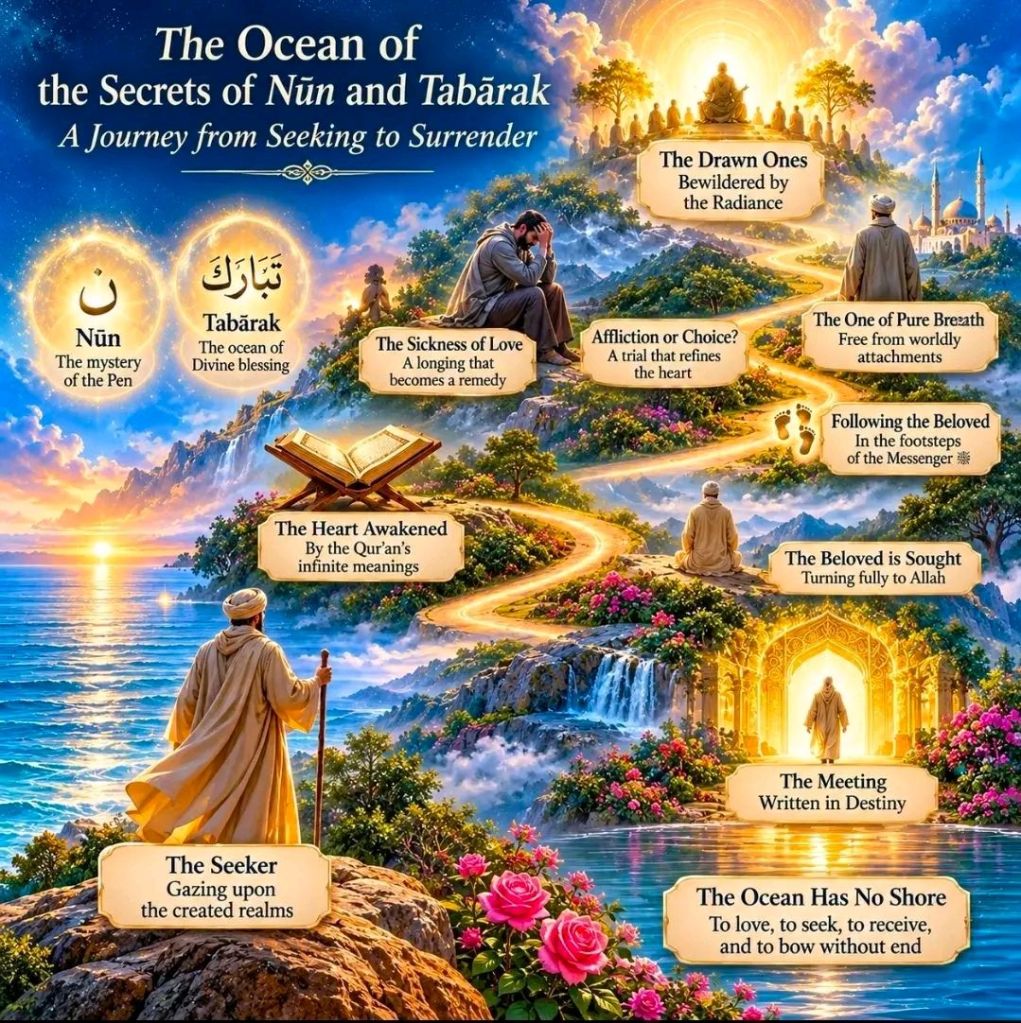
■ The Ocean of Nūn and Tabārak.
▪︎ Mysteries Of Eevelation, Divine attraction,
And The Bewilderment of the Lovers
There are oceans whose shores are never reached by the intellect. The people of love speak of them through letters, symbols, and allusions that carry meanings beyond the outward tongue.
Among these expressions is “The ocean of the secrets of Nūn and Tabārak” a poetic allusion to the mysteries of Qur’ānic revelation, the vastness of Divine knowledge, and the heart’s bewilderment before the majesty of Almighty Allāh.
The lover approaches this ocean not as one who possesses knowledge, but as one overcome by thirst.
He drinks, yet his thirst deepens; he receives, yet recognises his poverty; he is illuminated, yet the light reveals how little he truly knows.
The deeper he enters the ocean of Divine signs, the more he realises that no created being can encompass the knowledge of its Creator.
■ Nūn: The Mystery Of The Pen
▪︎ Almighty Allāh says:
ن ۚ وَالْقَلَمِ وَمَا يَسْطُرُونَ
Nūn. By the Pen and by what they write. (Qur’ān 68:1)
Nūn stands at the threshold of mystery, followed by the oath of the Pen and what is written. In the language of contemplation,
it evokes knowledge, decree, and realities beyond the reach of ordinary perception.
The letters of the Qur’ān are not approached
by the people of the heart with arrogance or claims of mastery.
Whatever reflections they inspire remain beneath the revealed meaning, for the servant cannot encompass the knowledge of the One who knows what is written, concealed, and yet to unfold.
The mystery of knowledge does not increase the true servant in self-importance; it increases him in awe, silence, and poverty before his Lord.
■ Tabārak: The Ocean of Divine Blessing
▪︎ Almighty Allāh declares:
تَبَارَكَ الَّذِي بِيَدِهِ الْمُلْكُ وَهُوَ عَلَىٰ كُلِّ شَيْءٍ قَدِيرٌ
Blessed is He in whose Hand is the dominion, and He is over all things Powerful.
(Qur’ān 67:1)
Tabārak evokes exalted majesty, abundant blessing, and the greatness of the One to Whom all sovereignty belongs. Every breath, every opening, every light, and every movement of the heart exists by His permission.
The lover may receive a sweetness in dhikr,
a tenderness in prayer, or a longing that transforms his life, but the gift is never the Giver.
No opening is his achievement, nor a rank he can claim. The more he receives, the more he recognises his dependence.
The ocean of Tabārak is an ocean of gratitude, before which the servant stands receiving, never possessing.
■ Between Nūn And Tabārak: The Ocean Of Secrets
When the majdhūb says, “From the ocean of the secrets of Nūn and Tabārak,” he brings together two Qur’ānic allusions: Nūn, evoking the Pen and what is written, and Tabārak, evoking Divine sovereignty and overflowing blessing.
Between these allusions, the heart contemplates an ocean of inexhaustible meaning: the mysteries of revelation, the wisdom of decree, and the blessings that descend upon the servant beyond his ability
to count or comprehend.
A verse may awaken repentance in one moment and longing in another. A word may
be recited thousands of times, yet on one occasion descend into the heart and transform the one who recites it.
The revelation remains unchanged, but
the servant is continually called to return.
The ocean is vast because the servant’s need for Almighty Allāh is without end.
■ The Sickness Of Love And The Remedy Of Longing
The lover asks, “Is love a sickness or a remedy?”
The majdhūb replies: “Its sickness is its remedy, and its remedy is its sickness.”
Love becomes a sickness when the heart can no longer find rest in heedlessness, when distance from its Lord becomes more painful than the hardships of the world.
Yet this longing becomes a remedy, driving
the servant towards repentance, remembrance, sincerity, and obedience.
The fire of love burns the pretensions of the ego, not the foundations of religion. It strips away pride, not the obligations of the Shariah. Its fruits should be humility before Almighty Allāh, mercy towards creation, and fidelity to the Sunnah of His Beloved Messenger ﷺ.
■ Affliction Outwardly, Divine Choosing Inwardly
The lover asks, “Is love an affliction or a
Divine choosing?”
The majdhūb answers: “Its outward appearance is affliction, but its inward
reality is Divine selection.”
The path of love is not always accompanied by sweetness. The heart may be refined through loss, patience through delay, sincerity through obscurity, and trust through the absence of what it desires.
Sometimes what the servant longs for becomes a veil, and its removal returns him
to his Lord.
Not every hardship is a sign of special rank. The wisdom of affliction belongs to Almighty Allāh, while the adab of the servant is patience, gratitude, and trust.
The lover does not demand to be recognised as chosen. He fears being left to himself.
■ The Bewilderment Of The Drawn Ones
When asked about the people of Divine attraction, the majdhūb says:
“They are bewildered by the dazzling radiance of nearness.”
This bewilderment, ḥayrah, is the heart’s astonishment before Divine majesty and its recognition that it cannot encompass what it witnesses. The greater its awareness of Almighty Allāh’s greatness, the smaller its claims become.
Such bewilderment is not the abandonment
of reason or departure from the Qur’ān and Sunnah.
The true measure of spiritual nearness is not extraordinary appearance or claims of unveiling, but humility, prayer, truthfulness,
and adab. The radiance of nearness is witnessed in the transformation of character.
■ The Seeker and the Sought
The lover asks how the sālik knows whether he is a seeker or one sought.
The majdhūb replies:
“If he gazes upon the created realms, he is a seeker; but if he gazes upon the Creator, he is one sought and beloved.”
The seeker begins by searching. He reflects upon creation, follows the paths of remembrance, and turns from heedlessness towards awareness.
As his heart becomes occupied with Almighty Allāh, the created world ceases to be the destination of his longing and becomes a sign pointing towards its Creator.
Creation remains creation, and the Creator remains utterly distinct from His creation.
The signs point towards Him, but nothing created is the Divine Essence.
To be sought is not a station the servant announces for himself. Divine love and acceptance are gifts of Almighty Allāh; the servant’s task is to seek faithfully and leave
the secret of acceptance to his Lord.
■ The Traces of the Beloved
When the lover asks what he should do if he desires wiṣāl, the majdhūb replies:
“He follows the traces of his Beloved and abandons idle talk and disputation.”
The traces of the Beloved Messenger ﷺ are found in prayer, mercy, patience, truthfulness, generosity, remembrance, and obedience. Love is not proven by the intensity of one’s language, but by the fidelity of one’s footsteps.
The lover follows rather than invents, seeks rather than boasts, and guards his tongue from useless argument. His aspiration is not to speak about nearness, but to become faithful to the One he longs for.
■ The One of Pure Breath
The majdhūb describes the one of pure breath as:
“He is free of impurities, occupied with the
Lord of mankind, and thus detached from all people.”
Such detachment is not hatred of humanity, nor withdrawal from compassion. It is freedom from dependence upon praise, blame, approval, and recognition.
He may live among people, serve them, and carry their burdens, yet his heart is not enslaved to them.
His inward occupation is remembrance, while his outward conduct is mercy. He is learning
to carry his heart back to Almighty Allāh in every circumstance.
■ The Meeting Already Written
At the end, the lover says,
“I am delighted to have met you, O beloved.”
The majdhūb replies:
“My meeting with you was already ordained and accounted for; it was written in the pages of our destinies.”
Some meetings are brief but leave a lasting mark. Some words arrive when the heart is ready to receive them.
Some people enter our lives to teach us love, others patience, and others the difference between attachment and surrender.
The servant sees the meeting, but not the entirety of its wisdom. He gives thanks and leaves the unseen to Almighty Allāh.
■ The Ocean Has No Shore
The ocean of the secrets of Nūn and Tabārak
is an ocean of poverty before the Lord of all knowledge and blessing.
Nūn reminds the heart of the mystery of the Pen and what is written. Tabārak reminds it that all dominion, majesty, and blessing belong to Almighty Allāh. Between knowledge and wonder, the lover stands in need, longing, and dependence.
He drinks, but does not possess. He is illuminated, but does not claim the light.
He longs, but does not presume.
He draws near, yet remains a servant.
And when the mysteries become too vast for the tongue, the heart returns to the simplest truth: there is no refuge, sustenance, opening, or light except through Almighty Allah.
The ocean is unending, but the servant’s way
is clear: to love without arrogance, to seek without presumption, to receive without claiming, and to bow without end.
And only with Almighty Allāh is true success.

