

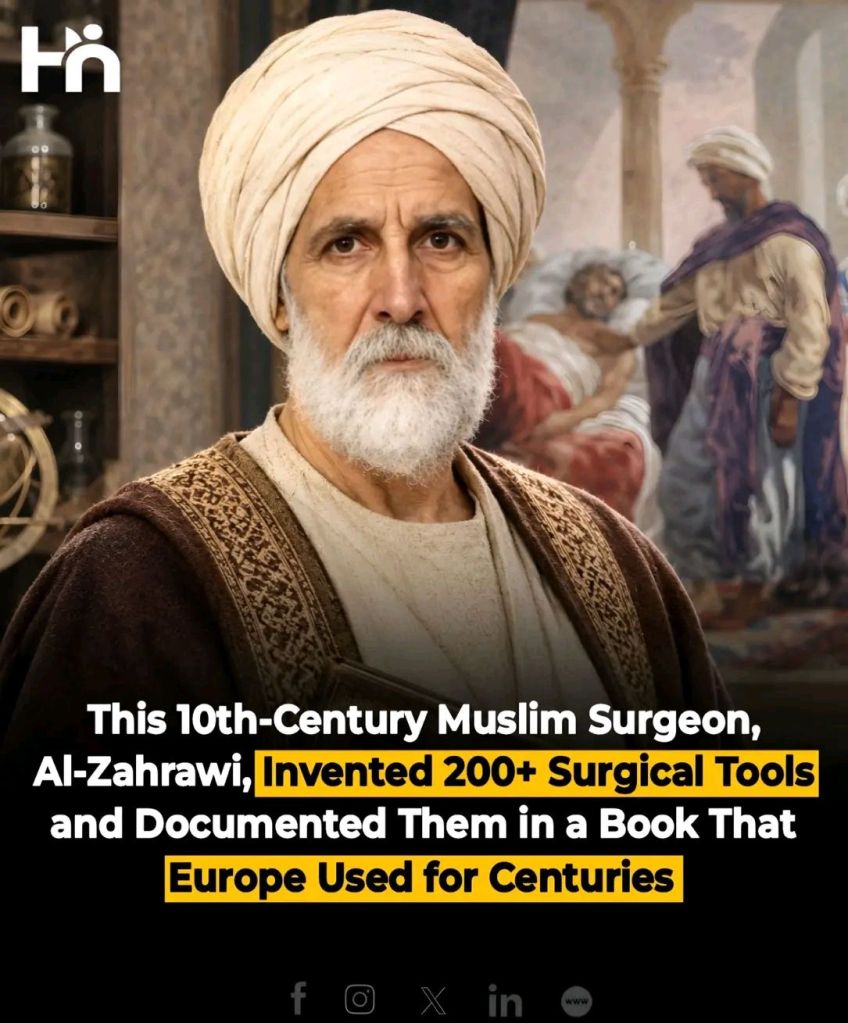
Abu al-Qasim Al-Zahrawi (936–1013), widely known in Europe as Abulcasis, was a Muslim physician and surgeon from Al-Andalus, in present-day Spain. He is remembered as one of the most influential figures in the history of surgery. At a time when surgical knowledge was often passed down through practical experience, Al-Zahrawi worked to make it more systematic by documenting medical procedures, instruments and techniques in a comprehensive medical encyclopedia.
His most famous work was Al-Tasrif, a 30-part medical encyclopedia covering different areas of medicine. Its final section was devoted entirely to surgery and described more than 200 surgical instruments, including scalpels, forceps, hooks, probes, scissors and tools used in dental and other operations. He provided illustrations and explained how the instruments were used, helping surgeons understand both the tools and the procedures they performed.
Al-Zahrawi also made important contributions to surgical practice. He described techniques for treating fractures and dislocations, removing bladder stones, controlling bleeding and performing other operations. He discussed the use of catgut, a material made from animal intestines, for internal stitches. His work emphasized that surgery required proper medical knowledge, practical training and careful judgement, rather than simply learning how to use instruments.
The influence of Al-Tasrif eventually reached Europe through its Latin translation by Gerard of Cremona in the 12th century. It became an important reference for European medical education and influenced surgeons for centuries. Today, Al-Zahrawi is widely remembered as one of the pioneers of operative surgery, while his illustrated work remains an important record of the medical achievements of the Islamic Golden Age.
Disclaimer: This report is based on historical and medical sources, including UNESCO, the U.S. Library of Congress and academic publications. The 200-plus figure refers to instruments described and illustrated in his work; it does not mean every instrument was invented by him.


