

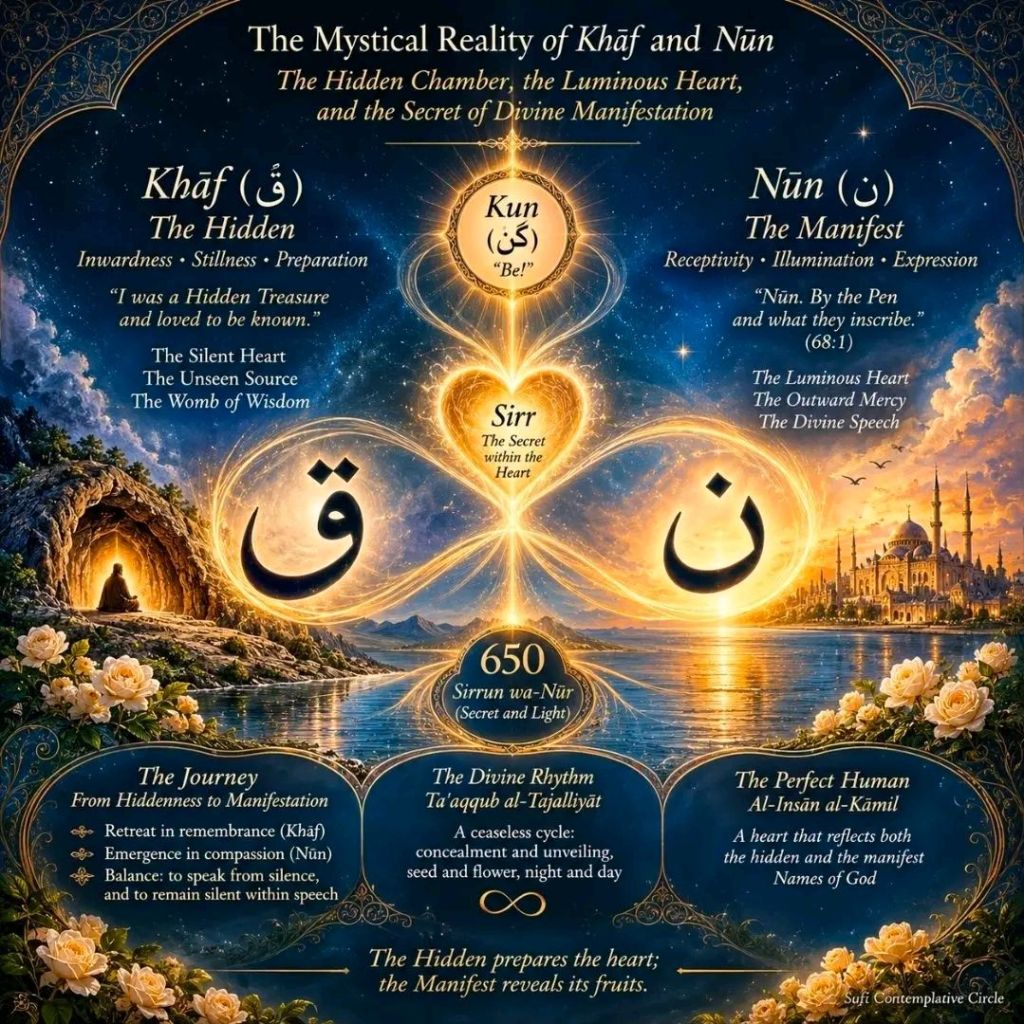
■ The Mystical Reality of Khāf and Nūn
The Hidden Chamber, the Luminous Heart,
and the Secret of Divine Manifestation
In the contemplative tradition of ʿIlm al-Ḥurūf, the spiritual science of letters, the Arabic alphabet becomes a means through which seekers reflect upon the mysteries of existence, the human heart, and the relationship between the unseen and the manifest.
The letters are more than instruments of speech and written symbols. Their forms, sounds and numerical correspondences
invite contemplation of the deeper realities
of creation.
Among these letters, Khāf (خ) and Nūn (ن)
may be contemplated as two complementary symbols: Khāf representing hiddenness, inwardness and spiritual preparation; Nūn representing receptivity, illumination and manifestation.
Together, they offer a symbolic journey through the movement of the spiritual secret (sirr) from concealment into awareness, and from inward awareness into outward expression.
■ The Depth of Khāf: The Hidden Chamber
of the Spirit
Khāf represents the inward stillness of the spiritual heart, the hidden chamber in which
the seeker withdraws from worldly distractions and becomes receptive to the remembrance of Almighty Allāh.
It symbolises the condition of spiritual potential before expression, where the disturbances of the ego gradually become quiet and the heart learns the meaning of surrender.
The Sufi tradition frequently contemplates the mystery of the unseen through the imagery of the Hidden Treasure, associated with the narration:
“I was a Hidden Treasure and loved to be known, so I created creation that I might be known.”
Although its attribution as a Prophetic hadith
is not established, its meaning has profoundly influenced later Sufi metaphysical reflection.
In this contemplative interpretation, Khāf becomes an image of hidden potential: the unseen reality preceding outward manifestation, where the seeker discovers
that not everything precious must be displayed, and not everything known must be spoken.
This inward dimension is closely connected with dhikr al-khafī, the silent remembrance of the heart.
▪︎ In al-Risālah al-Qushayriyyah, Imām al-Qushayrī, relates the account of Shaykh
Sahl ibn ʿAbd Allāh al-Tustarī, may Almighty Allāh sanctify their secrets,who was instructed to remember:
“Allāh is with me, Allāh is watching me,
Allāh is witnessing me.”
Shaykh Sahl relates that he was instructed to repeat these words inwardly, without moving his tongue, until he experienced sweetness within his innermost being.
This illustrates the spiritual meaning of Khāf: remembrance becoming established within the heart, even when the tongue remains silent.
▪︎ Shaykh Ibn ʿAṭāʾ Allāh al-Iskandarī, may Almighty Allāh sanctify his secret, writes in al-Ḥikam:
“Bury your existence in the earth of obscurity, for whatever sprouts forth, without having first been buried, flowers imperfectly.”
This wisdom reflects the necessity of hidden spiritual cultivation. Just as a seed develops beneath the earth before emerging into the light, the heart requires inward preparation before its spiritual qualities become visible through character and conduct.
Khāf therefore symbolises the protection of sincerity, the discipline of the ego and the cultivation of remembrance away from the desire for recognition.
■ The Birth of Nūn: The Luminous Expansion
When the heart has been cultivated through inward remembrance, it becomes increasingly receptive to spiritual understanding.
Here we contemplate Nūn (ن), whose curved form resembles a vessel receiving something placed within it.
Its shape invites reflection upon receptivity, the receiving of wisdom and the transformation of inward awareness into outward expression.
▪︎ The Qur’ān opens Sūrah al-Qalam with the mysterious letter:
ن ۚ وَالْقَلَمِ وَمَا يَسْطُرُونَ
“Nūn. By the Pen and what they inscribe.”
(Qur’ān 68:1)
The letter Nūn stands at the threshold of a chapter that immediately invokes the Pen
and the act of inscription.
In contemplative Sufi reflection, this relationship invites consideration of the unseen decree and its manifestation within creation.
Where Khāf symbolises inward concealment, Nūn symbolises receptivity and the emergence of meaning into expression.
The seeker who emerges from Khāf into Nūn does not abandon silence. Rather, the remembrance cultivated within begins to influence everything expressed outwardly.
His words become more measured, his actions more compassionate, and his presence less concerned with recognition.
▪︎ Shaykh Ibn ʿAṭāʾ Allāh writes:
“Actions are lifeless forms, but the presence of an inner reality of sincerity (sirr al-ikhlāṣ) within them is what endows them with life-giving Spirit.” (Al-Ḥikam al-ʿAṭāʾiyyah)
This reveals an essential principle: outward actions acquire their spiritual worth through
the sincerity from which they emerge.
Nūn therefore becomes an image of inward remembrance taking form through compassion, knowledge, truthful speech and righteous conduct.
■ The Numerical Mysteries: 600 and 50
Within the traditional Abjad numerical system, Arabic letters possess corresponding numerical values.
Khāf (خ) carries the value of 600, while Nūn (ن) carries the value of 50.
Their combined numerical value is 650.
In contemplative interpretations of ʿIlm al-Ḥurūf, numbers may serve as symbolic instruments for reflection, although their spiritual meanings are not universally agreed upon and should not be confused with established Qur’anic teachings.
▪︎ Khāf — 600: The Hidden Totality
The numerical value of Khāf may be contemplated as an image of concealed completeness: the possibilities contained within the unseen before they become visible within creation.
It represents stillness before expression, inwardness before outward movement, and the spiritual secret protected from the distractions of recognition.
▪︎ Nūn — 50: The Receptive Manifestation
Nūn becomes a symbol of receptivity and the emergence of inward meaning.
Its curved form invites contemplation of the heart as a vessel capable of receiving wisdom and reflecting it through conduct.
Their combined value, 650, is the numerical sum of these two letters. Any additional spiritual significance attributed to this number belongs to symbolic interpretation rather than an established numerical doctrine.
The deeper lesson is the relationship between hidden potential and manifested expression.
■ The Subtle Energies: Khāf and the Laṭāʾif
In Sufi metaphysics, the human being possesses subtle spiritual centres known as the Laṭāʾif. Their descriptions and arrangements differ among the various spiritual traditions, particularly within the Naqshbandī-Mujaddidī and other schools.
For this contemplation, Khāf may be associated symbolically with the innermost dimension of hidden remembrance, while Nūn may be associated with the receptive heart.
■ The Hidden Subtlety of Khāf
Khāf draws the seeker inward, representing humility, concealment and freedom from the desire for recognition.
▪︎ Shaykh Ibn ʿAṭāʾ Allāh writes:
“Nothing benefits the heart more than a spiritual retreat wherein it enters the domain
of meditation.” (Al-Ḥikam al-ʿAṭāʾiyyah)
Retreat creates an inward space in which the heart can examine its attachments, become attentive to remembrance and recognise its dependence upon Almighty Allāh.
■ The Receptive Heart of Nūn
Nūn represents the heart becoming receptive to wisdom and illumination. It symbolises the transformation of inward remembrance into outward mercy.
▪︎ Shaykh Ibn ʿAṭāʾ Allāh also writes:
“How can the heart be illumined while the forms of creatures are reflected in its mirror? Or how can it journey to Allah while shackled by its passions?” (Al-Ḥikam al-ʿAṭāʾiyyah)
The heart cannot properly reflect illumination while remaining dominated by attachment, heedlessness and the demands of the lower self. The seeker must therefore pursue purification before expecting inward understanding to become sound outward expression.
Khāf draws inward; Nūn expresses outward.
Khāf protects sincerity; Nūn manifests its fruits.
■ The Union of Hiddenness and Manifestation
The relationship between Khāf and Nūn may be understood through two fundamental principles of Islamic metaphysics: Tanzīh and Tashbīh.
Tanzīh affirms the absolute transcendence of Almighty Allāh, beyond resemblance to creation.
Tashbīh concerns the signs of divine Names and Attributes as they become known through their effects within creation, without suggesting that Almighty Allāh resembles His creation or is contained within it.
▪︎ Shaykh Ibn ʿAṭāʾ Allāh offers a profound reflection:
“The entire cosmos is darkness; it is illumined only by the manifestation of the Real within it.”
(Al-Ḥikam al-ʿAṭāʾiyyah)
This wisdom illuminates the relationship between hiddenness and manifestation.
The created world does not possess independent power or existence apart from Almighty Allāh. Its signs invite contemplation of the One who brought it into existence.
Yet the seeker must never confuse the signs with the Divine Essence itself.
The inward symbolism of Khāf reminds the seeker that the Divine Reality cannot be encompassed by human understanding, while Nūn invites contemplation of the signs of divine wisdom throughout creation.
The heart that understands this balance becomes increasingly free from spiritual arrogance and negligence. Whatever goodness appears through the human being is a gift from Almighty Allāh, not an independent possession.
■ The Secret of Creation: Kun
The relationship between hiddenness and manifestation naturally leads to contemplation of the Divine Command:
كُنْ فَيَكُونُ
“Be! And it is.” (Qur’ān 2:117)
The command Kun expresses the absolute power of Almighty Allāh, whose will is never dependent upon created means.
Khāf and Nūn may be contemplated symbolically alongside this command, but they do not literally constitute the word Kun.
The kāf and nūn of Kun form the Qur’anic expression of the Divine Command, while
Khāf offers an additional symbolic image of hiddenness preceding manifestation..
Every moment of existence is dependent
upon Almighty Allāh. Nothing possesses independent power of creation, and nothing exists outside His knowledge and sovereignty.
The seeker who contemplates Kun begins to recognise the poverty of creation before its Creator.
This is the foundation of true faqr: the recognition that everything belongs to Almighty Allāh and that the human being possesses nothing independently of Him.
■ The Human Heart: The Meeting Point
Within the human being, the heart becomes
the meeting point of these two symbolic dimensions.
Khāf represents inward remembrance, while Nūn represents the expression of that remembrance through the tongue, the hands and the conduct of the individual.
When inward sincerity and outward righteousness become harmonised, the human being approaches the ideal of al-Insān al-Kāmil, the Perfect Human.
The Perfect Human is understood as a comprehensive mirror of the divine Names, within the limits of created servanthood.
The supreme example of human perfection is the Beloved Messenger of Almighty Allāh, Sayyidunā Muḥammad ﷺ.
His blessed life illustrates the harmony between inward devotion and outward responsibility. His retreat in the cave of Ḥirāʾ reminds us of the significance of solitude, contemplation and preparation.
His emergence with Revelation demonstrates the importance of conveying divine guidance to humanity. He did not remain in retreat from the world. He returned to guide, teach, serve, forgive and establish the way of Almighty Allāh.
The purpose of inward illumination is therefore not permanent withdrawal from humanity, but the emergence of a heart whose relationship with Almighty Allāh transforms its relationship with creation.
■ The Dance of Hiddenness and Manifestation
The movement between Khāf and Nūn is not simply a progression from one spiritual state into another. It is a recurring rhythm of inwardness and outward expression.
The seeker withdraws into remembrance, returns to the world through service, and then returns again to inward reflection. This rhythm may be contemplated through the relationship between:
▪︎ Silence and speech.
▪︎ Night and day.
▪︎ Concealment and revelation.
▪︎ Retreat and companionship.
▪︎ Reflection and action.
In Sufi metaphysical language, the successive manifestations of divine signs may be contemplated through the expression taʿāqub al-tajalliyāt, the succession of unveilings.
The heart of the ʿārif becomes receptive to these signs, recognising that every moment offers an opportunity for reflection and remembrance.
Yet the seeker must never mistake the manifestation of divine signs for the Divine Essence itself..Khāf protects the secret of inwardness, while Nūn symbolises the expression of its spiritual fruits.
The seeker learns to speak from silence without losing humility, and to remain inwardly attentive while engaged with the world.
■ Returning to the Hidden Ocean
Khāf and Nūn may finally be contemplated as two complementary dimensions of the same spiritual journey.
Khāf is the stillness; Nūn is the expression.
Khāf is the hidden seed; Nūn is the flowering.
Khāf is inward remembrance; Nūn is its outward manifestation.
The seeker who traverses between these dimensions learns the art of spiritual balance: to speak from silence, to act from sincerity, and to remain inwardly connected to Almighty Allāh while fulfilling the responsibilities of worldly existence.
Every outward action should return the heart to remembrance, and every inward remembrance should cultivate goodness in outward conduct.
This is not a journey towards becoming divine, nor a dissolution of the distinction between Creator and creation. It is a journey towards the perfection of servanthood, ʿubūdiyyah.
▪︎《The Qur’ān declares:
“He is the First and the Last, the Manifest and the Hidden, and He is Knowing of all things.”
(Qur’ān 57:3)
This verse brings the contemplation of Khāf and Nūn towards its deepest conclusion.
The hidden and the manifest are both within the sovereignty and knowledge of Almighty Allāh. The heart must therefore learn to recognise His signs without attempting to encompass His Essence.
The final station is not the acquisition of a secret, the possession of extraordinary knowledge, or the attainment of a spiritual identity. It is sincerity before Almighty Allāh, humility before His creation, and the fulfilment of servanthood through love, remembrance and obedience.
Khāf teaches the seeker to guard the secret.
Nūn teaches the seeker to express its fruits.
And the heart, suspended between silence and illumination, learns that the greatest unveiling is not to be seen by creation, but to become sincere before the Creator.
The Hidden prepares the heart; the Manifest reveals its fruits. And the heart that remembers Almighty Allāh in silence must also demonstrate that remembrance through mercy in the world.
And only with Almighty Allāh is true success.


