Blog

अंबिया की माली विरासत का सुबूत

अंबिया की माली विरासत का सुबूत और हदीस-ए-«ला नूरस» का ऑपरेशन तीन उलमा-ए-अहले सुन्नत के अक़वाल की रौशनी में🔥📚

क़ारईन-ए-किराम: पहली बात मज़कूरा हदीस सही नहीं है। दूसरी बात अगर बिल-फ़र्ज़ इस हदीस को क़बूल करें तो इसकी सही तावील यह है जैसा इन तीन बुज़ुर्ग उलमा-ए-अहले सुन्नत ने लिखा है। यानी हदीस-ए-«إِنَّا مَعْشَرَ الْأَنْبِيَاءِ لَا نُورَثُ» का मतलब यह हरगिज़ नहीं कि अंबिया अलैहिमुस्सलाम अपना माली वारिस नहीं छोड़ते। इसका मतलब वही है जो क़ुर्तुबी, सरख़सी और नह्हास ने बयान किया है, कि जो माल सदक़ा कर दिया जाए उसकी विरासत नहीं होती, और यह अंबिया अलैहिमुस्सलाम का आम तरीक़ा है। इस तावील के बग़ैर यह हदीस क़ुरआन की वाज़ेह आयतों के ख़िलाफ़ हो जाएगी, और रसूलुल्लाह सल्लल्लाहु अलैहि व आलिही व सल्लम क़ुरआन के ख़िलाफ़ बात नहीं कर सकते।

क़ारईन-ए-किराम: आप बख़ूबी जानते हैं कि नबी सल्लल्लाहु अलैहि व आलिही व सल्लम के बाद जब नबी-ए-अकरम सल्लल्लाहु अलैहि व आलिही व सल्लम की लख़्त-ए-जिगर बेटी सैयदा फ़ातिमा सलामुल्लाह अलैहा ने दरबार-ए-ख़िलाफ़त में फ़दक का मुतालबा किया तो सैयदा फ़ातिमा सलामुल्लाह अलैहा के सामने एक  हदीस का सहारा लेते हुए कहा गया कि अंबिया अलैहिमुस्सलाम अपना माली वारिस नहीं छोड़ते, उनका माल सदक़ा होता है, इसलिए आप नबी सल्लल्लाहु अलैहि व आलिही व सल्लम की वारिसा नहीं हैं। यह दावा इसी हदीस की ग़लत तावील पर मबनी है, जिसका रद्द ख़ुद अहले सुन्नत के काफ़ी उलमा ने किया है। हम यहाँ तीन उलमा के अक़वाल से इसका रद्द करते हैं।

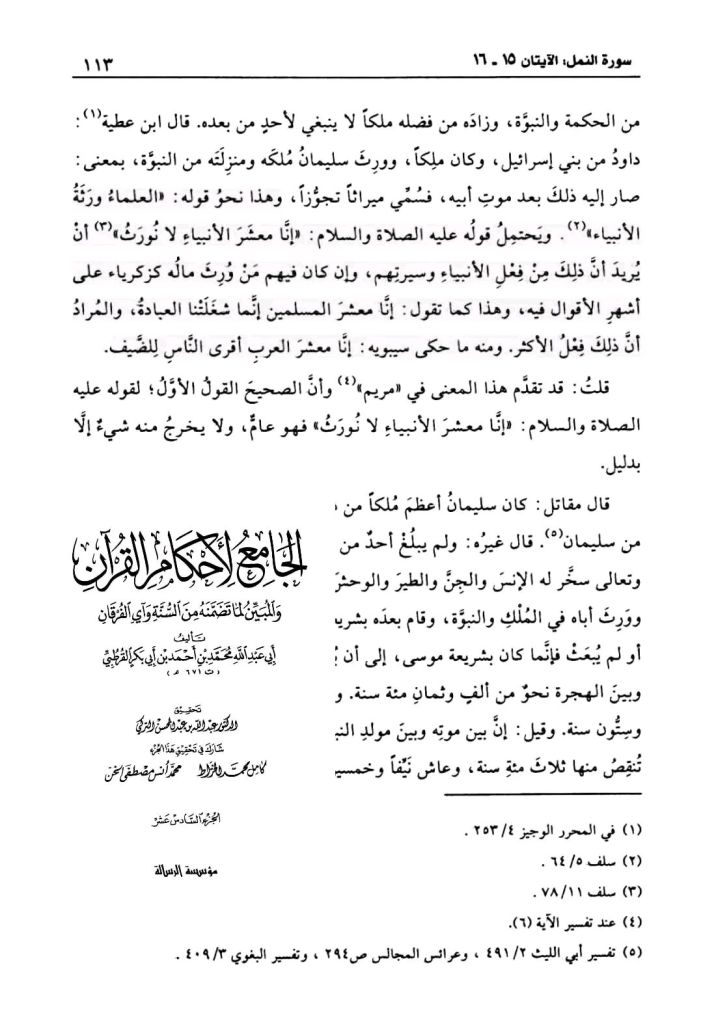
पहली दलील: इमाम क़ुर्तुबी अपनी तफ़सीर अल-जामे लि-अहकामिल क़ुरआन में सूरह नम्ल की आयत «وَوَرِثَ سُلَيْمَانُ دَاوُدَ» की तफ़सीर में लिखते हैं:

صَارَ ذَلِكَ إِلَيْهِ بَعْدَ مَوْتِ أَبِيهِ، فَسُمِّيَ مِيرَاثًا تَجَوُّزًا، وَهَذَا نَحْوُ قَوْلِهِ: «الْعُلَمَاءُ وَرَثَةُ الْأَنْبِيَاءِ». وَيُحْتَمَلُ قَوْلُهُ عَلَيْهِ الصَّلَاةُ وَالسَّلَامُ: «إِنَّا مَعْشَرَ الْأَنْبِيَاءِ لَا نُورَثُ» أَنْ يُرِيدَ أَنَّ ذَلِكَ مِنْ فِعْلِ الْأَنْبِيَاءِ وَسِيرَتِهِمْ، وَإِنْ كَانَ فِيهِمْ مَنْ وَرَثَ مَالَهُ كَزَكَرِيَّا عَلَى أَشْهَرِ الْأَقْوَالِ فِيهِ.

तर्जुमा: सुलेमान अलैहिस्सलाम को यह चीज़ बाप के मरने के बाद मिली, इसलिए इसको मजाज़न मीरास कहा गया। और नबी सल्लल्लाहु अलैहि व आलिही व सल्लम के इस क़ौल का यह मतलब भी हो सकता है कि हम अंबिया अलैहिमुस्सलाम विरासत नहीं छोड़ते, यानी यह अंबिया अलैहिमुस्सलाम का आम तरीक़ा है, अगरचे उनमें से बाज़ ऐसे भी हैं जिन्होंने अपना माल विरासत में छोड़ा, जैसे ज़करिया अलैहिस्सलाम, मशहूर क़ौल के मुताबिक़।

इससे साबित हुआ: क़ुर्तुबी ख़ुद मान रहे हैं कि ज़करिया अलैहिस्सलाम ने माल छोड़ा और उसकी विरासत हुई। पस यह क़ायदा कुल्ली नहीं कि नबी सल्लल्लाहु अलैहि व आलिही व सल्लम का माल कभी विरासत नहीं होता।

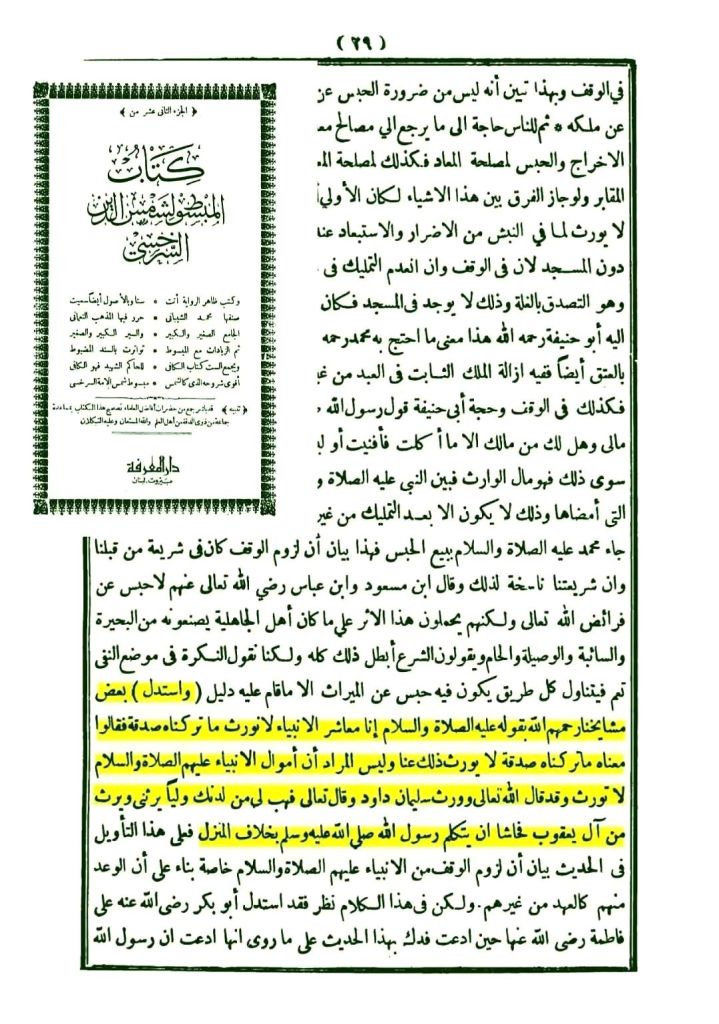
दूसरी दलील: इमाम सरख़सी अपनी किताब अल-मबसूत में अपने मशाइख़ का क़ौल नक़ल करते हुए लिखते हैं:

وَاسْتَدَلَّ بَعْضُ مَشَايِخِنَا رَحِمَهُمُ اللَّهُ بِقَوْلِهِ عَلَيْهِ الصَّلَاةُ وَالسَّلَامُ: إِنَّا مَعْشَرَ الْأَنْبِيَاءِ لَا نُورَثُ، مَا تَرَكْنَاهُ صَدَقَةٌ، فَقَالُوا: مَعْنَاهُ مَا تَرَكْنَاهُ صَدَقَةً لَا يُورَثُ ذَلِكَ عَنَّا، وَلَيْسَ الْمُرَادُ أَنَّ أَمْوَالَ الْأَنْبِيَاءِ عَلَيْهِمُ الصَّلَاةُ وَالسَّلَامُ لَا تُورَثُ، وَقَدْ قَالَ اللَّهُ تَعَالَى: وَوَرِثَ سُلَيْمَانُ دَاوُدَ، وَقَالَ تَعَالَى: فَهَبْ لِي مِنْ لَدُنْكَ وَلِيًّا يَرِثُنِي وَيَرِثُ مِنْ آلِ يَعْقُوبَ، فَحَاشَا أَنْ يَتَكَلَّمَ رَسُولُ اللَّهِ صَلَّى اللَّهُ عَلَيْهِ وَسَلَّمَ بِخِلَافِ التَّنْزِيلِ.

तर्जुमा: हमारे बाज़ मशाइख़ ने इस हदीस से दलील ली: हम अंबिया अलैहिमुस्सलाम की विरासत नहीं होती, जो हम छोड़ जाएँ वह सदक़ा है। उन्होंने कहा: इसका मतलब यह है कि जो चीज़ हमने सदक़ा करके छोड़ी वह विरासत में नहीं मिलेगी, और इससे यह मुराद नहीं कि अंबिया अलैहिमुस्सलाम के मालों की विरासत ही नहीं होती। और अल्लाह ने फ़रमाया: सुलेमान अलैहिस्सलाम ने दाऊद अलैहिस्सलाम की विरासत पाई। और फ़रमाया: मुझे एक वारिस अता फ़रमा जो मेरा वारिस हो और आल-ए-याक़ूब अलैहिस्सलाम का वारिस हो। पस यह नामुमकिन है कि रसूलुल्लाह सल्लल्लाहु अलैहि व आलिही व सल्लम क़ुरआन के ख़िलाफ़ बात करें।

इससे साबित हुआ: हदीस का मतलब सिर्फ़ सदक़ा किए हुए माल का है, न कि हर माल का। और रसूलुल्लाह सल्लल्लाहु अलैहि व आलिही व सल्लम क़ुरआन के ख़िलाफ़ बात नहीं कर सकते, जबकि क़ुरआन दो जगह अंबिया अलैहिमुस्सलाम की माली विरासत को साबित कर रहा है।

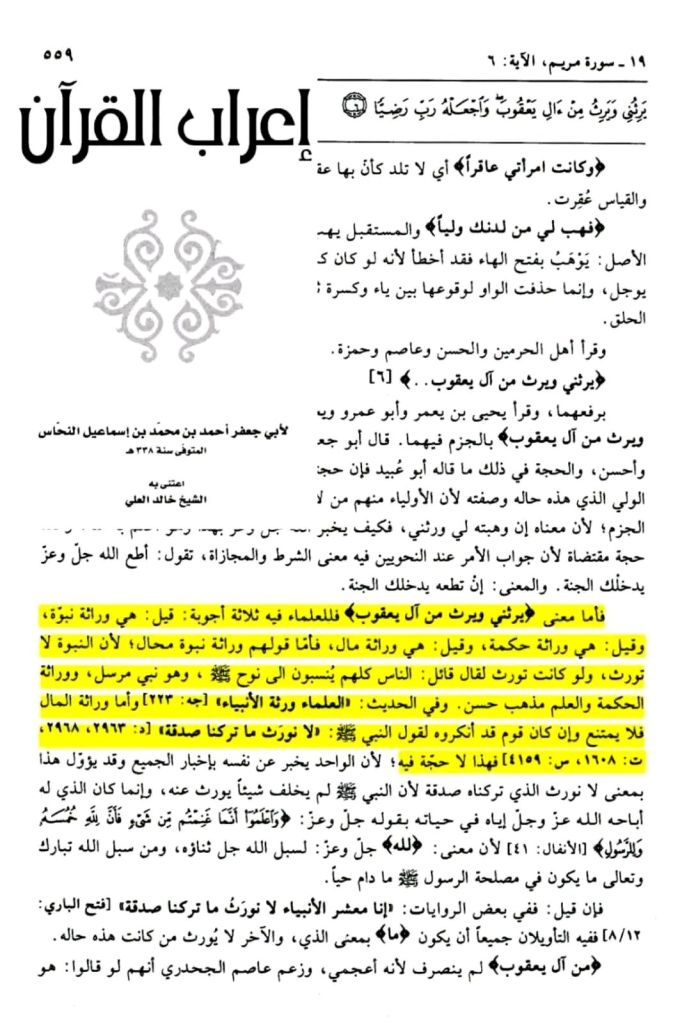
तीसरी दलील: अबू जाफ़र नह्हास अपनी तफ़सीर एराबुल क़ुरआन में सूरह मरियम की आयत «يَرِثُنِي وَيَرِثُ مِنْ آلِ يَعْقُوبَ» के बारे में फ़रमाते हैं:

فَأَمَّا مَعْنَى «يَرِثُنِي وَيَرِثُ مِنْ آلِ يَعْقُوبَ» فَلِلْعُلَمَاءِ فِيهِ ثَلَاثَةُ أَجْوِبَةٍ: قِيلَ: هِيَ وَرَاثَةُ نُبُوَّةٍ، وَقِيلَ: هِيَ وَرَاثَةُ حِكْمَةٍ، وَقِيلَ: هِيَ وَرَاثَةُ مَالٍ، فَأَمَّا قَوْلُهُمْ وَرَاثَةُ نُبُوَّةٍ فَمُحَالٌ؛ لِأَنَّ النُّبُوَّةَ لَا تُورَثُ، وَوَرَاثَةُ الْحِكْمَةِ وَالْعِلْمِ مَذْهَبٌ حَسَنٌ. وَأَمَّا وَرَاثَةُ الْمَالِ فَلَا يَمْتَنِعُ وَإِنْ كَانَ قَوْمٌ قَدْ أَنْكَرُوهُ لِقَوْلِ النَّبِيِّ ﷺ: «لَا نُورَثُ مَا تَرَكْنَا صَدَقَةٌ» فَهَذَا لَا حُجَّةَ فِيهِ؛

तर्जुमा: रहा «يَرِثُنِي وَيَرِثُ مِنْ آلِ يَعْقُوبَ» का मअना, तो इसमें उलमा के तीन जवाब हैं। कहा गया: यह नुबुव्वत की विरासत है, और कहा गया: यह हिकमत की विरासत है, और कहा गया: यह माल की विरासत है। पस रहा उनका यह क़ौल कि यह नुबुव्वत की विरासत है, तो यह मुहाल है, क्योंकि नुबुव्वत विरासत में नहीं दी जाती। और अगर नुबुव्वत विरासत में मिलती तो कहने वाला यह कहता कि सारे लोग नूह अलैहिस्सलाम की तरफ़ मंसूब होते हैं, और वह रसूल नबी हैं। और हिकमत व इल्म की विरासत एक अच्छा मज़हब है। और हदीस में है: «उलमा अंबिया अलैहिमुस्सलाम के वारिस हैं»। और रही माल की विरासत, तो यह नामुमकिन नहीं है, अगरचे एक क़ौम ने नबी सल्लल्लाहु अलैहि व आलिही व सल्लम के इस क़ौल की वजह से इसका इंकार किया है: «हमारी विरासत नहीं होती, जो हमने छोड़ा वह सदक़ा है» तो इसमें कोई हुज्जत नहीं है।

इससे साबित हुआ: इमाम नह्हास साफ़ कह रहे हैं कि माल की विरासत का इंकार बे-दलील है। ज़करिया अलैहिस्सलाम की दुआ में «يَرِثُنِي» से मुराद माल की विरासत भी है।

इन तीनों उलमा के अक़वाल से एक ही नतीजा निकलता है:

क़ुरआन में अंबिया अलैहिमुस्सलाम की माली विरासत दो वाज़ेह आयतों से साबित है: «وَوَرِثَ سُلَيْمَانُ دَاوُدَ» और «يَرِثُنِي وَيَرِثُ مِنْ آلِ يَعْقُوبَ»।

हदीस-ए-«إِنَّا مَعْشَرَ الْأَنْبِيَاءِ لَا نُورَثُ» का मतलब यह नहीं कि नबी सल्लल्लाहु अलैहि व आलिही व सल्लम का कोई माल वारिस को नहीं मिलता। इसका मतलब सिर्फ़ यह है कि जो माल नबी सल्लल्लाहु अलैहि व आलिही व सल्लम ने अपनी ज़िंदगी में सदक़ा कर दिया हो, उसकी विरासत नहीं होगी, न कि हर माल जो अंबिया अलैहिमुस्सलाम के पास हो वह सदक़ा है।

पस वह दावा कि अंबिया अलैहिमुस्सलाम अपना माली वारिस नहीं छोड़ते, और इस बुनियाद पर सैयदा फ़ातिमा सलामुल्लाह अलैहा को फ़दक से महरूम किया जाए, यह दावा ख़ुद इन तीनों उलमा के अक़वाल से रद्द हो जाता है। क्योंकि अगर अंबिया अलैहिमुस्सलाम की माली विरासत न होती तो ज़करिया अलैहिस्सलाम वारिस की दुआ क्यों करते, और सुलेमान अलैहिस्सलाम दाऊद अलैहिस्सलाम के वारिस क्यों बनते।

लिहाज़ा सैयदा फ़ातिमा सलामुल्लाह अलैहा रसूलुल्लाह सल्लल्लाहु अलैहि व आलिही व सल्लम की शरई वारिसा थीं, और फ़दक उनका हक़ था, जिसका इंकार क़ुरआन की इन आयतों के ख़िलाफ़ था।

अशहदु अन्न फ़ातिमा ज़हरा सलामउल्लाहु अलैहा सिद्दीक़तुल कुबरा”🌹

When the moon split part 4

• Choosing a Profession: Having grown up without inheritance under his uncle Abu Talib’s care, he initially earned a living tending goats for Banu Sa’d and later for the Quraysh in Makkah. Because of his integrity, he became widely known as “Al-Ameen” (the Trustworthy).


• Journey to Syria for Khadeejah: Impressed by his reputation, a wealthy businesswoman named Khadeejah bint Khuwaylid hired him to trade her merchandise in Syria alongside her servant, Maysarah. The trip yielded high profits, which he faithfully returned to her


• Marriage to Khadeejah Alaihissalam: Previously turned down proposals from Quraysh chiefs, Khadeejah was moved by Maysarah’s account of Muhammad’s (ﷺ) noble character. She proposed marriage through her friend Nafeesah, and he agreed after consulting his uncles.Following a proposal through her uncle Amr bin Asad and a dowry of twenty camels (or six in some accounts), Muhammad married Khadeejah in the presence of Banu Hashim and Quraysh chiefs, with Abu Talib delivering the sermon.

• Their Children: Khadeejah Alaihissalam was his first and only wife during her lifetime, bearing all of his children except Ibraheem (born to Mariya Qibtiya)—listed here as Qasim, Zaynab, Ruqayyah, Umm Kulthoom, Fatimah, Abdullah, and Ibraheem. All sons died in childhood, while all daughters lived to see his prophethood and migrate to Madinah; all except Fatimah Alaihissalam passed away before him, with Fatimah Alaihissalam dying six months after him.


• Rebuilding the Ka’bah: When Muhammadﷺ was thirty-five, a flood and an earlier fire damaged the Ka’bah. The Quraysh resolved to rebuild it using only lawful funds (excluding usury, prostitution, or larceny), and Waleed bin Mugheera was the first to begin dismantling the walls without harm.

• Rebuilding the Ka’bah: The tribes demolished the Ka’bah down to the original foundations laid by Prophet Ibraheem (Abraham) and shared the construction duties, with Muhammad ﷺ and his uncle Abbas carrying stones.


• Hijr Isma’eel: Because the tribes lacked enough funds to rebuild the entire structure on the original foundation, a Roman mason named Baqoom built a smaller low wall on the northern side enclosing about six cubits, known as Hijr Isma’eel.


• The Black Stone Dispute: When it was time to place the Black Stone, the tribal chieftains argued for four or five days over who would have the honor, bringing them to the brink of bloodshed.


• Abu Umayya’s Suggestion: The eldest chieftain, Abu Umayya, proposed letting the next man to enter the gate of the Ka’bah decide the matter—and that person turned out to be Muhammad ﷺ.


• The Resolution: Known for his trustworthiness, Muhammad ﷺ placed the Black Stone on a sheet and had each clan leader hold an edge to lift it together, before setting it into place with his own hands.

Notes that the Quraysh kept the doorway elevated to control access, doubled the wall height from nine to eighteen cubits, added a fifteen-cubit-high roof, and placed six pillars inside in two rows.

Hazrat Abbas bin Abdul Muttalib: Drinking Water Administrator for the Two Holy Cities

Abbas bin Abdul Muttalib: Drinking Water Administrator for the Two Holy Cities
Under the scorching hot sun of Mecca, there stood a tall, sturdy man from the Quraysh nobles with a loud voice that boomed like thunder.  He is Abbas bin Abdul Muttalib, beloved uncle of Rasulullah SAW and holder of the noble mandate of administering drinking water (Siqayah) for Hajj pilgrims at the Grand Mosque.  Since the dawn of prophecy, even though at first he hid his Islam for the sake of a missionary strategy in the heart of Mecca, Abbas’s chest was filled with obedience and deep love for his nephew who had become the Beloved of Allah.

Abbas’s side of heroism and loyalty was eternally etched in the Second Bai’at Aqabah incident.  In the eerie silence of the night in the Mina valley, Abbas was present to accompany Rasulullah SAW secretly.  With the authority and firmness of a true protector, he stood in front of the Ansar envoys from Medina, ensuring that they were truly able to protect Rasulullah SAW with their lives.  Abbas’s heroism was not the kind of bravery that showed off on the surface, but rather a silent shield that kept the Prophet safe from the daggers of the Quraysh in Mecca.

Abbas’ obedience to the orders of Rasulullah SAW was unconditional submission.  He was willing to remain in Mecca as a spy for the Islamic struggle, resisting the desire to emigrate with the Prophet in order to transmit every secret of the enemy’s movements to Medina.

The peak of heroism and proof of Abbas’ greatest love exploded violently in the Hunain valley.  When thousands of Muslim troops were suddenly bombarded by enemy arrows and scattered backwards in panic, Rasulullah SAW remained standing tall on his white mule alone.  At that crucial moment, Abbas sped off like a guard lion, holding tightly to the reins of the Prophet’s ride with one hand so that he would not plunge too far into the vortex of death.

At the command of Rasulullah SAW, Abbas raised his thundering voice across the valley: “O friends of the Samurah tree! O people of the Ansar!”  Abbas’s scream of heroism shook the souls of the friends who had scattered, drawing them back into closer ranks around the Prophet until a glorious victory was achieved.

After the death of Rasulullah SAW, the Prophet’s love for his uncle continued to be remembered by the people;  Even Caliph Umar bin Khattab gave thanks through Abbas’ prayer when a long drought hit, until the rain fell to wet the earth.  Until the end of his life, Abbas bin Abdul Muttalib was remembered as the administrator of drinking water for two holy cities, the protective hero of Rasulullah SAW, and an example of obedience who donated his entire soul and glory for the glory of Islam.

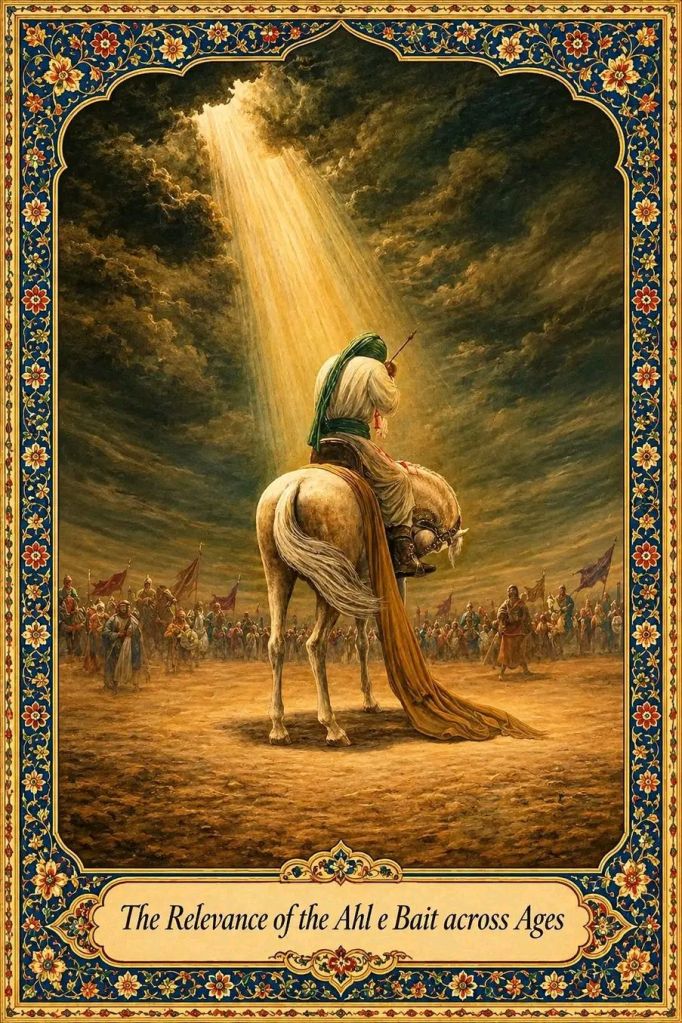
Revelance of the Ahle Bait across ages..

One evening in July 1400, the great Chishti master Sayyid Bande Nawaz Gesu Daraz related a curious story to his disciples. It concerned a journey to Karbala, an old woman, and a young man whose condition had left little room for hope. Gesu Daraz had heard the account several decades earlier from a friend, a resident of the Sultanate metropolis of Delhi named Maulana Hushamuddin.

After completing his Hajj pilgrimage, Maulana Hushamuddin had travelled to Karbala to pay his respects at the shrine of Imam Hussain. Among the pilgrims he encountered there was an old woman accompanied by her son, a young man who could neither see nor walk. His mother had brought him all the way to the shrine, perhaps having exhausted every other remedy available to her. There, she had him carried inside and laid across the tomb, following which they spread the sacred ghilaf, the cloth covering the grave, over his helpless body.

What happened next was nothing short of astonishing.

A little while later, the young man emerged from the shrine on his own feet. Not only could he walk, he could see. When the astonished onlookers asked him what had happened, he recounted that, while lying upon the tomb, he had seen Imam Hussain mounted upon a horse. Moved by his miserable condition, the Imam had passed his hand over the young man’s face and legs. His sight had returned, his limbs had been restored, and he had risen from the tomb completely cured.

The story, extraordinary as it sounds, was not without a parallel. Nearly a generation earlier, the great Moroccan traveller Ibn Battuta had recorded an account of remarkably similar happenings at another great shrine of the House of the Prophet.

During his visit to the shrine of Hazrat Ali in Najaf, Ibn Battuta heard of a custom associated with the 27th night of the Islamic month of Rajab. On that particular night, some 30-40 people suffering from paralysis and other afflictions were brought to the shrine and laid upon the tomb. Around them gathered the faithful, who occupied themselves with prayers, religious litanies, and Quranic recitations.

Then came the long vigil.

Before dawn, according to the account, the afflicted would rise from the tomb completely cured, their voices ringing out in praise of Hazrat Ali. Ibn Battuta, for his part, personally encountered three disabled men at the shrine. When he asked why they had not yet received their cure, they explained that they had missed the appointed night and were waiting for the following year.

The two accounts, separated by a generation and by the distance between Najaf and Karbala, belong to the same world of sacred expectation. At Najaf, it was Hazrat Ali; at Karbala, his son Imam Hussain. The afflicted came carrying the burdens that ordinary remedies had failed to lift, and placed their last hope in the intercession of the House of the Prophet.

And there, perhaps, lies a most delicious irony.

Nasibi sentiments might have been flourishing across much of the Islamic world, but the human body had its own politics, and suffering its own theology. When blindness, paralysis and other afflictions came knocking, doctrinal loyalties could suddenly become much more flexible. The Ahl-e-Bait, it seems, remained eminently useful, even in an age when their memory was not always treated with the reverence it deserved.

One could denounce them all they liked, but when the limbs failed and the eyes went dark, a little intercession from the family of the Prophet was definitely worth its weight in gold.