

■ The Nafs in the Metaphysics of Shaykh Ibn ʿArabī, may Almighty Allāh sanctify his secret.
In the thought of Shaykh Ibn Arabī, the nafs (self/soul) is not a fixed psychological entity
to be morally improved in isolation.
Rather, it is a locus of divine self-disclosure (maẓhar al-tajallī) a mirror in which reality appears according to the purity or opacity of perception.
The transformation of the nafs, therefore,
is not a movement from “evil to good” in a purely ethical sense, but a progressive lifting
of veils so that what was always present becomes witnessed without distortion.
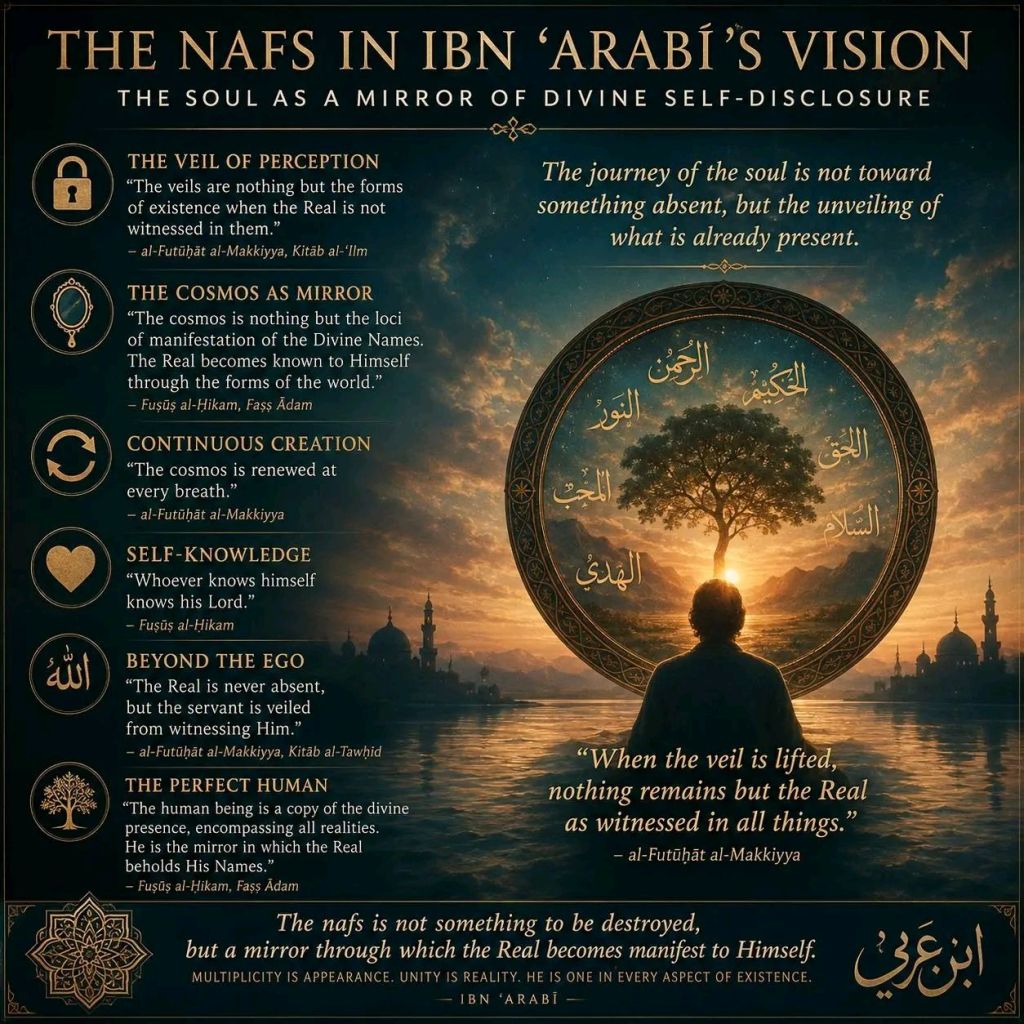
■ The Veiled Nature of the Self
Shaykh Ibn ʿArabī repeatedly grounds the problem of the human condition in ḥijāb (veil). In al-Futūḥāt al-Makkiyya.
▪︎ He states:
“The veils are nothing but the forms of existence when the Real is not witnessed in them.”
From this perspective, the nafs is not inherently separate from the Real, but it experiences separation through perception.
The veil is not absence of Allāh, but failure to recognize His presence within form.
Thus, the first condition of the nafs is forgetfulness (ghaflah), where the world appears as independently existing reality.
Shaykh Ibn ʿArabī’s metaphysics dissolves this assumption immediately: what is called “world” is nothing but divine manifestation misread as autonomy.
■ The Cosmos as Mirror and the Nafs
as the Reflective Locus.
The turning point in Shaykh Ibn ʿArabī’s anthropology is the realization that existence
is fundamentally reflective. In Fuṣūṣ al-Ḥikam, he writes:
“The cosmos is nothing but the loci of manifestation of the Divine Names.”
Here, the nafs is redefined. It is not merely a moral agent, but a mirror structured to receive the Names of Allāh according to capacity (istiʿdād).
Every emotional state, perception, and action
is a form in which a divine Name becomes visible.
Thus, the human self is not outside the
divine order it is one of its most complete articulations.
▪︎ Shaykh Ibn ʿArabī extends this principle further:
“The Real becomes known to Himself
through the forms of the world.”
This means that knowledge itself is not external acquisition, but self-disclosure of Reality within structured receptivity.
■ Continuous Creation and the Fluidity
of the Self
A key pillar of Shaykh Ibn ʿArabī’s ontology is that existence is never static. In al-Futūḥāt al-Makkiyya, he affirms:
“The cosmos is renewed at every breath.”
This principle radically transforms the understanding of the nafs. The self is not
a stable substance moving through time,
but a continuous re-creation at every instant.
Identity is therefore not fixed essence but ongoing manifestation.
The implication is profound: what is experienced as “selfhood” is actually a sequence of divine acts appearing in temporal form, while the Reality behind them remains unchanged.
■ Self-Knowledge as Divine Knowledge
The famous principle often attributed to Shaykh Ibn ʿArabī appears throughout his metaphysical system:
“Whoever knows himself knows his Lord.”
This statement does not point toward psychological introspection alone. Instead,
it indicates that the structure of the self is identical in pattern to the structure of divine manifestation.
▪︎ To know the nafs is to recognize:
▪︎ It’s dependence on continuous divine bestowal
▪︎ It’s lack of independent ontological standing
▪︎ It’s function as a mirror of divine Names
Thus, self-knowledge is not inward isolation but ontological unveiling of relational existence.
■ The Dissolution of Independent Agency
At the deepest level of realization, Shaykh Ibn ʿArabī removes the illusion of independent action. In al-Futūḥāt al-Makkiyya, he states:
“The Real is never absent, but the servant is veiled from witnessing Him.”
This means that what is experienced as “the self acting” is, in truth, divine action appearing through form.
When the veil is lifted, agency is no longer perceived as dual (God vs. self), but unified in witnessing.
▪︎ He further explains the result of unveiling:
“When the veil is lifted, nothing remains
but the Real as witnessed in all things.”
The nafs does not disappear in annihilation; rather, it ceases to be mistaken for an independent principle.
■ The Perfect Human and the Completion
of the Nafs
The culmination of the journey of the nafs is the realization of the insān al-kāmil (Perfect Human), a central doctrine of Ibn ʿArabī’s metaphysics. In Fuṣūṣ al-Ḥikam (Wisdom of Adam), he writes:
“The human being is a copy of the divine presence, encompassing all realities.”
▪︎ And in al-Futūḥāt al-Makkiyya:
“The cosmos does not reach perfection except through the Perfect Human, for he is the mirror in which the Real beholds His Names.”
In this state, the nafs is no longer experienced as limitation or conflict.
▪︎ It becomes:
▪︎ Fully transparent to divine self-disclosure
▪︎ Completely receptive to all Names
▪︎ No longer confined by partial identification
This is not self-destruction, but complete ontological integration into witnessing unity while remaining manifest in form.
■ The Nafs as a Mirror of the Real
Across Shaykh Ibn ʿArabī’s metaphysical system, the nafs is never truly “other” than
the Real. Its apparent separation is a function of perception, not ontology.
The journey of the soul is therefore not a movement toward something absent, but
a progressive unveiling of what is already present.
In his own language:
“He is One in every aspect of existence.”
▪︎ The final realization is that:
▪︎ Multiplicity is appearance
▪︎ Unity is reality
The nafs is the mirror in which the Real contemplates His own disclosure
Thus, the path of the soul does not end in possession or arrival, but in clear witnessing without distortion, where nothing is seen except the One manifesting through all things.
And Almighty Allāh knows best.


