

■ The Relationship of the Barzakh and the Soul
Among the most profound metaphysical doctrines articulated by Shaykh Ibn Arabī,
may Almighty Allāh sanctify his secret,
is the reality of the Barzakh.
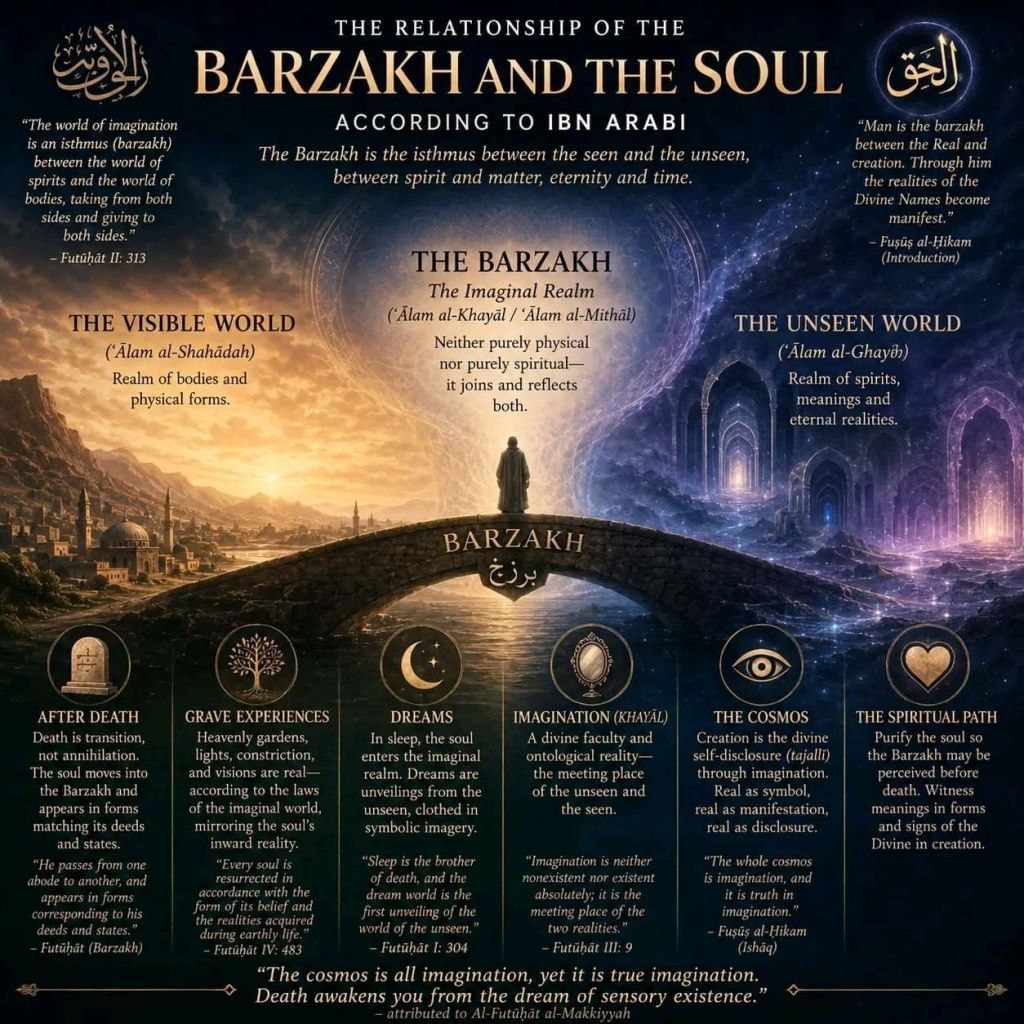
The intermediate realm that stands between spirit and matter, the unseen and the visible, eternity and temporal existence.
Yet for Shaykh Ibn Arabī, the Barzakh is not merely a “place” entered after death. It is a universal principle woven into the very structure of existence itself.
The Arabic word barzakh means an isthmus, barrier, or partition. However, Shaykh Ibn Arabī defines it in a uniquely paradoxical way: it separates two realities while simultaneously joining them.
Thus the Barzakh possesses qualities of both worlds without becoming identical to either.
▪︎ He writes:
“The world of imagination is an isthmus (barzakh) between the world of spirits and the world of bodies, taking from both sides and giving to both sides.”
▪︎ Al-Futūḥāt al-Makkiyyah, II: 313
This intermediate reality is what Shaykh Ibn Arabī calls ʿĀlam al-Khayāl or ʿĀlam al-Mithāl the Imaginal World.
It is neither purely physical nor purely abstract. Rather, it is the realm in which meanings become clothed in forms and forms become spiritualized.
▪︎ He says:
“Meanings take on forms in the imaginal presence, and forms become spiritualized there.”
▪︎ Al-Futūḥāt al-Makkiyyah, II: 377
For Shaykh Ibn Arabī, the human soul is intimately connected to this realm because
the soul itself is barzakhic in nature.
The human being stands between clay and spirit, between the world of density and the world of light. Thus man becomes a mirror between creation and the Divine.
▪︎ He writes:
“Man is the barzakh between the Real and creation. Through him the realities of the
Divine Names become manifest.”
▪︎ Fuṣūṣ al-Ḥikam
This is why the soul survives bodily death. Death, in Shaykh Ibn Arabī’s understanding,
is not annihilation but transition the soul withdrawing from the coarse physical body
into a subtler imaginal mode of existence.
▪︎ He explains:
“When the human being dies, he does not enter into absolute nonexistence. Rather, he passes from one abode to another, and appears in forms corresponding to his deeds and states.”
▪︎ Al-Futūḥāt al-Makkiyyah, Chapter on the Barzakh
The experiences of the grave, heavenly gardens, constriction, lights, and terrifying visions are therefore real, but real according
to the laws of the imaginal world rather than earthly physics. The Barzakh mirrors the inward reality of the soul.
▪︎ Shaykh Ibn Arabī states:
“Every soul is resurrected in accordance with the form of its belief and the realities acquired during earthly life.”
▪︎ Al-Futūḥāt al-Makkiyyah, IV: 483
The soul encounters its own truths objectified in symbolic form. This doctrine also explains dreams.
During sleep, the soul partially disengages from bodily constraints and enters the imaginal realm. Dreams are therefore not meaningless fantasies, but disclosures from the unseen clothed in symbolic imagery.
▪︎ Shaykh Ibn Arabī writes:
“Sleep is the brother of death, and the dream world is the first unveiling of the world of the unseen.”
▪︎ Al-Futūḥāt al-Makkiyyah, I: 304
Hence the famous wisdom often quoted by
the Sufis:
“People are asleep, and when they die they awaken.”
The worldly life itself resembles a dream when compared to the unveiled realities perceived after death.
Central to all of this is Shaykh Ibn Arabī’s understanding of khayāl (imagination).
Modern thought often treats imagination as fantasy or unreality, but Shaykh Ibn Arabī sees imagination as a divine faculty and ontological reality through which the unseen becomes manifest.
▪︎ He writes:
“Imagination is neither nonexistent nor existent absolutely; it is the meeting place of the two realities.”
▪︎ Al-Futūḥāt al-Makkiyyah, III: 9
▪︎ And elsewhere:
“Allāh made the world of imagination as a mirror in which meanings are seen clothed in sensory forms.”
▪︎ Al-Futūḥāt al-Makkiyyah, III: 275
Thus the cosmos itself becomes a grand barzakh. Creation is neither absolute being
nor pure nothingness; it is the imaginal self-disclosure (tajallī) of Almighty Allah.
Existence is symbolic, transparent, and revelatory for the one whose inner sight has awakened.
▪︎ Among Shaykh Ibn Arabi’s most famous statements is:
“Know that you are imagination, and all that you perceive and of which you say, ‘This is not imagination,’ is imagination. For all existence
is imagination within imagination.”
▪︎ Al-Futūḥāt al-Makkiyyah, III: 142
▪︎ And likewise:
“The whole cosmos is imagination, and it is truth in imagination. The one who understands this has attained the secrets of the Path.”
▪︎ Fuṣūṣ al-Ḥikam, chapter of Ishāq (Isaac)
These statements do not mean the world is unreal in the nihilistic sense. Rather, the world is real as symbol, real as manifestation, real as divine disclosure.
Just as a dream possesses meaning while not existing materially, so too creation is an imaginal unveiling of deeper realities.
Thus the spiritual traveler (sālik) seeks purification of the soul so that the Barzakh
may be consciously perceived before death.
The gnostic (ʿārif) begins to witness meanings within forms and divine signs within creation itself.Shaykh Ibn Arabī finally summarizes the mystery of existence and death in these words:
“The cosmos is all imagination, yet it is true imagination. Death awakens you from the dream of sensory existence.”
▪︎ Al-Futūḥāt al-Makkiyyah
In this vision, the Barzakh is not merely the realm entered after death it is the hidden architecture of existence itself.
The soul does not simply travel through the Barzakh; rather, it gradually awakens to the realization that its entire existence has always unfolded within this mysterious intermediary realm between contingency and the Eternal Real (al-Ḥaqq).
And Almighty Allāh knows best.
■ Teachings Of The Heart.


