The Hierarchy of Creation

The Hierarchy of Creation

God is the One Who created for you All that is on the earth.
Moreover, He turned to the heaven and fashioned seven heavens with harmony.
He is full of knowledge of all things.

Qur’an 23:17

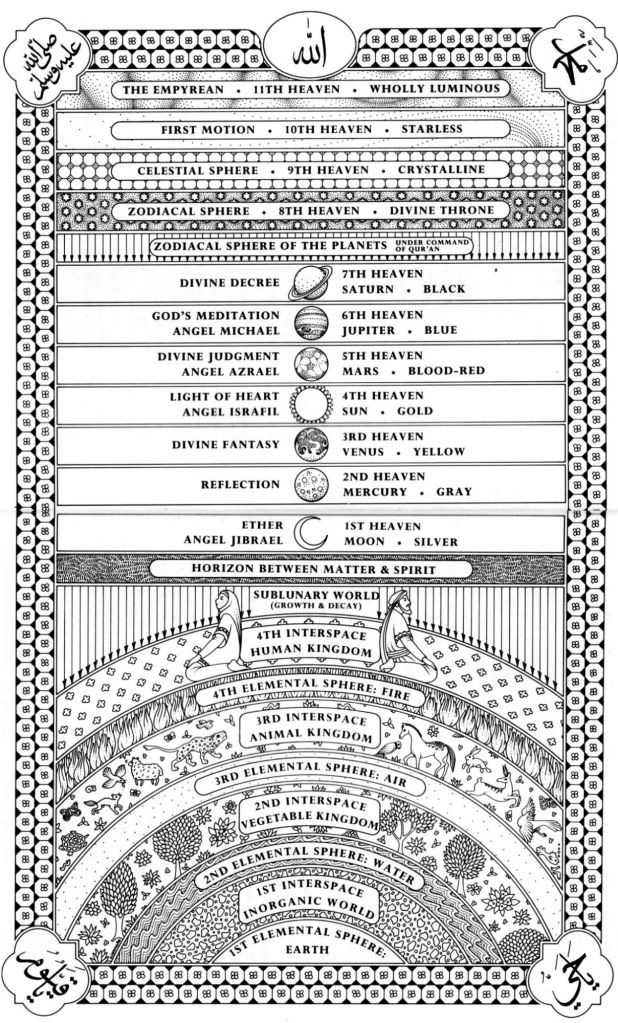
The hierarchy of creation extends from the most minute forms of terrestrial life up to Allah. The construction of this hierarchy was designed by Allah and is kept in form and balance by His will. In general terms, the whole of creation is divided into two parts: the known world of our human creation (insan) and the unseen (ghayb) and generally unknown world of the heavens.

The world below, as it were, is the sublunary world, consisting of four elemental spheres: the terrestrial, vegetative, animal, and human kingdoms. These four components are arranged in ascending order of creation, so that the human being occupies the highest position in the order of the physical creation. This dimension is governed by the rules of nature, which is to say the dominion of growth and decay, of life and death.

Above this created world of human existence lies the realm of the heavens, which are eleven in number. Each of these heavens is occupied by angelic forms and ultimately is populated with souls that depart from human bodies and earthly existence.

The various realms of earth and the heavens can be represented in their entirety in the accompanying chart.

Each of the elemental spheres-the terrestrial, vegetable, animal, and human kingdoms is composed of two parts: an elemental sphere and an interspace, with which it connects to the sphere above its own. Thus, the terrestrial sphere connects with the second elemental sphere via the in-organic world. When the element of water is combined with the terrestrial sphere, the vegetative world is created.

Likewise, the addition of air to earth and water creates fire. When all these combine-earth, water, air, and fire-the human form is made up.

The human kingdom is the interconnection to the heavenly realms. For most humans, the first heaven is represented by the moon: We first attain our strivings for the heavenly realms by viewing the moon. For those who occupy the dimension of the first heaven, or moon, the moon is the firmament and the second heaven represents a higher aspiration-Mercury is their heaven. And so on, up the hierarchy of the heavens.

Humans occupy the highest place in the realms of created life, by virtue of one reason only: Humans have been endowed with the faculty of reason, Cagl. The Cagl is the creative, rational reasoning power of the mind, which neither plants nor animals nor water has. These lower forms can only obey their instincts provided by the Creator. They are totally obedient to the laws of nature. For example, one can never “reason” with a deer. If one tries to approach one, it almost invariably bolts instantly and disappears, regard-less of the intent of the approaching human.

This holds true even for those animals that humans have sought to control. Dogs, for example, have not taken well to efforts to domesticate them. The more inbreeding that has occurred in a particular breed, the more neurotic the dogs become. Despite efforts to make dogs into pets, it is not so infrequent that a dog will for no reason turn wild upon a person or small child and kill him.

Animals that have been domesticated usually lose the natural dignity of their species. Animals of all kinds are marvelous in their natural terrain. But in that element they have intact all of their natural instinctive behavior, which is required for their survival. The lion does not kill in the wild out of malice. To be a killer is the position given to the lion in the creation, and the lion must do it.

Only humans have the capacity for creative reasoning, for the rational decision-making process by which we decide whether we are going to do a thing. This process is sometimes called free will. One can inform a human being that to do something dangerous will kill him; yet the human being-using his free will can act contrary to all the evidence and do it anyway. Animals have no such choice: A fish must be a fish.

Our mental decisions are accomplished by the ‘agl, and it is by virtue of this faculty alone that humans have been placed over all of the creation of the sublunary world.

When we aspire to something beyond the earthly existence, we move into the realm of the heavens. Most apparent to all are the zodiacal heavens, which are seven in number.

This is the realm of the planets, the first of which is the moon. Its color is white and silver, and it is constructed from the four elements mentioned, plus ether.

The second zodiacal planet is Mercury, whose color is gray. God said that He made Mercury with the addition of His own fikr, His own deep meditative thought.

Venus is the third zodiacal planet, and its color is yellow. Venus governs the world of similitudes, of analogies and metaphors, of poetry. Allah has informed us that Venus was created with the addition of His khayal, or imagination.

The sun, the fourth zodiacal planet, is presided over by Israfil, the Angel of Resurrection. The Prophet (s.a.w.s.) is reported to have related that Israfil told him that the Angel of Death scans the faces of seventy thousand people each day and, from these, chooses those who will be called from earthly existence. This planet God made from the light of His own heart, the fount of God, the absolute of the heart: love.

The fifth planet in the zodiac is Mars. Its color is blood-red. Azrael, the Angel of Death, presides over this planet, which is created from God’s wahm, or divine decision.

Jupiter is the sixth planet of the zodiac, presided over by the archangel Michael and formed of the Light of Himmah-the light of Allah’s reflection. The final zodiacal planet is Saturn. Its color is black. Saturn, being the highest in the hierarchy, was the first zodiacal constellation to be created. These first seven heavens (presented in reverse order, from lowest to highest) are descriptively named samā’. The word samā’ (heaven) is linked by sound to samā, an Arabic word meaning “ecstatic contemplation.” Each heaven exists with a relation to both something above and something below
itself.

These heavens are inhabited by various beings of the creation. There are disembodied souls (having died already to earth life and awaiting the yawm al-qiyāmmah, or Day of Judgment) in one or other of the heavens. All the angels exist in all of these various heavens, depending upon their function and rank.

In addition to human souls and angels, Allah also created jinns. Whereas He created humans from the four elements of earth, water, air, and fire, He made the jinns from “smokeless fire.” The jinns, which are described fully in the Holy Qur’an, can from time to time assume human form. Generally, they are harmless or favorably inclined to humans, but they can be malevo-lent. They have great effect upon human affairs and frequently cause imbalances that we would identify as disease. A prime example is colic in infants, who are especially prone to the influence of jinns. Certain herbal substances and recitations are used to dispel jinns.

When the soul is extracted from human life, it begins to ascend through these heavenly realms. So a person would always have consideration of a prior state, and also something to look forward to. This is the reality of the heavenly existence. Those who believe in reincarnation have arrived at their concepts by only partially understanding the entire creation of the heavens.

When we arrive at the highest heaven of the zodiac, we are at the

threshold of the Throne of Allah, called the Carsh. This is actually a meta-phorical statement, as no one could imagine sitting in or anywhere near the seat of Almighty Allah. This eighth heaven constitutes the limit of the physical confines of our universe. The universe we study with telescopes, laser beams, and radio waves reaches its limit at this point of the eighth heaven. Although science has not arrived at this barrier yet, it may in time, God willing.

There are 18,000 created universes, of which we know about only one, the one we inhabit. The other 17,999 exist contiguous to our own and have other functions that we do not know about and never will. Allah has said that He did not create humans with the capacity to totally understand all of His creation. But at the moment of death, when the veils are torn away, each person will instantly see the whole nature of the heavens and the universe and will be astonished at the ingenuity of God’s design. Incidentally, Allah has said that despite the complexity of the heavens, He has created the human body infinitely more complex! But for now we shall have to be content to know that there is unimaginable vastness. This inspires us to accept the majesty and power of our Creator, Who has insisted upon many thousands of dimensions of creation; we humans see only one drop in this divine cosmic ocean.

The events of the eighth heaven are directed by Allah Himself; in the lower realms, Allah directs intermediaries to accomplish His designs. When events like shooting stars and meteorites occur in our zodiac, they are caused by actions in this ninth heaven. The regular orbiting of our fixed planets in the earthly heavens is regulated from this heaven.

The ninth heaven is the Crystalline, called the ‘arsh, meaning the Throne of Allah, the dazzlement of God’s glory. This state of existence is totally beyond conception or description. A great Sufi once said, “He who climbed over the wall to the ‘arsh, no one ever heard of him again.”

The tenth heaven contains no planets or stars and thus is called the Starless Heaven. It is where the motions of all the other spheres originate, directly under the command and decision of Allah the Almighty.

The eleventh heaven is called the Empyrean, or the Heaven of Heavens. It is wholly luminous, nothing but pure, complete, overwhelming light. Mawlānā Rūmī (r.a.) celebrated this realm when he wrote: “What do we care for the Empyrean and the skies? Our journey is to the Rose Garden of Union.”

Allah has informed us in the Qur’an that when He decided to make the creation, the first thing He made was the soul of prophecy. And, this, He said, He made from His own light, or nür. In other words, for all of the prophets Allah sent to earth with information for human beings about the nature of the creation, God made for them one soul only. He put this in 120,000 successive human forms, both male and female, some known to the world, some not. Allah made this unimaginably elegant soul from His nür,


His own light. That is why the prophets were able to have such amazing effect upon the world: Allah gave them the powers of illumination over the world.

Allah further said that “If I had not created the soul of prophecy, I would not have created the world.” After Allah created this soul of prophecy, it was so brilliant and luminous that it began to perspire. And from this perspiration of the soul of prophecy, Allah made the soul of the rose. This is why the rose has such a magnificent essence and is called the mother of scents. Anyone who looks at a rose smiles and is uplifted, and people all over the world honor and caress the rose instinctively. Indeed, the rose is the symbol of love itself.

We can see from this chart or pathway of the evolution through the hierarchy of creation that humans occupy a relatively low point in it all; there are many levels above that we cannot reach with the physical body. After the earthly, terrestrial life, there are many additional stages, which of necessity must be traversed using the vehicle of the soul. There is a stage beyond the Heaven of Heavens, past the Empyrean, called wişāl, or the wedding to God Almighty. This alone is the goal of the true Sufi and the real meaning of La ilaha illa Llah that one is content with nothing except the ultimate and final union with the Beloved, the Owner, Creator, and Sustainer of all the Worlds. Yā hayyū! Ya qayyūm!

Every scripture and every prophet from the first have said the same thing: that we are created by a wise and loving Creator, and that the special purpose of our existence is to endeavor to work our way back to Him. Our objective in life is to regain union with God, and everything in our life is an immense pageant designed to assist us in that journey. That is why one who is active on the Sufi path is referred to as sālik, the traveler.

Everything we consider to be kind, good, and desirable in this life is but the minutest manifestation of the final, absolute, and incontrovertible ac-tuality of those things which are owned by Allah and not by anyone else. This final and ultimate knowledge about all things is called haqiqat (from haqq, truth).

When we speak of love and say we want to be loved or to love someone, what we mean is that we yearn for that absolute love that will overwhelm us and burn us to ashes so that we die of love. One human cannot provide such majestic power of love for another. It is only the Divine Beloved who can annihilate us. That is what the Sufi seeks, or dies trying to achieve.

The journey from a confused, earthly person to one united forever with the Divine Reality is a long, complex, and difficult journey. Therefore, the Sufis have elaborated the various stages on this path and have developed various signposts and measures that can be used to identify where one is on the path. This chart of progression on the journey to the Beloved is called the stations of the soul.

The Prophet Muhammad’sﷺ Ancestors

The Prophet Muhammad’sﷺ  Ancestors

Lineage being an important consideration in Arab society, the Prophet’s family tree was well-documented. He was born into a family that traced its ancestry back to the Prophet Ibraheem (Abraham) through Isma’eel (Ishmael).

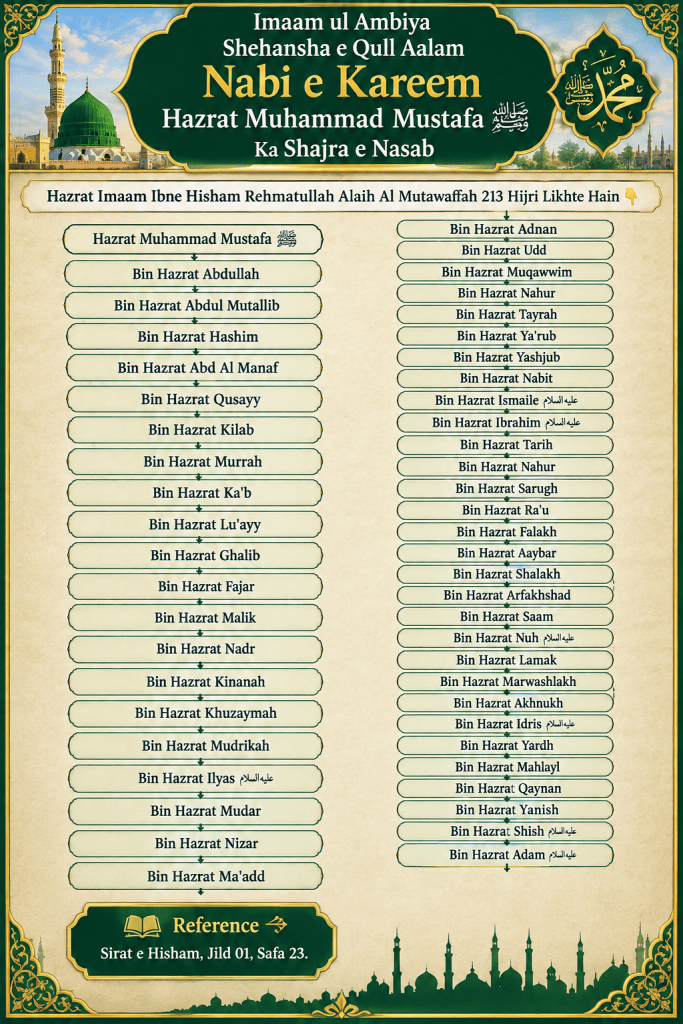
The Prophet’s lineage is as follows: Muhammad bin Abdullah bin Abdul Muttalib bin Hashim bin Abdu Munaf bin Qusayy bin Kilab bin Murrah bin Ka’b bin Luayy bin Ghalib bin Fihr bin Malik bin Nadir bin Kinana bin Khuzaymah bin Mudrika bin Ilyas bin Mudhr bin Nizar bin Ma’d bin Adnan.

While all scholars agree that Adnan was the descendant of Ismaeel, there is much dispute about the number of generations between the two and the names of each descendant.

The Prophet’s mother was Amina, the daughter of Wahb bin Abdu Munaf bin Zuhra bin Kilab. Kilab also appears as a paternal ancestor of the Prophet. It is said that his real name was Urwa or Hakim, but he was known as Kilab because of his passion for hunting with dogs (called “Kilab” in Arabic).

The Prophet’s tribe

The Prophet belonged to the tribe known as Quraysh, the most respected tribe in Arabia. “Quraysh” was, in fact, the surname of Fihr bin Malik or Nadir bin Kinana. Later, his progeny came to be known by the name Quraysh.

The Quraysh enjoyed a position of honor in the peninsula. One member of this tribe, Qusayy, played an especially vital role in establishing the greatness of this tribe. His real name was Zayd, and upon his father’s death, his mother settled among the Azra tribe near Syria. It was there that Qusayy was brought up. He returned to Makkah during his youth, and assumed the trusteeship of the Ka’bah. Because of his prestigious position, he was at

The Ka’bah was the first house of worship built for mankind. It was built by Adam, and later rebuilt by the Prophets Ibraheem and Isma’eel.

liberty to open the door of the Ka’bah whenever and for whomsoever he liked. He established the system of playing host to the pilgrims who journeyed to Makkah, preparing large quantities of food for them, and serving beverages made from honey, dates or raisins.

Qusayy also built a house north of the Ka’bah, which he named Dar Al-Nadwah, and in it were held many of the tribe’s official activities. Dar Al-Nadwah housed the tribal parliament, and marriages were also performed on its premises.

Qusayy was entrusted with the standard and bow of the Quraysh. No one but he had the right to fasten on the battle standard. Gracious and wise, he was obeyed unhesitatingly by his tribesmen who, under his leadership, settled in Makkah, and grew from a scattered band of people into a homogeneous community.

Lineage

The Prophet’s lineage is called Hashmi after his great grandfather, Hashim. Hashim assumed the position of host to the pilgrims, a privilege which, after him, was transferred to his brother, Muttalib. After Muttalib’s death, the progeny of Hashim reclaimed this privilege and retained it until the advent of Islam.

Hashim was very well-respected and earned the title Sayyed Bathaa (chief of Bathaa). He was called Hashim (one who mashes something) because he used to mash pieces of bread in meat and soup and distribute it for others to eat.

The Quraysh were merchants by profession, and Hashim arranged trade journeys for them to Yemen each winter and to Syria each summer. He obtained security for them from the authorities in both these countries. In Surah Quraysh (a “chapter” of the Qur’ân is called a “Surah”), Allâh reminds the Quraysh of their debt to Him for these important trade expeditions.

Hashim once passed by Yathrib (later known as Madinah) en route to Syria, and there he married Salma bint Amr, a lady from thetribe Banu Adiy bin Najjar. He halted there for a few days and then left for Syria. He passed away in Gaza, a famous city in Palestine. At the time of his departure, Salma was pregnant. She gave birth to a son whose hair had white streaks. She therefore named him Shayba, which means “one with gray hair.” None of Hashim’s relatives in Makkah knew about the birth of Shayba. Eight years later, however, Muttalib found out about his dead brother’s son and decided to bring Shayba to Makkah. When he entered Makkah with Shayba, the people thought the young boy was Muttalib’s slave and referred to Shayba as Abdul Muttalib, which means ‘Muttalib’s slave”. Thus, Shayba became known as Abdul Muttalib.

Abdul Muttalib grew up to be a very handsome man and became a leading figure of the Quraysh tribe. He was the chieftain of the Quraysh and oversaw the tribe’s trade caravans. Famous for his generosity, he was called “the Generous.” He gave his leftovers to the needy, and even to animals and birds. For this reason, he was described as the “feeder of men on earth and of beasts and birds on the mountaintops.”

Abdul Muttalib also had the honor of rediscovering the sacred well of Zamzam. This well had gushed forth when the infant Isma’eel kicked at the dry sand while his mother, Hajar (Hagar), searched for water. The location of the well had been forgotten ever since the tribe of Jurhum covered it when they were being exiled from Makkah. One night Abdul Muttalib had a dream in which he was shown where to dig the well. When he started digging next to the Ka’bah, the water of Zamzam began to flow again.

It was also during Abdul Muttalib’s time that the Ka’bah was attacked by the Abyssinian conqueror Abraha and his men, whom the Qur’ân refers to as the “Companions of the Elephant.” Abraha advanced with an army of sixty thousand men, intent on destroying the Ka’bah. By destroying the Ka’bah, he hoped to divert Arab pilgrims to his church in Yemen.

Abraha reached the valley of Muhassir, between Muzdalifah and Mina, ready to invade Makkah. As he advanced with his elephant, the beast that had terrified all of Makkah suddenly refused to move. As for the sixty thousand soldiers, Allâh, in defense of His Sacred House of worship, sent flocks of birds to pelt the invaders with stones. The soldiers were repulsed, and they lay felled by the stones, their bodies resembling “mashed corn.” Apart from the miraculous intervention of Allâh in defense of the Ka’bah, this episode in Makkan history showed the strength of Abdul Muttalib’s character. He stood up to Abraha’s might in defense of his own property, unshakable in his faith that Allâh would protect His sacred house, the Ka’bah.

Abdul Muttalib’s son, Abdullah, the father of the Prophet, was a handsome youth. He was called “Dhabih” (the sacrificed) in reference to the rediscovery of Zamzam. When Abdul Muttalib was digging beside the Ka’bah in search of the old well, the Quraysh watched him idly. Once he began to reach wet soil, they insisted on sharing in his discovery, and they raised a great clamor. Abdul Muttalib vowed to Allâh that he would sacrifice one of his ten sons if he were allowed to uncover the well. In the end, Abdul Muttalib continued excavating and discovered the old well.

Afterwards, he drew lots to determine which son he would sacrifice, and Abdullah was chosen. Abdul Muttalib took Abdullah to the Ka’bah and was prepared to sacrifice him, but the Quraysh, particularly Abdullah’s brothers and maternal uncles, were opposed to the sacrifice. Finally, it was decided that one hundred camels should be sacrificed in his place. Hence the Prophet called the descendant of the “two sacrificed ones” (Ismaeel ال and his own father, Abdullah).Similarly, he is referred to as the descendant of the “two elders held for ransom,” for Ismaeelال was ransomed for a ram and his father for a hundred camels.

Abdullah was married to Amina, the daughter of Wahb. Wahb was a chieftain of Banu Zahra. Shortly after the marriage, Amina became pregnant, but before she could give birth to their child, Abdullah was sent by his father to Yathrib or Syria on business. Tragically, he passed away in Yathrib on the return journey and was buried in the house of Nabgha Dhabyani.

Who is meant by those in command in verse AYAT-E-ULIL AMAR??

VERSE 13 OR “AYAT-E-ULIL AMAR”

In Surah Nisa, verse 59, the Qur’an declares:

يَأَيُّهَا الَّذِينَ آمَنُوا أَطِيعُوا اللَّهَ وَأَطِيعُوا الرَّسُوْلَ وَأُولِي الْأَمْرِ مِنْكُمْ

“O believers! Obey Allah and Obey the messenger, and those who have power of command amongst you.”

Hadrat Abdul Ghaffar bin Qasim reports that Hadrat Sayyiduna Imam Jafer Saadiq Radi Allahu ‘Anhu was once asked about who is meant by those in command. He replied, “I swear by Allah azza wajal that among them is ‘Ali.” (As Sawaaiqu Al Muharriqah)

Who are Ahle Dhikr ??

VERSE 12 OR “AYAT AHLUZ DHIKR”

In Surah Al Ambiyah, verse 7, the Holy Qur’an declares:

فَسْتَلُوا أَهْلَ الذِّكْرِ إِنْ كُنْتُمْ لَا تَعْلَمُونَ ) “O people! Ask the men of knowledge if you have no knowledge.”

Hadrat Sayyiduna Jaber bin Abdullah Radi Allahu ‘Anhu narrates that once Hadrat Sayyiduna ‘Ali Radi Allahu Anhu was asked, “Who are the Ahle Dhikr who have been mentioned that we should question?” He replied, “We are the people of Dhikr.” (As Sawaaiqu Al Muharriqah)

ख़ातूने जन्नत सइयदा फातिमा सलामुल्लाह अलैहा के मनाकिब

ख़ातूने जन्नत सइयदा फातिमा सलामुल्लाह अलैहा के मनाकिब :-

हज़रत सइयदा फातिमा अलैहस्सलाम ख़वातीन में सबसे अफज़ल व आला हैं और कायनात की तमाम औरतों की सरदार हैं अल्लाह तआला ने इन्हे खास इनायात व सिफात से नवाज़ा है पूरी इन्सानी कायनात में किसी को हूर का लक्ब अता नहीं हुआ आप खास इनायात व सिफात व ऐज़ाज़ की बुनियाद पर खास अज़मतों की हामिल थीं आप आबिदा, ज़ाहिदा, ताहिरा, शाकिरा व साबिरा और रब की रज़ा पर राज़ी रहने वाली बेमिस्ल पाकीज़ा खातून थीं हुजूर सल्लल्लाहु अलैह वसल्लम की नूरे नज़र उम्मुल मोमिनीन हज़रत खदीज़ातुल कुबरा (रजिअल्लाहु तआला अन्हा) की लख़्ते जिगर हज़रत मौला अली (करमल्लाहु वजहुल करीम) की जोज़ा और हसनैन करीमैन (रजिअल्लाहु तआला अन्हुम) की माँ और तमाम ख़वातीने जन्नत की सरदार हैं।

अल्लाह तआला ने सइयदा फातिमा (सलामुल्लाह अलैहा) को वो एज़ाज़ और बुलन्द मकामो मरतब से नवाज़ा जिसकी कोई दूसरी मिसाल नहीं और किसी दूसरी खातून को ये शरफ हासिल न हुआ आपकी खुसूसियात में से ये भी है कि आपका निकाह अर्शे आज़म पर मुनक़्क़िद हुआ और आप मासूमीन की फेहरिस्त व आसमानी शाख़्सियतों के जुमरे में शामिल हैं सरवरे कायनात रहमते दो आलम सल्लल्लाहु अलैह वसल्लम को अपनी सबसे प्यारी व लाडली बेटी सइयदा फातिमा (सलामुल्लाह अलैहा) से बेहद मुहब्बत थी और इस मुहब्बत का अंदाज़ जुदागाना था हुजूरसल्लल्लाहु अलैह वसल्लम से सइयदा फातिमा अलैहस्सलाम का रिश्ता सिर्फ बाप और बेटी का रिश्ता न था बल्कि हुक्मे इलाही से उम्मत के मुस्तबिल व हक़ व हिदायत और इमामत व कियादत (रहनुमाई) और रहबरी से मुन्सलिक है।

उम्मुल मोमिनीन हज़रत आयशा सिद्दीका (रजिअल्लाहु तआला अन्हा) फरमाती हैं सरवरे कायनात सल्लल्लाहु अलैह वसल्लम ने खातूने जन्नत सइयदा फातिमा (रजिअल्लाहु तआला अन्हा) से फ़रमाया- ऐ फातिमा क्या तुम इस बात पर राज़ी नहीं कि तुम मेरी उम्मत की तमाम औरतों की सरदार हो। (सही मुस्लिम-6/121)

हज़रत हुजैफा (रजिअल्लाहु तआला अन्हु) से रिवायत है फ़रमाते हैं कि मेरी वालिदा ने मुझसे पूछा कि तुमने कब हुजूर सल्लल्लाहु अलैह वसल्लम से मुलाकात की थी मैने कहा कि इतनी मुद्दत से मैं हुजूर सल्लल्लाहु अलैह वसल्लम से नहीं मिल सका ये सुनकर वो रंज़ीदा हुईं तो मैंने अर्ज़ किया कि मुझे इजाज़त दीजिये कि मैं हुजूर सल्लल्लाहु अलैह वसल्लम के साथ मग़रिब की नमाज़ पढूँ और तुम्हारे और अपने लिये दुआये मग़फ्रित कराऊँ पस मैं हुजूर सल्लल्लाहु अलैह वसल्लम की खिदमत में हाज़िर हुआ और आप सल्लल्लाहु अलैह वसल्लम के साथ नमाज़े मग़रिब अदा की यहाँ तक कि आप सल्लल्लाहु अलैह वसल्लम ने नमाज़े इशां अदा फरमाई और चल पड़े मैं भी आप सल्लल्लाहु अलैह वसल्लम के पीछे चल पड़ा मेरी आहट सुनकर आप सल्लल्लाहु अलैह वसल्लम ने फ़रमाया कौन हुजैफा है मैंने अर्ज किया जी हाँ आपसल्लल्लाहु अलैह वसल्लम ने फरमाया तुझे क्या काम है अल्लाह तुझे और तेरी माँ को बख़्श दे फिर फ़रमाया यह एक फरिश्ता है जो आज रात से पहले कभी नहीं उतरा इसने अपने रब से इजाज़त माँगकर मुझे सलाम करने और मुझे ये खुशखबरी देने के लिये हाज़िर हुआ है कि फातिमा (अलैहस्सलाम) तमाम जन्नती औरतों की सरदार हैं और हसन व हुसैन (अलैहिमुस्सलाम) तमाम जन्नती नौ जवानों के सरदार हैं। (तिर्मिज़ी-2/734)

तसरीहः- मजकूरा हदीस पाक से कई बातें वाज़ेह हुईं
हैं कि हज़रत हुज़ेफ़ा (रजिअल्लाहु तआला अन्हु) अपनी और अपनी वालिदा की दुआये मग़फिरत के इरादे से नबी अकरम सल्लल्लाहु अलैह वसल्लम की ख़िदमत में हाज़िर हुये थे लेकिन हज़रत हुज़ेफ़ा के (दुआये मग़फिरत) अर्ज़ करने से कब्ल सरवरे कायनात सल्लल्लाहु अलैह वसल्लम का ये फरमाना कि ऐ हुजैफा अल्लाह तआला तुझे और तेरी माँ को बख़्श दे आप सल्लल्लाहु अलैह वसल्लम का ये इरशादे मुबारक आपके इल्मे गैब पर दलालत करता है कि आप सल्लल्लाहु अलैह वसल्लम के इल्मे ग़ैब में ये बात थी कि हज़रत हुजैफा (रजिअल्लाहु तआला अन्हु) किस इरादे से मेरे पास आये हैं।

दूसरी बात ये कि हुजूर सल्लल्लाहु अलैह वसल्लम पर सलाम पढ़ने पर लगने वाले एतराज़ात की नफी कर दी कि जब मलाइका (फरिश्ते) इज़्ने खुदा से हुजूर सल्लल्लाहु अलैह वसल्लम को सलाम अर्ज़ करने की ग़रज़ से आते हैं तो हम मुसलमान अपने प्यारे आका ताजदारे मदीना रहमते दो आलम सल्लल्लाहु अलैह वसल्लम पर सलाम भेजते हैं तो बाज़ लोगों को क्यों तकलीफ होती है और सलाम पढ़ने पर एतराज़ात लगाते हैं हालाँकि उनके तमाम एतराज़ात बे बुनियाद और बद अकीदगी और उनके बे-ईमान होने पर दलालत करते हैं।

तीसरी बात ये कि अल्लाह तआला ने फरिश्ते के ज़रिये अपने महबूब तक ये पैग़ाम और खुशख़बरी भेजी कि खातूने जन्नत सइयदा फातिमा (अलैहस्सलाम) तमाम खवातीने जन्नत की सरदार हैं और हसनैन करीमैन (अलैहिमुस्सलाम) तमाम जवानाने जन्नत के सरदार हैं बल्कि हकीकत ये है कि हसनैन करीमैन तमाम जन्नती मर्दों के सरदार हैं क्योंकि हदीस पाक में है कि जन्नत में कोई भी मर्द व औरत बूढ़ा नहीं होगा यानी सब जवान होंगे और तीस साल की उम्र के होंगे और हमेशा इसी उम्र में रहेंगे और न कभी उनकी जवानी ख़त्म होगी।

रसूले अकरम सल्लल्लाहु अलैह वसल्लम ने फ़रमाया- फातिमा मेरे जिगर का टुकड़ा है उसकी तकलीफ मेरी तकलीफ है और जो चीज़ उसे अज़ियत दे वो मेरे लिये भी अज़्ज़ियतनाक है (तिर्मिज़ी-2/763)

नबी करीम सल्लल्लाहु अलैह वसल्लम ने फ़रमाया- फातिमा मेरे जिस्म का हिस्सा है जिसने फातिमा को गुस्सा दिलाया उसने मुझे गुस्सा दिलाया। (सही बुखारी-2/424)

सरकारे दो आलम सल्लल्लाहु अलैह वसल्लम ने फ़रमाया- बेशक फातिमा मेरी शाखे समरबार है जिस चीज़ से उसे खुशी होती है उस चीज़ से मुझे भी खुशी होती है और जिस चीज़ से उसे तकलीफ पहुँचती है उस चीज़ से मुझे भी तकलीफ़ पहुँचती है
(मुस्तदरक हाकिम-3/168) (मुस्नद अहमद-4/332)

खातूने जन्नत सइयदा फातिमा (रजिअल्लाहु तआला अन्हा) से हुजूर सल्लल्लाहु अलैह वसल्लम की मुहब्बत का यह एक अलग अंदाज़ है कि हुजूर सल्लल्लाहु अलैह वसल्लम ने सइयदा फातिमा को अपने जिस्म अदस का एक जुज़ और जिगर का टुकड़ा कहा और आप सल्लल्लाहु अलैह वसल्लम का ये फरमाना कि फातिमा की हर तकलीफ गोया मेरी तकलीफ है और फातिमा (अलैहस्सलाम) को गुस्सा दिलाना और उन्हें नाराज़ करना गोया मुझ (हुजूर सल्लल्लाहु अलैह वसल्लम) को गुस्सा दिलाना और नाराज़ करना है और सइयदा फातिमा को जो चीज़ खुशी पहुँचाती है वो चीज़ मुझे भी खुशी पहुँचाती है और ये हुजूर सल्लल्लाहु अलैह वसल्लम और सइयदा फातिमा (सलामुल्लाह अलैहा) के दरमियान अनोखी और बे मिस्ल बाहमी मुहब्बत है जिसकी कोई दूसरी मिसाल नहीं है और हुजूर सल्लल्लाहु अलैह वसल्लम की तकलीफ व नाराज़गी दरअस्ल अल्लाह तआला की नाराज़गी और गज़ब का बाइस है। एक

हज़रत मौला अली (करमल्लाहु वजहुल करीम) से रिवायत है रसूले अकरम सल्लल्लाहु अलैह वसल्लम ने सइयदा फातिमा से फरमाया- बेश्क अल्लाह तआला तेरी नाराज़गी पर नाराज़ होता है और तेरी रज़ा पर राज़ी होता है। (मुअजम कबीर-तबरानी-1 /108)
(मुस्तदरक हाकिम-3/167)

हज़रत अब्दुल्लाह बिन उमर (रज़िअल्लाहु तआला अन्हु) से रिवायत है कि नबी अकरम सल्लल्लाहु अलैह वसल्लम जब सफर का इरादा फरमाते तो अपने अहल व अयाल में सबसे आखिर में सइयदा फातिमा से गुफ़्तगू फ्रमाकर सफर पर र’वाना होते और सफ़र से बापसी पर सबसे पहले सइयदा फातिमा के पास तशरीफ लाते और फरमाते- ऐ फातिमा मेरे माँ बाप तुझ पर कुर्बान हों।
(इब्ने असाकर-तारीख दमिश्क-43/141) (हाकिम- अल मुस्तदरक-3/169,170)

तमाम सहाबाकिराम का ये मालूम था कि जब हुजूर सल्लल्लाहु अलैह वसल्लम की खिदमत में हाज़िर होते और कुछ अर्ज़ करते तो कहते कि या रसूलुल्लाह मेरे माँ बाप आप पर कुर्बान हों मगर नबी करीम सल्लल्लाहु अलैह वसल्लम के नज़दीक सइयदा फातिमा (अलैहस्सलाम) की कदरो मन्ज़िलत व ऐज़ाज़ का वो बुलन्द मकाम था कि हुजूर सल्लल्लाहु अलैह वसल्लम अपनी लख़्ते जिगर खातूने जन्नत सइयदा फातिमा से फ़रमाते ऐ फातिमा मेरे माँ बाप तुझ पर कुर्बान हों।

हज़रत मौला अली (करमल्लाहु वजहुल करीम) से रिवायत है नबी अकरम सल्लल्लाहु अलैह वसल्लम ने फरमाया- मेरे पास एक फरिश्ते ने आकर अर्ज़ किया या रसूलुल्लाह अल्लाह तआला ने आप पर सलाम भेजा और फरमाया कि मैने आपकी बेटी फातिमा का निकाह माला-ए-आला (अर्थे आज़म) पर अली बिन अबू तालिब से कर दिया है पस आप ज़मीन पर फातिमा का निकाह अली से कर दें।
(मुहिब्बे तबरी-1/73)

हज़रत अब्दुल्लाह बिन मसऊद रज़िअल्लाहु तआला अन्हु से रिवायत है सरवरे कायनात सल्लल्लाहु अलैह वसल्लम ने फरमाया अल्लाह तआला ने मुझे हुक्म फ़रमाया है कि फातिमा का निकाह अली से कर दूँ।
(मजमउज़्ज़वाइद-9/204) (मुअजम कबीर-तबरानी-10/156)

सइयदा फातिमा सलामुल्लाह अलैहा की शानो अज़मत का ये आलम कि आपको ये शरफे अज़ीम हासिल हुआ है कि आपका निकाह अल्लाह रब्बुल इज़्ज़त ने अर्शे आज़म पर मुनक़्क़िद किया और आपके मजलिसे निकाह में (40) चालीस हज़ार रिश्तों ने शिर्कत की फिर हुक्मे खुदा से ज़मीन पर आपका निकाह हज़रत मौला अली से हुआ।

हज़रत मौला अली शेरे खुदा करमल्लाहु वजहुल करीम से रिवायत है नबी करीम सल्लल्लाहु अलैह वसल्लम ने फरमाया मेरी बेटी फातिमा कयामत के दिन इस तरह उठेगी कि उस पर इज़्ज़त का जोड़ा होगा जिसे आवे हयात में धोया गया होगा सारी मखलूक उसे देखकर दंग रह जायेगी फिर उसे जन्नत का लिबास पहनाया जायेगा जिसका हर हुल्ला (जन्नती लिबास) हज़ार हुल्लों पर मुशतमिल होगा और हर एक पर सब्ज़ ख़त से लिखा होगा मेरी बेटी फातिमा को अहसन (बहुत अच्छी, बहुत खूब) सूरत व अकमल (बड़ी कामिल, निहायत माहिरे फन) व तमाम तर करामत और इज़्ज़त के साथ दुल्हन की तरह सजाकर सत्तर हज़ार हूरों के झुरमुट में जन्नत में ले जाया जायेगा। (मुहिब्ब तबरी-95)


हज़रत मौला अली मुर्तज़ा करमल्लाहु वजहुल करीम से रिवायत है रसूले अकरम सल्लल्लाहु अलैह वसल्लम ने फ़रमाया- कयामत के दिन मुझे बुर्राक पर और मेरी बेटी फातिमा को मेरी सवारी उज़बा पर बिठाया जायेगा (तारीख दमिश्क-10/353)

रोज़े क्यामत अल्लाह रब्बुल इज़्ज़त हज़रत सइयदा फातिमा ज़हरा (अलैहस्सलाम) को वो बुलन्द मक़ाम व इज़्ज़तो इकराम से सरफराज़ फ़रमायेगा कि अम्बियाकिराम भी उन्हें देखकर रश्क करेंगे रोज़े क्यामत हुक्मे खुदा होगा कि ऐ महशर वालो अपनी निगाहें और सरों को झुका लो ताकि फातिमा बिन्ते मुहम्मद (सल्लल्लाहु अलैह वसल्लम) गुज़र जाये और आप दो सब्ज़ चादरों में लिपटी हुई सत्तर हज़ार हूरों के झुरमुट में गुज़र जायेंगीं।

हज़रत अबू अइयूब अन्सारी (रजिअल्लाहु तआला अन्हु) से रिवायत है कि रोज़े क्यामत अर्श की गहराइयों से एक निदा देने वाला आवाज़ देगा कि ऐ महशर वालों अपने सरों को झुकालो और अपनी निगाहें नीची कर लो ताकि फातिमा बिन्ते मुहम्मद (सल्लल्लाहु अलैह वसल्लम) पुल सिरात से गुज़र जायें पस आप सत्तर हज़ार खादिमा हूरों के साथ गुज़रेंगी। (मुहिब्बे तबरी-1/94) (कंजुल उम्माल-12/105)

उम्मुल मोमिनीन हज़रत आयशा सिद्दीका (रज़िअल्लाहु तआला अन्हा) से रिवायत है फरमाती हैं कि मैने रसूले अकरम (सल्लल्लाहु अलैह वसल्लम) की साहबज़ादी खातूने जन्नत सइयदा फातिमा से बढ़कर किसी को आदात हसन सीरत व किरदार और वकार व उठने बैठने में हुजूर सल्लल्लाहु अलैह वसल्लम के मुशाबा नही देखा नीज़ फ़रमातीं हैं जब फातिमा (रजिअल्लाहु तआला अन्हा) तशरीफ लातीं तो हुजूर सल्लल्लाहु अलैह वसल्लम (उनके इस्तकबाल के लिये) खड़े हो जाते और उन्हें चूमते फिर उन्हें अपनी जगह बिठाते और जब हुजूर सल्लल्लाहु अलैह वसल्लम सइयदा फातिमा (सलामुल्लाह अलैहा) के यहाँ तशरीफ ले जाते तो सइयदा फातिमा (हुजूर सल्लल्लाहु अलैह वसल्लम के इस्तकबाल के लिये) खड़ी हो जातीं और हुजूर सल्लल्लाहु अलैह वसल्लम को चूमती और अपनी जगह बिठाती जब हुजूर सल्लल्लाहु अलैह वसल्लम अलील (बीमार) हुये तो सइयदा फातिमा (रजिअल्लाहु तआला अन्हा) हाज़िर हुईं और आप सल्लल्लाहु अलैह वसल्लम पर झुक गईं आप का बोसा लिया फिर सर उठाया और रो पड़ीं फिर दोबारा झुकीं और सर उठाया तो हंस रही थीं हुजूर सल्लल्लाहु अलैह वसल्लम के विसाल के बाद मैंने उनसे पूछा कि बताओ कि जब आप हुजूर सल्लल्लाहु अलैह वसल्लम पर पहली बार झुकीं और सर उठाया तो आप रो रहीं थीं फिर दोबारा झुककर सर उठाया तो हंस रहीं थीं इसकी क्या वजह है तो आपने फ़रमाया-मुझे हुजूर सल्लल्लाहु अलैह वसल्लम ने बताया कि इसी मर्ज़ में मेरा विसाल होगा तो मैं रो पड़ी फिर बताया अहले बैत में सबसे पहले तुम मुझसे मिलोगी ये सुनकर मैं हंस पड़ी। (तिर्मिज़ी-2/765) (सही बुखारी-2/424)

हज़रत उम्मे सलमा (रज़िअल्लाहु तआला अन्हा) रिवायत करती हैं कि जब सइयदा फातिमा ज़हरा (अलैहस्सलाम) अपनी मरजुल मौत में मुब्तिला हुईं तो मैं उनकी तीमारदारी किया करती थी बीमारी के इस
पूरे अर्से के दौरान जहाँ तक मैंने देखा कि एक दिन सुबह उनकी हालत बेहतर थी और हज़रत मौला अली (अलैहस्सलाम) किसी काम से बाहर गये थे सइयदा फातिमा ज़हरा ने कहा ऐ अम्मा (उम्मे सलमा) मेरे गुस्ल के लिये पानी लायें तो मैं पानी लायी और आप सइयदा फातिमा (रजिअल्लाहु तआला अन्हा) ने गुस्ल किया फिर बोलीं अम्मा मुझे नया लिवास दें और मैंने ऐसा ही किया फिर आप किब्ला रूख होकर लेट गईं और अपना हाथ मुबारक अपने रूखसार अक्दस के नीचे कर लिया और फरमाया अम्मा अब मेरी वफात हो जायेगी मैं (गुस्ल करके) पाक हो चुकी हूँ लिहाज़ा मुझे कोई न खोले पस उसी जगह आपकी वफात हो गई। (मुस्नद अहमद-6/461) (मजमउज़्ज़वाइद-9/210)

हजरत जाबिर बिन अब्दुल्लाह (रजिअल्लाहु तआला अन्हु) से रिवायत है नबी करीम सल्लल्लाहु अलैह वसल्लम ने फरमाया मेरी बेटी का नाम फातिमा इसलिये रखा गया है कि अल्लाह तआला ने उसे और उससे मुहब्बत रखने वालों को दोज़ख से अलग-थलग कर दिया है। (कंजुल उम्माल-12/109 ह०-34227) (अल फिरदौस-1/364)

हजरत अबू हुरैरा (रजिअल्लाहु तआला अन्हु) से रिवायत है कि हज़रत मौला अली (रजिअल्लाहु तआला अन्हु) ने बारगाहे रिसालत माब में अर्ज किया या रसूलुल्लाह आपको मेरे और फातिमा में कौन ज़्यादा महबूब है आप सल्लल्लाहु अलैह वसल्लम ने फ़रमाया फातिमा मुझे तुम से ज़्यादा प्यारी है और तुम मुझे उससे ज़्यादा अज़ीज़ हो (मजमउज़्ज़वाइद-9/173)
(मुअजम औसत-तबरानी-7/343 ह०-7675)