
The Prophet Muhammad’sﷺ Ancestors
Lineage being an important consideration in Arab society, the Prophet’s family tree was well-documented. He was born into a family that traced its ancestry back to the Prophet Ibraheem (Abraham) through Isma’eel (Ishmael).
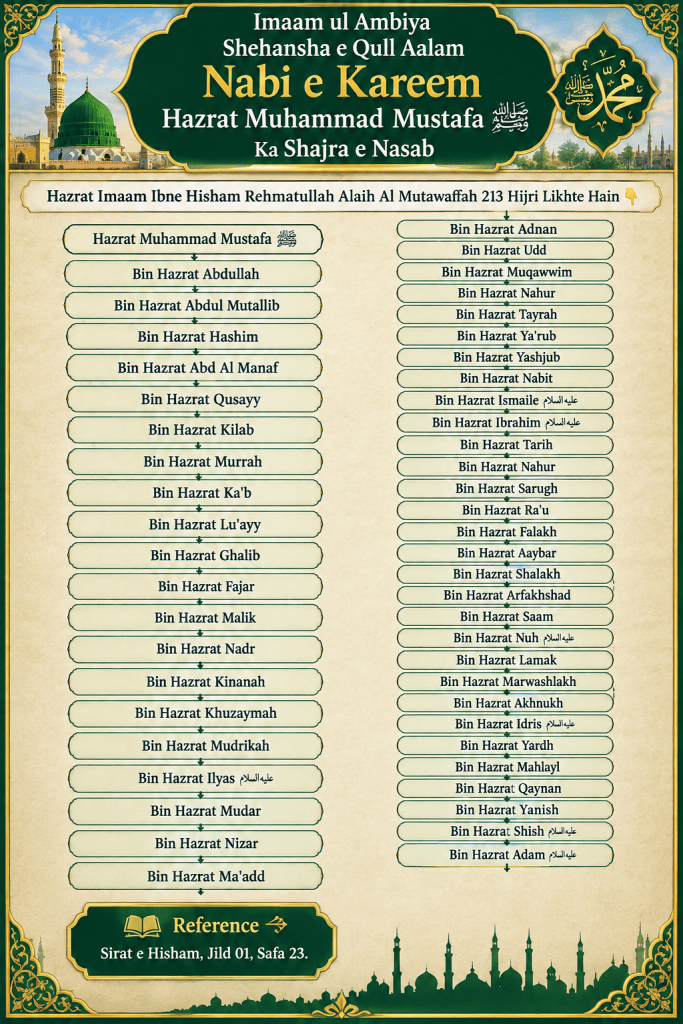
The Prophet’s lineage is as follows: Muhammad bin Abdullah bin Abdul Muttalib bin Hashim bin Abdu Munaf bin Qusayy bin Kilab bin Murrah bin Ka’b bin Luayy bin Ghalib bin Fihr bin Malik bin Nadir bin Kinana bin Khuzaymah bin Mudrika bin Ilyas bin Mudhr bin Nizar bin Ma’d bin Adnan.
While all scholars agree that Adnan was the descendant of Ismaeel, there is much dispute about the number of generations between the two and the names of each descendant.
The Prophet’s mother was Amina, the daughter of Wahb bin Abdu Munaf bin Zuhra bin Kilab. Kilab also appears as a paternal ancestor of the Prophet. It is said that his real name was Urwa or Hakim, but he was known as Kilab because of his passion for hunting with dogs (called “Kilab” in Arabic).
The Prophet’s tribe
The Prophet belonged to the tribe known as Quraysh, the most respected tribe in Arabia. “Quraysh” was, in fact, the surname of Fihr bin Malik or Nadir bin Kinana. Later, his progeny came to be known by the name Quraysh.
The Quraysh enjoyed a position of honor in the peninsula. One member of this tribe, Qusayy, played an especially vital role in establishing the greatness of this tribe. His real name was Zayd, and upon his father’s death, his mother settled among the Azra tribe near Syria. It was there that Qusayy was brought up. He returned to Makkah during his youth, and assumed the trusteeship of the Ka’bah. Because of his prestigious position, he was at
The Ka’bah was the first house of worship built for mankind. It was built by Adam, and later rebuilt by the Prophets Ibraheem and Isma’eel.
liberty to open the door of the Ka’bah whenever and for whomsoever he liked. He established the system of playing host to the pilgrims who journeyed to Makkah, preparing large quantities of food for them, and serving beverages made from honey, dates or raisins.
Qusayy also built a house north of the Ka’bah, which he named Dar Al-Nadwah, and in it were held many of the tribe’s official activities. Dar Al-Nadwah housed the tribal parliament, and marriages were also performed on its premises.
Qusayy was entrusted with the standard and bow of the Quraysh. No one but he had the right to fasten on the battle standard. Gracious and wise, he was obeyed unhesitatingly by his tribesmen who, under his leadership, settled in Makkah, and grew from a scattered band of people into a homogeneous community.
Lineage
The Prophet’s lineage is called Hashmi after his great grandfather, Hashim. Hashim assumed the position of host to the pilgrims, a privilege which, after him, was transferred to his brother, Muttalib. After Muttalib’s death, the progeny of Hashim reclaimed this privilege and retained it until the advent of Islam.
Hashim was very well-respected and earned the title Sayyed Bathaa (chief of Bathaa). He was called Hashim (one who mashes something) because he used to mash pieces of bread in meat and soup and distribute it for others to eat.
The Quraysh were merchants by profession, and Hashim arranged trade journeys for them to Yemen each winter and to Syria each summer. He obtained security for them from the authorities in both these countries. In Surah Quraysh (a “chapter” of the Qur’ân is called a “Surah”), Allâh reminds the Quraysh of their debt to Him for these important trade expeditions.
Hashim once passed by Yathrib (later known as Madinah) en route to Syria, and there he married Salma bint Amr, a lady from thetribe Banu Adiy bin Najjar. He halted there for a few days and then left for Syria. He passed away in Gaza, a famous city in Palestine. At the time of his departure, Salma was pregnant. She gave birth to a son whose hair had white streaks. She therefore named him Shayba, which means “one with gray hair.” None of Hashim’s relatives in Makkah knew about the birth of Shayba. Eight years later, however, Muttalib found out about his dead brother’s son and decided to bring Shayba to Makkah. When he entered Makkah with Shayba, the people thought the young boy was Muttalib’s slave and referred to Shayba as Abdul Muttalib, which means ‘Muttalib’s slave”. Thus, Shayba became known as Abdul Muttalib.
Abdul Muttalib grew up to be a very handsome man and became a leading figure of the Quraysh tribe. He was the chieftain of the Quraysh and oversaw the tribe’s trade caravans. Famous for his generosity, he was called “the Generous.” He gave his leftovers to the needy, and even to animals and birds. For this reason, he was described as the “feeder of men on earth and of beasts and birds on the mountaintops.”
Abdul Muttalib also had the honor of rediscovering the sacred well of Zamzam. This well had gushed forth when the infant Isma’eel kicked at the dry sand while his mother, Hajar (Hagar), searched for water. The location of the well had been forgotten ever since the tribe of Jurhum covered it when they were being exiled from Makkah. One night Abdul Muttalib had a dream in which he was shown where to dig the well. When he started digging next to the Ka’bah, the water of Zamzam began to flow again.
It was also during Abdul Muttalib’s time that the Ka’bah was attacked by the Abyssinian conqueror Abraha and his men, whom the Qur’ân refers to as the “Companions of the Elephant.” Abraha advanced with an army of sixty thousand men, intent on destroying the Ka’bah. By destroying the Ka’bah, he hoped to divert Arab pilgrims to his church in Yemen.
Abraha reached the valley of Muhassir, between Muzdalifah and Mina, ready to invade Makkah. As he advanced with his elephant, the beast that had terrified all of Makkah suddenly refused to move. As for the sixty thousand soldiers, Allâh, in defense of His Sacred House of worship, sent flocks of birds to pelt the invaders with stones. The soldiers were repulsed, and they lay felled by the stones, their bodies resembling “mashed corn.” Apart from the miraculous intervention of Allâh in defense of the Ka’bah, this episode in Makkan history showed the strength of Abdul Muttalib’s character. He stood up to Abraha’s might in defense of his own property, unshakable in his faith that Allâh would protect His sacred house, the Ka’bah.
Abdul Muttalib’s son, Abdullah, the father of the Prophet, was a handsome youth. He was called “Dhabih” (the sacrificed) in reference to the rediscovery of Zamzam. When Abdul Muttalib was digging beside the Ka’bah in search of the old well, the Quraysh watched him idly. Once he began to reach wet soil, they insisted on sharing in his discovery, and they raised a great clamor. Abdul Muttalib vowed to Allâh that he would sacrifice one of his ten sons if he were allowed to uncover the well. In the end, Abdul Muttalib continued excavating and discovered the old well.
Afterwards, he drew lots to determine which son he would sacrifice, and Abdullah was chosen. Abdul Muttalib took Abdullah to the Ka’bah and was prepared to sacrifice him, but the Quraysh, particularly Abdullah’s brothers and maternal uncles, were opposed to the sacrifice. Finally, it was decided that one hundred camels should be sacrificed in his place. Hence the Prophet called the descendant of the “two sacrificed ones” (Ismaeel ال and his own father, Abdullah).Similarly, he is referred to as the descendant of the “two elders held for ransom,” for Ismaeelال was ransomed for a ram and his father for a hundred camels.
Abdullah was married to Amina, the daughter of Wahb. Wahb was a chieftain of Banu Zahra. Shortly after the marriage, Amina became pregnant, but before she could give birth to their child, Abdullah was sent by his father to Yathrib or Syria on business. Tragically, he passed away in Yathrib on the return journey and was buried in the house of Nabgha Dhabyani.