


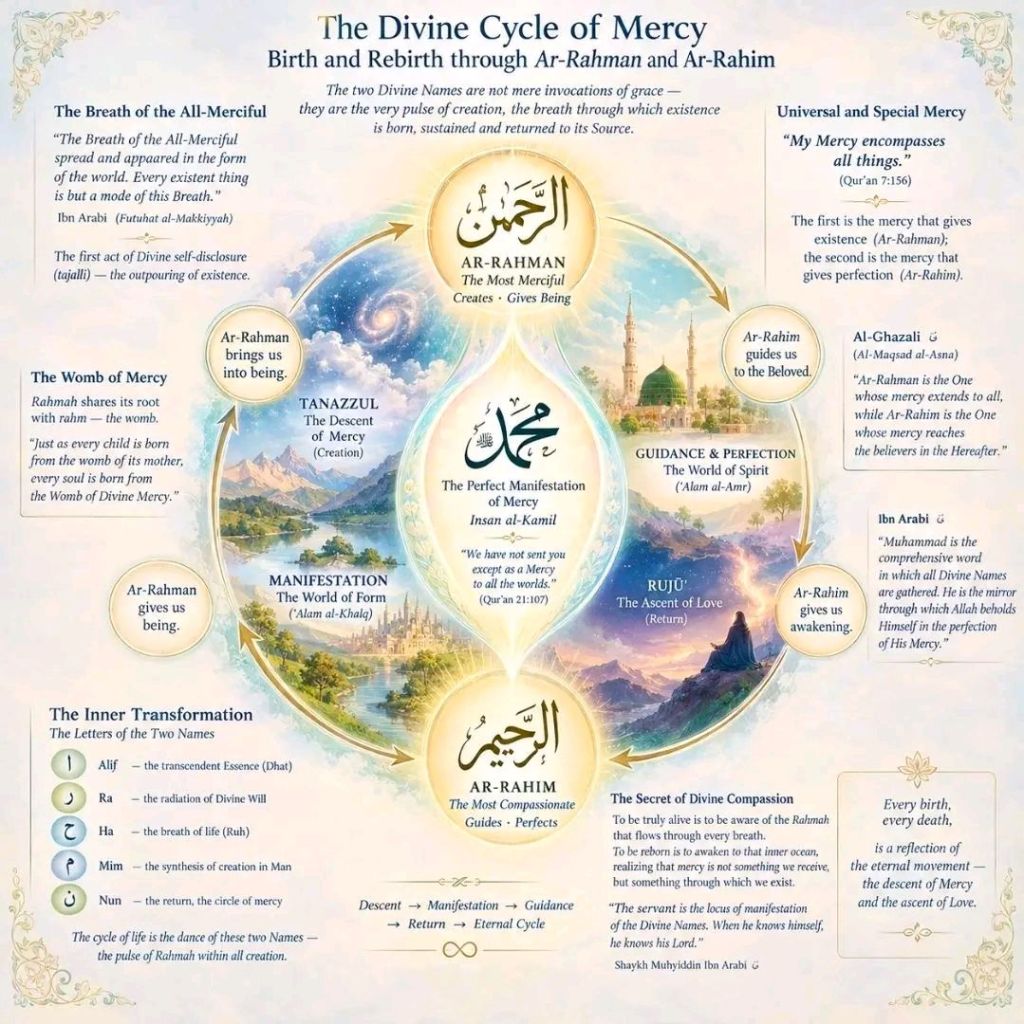
■ The Divine Cycle of Mercy: Birth and Rebirth through Ar-Raḥmān and Ar-Raḥīm
Among the Beautiful Names of Almighty Allāh ﷻ are Ar-Raḥmān, The Most Merciful, and Ar-Raḥīm, The Especially Merciful.
These two Names surround the servant from the beginning of his existence to the completion of his journey.
Through Divine Mercy, existence is brought forth and sustained. Through Divine Mercy,
the heart is awakened, purified and guided. Through Divine Mercy, the servant is given the ability to repent, remember and return.
The people of spiritual realization have therefore contemplated in these Names a profound movement: descent and return, manifestation and remembrance, creation and spiritual awakening.
The world is not abandoned to itself.
Every breath is sustained by Divine generosity.
Every moment of existence is encompassed by Divine Mercy. And every sincere return of the servant toward Almighty Allāh is itself made possible by the Mercy that preceded him.
■ The Breath of the All-Merciful
Among the profound teachings of Shaykh Muḥyī al-Dīn Ibn ʿArabī, may Almighty Allāh sanctify his secret, is the doctrine of Nafas al-Raḥmān, the Breath of the All-Merciful.
Shaykh Ibn ʿArabī uses the imagery of the Divine Breath to contemplate the continual manifestation of the possible realities of existence.
The metaphor of breathing conveys both expansion and relief: what was concealed becomes manifest, and what was constricted is given room to appear. His discussions of
the Divine Breaths are particularly developed
in the al-Futūḥāt al-Makkiyyah.
This should not be understood as a physical breath belonging to Almighty Allāh. Rather,
it is a language of spiritual contemplation concerning Divine manifestation, mercy and the continual dependence of creation upon its Creator.
The servant therefore does not possess independent existence.
His being is received.
His life is received.
His every breath is received.
▪︎ The Qur’ān declares:
وَرَحْمَتِي وَسِعَتْ كُلَّ شَيْءٍ
“My Mercy encompasses all things.”
(Qur’ān 7:156)
Nothing escapes the encompassing reality of Divine Mercy.
▪︎ Yet the same verse continues:
فَسَأَكْتُبُهَا لِلَّذِينَ يَتَّقُونَ
“I will ordain it for those who are conscious
of Me.”
Here the seeker discovers another dimension of Mercy: a mercy received not merely as existence, but as guidance, purification, forgiveness and spiritual completion.
■ From the Womb of Mercy to the Awakening of the Heart
The Arabic word raḥmah is connected linguistically with raḥim, the womb.
The image is deeply evocative. A child develops within a hidden place of protection and nourishment before emerging into the world. Likewise, the servant’s entire existence is surrounded by forms of Divine care of which he may remain unaware.
He did not create himself.
He did not choose his first breath.
He does not sustain his own heart.
He lives by gifts he did not create.
And yet the greatest birth is not the birth of
the body. It is the awakening of the heart.
The first birth brings the human being into the world of physical existence. The second is the awakening through which the heart begins to recognise the One upon whom its existence has always depended..The servant moves from merely living to knowing that he is being sustained.
From Heedlessness to Remembrance.
From dependence upon creation to reliance upon the Creator. From seeing the gift to recognising the Giver.
This is the spiritual meaning of rebirth contemplated by the people of the path: not reincarnation or another earthly life, but the renewal of the heart through faith, repentance, remembrance and Divine guidance.
■ The Mercy That Calls the Servant Back
The return of the servant is itself one of the manifestations of Divine Mercy.
Shaykh Abū Ṭālib al-Makkī, may Almighty Allāh sanctify his secret, writes in Qūt al-Qulūb of the danger of despairing of the Divine favour.
▪︎ He says:
“Let no servant despair of the bounty of his Master, nor cut off hope from His rope after
he has come to know Him, for the Master is Generous and Merciful.”
He continues by urging the servant not to abandon the Divine door because of his shortcomings, but to continue drawing near through what Almighty Allāh loves. (Qūt al-Qulūb, discussion of Divine love and knowledge).
This is an essential secret of the path.
The servant sins, and is called to repent.
He becomes heedless, and is called to remember. He falls, and is given the opportunity to rise. He becomes distant,
and the door of return remains open.
The return is therefore not proof that the servant has independently found his way back.
It is proof of a Mercy that continues to call him.
■ Ar-Raḥmān and Ar-Raḥīm: Being and Becoming
The two Names invite the seeker to contemplate two dimensions of his journey.
▪︎ Ar-Raḥmān — the Mercy through which existence is bestowed and sustained.
▪︎ Ar-Raḥīm — the Mercy through which the servant is guided, forgiven, refined and brought toward felicity.
▪︎ The first reminds us:
You exist because Almighty Allāh has given you existence.
▪︎ The second reminds us:
You are not abandoned after being created.
You are given guidance.
You are given opportunities to repent.
You are given moments in which the heart awakens.
You are given the Qur’ān.
You are given the example of the Messenger of Allāh ﷺ. And every sincere return is itself a gift from the One to whom you return.
Shaykh Abū Ṭālib al-Makkī makes a beautiful distinction when discussing Divine Mercy, love and contentment. He describes mercy as preceding the servant’s movement into love and then into riḍā, contentment with Almighty Allāh.
The servant does not manufacture this journey by his own strength. He receives tawfīq at every stage.
■ The Muhammadan Mirror of Mercy
At the centre of the prophetic understanding of Divine Mercy stands the Beloved Messenger
of Almighty Allāh ﷺ.
▪︎ Almighty Allāh ﷻ says:
وَمَا أَرْسَلْنَاكَ إِلَّا رَحْمَةً لِّلْعَالَمِينَ
“We have not sent you except as a mercy to the worlds.” (Qur’ān 21:107)
The Messenger ﷺ is the supreme human example of what it means to live under Divine Mercy and to become a means through which mercy reaches creation..His mercy was not sentiment alone.
It appeared through revelation, worship, justice, forgiveness, patience, courage, compassion and guidance. He taught humanity how to turn toward Almighty Allāh.
He taught hearts how to remember. He taught souls how to worship. And he showed, through his character, how Divine guidance transforms human conduct.
For this reason, the seeker who speaks of Divine Mercy cannot separate that Mercy from following the Messenger of Allāh ﷺ.
▪︎ Almighty Allāh says:
قُلْ إِن كُنتُمْ تُحِبُّونَ اللَّهَ فَاتَّبِعُونِي يُحْبِبْكُمُ اللَّهُ
“Say: If you love Allah, then follow me; Allah will love you.” (Qur’ān 3:31)
The Muhammadan way is therefore the illuminated path by which the servant learns how to receive Divine Mercy and respond to it.
■ Mercy Becoming Character
Divine Mercy must eventually become visible in the character of the servant.
▪︎
Shaykh Sahl al-Tustarī, may Almighty Allāh sanctify his secret, was asked about good character.
▪︎ He replied:
“Its least is forbearance, abandoning retaliation, showing mercy to the wrongdoer, asking forgiveness for him, and compassion toward him.” (Imām al-Ghazālī in Iḥyāʾ ʿUlūm al-Dīn, in his discussion of good character)
What a profound connection this establishes.
The seeker contemplates the Mercy of Ar-Raḥmān and Ar-Raḥīm, and then learns to become merciful.
He experiences forgiveness and learns to forgive. He receives patience from Almighty Allāh and learns patience with His creation.
He hopes for Divine pardon and learns not to be quick to condemn others.
This is where mystical contemplation becomes spiritual transformation. The servant does not merely speak about Mercy. Mercy begins to reshape him.
■ Descent and Return
The people of spiritual knowledge speak of tanazzul, Divine descent or manifestation and rujūʿ, return.
These expressions should not be understood as implying that Almighty Allāh physically moves from one place to another. They belong to the language of spiritual contemplation concerning the manifestation of Divine Names and the servant’s return through worship, repentance and recognition.
From one perspective, existence is continually receiving. From another, the servant is continually being called back.
Mercy descends. The servant receives.
The heart awakens. The servant remembers.
The servant turns. And he returns to his Lord through obedience, repentance and surrender.
▪︎ Shaykh Abū al-Qāsim al-Junayd al-Baghdādī, may Almighty Allāh sanctify his secret, expressed the inner meaning of this transformation:
“It is that the Real causes you to die to yourself and gives you life through Him.” (Al-Risālah al-Qushayriyyah, chapter on the definition of Taṣawwuf)
This beautifully illuminates the meaning of spiritual rebirth. The “death” is not physical death. It is the diminishing of the dominance of the ego the false assumption that the self is independent, self-sufficient and the centre of existence.
And the “life” is the life of servanthood:
life through remembrance, obedience, humility and nearness to Almighty Allāh.
▪︎ Imām Al-Junāyd, may Almighty Allāh sanctify his secret, is also reported as saying:
“The Sufi is like the earth: the righteous and the wicked walk upon it; like the cloud: it shades everything; and like the rain: it gives drink to everything.”
The saying is transmitted in later Sufi literature with references to al-Qushayrī’s Risālah and other early collections.
Whether contemplating the earth, the cloud or the rain, the image points toward a heart that has become a vessel of benefit.
The earth does not ask who walks upon it.
The cloud does not select whom it shades.
The rain does not ask who will receive its water. So too the heart refined by Divine Mercy becomes increasingly generous in mercy toward creation.
This does not mean abandoning discernment or the Sharīʿah. Rather, it means that truth and mercy are no longer enemies within the heart.
The servant learns when to be firm and when to be gentle, when to correct and when to forgive, when to speak and when silence is better.
■ From Form to Light
The servant begins by seeing the world.
Then he begins to see the signs of Almighty Allāh within the world.
Beauty reminds him of Divine Beauty.
Generosity reminds him of Al-Karīm.
Forgiveness reminds him of Al-Ghafūr.
Gentleness reminds him of Al-Laṭīf.
And mercy reminds him of Ar-Raḥmān and Ar-Raḥīm.
Gradually, creation becomes a school of remembrance. A blessing becomes an occasion for gratitude. A trial becomes an occasion for patience. A loss becomes an occasion for detachment. A closed door becomes an occasion for reliance.
A sin becomes an occasion for repentance.
A moment of weakness becomes an occasion for recognising one’s poverty before Almighty Allāh. The seeker begins to look beyond the gift toward the Giver.
Shaykh Abū Ṭālib al-Makkī gives a particularly subtle warning here. He writes that love of blessings can become confused with love of the Bestower, so that a person may imagine himself to love Almighty Allāh while actually remaining attached to what he receives from Him.
This is a profound station of spiritual discernment.
■ The Inner Movement of the Divine Names
The sacred diagram associated with this contemplation may also be read symbolically through the letters of Ar-Raḥmān and Ar-Raḥīm.
Such letter symbolism belongs to the realm of spiritual interpretation rather than an established doctrine of the Qur’ān and Sunnah, and should therefore be approached with humility.
▪︎ The Alif (ا) may be contemplated as a reminder of transcendence and Divine Oneness.
▪︎ The Rāʾ (ر) may evoke manifestation and Divine command.
▪︎ The Ḥāʾ (ح) may remind the seeker of breath and life.
▪︎ The Mīm (م) may evoke the human being as a locus in which many created realities are gathered.
▪︎ And the Nūn (ن) of Ar-Raḥmān may be contemplated symbolically as the completion of a circle existence continually receiving and returning within the encompassing Mercy of Almighty Allāh.
These are contemplative indications, not claims about the intrinsic meanings of the letters themselves.
The deeper lesson lies beyond the letters.
It lies in the Reality to which they point.
■ The Secret of Divine Compassion
Ultimately, the purpose of contemplating Ar-Raḥmān and Ar-Raḥīm is not merely to acquire mystical language.
It is to become transformed by what these Names teach. To know that Almighty Allāh is Ar-Raḥmān should make the servant grateful.
To know that He is Ar-Raḥīm should make him hopeful.
To know that His Mercy encompasses all things should prevent despair. To know that
He forgives should make the servant quick to repent. And to receive mercy should teach him to become merciful toward others.
▪︎ The Messenger of Allāh ﷺ said:
“The merciful are shown mercy by the Most Merciful. Show mercy to those on earth and
the One above the heavens will show mercy to you.” (Jāmiʿ al-Tirmidhī, 1924)
Divine Mercy is therefore not merely something to contemplate. It is something to receive, recognise and embody through righteous character.
■ The Eternal Return
Every morning carries the possibility of awakening. Every repentance is a return.
Every sincere prayer is a return.
Every tear shed before Almighty Allāh is a return. Every act of obedience is a return.
Every remembrance is a return. And ultimately, every soul will return to its Lord.
▪︎ Almighty Allāh ﷻ says:
أَلَا إِلَى اللَّهِ تَصِيرُ الْأُمُورُ
“Surely, to Allah all matters return.”
(Qur’ān 42:53)
The seeker therefore learns to see his entire journey beneath the vast canopy of Divine Mercy.
He came by Mercy.
He lives by Mercy.
He is guided by Mercy.
He repents through Mercy.
He hopes through Mercy.
And he returns to his Lord by Mercy.
This is the deeper rhythm contemplated in Ar-Raḥmān and Ar-Raḥīm:
Mercy gives existence.
Mercy sustains existence.
Mercy awakens the heart.
Mercy guides the seeker.
Mercy receives the returning servant.
The journey is not reincarnation.
It is the continual renewal of the servant through tajallī, remembrance, repentance and rujūʿ manifestation, awakening and return.
And perhaps this is one of the most beautiful meanings hidden within the spiritual language of “rebirth”:
The body is born once. But the heart may be born again and again. It is born when it remembers after heedlessness. Born when it repents after sin.
Born when it trusts after fear.
Born when it forgives after being wounded.
Born when it becomes humble after pride.
Born when it recognises the Giver behind every gift. And born when, after wandering through the forms of creation, it turns once more toward its Creator.
The servant begins by receiving the gifts of Ar-Raḥmān. He awakens through the guidance of Ar-Raḥīm. He follows the way of the Beloved Messenger ﷺ.
He purifies the heart. He remembers his Lord.
He returns..And eventually he discovers that the Mercy he had been seeking was surrounding him from the beginning.
Ar-Raḥmān is the Mercy that encompasses.
Ar-Raḥīm is the Mercy that draws the servant toward completion. The Messenger of Mercy ﷺ is the supreme example of how that Mercy is lived. The servant is the one who awakens, remembers and returns.
And beyond every descent, every awakening and every return is the boundless Mercy of Almighty Allāh.
وَرَحْمَتِي وَسِعَتْ كُلَّ شَيْءٍ
“My Mercy encompasses all things.”
(Qur’ān 7:156)
And only with Almighty Allāh is true success.


