


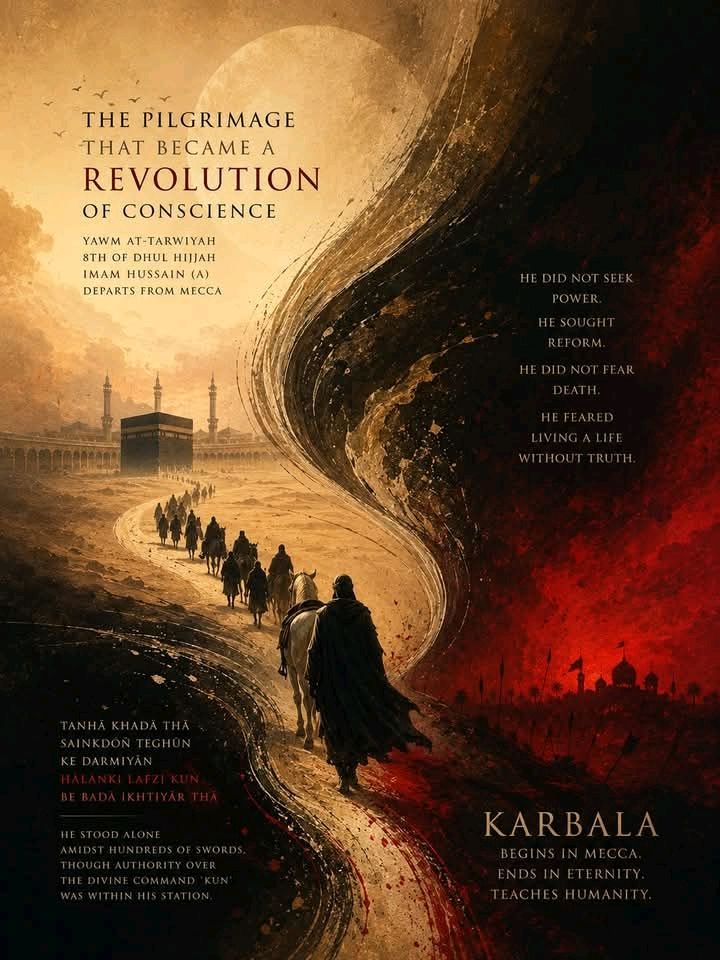
🟢🟡🟢 The Pilgrimage That Became a Revolution of Conscience : Imam Hussain’s (A) Journey of Eternal Witness From the Haram to the Desert
On the 8th of Dhul Hijjah – Yawm at-Tarwiyah – while the multitudes prepared themselves for Hajj in the sacred precincts of Mecca, Imam Husayn (A) departed from the city of his grandfather (saww).
Outwardly, it appeared to be the leaving of a sanctuary. Inwardly, it was the beginning of the greatest revolutions of conscience in human history.
The atmosphere around Mecca had darkened under the rule of Yazid ibn Mu‘awiyah (la). A tyrannical political authority sought sacred legitimacy. Allegiance was being demanded not only from bodies, but from souls. Imam Hussain (A), the grandson of Rasulullah (saww), understood that to endorse such tyranny with silence or bay‘ah would be to place the seal of Prophetic legitimacy upon corruption itself.
Yet even then, Imam Hussain (A) did not rise for worldly power. He himself declared:
«إِنِّي لَمْ أَخْرُجْ أَشِرًا وَلَا بَطِرًا وَلَا مُفْسِدًا وَلَا ظَالِمًا، وَإِنَّمَا خَرَجْتُ لِطَلَبِ الْإِصْلَاحِ فِي أُمَّةِ جَدِّي»
Innī lam akhruj ashiran wa lā baṭiran wa lā mufsidan wa lā ẓāliman, wa innamā kharajtu li-ṭalab al-iṣlāḥ fī ummati jaddī.
“I have not risen out of arrogance, vanity, corruption, or oppression. Rather, I have risen only to seek reform in the Ummah of my grandfather.”
These were not the words of rebellion for dominion.
They were the words of a divine witness refusing to allow Islam to become a servant of empire.
Reports had already emerged that assassins intended to spill his blood even within the sanctity of the Haram. Imam Hussain (A) chose to leave before the outward completion of Hajj so that the Sacred House of Allah would not become desecrated by bloodshed. Thus, his pilgrimage transformed into something far greater than ritual movement – it became a migration of truth itself.
From that moment onward, every step towards Karbala carried the weight of destiny.
He travelled not alone, but with the household of Prophethood – women, children, companions, and inheritors of divine light. This itself was a proclamation: this was not an army marching towards conquest, but truth walking knowingly towards sacrifice. Perhaps nothing captures the solitude and grandeur of that stand more than these lines by an Ahl al-Sunnah brother (I fail to recall the name):
تنہا کھڑا تھا سینکڑوں تیغوں کے درمیان
حالانکہ لفظِ کُن پہ بَدا اختیار تھا
Tanhā khadā thā sainkṛoñ teghoñ ke darmiyān,
hālānki lafẓ-e-Kun pe badā ikhtiyār thā.
“He stood alone amidst hundreds of swords,
though authority over the Divine command ‘Kun’ was within his station.”
For Karbala was never about inability. It was about divine proof. Had Imam Hussain (A) wished merely for worldly survival, history would have unfolded differently. But the purpose of Karbala was not the destruction of enemies through miraculous force. Rather, it was THE UNVEILING OF TRUTH BEFORE HUMANITY SO COMPLETELY THAT NO VEIL COULD REMAIN OVER FALSEHOOD.
Thus Imam Hussain (A) stood in the scorching plains of Karbala not as a defeated man, but as the AXIS SEPARATING TRUTH FROM DISTORTION. Through thirst, abandonment, martyrdom, and grief, he exposed the nature of tyranny more powerfully than armies ever could. And in that lies the eternal mystery of Ashura:
🟢 that apparent worldly defeat became metaphysical victory. Empires possessed soldiers, wealth, palaces, and propaganda.
But Imam Hussain (A) possessed truth.
And truth, even when left with only a few companions beneath the burning desert sky, outweighs entire civilizations built upon falsehood.
This is why the departure on Yawm at-Tarwiyah still echoes across centuries.
Because it was not merely a journey from Mecca to Karbala. It was the migration of Wilayah carrying the final proof against oppression. A pilgrimage that became a revolution of conscience. A DEPARTURE FROM THE HARAM THAT AWAKENED THE SOUL OF HUMANITY FOREVER.


