


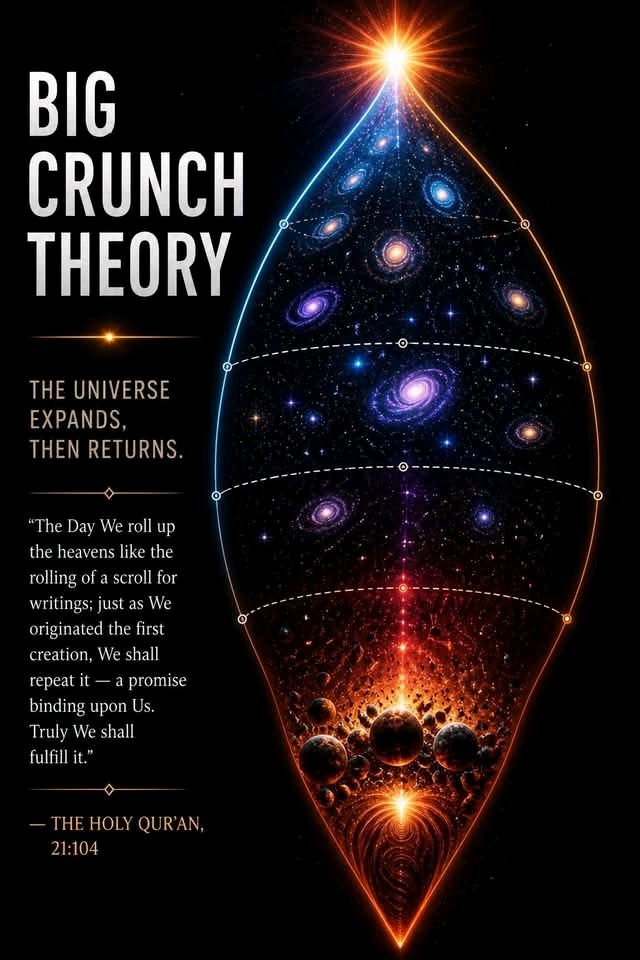
“The Day We roll up the heavens like the rolling of a scroll for writings; just as We originated the first creation, We shall repeat it — a promise binding upon Us. Truly We shall fulfill it.”
— The Holy Qur’an, 21:104
Scientific Signs of the Holy Qur’an
The Theory of the Big Crunch
Modern cosmology proposes several possible endings for the universe, including the Big Freeze, Big Rip, vacuum decay, cyclic cosmology, and the hypothetical Big Crunch (1–12). The Big Crunch scenario suggests that cosmic expansion could eventually slow, stop, and reverse, causing all galaxies and matter to collapse back into an extremely dense state (13–20). Although the currently dominant cosmological model favors accelerated expansion due to dark energy, some recent theoretical and observational discussions have reopened scientific debate about whether dark energy may evolve over time, potentially allowing a future contraction of the universe (21–30).
The Qur’anic verse in Surah Al-Anbiya (21:104) describes the heavens being “rolled up” like a scroll. Muslim writers and some comparative religion researchers have interpreted this imagery as conceptually compatible with modern cosmological ideas involving contraction or cyclic re-creation of the cosmos (31–38). The verse also connects the end of creation with a renewed creation, resembling certain cyclic universe models proposed in theoretical cosmology (39–45).
According to modern astrophysics, the universe began approximately 13.8 billion years ago in an extremely hot and dense state known as the Big Bang (46–55). Evidence supporting this model includes cosmic microwave background radiation, galactic redshifts, primordial nucleosynthesis, and large-scale structure formation (56–63). The expansion of the universe was first observed through Edwin Hubble’s measurements of distant galaxies, demonstrating that galaxies are moving away from one another (64–67).
Theoretical models developed from Einstein’s General Relativity show that the fate of the universe depends on total energy density, dark matter, dark energy, and cosmic curvature (68–75). Earlier cosmological models suggested that if the density of matter were sufficiently high, gravitational attraction could eventually halt expansion and trigger collapse (76–82). This became known as the Big Crunch hypothesis (83–87).
Dark matter plays a major role in cosmic structure formation because its gravitational effects influence galaxies and galaxy clusters (88–94). Observations of galactic rotation curves, gravitational lensing, and cosmic microwave background anisotropies strongly support the existence of dark matter (95–102). However, dark matter itself does not emit or absorb light, making it invisible to direct observation (103–106). Scientists continue searching for dark matter particles using underground detectors, particle accelerators, and astronomical surveys (107–112).
In the late 1990s, observations of distant Type Ia supernovae revealed that the expansion of the universe is accelerating rather than slowing down (113–116). This discovery led to the modern concept of dark energy, which is currently estimated to constitute roughly 68–70% of the universe’s total energy density (117–120). Consequently, the Big Crunch is no longer considered the leading cosmological scenario, though some evolving dark-energy models still leave open the possibility of future contraction.
For believers, the Qur’anic description of the heavens being folded or rolled up is viewed as spiritually and philosophically harmonious with modern scientific discussions about the finite destiny of the cosmos. While science and scripture operate in different domains and methodologies, the comparison continues to inspire dialogue between cosmology, philosophy, and theology.
The Holy Quran, God’s last word to humanity, not only contains precepts , concepts about God, solution to man’s problems, laws, news about the perished nations, highly elevated philosophy , matchless concepts of ethics, all coupled with ecstasy that moves one’s heart but also it always renders the evidence to the existence of God and evidence to divine source of the Holy Quran according to the culture of every age and every man.
Logical questions
Prophet Mohammed (peace be upon him) who could not read nor could he write.
Why did he indulge himself in such sensitive scientific question that people at his time didn’t understand and was completely out the scope of their minds?
Why didn’t he follow the culture of his time at least to avoid any scientific confrontation with them?
We read in the Holy Quran ” we will show them out signs in the horizons and in themselves”
How could he know that man will conquer the universe and made these amazing discoveries unless he was a prophet from God?
How could he know that man will develop a science called anatomy unless he was a prophet?
He must have been a prophet, who received his revelation from God.
⸻
Academic References
1. Albert Einstein — Relativity: The Special and General Theory
2. Stephen Hawking — A Brief History of Time
3. Steven Weinberg — The First Three Minutes
4. Roger Penrose — The Road to Reality
5. Sean Carroll — From Eternity to Here
6. Brian Greene — The Fabric of the Cosmos
7. Martin Rees — Just Six Numbers
8. Kip Thorne — Black Holes and Time Warps
9. George Gamow — The Creation of the Universe
10. Paul Davies — The Last Three Minutes
11. Lawrence Krauss — A Universe from Nothing
12. Max Tegmark — Our Mathematical Universe
13. Alexander Friedmann — “On the Curvature of Space”
14. Georges Lemaître — “The Primeval Atom Hypothesis”
15. Edwin Hubble — “A Relation Between Distance and Radial Velocity”
16. Allan Sandage — The Redshift-Distance Relation
17. James Peebles — Principles of Physical Cosmology
18. Edward Harrison — Cosmology: The Science of the Universe
19. P.J.E. Peebles — Large Scale Structure of the Universe
20. Yakov Zel’dovich — Structure Formation in Cosmology
21. Adam Riess et al. — “Observational Evidence from Supernovae”
22. Saul Perlmutter et al. — “Measurements of Omega and Lambda”
23. Brian Schmidt et al. — “The Accelerating Universe”
24. Planck Collaboration — Planck Cosmological Parameters
25. WMAP Collaboration — Cosmic Microwave Background Results
26. DESI Collaboration — Dark Energy Survey Findings
27. Vera Rubin — “Dark Matter in Spiral Galaxies”
28. Fritz Zwicky — “Missing Mass Problem”
29. Andrei Linde — Inflationary Cosmology
30. Alan Guth — The Inflationary Universe
31. Paul Steinhardt — Endless Universe
32. Neil Turok — Cyclic Universe Theory
33. Roger Penrose — Conformal Cyclic Cosmology
34. Stephen Hawking & George Ellis — Large Scale Structure of Space-Time
35. John Barrow — Theories of Everything
36. Bernard Carr — Universe or Multiverse?
37. Michio Kaku — Parallel Worlds
38. Lee Smolin — The Life of the Cosmos
39. Carlo Rovelli — Reality Is Not What It Seems
40. Subrahmanyan Chandrasekhar — An Introduction to Stellar Structure
41. Richard Tolman — Relativity, Thermodynamics and Cosmology
42. Hermann Bondi — Cosmology
43. Fred Hoyle — Frontiers of Astronomy
44. George Ellis — The Large Scale Structure of Space-Time
45. Dennis Sciama — Modern Cosmology
46. COBE Collaboration — Detection of Cosmic Microwave Background
47. Arno Penzias & Robert Wilson — “Measurement of Excess Antenna Temperature”
48. George Smoot — Wrinkles in Time
49. Andrei Sakharov — Cosmological Baryogenesis
50. Steven Hawking — “Singularities in Cosmology”
51. Roger Penrose — “Gravitational Collapse and Singularities”
52. Brandon Carter — “Anthropic Principle”
53. Neil deGrasse Tyson — Astrophysics for People in a Hurry
54. Joseph Silk — The Big Bang
55. Simon Singh — Big Bang
56. J.V. Narlikar — Introduction to Cosmology
57. Barbara Ryden — Introduction to Cosmology
58. Andrew Liddle — Modern Cosmology
59. Scott Dodelson — Modern Cosmology
60. Peter Coles — Cosmology
61. Malcolm Longair — Galaxy Formation
62. Abraham Loeb — First Galaxies in the Universe
63. Michael Rowan-Robinson — Cosmology
64. Edwin Hubble — Realm of the Nebulae
65. Carl Sagan — Cosmos
66. Neil Cornish — Topology of the Universe
67. Lisa Randall — Warped Passages
68. Sean Carroll — Spacetime and Geometry
69. Misner, Thorne & Wheeler — Gravitation
70. Robert Wald — General Relativity
71. Steven Weinberg — Cosmology
72. Hawley & Holcomb — Foundations of Modern Cosmology
73. David Spergel — WMAP Cosmological Interpretation
74. Max Planck Collaboration — Planck 2018 Results
75. Vera Rubin & Kent Ford — “Rotation of the Andromeda Galaxy”
76. Sandra Faber — Dark Matter in the Universe
77. Jeremiah Ostriker — “The Invisible Universe”
78. Joel Primack — Cold Dark Matter Cosmology
79. Mordehai Milgrom — Modified Newtonian Dynamics
80. Jacob Bekenstein — Relativistic MOND
81. Ethan Siegel — Beyond the Galaxy
82. Katie Mack — The End of Everything
83. Martin Bojowald — Quantum Cosmology
84. Leonard Susskind — The Cosmic Landscape
85. Frank Close — Particle Physics
86. Lisa Randall — Dark Matter and the Dinosaurs
87. Katherine Freese — The Cosmic Cocktail
88. Gianfranco Bertone — Particle Dark Matter
89. Dan Hooper — Dark Cosmos
90. Freeman Dyson — “Time Without End”
91. Ruediger Vaas — Dark Energy and Life’s Ultimate Future
92. Avi Loeb — Extraterrestrial
93. Brian Cox — Why Does E=mc²?
94. Leonard Mlodinow — Euclid’s Window
95. Hawking & Mlodinow — The Grand Design
96. Greene & Ooguri — The Hidden Reality
97. Richard Feynman — The Character of Physical Law
98. Steven Strogatz — Infinite Powers
99. David Deutsch — The Beginning of Infinity
100. Arthur Eddington — The Nature of the Physical World
101. Subir Sarkar — Particle Astrophysics
102. Martin Harwit — Astrophysical Concepts
103. Frank Shu — The Physical Universe
104. Charles Misner — Cosmological Models
105. William Press — Numerical Recipes in Cosmology
106. Richard Gott — Time Travel in Einstein’s Universe
107. CERN Collaboration — Searches for Dark Matter
108. LUX Collaboration — Dark Matter Detection Results
109. XENON Collaboration — Direct Detection Constraints
110. PandaX Collaboration — Dark Matter Experiments
111. DES Collaboration — Dark Energy Survey Publications
112. Euclid Collaboration — Dark Universe Mission
113. Riess, Schmidt & Perlmutter — Nobel Prize Lectures
114. Saul Perlmutter — Supernova Cosmology Project
115. Adam Riess — Expansion of the Universe
116. Brian Schmidt — Observational Cosmology
117. Michael Turner — “Dark Energy and the Accelerating Universe”
118. Sean Carroll — “The Cosmological Constant”
119. Paul Davies — God and the New Physics
120. Ian Barbour — Religion and Science


