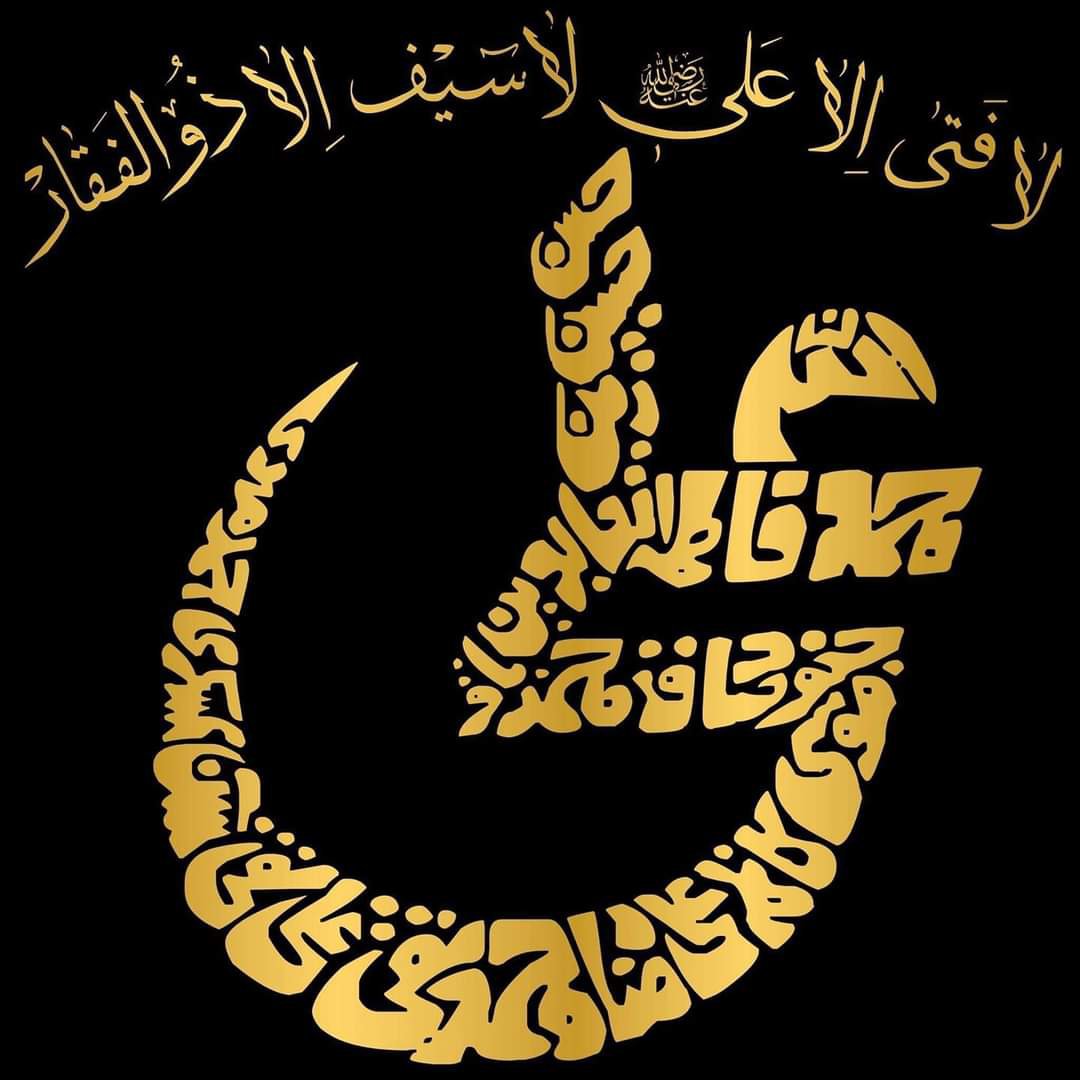
THE PERSONALITY OF ALI (A.S.)
History tells us that Ali (A.S.) was a man of middle height, stout built and clear fair complexion. He had
broad forehead with a few hair on his pate. Big black piercing eyes, handsome face, broad shoulders,
powerful arms and rough hands, vast chest and a long muscular neck. He walked with kind disposition,
very agile in his movements and courteous in his behaviour. He had a smiling face, pleasing manners
and never lost his temper. He never had a servant and never allowed his slaves to work hard. He
himself rubbed oil over the body of his camel, even when he was the ruler of the Muslim world. His
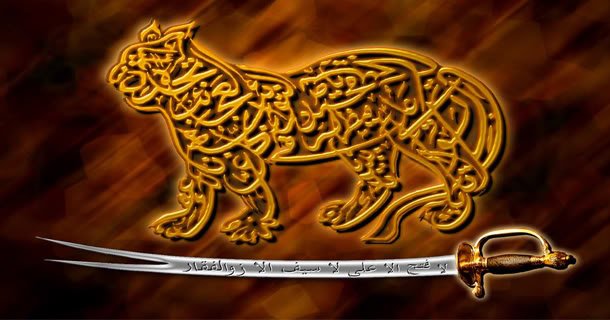
horse, his turban and his sword had special names. He gave names to everything he used. Often he
would carry his household goods himself and if anybody offered to relieve him of the weight he would
refuse. His words and deeds bore stamps of nobility, sagacity and courage of conviction. He had his
own independent views about life and its problems. He never deceived, misled or betrayed anybody. In
various phases and periods of his life, he exhibited marvellous strength of body and mind, which was
due to his sincere belief in truth and justice. He used to deal with his officers and relatives very strictly.
He reprimanded his own friends, governors and employees even if they accepted a bread as bribe.
Warning one of them he wrote, “By Allah if you embezzle with the people’s money, I will take such
actions against you that your life will become miserable, humiliated and you will become a pauper”. To
another he wrote, “I have learned that you have swept the floor and have pocketed whatever you could
lay your hands on and have spent on yourself, therefore send all your accounts to me”. To one of his
officers who had taken bribe from some helpless persons he wrote, “If you do not return their money,
and if I get hold of you I will deal with you the way Allah has made me duty bound. I will strike you with
my sword and whosoever ever has been attacked by me has gone straight to hell.”
The Prophet (S.A.W) likened him to the gateway of knowledge and wisdom of which he (the Prophet
(S.A.W)) was the city. He was the most learned person, the most brave man and the most eloquent
speaker and orator. He had such a thorough knowledge of human mind that he always arrived at
correct conclusions and never changed his opinions. Even his worst enemies relied on his opinions
and advice. They gave him such complicated cases to decide which they themselves found difficult to
digest or even understand. History has recorded some seventy two occasions when Umar Bin Khattab
declared “Had Ali not been there (to advise), Umar would have been destroyed”.
His judgement was also considered to be the best judgement. Justice was part of his soul and spirit
and was attached to his heart. It was his nature, it was an element, a source of power in every part of
his body and flowed in his vein like blood. Nobody could set better examples in Muslim law than Ali
(A.S.). He possessed complete knowledge of the revelations of Quran and Islamic laws. Whenever
complicated matters were brought to him he applied his mind in a correct way and decided the matter
which was just. Ali (A.S.)’s help to Umar Bin Khattab’s desperation forced him to confess that, “O Abul
Hasan I do not welcome those problems for the solution of which you are not available”. When he acted
as a judge he always kept the interest of the common man and the society at heart. He is considered as
the first judge who justified the right of the common man in a philosophical manner and said, “It is the
duty of every ruler to honour the right of the common man even ignoring the interest of the
complainant. It is necessary to see that justice is done to the entire society for the maintenance of law
and order”. He made such laws that people were forced to get together and have links with one
another; and in the matter of rights and duties he treated everyone alike.
Imam Abu Hanifa who is known as Imam-e-Azam was the student of the great grandson of Ali (A.S.). He
had learned the Islamic jurisprudence through his father and grand father. In the same way Maalik Ibne
Anas received the lessons in Islamic jurisprudence from the grandson of Ali (A.S.) who had learned the
same from Ali (A.S.). Maalik learned from Rabeea, Rabeea from Akrama, Akrama from Abdulla Ibne
Abbas, and Abdulla Ibne Abbas from Ali (A.S.). Abdulla Ibne Abbas who was the teacher of all these
scholars was once asked as to what relations his knowledge has with the knowledge of his cousin Ali
(A.S.). Abdulla replied, “The same which a drop has with the ocean”.
Many got perplexed about him and imagined him to be an incarnation of God. But he himself was pious
file:///D|/books/Ali/chap7.htm (1 of 3) [8/8/2000 4:14:32 AM]
alimir
and God-fearing. In his personality so many contrasting facets had so gathered that it was difficult to
believe that a human mind could manifest such a combination. It is said that scholars produce students
and not followers. Socialist create followers and not a complete man. Ascetics teach submission and
not fighting, but in Ali (A.S.) we find the characteristics of a scholar, an ascetic, and that of a Prophet
(S.A.W). His school was the school of intellect and thought. The school of revolution, submission,
discipline, goodness, beauty, ecstasy and movements. Throughout his life he was harmonized
equilibrated being. He had gathered together the perfections of humanity. He possessed a deep and far
reaching mind, tender and over flowing affection. He had both perfection of body and perfection of
spirit. When he prayed at night, he cut himself off from everything else. And during the day people saw
his kindness and altruism and listened to his advice, counsel and wise words. At night the stars looked
down on the tears of his worship and the heavens heard his prayers of love.
He was both learned and wise, he was both a Gnostic and a leader of society. He was both, a man who
denied his self, and a soldier. He was both a judge and a worker, a speaker and a writer. In sum he was
a perfect man in all it’s senses and all its attractions. He was a scion of a very illustrious rich and noble
clan. Yet he ate, dressed and lived like a poor person. He himself grinded barley for his own bread and
had given strict orders that nothing should be added to his bread, and even chaffs and husk were not
separated from the flour of his bread. His bread used to be so dry, stale and hard which he himself
prepared that he had to exert and press it with his knees to break it. He often took his bread with salt
and vinegar, and for a change would take vegetables or milk. He would seldom take meat and would
say,
“Don’t make your stomach a graveyard of slaughtered animals.” When he went out he carried with him
fried and powdered corn which he mixed with water and ate. He humbly patched his shoes and his
clothes were of thin coarse cotton material, often woven in his own house, with patches on it.
Sometimes he wore a mantle as his shirt and used to tie it to his waist, with a rope. Once an enemy
taunted him for his dress, Ali (A.S.) replied, “Let go! It is the kind our people can afford. Why don’t you
think of their lives and dresses. I shall improve my standard of living after I succeed in improving
theirs.”
Even when he was the ruler of the Muslim world, he wore the same old shirt that he had brought from
Madina. When somebody pointed at the patches on his dress he said “this patchy dress produces the
feeling of modesty and love of God. My dress is not a display of pride. It is a dress which is worn by
all”. To him wealth was for the use of other needy persons and not for himself and his family. He never
hid his earnings because the purpose of his earning was to help the needy and the oppressed and to
save them from the exploitation of the tyrants and to make their lives happier. Change of time and
change of circumstances did not bring any change in his bearing or character. Even when he was
acclaimed as the Caliph of the Muslim world he was the same Ali (A.S.) as the people had seen during
the previous regimes. He lived in a simple house and hated the whole paraphernalia of pomp and show.
He used to tell the people of Kufa, (a city of Iraq, the capital of the Muslim world) “I have come to your
city with my own dress, my own camel and my own saddle. If I return with anything else from here, you
may then call me dishonest”. In his house he said, “A wise man never loves a house which he has to
vacate soon. I have before my eyes my own permanent house (Heaven) where I have transferred all my
belongings, and I will be going there soon.” He never worried for his food, water or peaceful sleep.
Because he could never forget that many people in his own country could not afford a single bread and
many slept hungry. And then he said, “Should I be content by being called the leader of the faithfuls
without sharing their agony?”. He believed that if a ruler fails to establish the right of the people and
remove the wrongs done to them he is the worst person on earth. In him the qualifications of a poet,
soldier and a saint were united. He had a soft corner for the old, weak, infirm, disabled and poor people.
Children were his favourite. He loved nature and watering the trees was his favourite job. Whenever he
passed through the mountains of Ohad he looked at them with love and said, “This is the mountain that
loves us and we love it too.”
He was one of those persons who had power to attract and the power to repel. And both these powers
were extremely strong. Perhaps nowhere in the world can another Ali (A.S.) be found, in any century or
epoch. He had remarkable friends truly historical, ready to sacrifice themselves on him, forbearing,
burning with love for him like flames from a bonfire and full of light. They deemed giving up their lives
file:///D|/books/Ali/chap7.htm (2 of 3) [8/8/2000 4:14:32 AM]
alimir
in his way to be their aim, and their glory, and they became oblivious of everything in their friendship
with him. Years and even centuries have passed since the death of Ali (A.S.), but his attractions still
send out the same rays of light, and people are still dazzled when they turn to it.







 Aal-e-Qutub Aal-e-Syed Abdullah Shah Ghazi