Qazi Noorullah Shaheed-e-Salis says in his ‘Majaalis’ about him. The name of Abu Ayub bin Zaid al-Ansari is Khalid but his ‘Kuniyyat’ sur-name dominated his name.
He was a Medinite and therefore one of the eminent Ansar. He was the man at whose house the Prophet of Allah (s.a.w.a.) took up his lodging, when he migrated from Mecca to Medina. This was considered to be a great honour. He and his mother’s services to the Holy Prophet (s.a.w.a.) as long as he stayed in his house are well-known.
He was one of those eminent companions, who participated in Badr and other holy battles.
When Safiyyah wife of the Prophet (s.a.w.a.) came to her husband’s house, the same night Abu Ayub, having fully armed himself with weapons, had been keeping guard round the tent of the Prophet (s.a.w.a.). Next morning when the Prophet (s.a.w.a.) saw him, he prayed for him and said,
O Allah! Protect Abu Ayub just as he has protected your Prophet.
In the battles of Jamal (Camel), Siffeen and Nehrwan Abu Ayub was serving Ameerul Momineen (a.s.) and was fighting on his side.
It is recorded in the translation of Ibne A’sam-e-Koofi’s ‘Futooh’ that during the days of the battle of Siffeen, when Abu Ayub was fighting on Ameerul Momineen (a.s.)’s side got out of the lines and challenged the enemy in the battle-field. He called them loudly to come on and fight, but none of the Syrians came forward to face him. When he saw that no body came out, he spurred his horse and swooped upon the Syrian army. None of them could stand his attack. He turned towards the main screen of Muawiyah’s camp. Muawiyah was standing near it. He saw Abu Ayub and fled away. Abu Ayub entered the door and came out from another side. Abu Ayub standing at his door challenged them to fight. A group of Syrians, however, came out to face him. Abu Ayub made several attacks on them and wounded some of their notable fight-ers. Then he came back safely to his place. After that Muawiyah entered his tent, pale and dismal looking. He bitterly scolded his own men that a horse-man from Ali (a.s.)’s ranks made such an attack that he entered his tent as if they were all held captives or their hands had been tied up and they had not the power to raise a handful of dust and throw it on the face of his (Ayub’s) horse.
A Syrian whose name was Mutaraffe’ bin Mansoor said, ‘O Muaw-iyah! Be content. Just as that horse-man attacked us and entered the
door-screen of your tent, I will also make an attack and go to the door-screen of Ali bin Abi Talib (a.s.). If I see Ali (a.s.) and get an opportunity, I will inflict wound on him and will make you happy.’ So saying, he rode his horse and plunged himself into Ameerul Momineen (a.s.)’s army and ran up to his door. When Abu Ayub saw him, he turned his horse to-wards him. Reaching him he struck his scimitar at his neck and cut it off from side to side and on account of the briskness of his hand and the sharpness of his scimitar, the enemy’s head remained on his neck, but when the horse stumbled, the head fell on one side, and his body fell on the other side of the ground. The people, who were witnessing this scene, were surprised to see the ingenuity with which Abu Ayub inflic-ted the wound and highly praised him for his skill.
During the time of Muawiyah, Abu Ayub went to Rome to fight against the infidels. When he had reached that territory he fell ill. Before he died he made a will that at whatever place there was an encounter with the enemy he should be buried there. Accordingly he was perhaps buried in Istanbul near the ramparts of that city. His Holy tomb is the place, where Muslims and Christians quench their thirst. The author of Isteeaab writes that when the Romans got rid of war, they decided to open his grave, put there was such a terrible rainfall in that area that they gave up their intention.
Sheikh Abbas Qummi (r.a.) says that the Holy Prophet (s.a.w.a.) had already given information about Abu Ayub’s place of burial. He had foretold that one of his pious companions would be buried near the ram-parts of Constantinople.
“And whoever does a good-deed, We shall increase to him good in respect thereof.”
Hadrat Sayyiduna ibn Abbas Radi Allahu Anhuma states that, “In this verse, the meaning of ‘good-deed’ implies doing good to the Ahle Bayt.” (As Sawaaiqu Al Muharriqah)
• Supporting Classical Sources. Beyond Al-Sawa’iq al-Muhriqah, classical Hadith and Tafsir works record similar narrations connecting hasanah in this verse to the love of the Ahl al-Bayt: • Imam Ahmad ibn Hanbal in Musnad Ahmad • Imam al-Hakim in Al-Mustadrak • Imam al-Tabarani and Ibn Abi Hatim in their respective collections • Broader Exegetical Context. Classical commentators also note a related narration from Ibn Abbas in Sahih al-Bukhari regarding the first half of the same verse (al-mawaddah fi al-qurba), where he explained it to Sa’id ibn Jubayr as encompassing the broader blood ties between the Prophet ﷺ and the clans of Quraysh. Both Sunni and Shia scholars highlight how these narrations collectively emphasize the elevated status of the Prophet’s family and the spiritual reward of showing them affection and respect.
Surah Ash-Shura (Ayat 23) ke dusre hisse se hai, jisme Allah Ta’ala farmata hai: “Aur jo koi neki (hasanah) kamayega, Hum uske liye usme bhalai badha denge.” Yeh tafseer mashhoor Sunni aalim Imam Ibn Hajar al-Haythami ki kitab Al-Sawa’iq al-Muhriqah mein darj hai.
Zaroori Tafseel aur Hawale
• Ayat ka Pas-e-Manzar. Mukammal ayat (Surah Ash-Shura 42:23) ke do hisse hain. Pehle hisse mein Nabi Kareem ﷺ ko hukm diya gaya ke aap farma dein, “Main tumse is par koi ajr nahi maangta siwaye rishtedaron ki mohabbat ke (al-mawaddah fi al-qurba).” Uske foran baad ayat mein “neki” (hasanah) kamane ke ajr ka zikr hai. • Al-Sawa’iq al-Muhriqah ka Hawala. Al-Sawa’iq al-Muhriqah ke Baab 11, Fasl 1 mein Imam Ibn Hajar al-Haythami ne Hadrat Abdullah ibn Abbas (Radi Allahu Anhuma) ka qaul naqal kiya hai. Unhone farmaya ke is ayat mein hasanah (neki) se murad Ahl-e-Bayt se mohabbat karna aur unke saath bhalai karna hai. • Deegar Mustanad Kitabein. Al-Sawa’iq al-Muhriqah ke ilawa bhi kai purani Hadith aur Tafseer ki kitabon mein is tarah ki riwayatein milti hain jo is ayat ki hasanah ko Ahl-e-Bayt ki mohabbat se jodti hain: • Imam Ahmad ibn Hanbal ki Musnad Ahmad • Imam al-Hakim ki Al-Mustadrak • Imam al-Tabarani aur Ibn Abi Hatim ki kitabein • Tafseer ka Wasee Pehlu. Mufassireen ne Sahih al-Bukhari ki ek riwayat ka bhi zikr kiya hai jisme Hadrat Ibn Abbas ne Sa’id ibn Jubayr ko is ayat ke pehle hisse (al-mawaddah fi al-qurba) ka matlab samjhate hue Quraysh ke qabeelon aur Nabi ﷺ ke darmiyan rishtedari ka hawala diya tha. Sunni aur Shia dono ulama is baat par ittefaq rakhte hain ke yeh riwayatein Ahl-e-Bayt ke buland maqam aur unse mohabbat ki fazilat ko zahir karti hain.
God is the One Who created for you All that is on the earth. Moreover, He turned to the heaven and fashioned seven heavens with harmony. He is full of knowledge of all things.
Qur’an 23:17
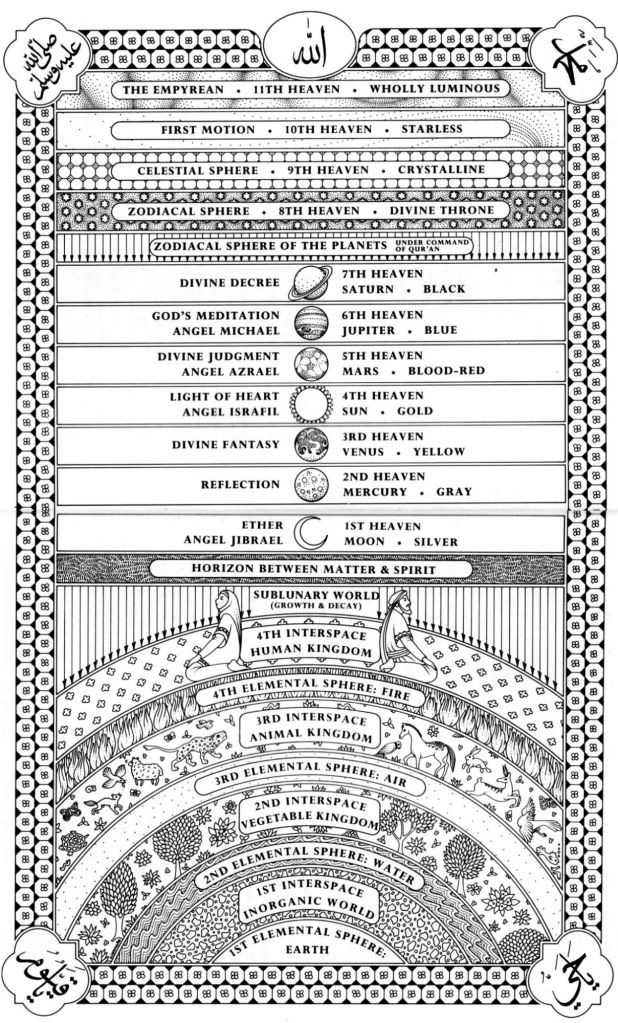
The hierarchy of creation extends from the most minute forms of terrestrial life up to Allah. The construction of this hierarchy was designed by Allah and is kept in form and balance by His will. In general terms, the whole of creation is divided into two parts: the known world of our human creation (insan) and the unseen (ghayb) and generally unknown world of the heavens.
The world below, as it were, is the sublunary world, consisting of four elemental spheres: the terrestrial, vegetative, animal, and human kingdoms. These four components are arranged in ascending order of creation, so that the human being occupies the highest position in the order of the physical creation. This dimension is governed by the rules of nature, which is to say the dominion of growth and decay, of life and death.
Above this created world of human existence lies the realm of the heavens, which are eleven in number. Each of these heavens is occupied by angelic forms and ultimately is populated with souls that depart from human bodies and earthly existence.
The various realms of earth and the heavens can be represented in their entirety in the accompanying chart.
Each of the elemental spheres-the terrestrial, vegetable, animal, and human kingdoms is composed of two parts: an elemental sphere and an interspace, with which it connects to the sphere above its own. Thus, the terrestrial sphere connects with the second elemental sphere via the in-organic world. When the element of water is combined with the terrestrial sphere, the vegetative world is created.
Likewise, the addition of air to earth and water creates fire. When all these combine-earth, water, air, and fire-the human form is made up.
The human kingdom is the interconnection to the heavenly realms. For most humans, the first heaven is represented by the moon: We first attain our strivings for the heavenly realms by viewing the moon. For those who occupy the dimension of the first heaven, or moon, the moon is the firmament and the second heaven represents a higher aspiration-Mercury is their heaven. And so on, up the hierarchy of the heavens.
Humans occupy the highest place in the realms of created life, by virtue of one reason only: Humans have been endowed with the faculty of reason, Cagl. The Cagl is the creative, rational reasoning power of the mind, which neither plants nor animals nor water has. These lower forms can only obey their instincts provided by the Creator. They are totally obedient to the laws of nature. For example, one can never “reason” with a deer. If one tries to approach one, it almost invariably bolts instantly and disappears, regard-less of the intent of the approaching human.
This holds true even for those animals that humans have sought to control. Dogs, for example, have not taken well to efforts to domesticate them. The more inbreeding that has occurred in a particular breed, the more neurotic the dogs become. Despite efforts to make dogs into pets, it is not so infrequent that a dog will for no reason turn wild upon a person or small child and kill him.
Animals that have been domesticated usually lose the natural dignity of their species. Animals of all kinds are marvelous in their natural terrain. But in that element they have intact all of their natural instinctive behavior, which is required for their survival. The lion does not kill in the wild out of malice. To be a killer is the position given to the lion in the creation, and the lion must do it.
Only humans have the capacity for creative reasoning, for the rational decision-making process by which we decide whether we are going to do a thing. This process is sometimes called free will. One can inform a human being that to do something dangerous will kill him; yet the human being-using his free will can act contrary to all the evidence and do it anyway. Animals have no such choice: A fish must be a fish.
Our mental decisions are accomplished by the ‘agl, and it is by virtue of this faculty alone that humans have been placed over all of the creation of the sublunary world.
When we aspire to something beyond the earthly existence, we move into the realm of the heavens. Most apparent to all are the zodiacal heavens, which are seven in number.
This is the realm of the planets, the first of which is the moon. Its color is white and silver, and it is constructed from the four elements mentioned, plus ether.
The second zodiacal planet is Mercury, whose color is gray. God said that He made Mercury with the addition of His own fikr, His own deep meditative thought.
Venus is the third zodiacal planet, and its color is yellow. Venus governs the world of similitudes, of analogies and metaphors, of poetry. Allah has informed us that Venus was created with the addition of His khayal, or imagination.
The sun, the fourth zodiacal planet, is presided over by Israfil, the Angel of Resurrection. The Prophet (s.a.w.s.) is reported to have related that Israfil told him that the Angel of Death scans the faces of seventy thousand people each day and, from these, chooses those who will be called from earthly existence. This planet God made from the light of His own heart, the fount of God, the absolute of the heart: love.
The fifth planet in the zodiac is Mars. Its color is blood-red. Azrael, the Angel of Death, presides over this planet, which is created from God’s wahm, or divine decision.
Jupiter is the sixth planet of the zodiac, presided over by the archangel Michael and formed of the Light of Himmah-the light of Allah’s reflection. The final zodiacal planet is Saturn. Its color is black. Saturn, being the highest in the hierarchy, was the first zodiacal constellation to be created. These first seven heavens (presented in reverse order, from lowest to highest) are descriptively named samā’. The word samā’ (heaven) is linked by sound to samā, an Arabic word meaning “ecstatic contemplation.” Each heaven exists with a relation to both something above and something below itself.
These heavens are inhabited by various beings of the creation. There are disembodied souls (having died already to earth life and awaiting the yawm al-qiyāmmah, or Day of Judgment) in one or other of the heavens. All the angels exist in all of these various heavens, depending upon their function and rank.
In addition to human souls and angels, Allah also created jinns. Whereas He created humans from the four elements of earth, water, air, and fire, He made the jinns from “smokeless fire.” The jinns, which are described fully in the Holy Qur’an, can from time to time assume human form. Generally, they are harmless or favorably inclined to humans, but they can be malevo-lent. They have great effect upon human affairs and frequently cause imbalances that we would identify as disease. A prime example is colic in infants, who are especially prone to the influence of jinns. Certain herbal substances and recitations are used to dispel jinns.
When the soul is extracted from human life, it begins to ascend through these heavenly realms. So a person would always have consideration of a prior state, and also something to look forward to. This is the reality of the heavenly existence. Those who believe in reincarnation have arrived at their concepts by only partially understanding the entire creation of the heavens.
When we arrive at the highest heaven of the zodiac, we are at the
threshold of the Throne of Allah, called the Carsh. This is actually a meta-phorical statement, as no one could imagine sitting in or anywhere near the seat of Almighty Allah. This eighth heaven constitutes the limit of the physical confines of our universe. The universe we study with telescopes, laser beams, and radio waves reaches its limit at this point of the eighth heaven. Although science has not arrived at this barrier yet, it may in time, God willing.
There are 18,000 created universes, of which we know about only one, the one we inhabit. The other 17,999 exist contiguous to our own and have other functions that we do not know about and never will. Allah has said that He did not create humans with the capacity to totally understand all of His creation. But at the moment of death, when the veils are torn away, each person will instantly see the whole nature of the heavens and the universe and will be astonished at the ingenuity of God’s design. Incidentally, Allah has said that despite the complexity of the heavens, He has created the human body infinitely more complex! But for now we shall have to be content to know that there is unimaginable vastness. This inspires us to accept the majesty and power of our Creator, Who has insisted upon many thousands of dimensions of creation; we humans see only one drop in this divine cosmic ocean.
The events of the eighth heaven are directed by Allah Himself; in the lower realms, Allah directs intermediaries to accomplish His designs. When events like shooting stars and meteorites occur in our zodiac, they are caused by actions in this ninth heaven. The regular orbiting of our fixed planets in the earthly heavens is regulated from this heaven.
The ninth heaven is the Crystalline, called the ‘arsh, meaning the Throne of Allah, the dazzlement of God’s glory. This state of existence is totally beyond conception or description. A great Sufi once said, “He who climbed over the wall to the ‘arsh, no one ever heard of him again.”
The tenth heaven contains no planets or stars and thus is called the Starless Heaven. It is where the motions of all the other spheres originate, directly under the command and decision of Allah the Almighty.
The eleventh heaven is called the Empyrean, or the Heaven of Heavens. It is wholly luminous, nothing but pure, complete, overwhelming light. Mawlānā Rūmī (r.a.) celebrated this realm when he wrote: “What do we care for the Empyrean and the skies? Our journey is to the Rose Garden of Union.”
Allah has informed us in the Qur’an that when He decided to make the creation, the first thing He made was the soul of prophecy. And, this, He said, He made from His own light, or nür. In other words, for all of the prophets Allah sent to earth with information for human beings about the nature of the creation, God made for them one soul only. He put this in 120,000 successive human forms, both male and female, some known to the world, some not. Allah made this unimaginably elegant soul from His nür,
His own light. That is why the prophets were able to have such amazing effect upon the world: Allah gave them the powers of illumination over the world.
Allah further said that “If I had not created the soul of prophecy, I would not have created the world.” After Allah created this soul of prophecy, it was so brilliant and luminous that it began to perspire. And from this perspiration of the soul of prophecy, Allah made the soul of the rose. This is why the rose has such a magnificent essence and is called the mother of scents. Anyone who looks at a rose smiles and is uplifted, and people all over the world honor and caress the rose instinctively. Indeed, the rose is the symbol of love itself.
We can see from this chart or pathway of the evolution through the hierarchy of creation that humans occupy a relatively low point in it all; there are many levels above that we cannot reach with the physical body. After the earthly, terrestrial life, there are many additional stages, which of necessity must be traversed using the vehicle of the soul. There is a stage beyond the Heaven of Heavens, past the Empyrean, called wişāl, or the wedding to God Almighty. This alone is the goal of the true Sufi and the real meaning of La ilaha illa Llah that one is content with nothing except the ultimate and final union with the Beloved, the Owner, Creator, and Sustainer of all the Worlds. Yā hayyū! Ya qayyūm!
Every scripture and every prophet from the first have said the same thing: that we are created by a wise and loving Creator, and that the special purpose of our existence is to endeavor to work our way back to Him. Our objective in life is to regain union with God, and everything in our life is an immense pageant designed to assist us in that journey. That is why one who is active on the Sufi path is referred to as sālik, the traveler.
Everything we consider to be kind, good, and desirable in this life is but the minutest manifestation of the final, absolute, and incontrovertible ac-tuality of those things which are owned by Allah and not by anyone else. This final and ultimate knowledge about all things is called haqiqat (from haqq, truth).
When we speak of love and say we want to be loved or to love someone, what we mean is that we yearn for that absolute love that will overwhelm us and burn us to ashes so that we die of love. One human cannot provide such majestic power of love for another. It is only the Divine Beloved who can annihilate us. That is what the Sufi seeks, or dies trying to achieve.
The journey from a confused, earthly person to one united forever with the Divine Reality is a long, complex, and difficult journey. Therefore, the Sufis have elaborated the various stages on this path and have developed various signposts and measures that can be used to identify where one is on the path. This chart of progression on the journey to the Beloved is called the stations of the soul.
Lineage being an important consideration in Arab society, the Prophet’s family tree was well-documented. He was born into a family that traced its ancestry back to the Prophet Ibraheem (Abraham) through Isma’eel (Ishmael).
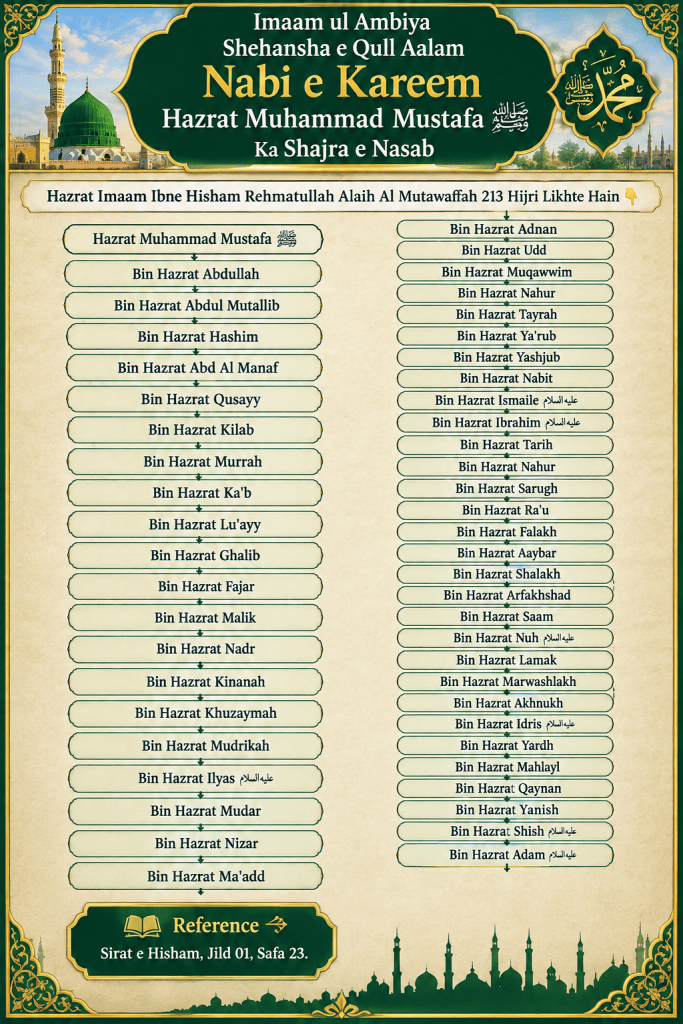
The Prophet’s lineage is as follows: Muhammad bin Abdullah bin Abdul Muttalib bin Hashim bin Abdu Munaf bin Qusayy bin Kilab bin Murrah bin Ka’b bin Luayy bin Ghalib bin Fihr bin Malik bin Nadir bin Kinana bin Khuzaymah bin Mudrika bin Ilyas bin Mudhr bin Nizar bin Ma’d bin Adnan.
While all scholars agree that Adnan was the descendant of Ismaeel, there is much dispute about the number of generations between the two and the names of each descendant.
The Prophet’s mother was Amina, the daughter of Wahb bin Abdu Munaf bin Zuhra bin Kilab. Kilab also appears as a paternal ancestor of the Prophet. It is said that his real name was Urwa or Hakim, but he was known as Kilab because of his passion for hunting with dogs (called “Kilab” in Arabic).
The Prophet’s tribe
The Prophet belonged to the tribe known as Quraysh, the most respected tribe in Arabia. “Quraysh” was, in fact, the surname of Fihr bin Malik or Nadir bin Kinana. Later, his progeny came to be known by the name Quraysh.
The Quraysh enjoyed a position of honor in the peninsula. One member of this tribe, Qusayy, played an especially vital role in establishing the greatness of this tribe. His real name was Zayd, and upon his father’s death, his mother settled among the Azra tribe near Syria. It was there that Qusayy was brought up. He returned to Makkah during his youth, and assumed the trusteeship of the Ka’bah. Because of his prestigious position, he was at
The Ka’bah was the first house of worship built for mankind. It was built by Adam, and later rebuilt by the Prophets Ibraheem and Isma’eel.
liberty to open the door of the Ka’bah whenever and for whomsoever he liked. He established the system of playing host to the pilgrims who journeyed to Makkah, preparing large quantities of food for them, and serving beverages made from honey, dates or raisins.
Qusayy also built a house north of the Ka’bah, which he named Dar Al-Nadwah, and in it were held many of the tribe’s official activities. Dar Al-Nadwah housed the tribal parliament, and marriages were also performed on its premises.
Qusayy was entrusted with the standard and bow of the Quraysh. No one but he had the right to fasten on the battle standard. Gracious and wise, he was obeyed unhesitatingly by his tribesmen who, under his leadership, settled in Makkah, and grew from a scattered band of people into a homogeneous community.
Lineage
The Prophet’s lineage is called Hashmi after his great grandfather, Hashim. Hashim assumed the position of host to the pilgrims, a privilege which, after him, was transferred to his brother, Muttalib. After Muttalib’s death, the progeny of Hashim reclaimed this privilege and retained it until the advent of Islam.
Hashim was very well-respected and earned the title Sayyed Bathaa (chief of Bathaa). He was called Hashim (one who mashes something) because he used to mash pieces of bread in meat and soup and distribute it for others to eat.
The Quraysh were merchants by profession, and Hashim arranged trade journeys for them to Yemen each winter and to Syria each summer. He obtained security for them from the authorities in both these countries. In Surah Quraysh (a “chapter” of the Qur’ân is called a “Surah”), Allâh reminds the Quraysh of their debt to Him for these important trade expeditions.
Hashim once passed by Yathrib (later known as Madinah) en route to Syria, and there he married Salma bint Amr, a lady from thetribe Banu Adiy bin Najjar. He halted there for a few days and then left for Syria. He passed away in Gaza, a famous city in Palestine. At the time of his departure, Salma was pregnant. She gave birth to a son whose hair had white streaks. She therefore named him Shayba, which means “one with gray hair.” None of Hashim’s relatives in Makkah knew about the birth of Shayba. Eight years later, however, Muttalib found out about his dead brother’s son and decided to bring Shayba to Makkah. When he entered Makkah with Shayba, the people thought the young boy was Muttalib’s slave and referred to Shayba as Abdul Muttalib, which means ‘Muttalib’s slave”. Thus, Shayba became known as Abdul Muttalib.
Abdul Muttalib grew up to be a very handsome man and became a leading figure of the Quraysh tribe. He was the chieftain of the Quraysh and oversaw the tribe’s trade caravans. Famous for his generosity, he was called “the Generous.” He gave his leftovers to the needy, and even to animals and birds. For this reason, he was described as the “feeder of men on earth and of beasts and birds on the mountaintops.”
Abdul Muttalib also had the honor of rediscovering the sacred well of Zamzam. This well had gushed forth when the infant Isma’eel kicked at the dry sand while his mother, Hajar (Hagar), searched for water. The location of the well had been forgotten ever since the tribe of Jurhum covered it when they were being exiled from Makkah. One night Abdul Muttalib had a dream in which he was shown where to dig the well. When he started digging next to the Ka’bah, the water of Zamzam began to flow again.
It was also during Abdul Muttalib’s time that the Ka’bah was attacked by the Abyssinian conqueror Abraha and his men, whom the Qur’ân refers to as the “Companions of the Elephant.” Abraha advanced with an army of sixty thousand men, intent on destroying the Ka’bah. By destroying the Ka’bah, he hoped to divert Arab pilgrims to his church in Yemen.
Abraha reached the valley of Muhassir, between Muzdalifah and Mina, ready to invade Makkah. As he advanced with his elephant, the beast that had terrified all of Makkah suddenly refused to move. As for the sixty thousand soldiers, Allâh, in defense of His Sacred House of worship, sent flocks of birds to pelt the invaders with stones. The soldiers were repulsed, and they lay felled by the stones, their bodies resembling “mashed corn.” Apart from the miraculous intervention of Allâh in defense of the Ka’bah, this episode in Makkan history showed the strength of Abdul Muttalib’s character. He stood up to Abraha’s might in defense of his own property, unshakable in his faith that Allâh would protect His sacred house, the Ka’bah.
Abdul Muttalib’s son, Abdullah, the father of the Prophet, was a handsome youth. He was called “Dhabih” (the sacrificed) in reference to the rediscovery of Zamzam. When Abdul Muttalib was digging beside the Ka’bah in search of the old well, the Quraysh watched him idly. Once he began to reach wet soil, they insisted on sharing in his discovery, and they raised a great clamor. Abdul Muttalib vowed to Allâh that he would sacrifice one of his ten sons if he were allowed to uncover the well. In the end, Abdul Muttalib continued excavating and discovered the old well.
Afterwards, he drew lots to determine which son he would sacrifice, and Abdullah was chosen. Abdul Muttalib took Abdullah to the Ka’bah and was prepared to sacrifice him, but the Quraysh, particularly Abdullah’s brothers and maternal uncles, were opposed to the sacrifice. Finally, it was decided that one hundred camels should be sacrificed in his place. Hence the Prophet called the descendant of the “two sacrificed ones” (Ismaeel ال and his own father, Abdullah).Similarly, he is referred to as the descendant of the “two elders held for ransom,” for Ismaeelال was ransomed for a ram and his father for a hundred camels.
Abdullah was married to Amina, the daughter of Wahb. Wahb was a chieftain of Banu Zahra. Shortly after the marriage, Amina became pregnant, but before she could give birth to their child, Abdullah was sent by his father to Yathrib or Syria on business. Tragically, he passed away in Yathrib on the return journey and was buried in the house of Nabgha Dhabyani.
“O believers! Obey Allah and Obey the messenger, and those who have power of command amongst you.”
Hadrat Abdul Ghaffar bin Qasim reports that Hadrat Sayyiduna Imam Jafer Saadiq Radi Allahu ‘Anhu was once asked about who is meant by those in command. He replied, “I swear by Allah azza wajal that among them is ‘Ali.” (As Sawaaiqu Al Muharriqah)