


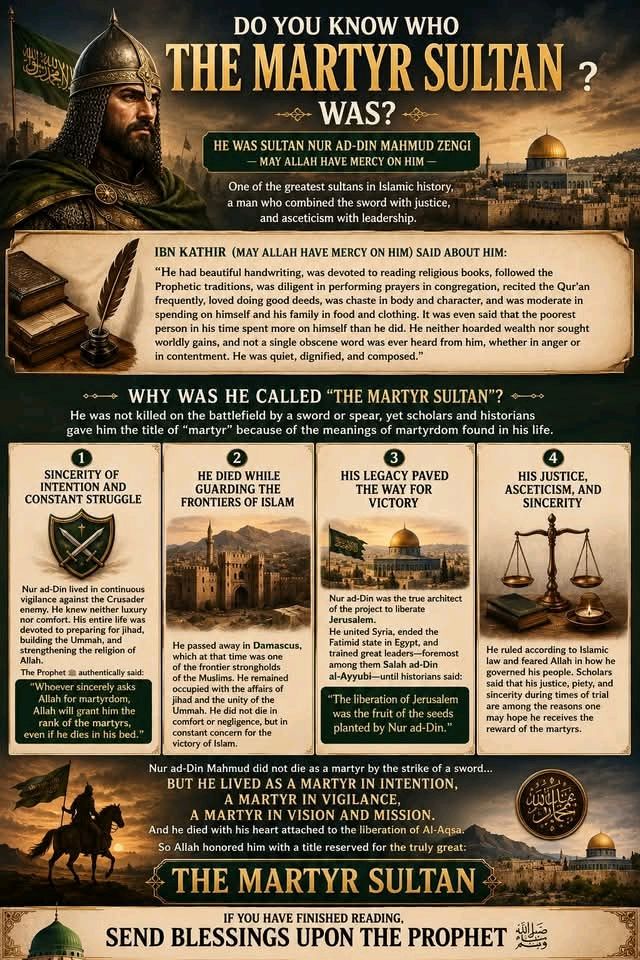
Do You Know Who “The Martyr Sultan” Was?
He was Nur ad-Din Mahmud Zengi — may Allah have mercy upon him — one of the greatest sultans in Islamic history, a man who combined the sword with justice, and asceticism with leadership.
Ibn Kathir said about him:
“May Allah have mercy on him—he had beautiful handwriting, was devoted to reading religious books, followed the Prophetic traditions, was diligent in performing prayers in congregation, recited the Qur’an frequently, loved doing good deeds, was chaste in body and character, and was moderate in spending on himself and his family in food and clothing. It was even said that the poorest person in his time spent more on himself than he did. He neither hoarded wealth nor sought worldly gains, and not a single obscene word was ever heard from him, whether in anger or in contentment. He was quiet, dignified, and composed.”
Why Was He Called “The Martyr Sultan”?
Nur ad-Din Mahmud Zengi was not killed on the battlefield by a sword or spear, yet scholars and historians honored him with the title of martyr because he embodied the true meanings of martyrdom. This was for several reasons:
First: Sincerity of Intention and Constant Struggle
Nur ad-Din lived in continuous vigilance against the Crusader enemy. He knew neither luxury nor comfort. His entire life was devoted to preparing for jihad, building the Ummah, and strengthening the religion of Allah.
The Prophet ﷺ authentically said:
“Whoever sincerely asks Allah for martyrdom, Allah will grant him the rank of the martyrs, even if he dies in his bed.”
Second: He Died While Guarding the Frontiers of Islam
He passed away in Damascus, which at that time was one of the frontier strongholds of the Muslims. He remained occupied with the affairs of jihad and the unity of the Ummah. He did not die in comfort or negligence, but in constant concern for the victory of Islam.
Third: His Legacy Paved the Way for Victory
Nur ad-Din was the true architect of the project to liberate Jerusalem.
He united شام (Greater Syria), ended the Fatimid state in Egypt, and trained great leaders—foremost among them Salah ad-Din al-Ayyubi—until historians said:
“The liberation of Jerusalem was the fruit of the seeds planted by Nur ad-Din.”
Fourth: His Justice, Asceticism, and Sincerity
He ruled according to Islamic law and feared Allah in how he governed his people. Scholars said that his justice, piety, and sincerity during times of trial are among the reasons one may hope he receives the reward of the martyrs.
Nur ad-Din Mahmud did not die as a martyr by the strike of a sword…
But he lived as a martyr in intention,
A martyr in vigilance,
A martyr in vision and mission.
And he died with his heart attached to the liberation of Al-Aqsa Mosque.
So Allah honored him with a title reserved for the truly great:
The Martyr Sultan
If you have finished reading, send blessings upon the Prophet Muhammad ﷺ.


