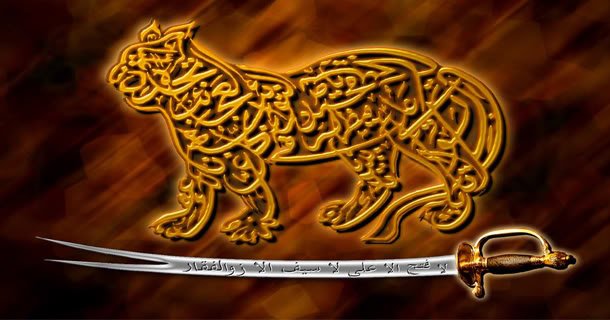


Maula Ali ka Tauheed Par Khutba by Syed Tayyab Shah Gillani.


He (Ibn Sa’d) said: All Ibn Muhammad informed us on the authority of Said Ibn Abi 'Arubah, he on the authority of Qatadah, he on the authority of a man of Banu Sadus, he said: The Apostle of Allah, may Allah bless him, wrote to Bakr Ibn Wa'il: After that, embrace Islam and you will be safe. Qatedah said: They did not find a person to read it till a man of Banu Dubay'ah Ibn Rabiah
came to them. He read it and they (Banu Dubay’ah) came to be called
Banu al-Katib. The person who had received the epistle of the Apostle of
Allah, may Allah bless him, was Zabyan Ibn Marthad al-Sadusi.


Discoveries in Algebra
On algebra, we have an exhaustive list of discoveries, including algebra itself:
. Founded algebra as the science of Al-Jabr and Al-muqabala, or completion and balancing (Muhammad Ibn Musa Al-Khwarizmi).
. Generated a Pascal Triangle and almost gave a rigorous proof for the coefficients of a binomial expansion, and advancede the binomial theorem, arguably the most significant theorem in algebra save the fundamental theorem of algebra (Abu Bakr Al-Kharaji).
• Gave extensive and algorithmic solutions to ax² = bx, ax² = c, ax² = bx =c, ax² + c = bx, and bx+c = = ax², where a, b, and c are coefficients (Muhammad Ibn Musa AlKhwarizmi).
Solved quadratic equations by “completing the square” (Muhammad Ibn Musa AlKhwarizmi)
• Transitioned algebra as a science away from geometry and closer to modern arithmetic (Abu Bakr Al-Karaji).
. Almost gave the following property: x xn Bakr Al-Karaji) – xm+n, but did not define xº = 1 (Abu
An excerpt from Al-Khwarizmi’s algebra book, The Compendious Book on Calculation by Completion and Balancing which was used in Europe as the main text for algebra until the 16th century [10].
On Mathematical logic, we only have the use of premodern induction, and this is due to math’s only historically recent formulation of (and emphasis on) proof writing and logic.
Conclusion
“Everything is Political” -Thomas Mann
“[Mathematics] finally secured a firm grip on life in the highly congenial soil of Greece and waxed stronglhy for a short period… With the decline of Greek civilisation, the plant reamined dormant for a thousand years… when the plant was transported to Europe proper and once more imbedded in fertile soil”
One cannot understate the impact of Islam in its contribution to mathematics. Indeed, almost all topics in mathematics, including but not limited to algebra, arithmetic, trigonometry, geometry, number theory, (informal) calculus, logic, and applied engineering, were all pushed to greater heights due to Islam’s mandate of seeking knowledge.
Now, as apolitical as it may seem, the discipline of mathematics is perhaps the most latently political. The vast majority of math historians, professors, and teachers know that the mathematical curriculum across the U.S. (and Europe) emphasize European Renaissance mathematics to the disadvantage of Babylonian, Chinese, Indian, and Islamic mathematics. However, just as the ancient Greeks acknowledged the triumphs in math of the ancient Egyptians and Babylonians, we too (The West) should acknowledge the debt we owe to Islamic empires [17]. Interestingly, we see that The European Renaissance relied heavily on
Plato and Plutarch acknowledged Egyptian advancements in math, astronomy, and other dicspilines. Thales and Pythagroas traveled to Egypt and Babylonia to learn about math. the mathematical, medical, and scientific discoveries of muslim scholars of the medieval age, discoveries which later became the building blocks of the current western world. so, how can we (the west), ensure mathematics veers towards a purely scientific science? this can occur through the teaching of multiculturism in math classrooms.
firstly, a multicultural approach allows students of all heritages to be proud of their heritages’ contributions to math. a multicultural approach paints math as a universal discipline, inconsistent with just european ambition, and consistent with babylonian, greek, egyptian, indian, chinese, islamic, and european ideas. a specific way to incorporate multiculturalism in mathematicians is through the naming and renaming of theorems, results, and ideas in the mathematical discipline.
for instance, though the pythagorean theorem is named after pythagoras, a brilliant mathematician in greek civilization, the theorem was used time and again by egyptians, ancient mesopotamians, and northern europeans centuries before the height of greek innovation. renaming of theorems and results leads to the exhibition of the inherent multiculturalism embedded in the study of mathematics.
math need be presented as a discipline interconnected between cultures, sought after by all, innovated incrementally by various civilizations, and discovered by indians, chinese, europeans, muslims, and others alike. math can be done, irrespective of creed, color, or origin, and different civilizations’ contributions should be emphasized in math classrooms from k-12 and beyond. this paper puts into perspective that one such creed and it’s followers, islam and muslims, have indeed contributed to mathematics, more so than meets the eye, and more so than what is taught.


APPEARANCE, BEARING &LOOKS
The study of human appearance and bearing is an important branch of psychology. This is based on innumerable studies and experiments. These psychologists study the eyes, nose, forehead and other parts of the body and arrive at a conclusion about the person’s nature and temperament. According to these experts, a bulging forehead is a sign of intelligence and cleverness. When the arms of a person are firm and wide, he has the qualities of a leader of men. The hardness of hair, according to them, is a sign of valor and big eyes indicate a person who is quick of nature. One who has a short neck might be tricky and querulous. When a person has fleshy calves is generally foolish. One who has small and sunken eyes is tricky and treacherous. One who has weak and thin shoulders is apt to be poor in thinking. Although these are hypothetical assessments, at best, they give a fair idea about the persons under study.
According to the books of history and biography, the appearance of Ameer al Momineen (a.s.) can be described as given here:
His body was heavy, his complexion light wheatish, his appearance and bearing were very attractive, his visage was smiling and shiny like the full moon. Abul Hajaj Mudrak says, “Kaana man ahsan an naas wajha – He was more handsome and attractive than others. “He had a wide forehead. Ibne Abbas says, “Maa raayat ahsan min sharsat Ali(a.s.) – I have not seen temples better looking than those of Ali (a.s.)”On his forehead calluses had developed on account of excessive prostration in prayer. He had a delicate and pointed nose and eyes big and dark that reflected determination and boldness. Abul Hajaj says that he had seen traces of collyrium in Hazrat Ali (a.s.)’s eyes. His eyes were bright, eye brows were bow shaped, eye lashes long, teeth properly spaced and shining. Zarara bin Zamra says, “An tabassum fa-an masal lulual manzoom – When he smiled the teeth shone like strings of pearls! “His neck was muscular and long. His chest was wide and hairy. His biceps were well formed. His wrists were strong and firm and finding the joint between the wrists and the arms was difficult. His collar bones were wide and strong. His palms were hard and the knees were neither weak nor fleshy. His tummy was rather bulgy. His beard was dense and wide. The hair of his head was grey. Mohammed ibne Hanafia says, “Akhtasab bilhana marrat summa tarka – Hazrat Ali (a.s.) once dyed his hair with henna once, and then abstained from doing it” Because of excessive use of the armor, the hair on his forehead had fallen. His height slightly more than the average. Hazrat Ali (a.s.) himself said,”Khalakhni mautad la azrab al qaseer fa-aqda wazrab al taweel faqtah Allah has bestowed on me a modest body and height When my adversary is short, I strike on his head to cut him into two pieces and if he is tall I cut him horizontally int two.” His voice was clear and loud, his style and speed of walking was like that of the Prophet (s.a.), elegant and slightly drooping to the front. When he advanced to face an adversary in battle, he used to walk briskly.and his eyes used to get reddish.
Ibne Qatiba writes in Al Ma-arif that a woman saw Hazrat Ali (a.s.) and said,”Ka-anhu kasr summa jabar” The meaning of these words is that he had been broken and again rejoined! People thought that it means that his
body was asymmetrical. In fact what the woman said was an Arabic idiom and its allegorical meaning is different from its apparent meaning. Therefore Sayed Mohsin Aamili writes in Ai-aan al Shia and Omer Abul Nasr in Al Zahra also writes thesaying of Ibn e Aisha that the quoted sentence is for the person whose arms are muscular and his eyes piercing the ground and not a person who is asymmetrical of body!


SELECTIONS FROM BAL-E-JIBREEL BY IQBAL
COUPLET 1
دلوں کو مرکز مہر و وفا کر * حریم کبریا سے آشنا کر جسے نان جویں بخشی ہے تو نے * اسے بازوۓ حیدر بھی عطا کر Dilon Ko markaze Mehro Wafa Kar, Harime Kibrya se ashna Kar
Jisey nane Jaween bukhshi hai toone, Usey bazoo-e Haider bhi ata Kar
Allama Iqbal invokes God in prayer that He may bestow upon the Muslims the love for their creator and Islam. God in His infinite mercy has granted us food for our existence. It is He who can bestow upon us the faculty and strength to serve Islam. According to him the fountain-head of all guidance is the distinguished personality of Hazrat Ali (a.s.) who was the strongest general in the Arab world although he spent his life by living on barley bread only. Hazrat Ali (a.s.) had the unique distinction of combining in himself the qualities of perfect learning, piety and lofty courage. The Holy Prophet (s.a.w.) had said, “I am the city of knowledge and Ali is its gate”. So if we want to know the Prophet’s (s.a.w.) we should know Hazrat Ali (a.s.). We cannot reach the city unless we reach the gate. Hazrat Ali’s (a.s.) knowledge was as perfect as anybody could imagine. Once he said, “If the curtain between me and God could be removed my belief would not be increased.” His belief in and cognition of God had reached the highest point. Hazrat Ali (a.s.) used to say, “Ask me anything before I am no more.” Allama Iqbal was so much enamoured of the qualities of Hazrat Ali that he wishes every Muslim to follow his footstep so that he may lead a glorious life.
COUPLET 2 3
کبھی تنہائی کوہ و دمن عشق – کبھی سوز و سرور و انجمن عشق و کبھی سرمایۂ محراب و منبر * کبھی مولا علی خیبر شکن عشق * Kabhi tanhai-e- Koh-o daman Ishq, Kabhi Soz o Sarod o anjuman Ishq
Kabhi Sarmaya-o-mehrab o member, Kabhi mola Ali Khayber shikan Ishq
Allama Iqbal says that true love manifests itself in various fields. It is not confined to a particular sphere. Sometimes we find true love being shown in seclusion (Cave of Hira) where the Holy Prophet (s.a.w.) was in prayers before his installation as Prophet, sometimes it is seen when the devotees bow down in prayers, reciting the Holy Quran and the praises of God and sometimes in taking up sword to defend Islam and and crush the enemies of Islam as was done by Hazrat Ali (a.s.) in various Islamic battles, like Khayber Khandaq etc.
COUPLET 4
خیرہ نہ کر سکا مجھے جلوۂ دانش فرنگ « سرمہ ہے میری آنکھ کا خاک مدینہ و نجف *
Kheera na Karsaka mujhey jalwae danish e farang, Surma hai meri ankh ka Khak e Medina-o Najaf
Allama Iqbal possessed a high standard of learning. He took his Masters degree in Philosophy from the Punjab University and also from Cambridge and Doetrate from Munich (Germany). He carried on research work on Philosophical concepts in Iran. His poetical works in Persian and Urdu have been regarded as of highest order in modern age. Iqbal who studied foreign literature an concepts so intensively came to the conclusion that the fountain-heads of all knowledge are only the Prophet (s.a.w.) and Hazrat Ali (a.s.). He firmly believes in the saying of the Prophet Mohammad (s.a.w.), “I am the city of knowledge and Ali is its gate”. So fondly he says that his eyes can get light only from the dust of Madina and Najaf where the souls of the Prophet (s.a.w.) and Hazrat Ali (a.s.) rest. He travelled abroad and made intensive studies and researches but he could not be impressed by any other source of knowledge except the Prophet (s.a.w.) and Hazrat Ali (a.s.).COUPLET 5
دارا و سکندر سے وہ مرد فقیر اولی « ہو جس کی فقیری میں بوۓ اسد اللہی ة * Dara o Sikander sey woh mard e faqir aula, Ho jiski faqiri men boo-e-asadullahi
Allama Iqbal looks down upon all pomp of monarchy and strength. He had studied the various aspects of the life of Hazrat Ali (a.s.) a top most man of learning, best judge, greatest warrior, the most loyal comrade of the Holy Prophet, in whose praise the ayat-e-Tathir and Hal-ata were revealed and he has unaccountable love for him. He says that a beggar who lives upto the ideals of Hazrat Ali is far superior in his eyes to the crowns and monarchs who have power and authority but are devoid of saintly sprits.
COUPLET 6
بڑھ کے خیبر سے ہے یہ معرکہ دین و وطن * اس زمانے میں کوئی حیدر کرار بھی ہے Barh ke Khayber sey hai yeh marikae din o watan, Is zamaney men koi Haydere Karrar bhi hai
Allama Iqbal stresses the need for unity among Muslims. He abhors the present trend of unity for political purposes. It is a fallacious Concept and must be fought against. He fondly asks if there is one who could smash this fort as Hazrat Ali (a.s.) did when he conquered Khayber.
COUPLET 7
یا عقل کی روباہی یا عشق یداللهی * یا حیلۂ افرنگی یا حمله ترکانہ Ya aql ki robahi ya Ishq e yadullahi, Ya According to Allama Iqbal our intellect is often misled by deceptive arguments. We should have before us as an ideal the true love as possessed by Hazrat Ali (a.s.) towards God Almighty. That love did not care for any bodily pain or worldly troubles. So we should also follow in the footsteps of Hazrat Ali (a.s.) who sacrificed his all in the way of God. If we fail to do that our lives are doomed to a miserable end.
COUPLET 8-9
و مستی نے نوازی * جلال عشق و مستی بے نیازی عشق جمال کمال عشق و مستی ظرف حیدر * زوال عشق و مستی حرف رازی Jamal-e-Ishqo Masti nai nawazi, Jalal-e-Ishqo Masti be niazi
Kamal e Ishqo Masti zarbe Haider, Zawal e Ishq o masti harf-e razi
Allama Iqbal considers that Hazrat Ali (a.s.) has reached the acme of true love for God. The exalted and ecstatic love of Hazrat Ali (a.s.) for God could manifest itself in his submission and prayers to God. It could also be shown in the superb courage with which he fought the battles of Islam. It was through his actions that he reached the highest position of love. Dr. Iqbal wishes us to follow Hazrat Ali (a.s.) and refrain from wasting our time in metaphysical discourses. The very concept of true love fail if we do not act according to the precepts of Islam.
COUPLET 10
امارت کیا شکوہ خسروی بھی ہو تو کیا حاصل ” نہ زور حیدری تجھ میں نہ استغنائے سلمانی *
heela e afrangi ya hamla e TurkanaImarat Kiya shikoh-e-Khus-avibhi ho to Kiya hasil, Na zor e Hayderi tujhmen na istighna-e-salmani
Allama Iqbal deplores the condition of the Muslims at the present time. We do not possess physical strength and contented heart. We have forgotten to take lessons from the precepts and examples set by Hazrat Ali (a.s.) and his follower Hazrat Salman. If we inculcate that spirit of Islam then alone we can achieve the true aim of life. The worldly pomp of a King or the boast of wealth are good-for-nothing.
 Aal-e-Qutub Aal-e-Syed Abdullah Shah Ghazi