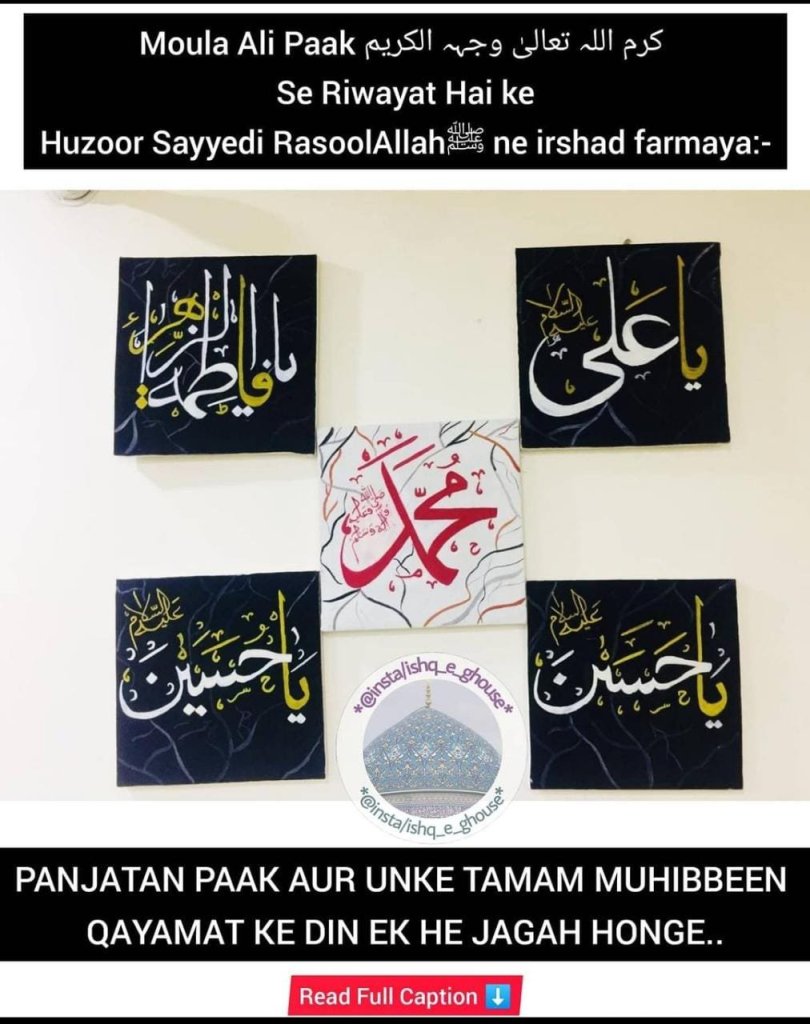
PANJATAN PAAK AUR UNKE TAMAM MUHIBB QAYAMAT KE DIN EK HE JAGAH HONGE..
Moula Ali KarramAllahu Ta’ala Wajhahul Kareem se riwayat hai ke Huzoor Nabi-e-Akram SallAllahu Alaihi wa Aalihi wa Sallam ne farmaya: Mai, Ali, Fatima, Hasan wa Hussain aur Hamare Muhibbeen sab Roz-e-Qayamat ek he jagah ikatthe honge. Qayamat ke Din Hamara Khana Peena bhi Ikattha hoga, yahan tak ke logon me faisle kar diye jaenge.”
Haythami ne Majma-uz-zawaid (9:174) me kaha ke isey Tabarani ne riwayat kiya hai aur mai iske raawiyon ko nahi jaanta
Tabarani, al -Mujam-ul-kabir (3:41 #2623)
Yaani Qayamat ka din Muhibbeen e Ahle Bayt e Athar Alaihimusalam ke liye mazedar Mubarak din hoga aur baaki logo keliye HAULNAAK din!!!
abhi waqt hai dekho kis jagah rehna pasand hai!! AhleBait e Paak aur Khulfa e Rashideen ke Tariqe per chalo.. . Keep Loving The Prophetﷺ and his Ahle Bait Adab e Sahaba wa Awliya Allah
Arriving at Tabuk and camping there, the Muslim army was ready
to face the enemy. There. Allâh’s Messenger ﷺ the delivered an eloquent speech that included the most inclusive words.
In that speech he urged the Muslims to seek the welfare of this world and the world to come. He warned them and gave them good tidings. By doing that he encouraged those who were broken in spirits, and blocked up the gap of shortage and mess they were suffering from due to lack of supplies, food and other substances
Upon learning of the Muslims’ march, the Byzantines and their allies were so terrified that none of them dared set out to fight. On the contrary they scattered inside their territory. It brought, in itself. a good credit to the Muslim forces which had gained military reputation in the mid and remote lands of Arabian Peninsula.
The great and serious political profits that the Muslim forces had obtained, were far better than the ones they could have acquired if the two armies had been engaged in military confrontation.
The Head of Ailah. Yahnah bin Rawbah came to Allâh’s Messenger ﷺ made peace with him and paid him the tribute (Al-Jizyah). Both the Jarba’ and Adhruh peoples paid him tribute, as well. So Allâh’s Messengerﷺ gave each a guarantee letter, similar to Yahnah’s, stating:
“In the Name of Allâh, the Most Gracious, the Most Merciful.
This is a guarantee of protection from Allâh, and Muhammadﷺ the Prophet , the Messenger of Allâh, to Yahnah bin Rawbah and the people of Ailah; their ships and their caravans on land and sea shall have the custody of Allâh and the Prophet Muhammadﷺ, he and whosoever are with him of the people of Ash-Sham and those of the sea. Whosoever contravenes this treaty, his wealth shall not save him; it shall be the fair prize of him that takes it. Now it should not be lawful to hinder the men from any springs which they have been in the habit of frequenting, nor from any journeys they desire to make, whether by sea or by land.”
Allâh’s Messengerﷺ dispatched Khalid bin Al-Walid at the
head of four hundred and fifty horsemen to ‘Ukaidir, the Chief of Dumatul-Jandal and said to him: “You will see him hunting wild cattle.”
So when Khalid in drew within sight of his castle, he saw the wild cattle coming out rubbing their horns against the castle gate. As it was a moonlit night, Khalid could see Ukaidir come out to hunt them, so he captured him – though he was surrounded by his men – and brought him back to Allâh’s Messengerﷺ who spared his life and made peace with him for the payment of two thousand camels, eight hundred heads of cattle, four hundred coats of armor and four hundred lances. He obliged him to recognize the duty of paying tribute and charged him with collecting it from Dumat, Tabuk, Ailah and Taima’.
The tribes, who were before allies with the Byzantines, became quite certain that their dependence on their former masters came to an end. Therefore they turned into being supporters of the Muslims. The Islamic State had therefore expanded its borders to an extent that it touched the Byzantines’ borders. So we see that the Byzantine agents’ role was over.
Returning to Madinah
The Muslim army returned from Tabuk victoriously, without being deceived or wronged. That was because Allâh had sufficed them from the evils of fighting.
On the way back and at a mountain road, twelve hypocrites sought the Prophet’s life and that was while he was passing along that mountain road with only ‘Ammar holding the rein of his she-camel and Hudhaifah bin Al-Yaman Radiallahu anhoo driving it, at the time that people had already gone down into the bottom of the valley,
The hypocrites seized that opportunity to seek the Prophet’s life. As Allâh’s Messenger ﷺ and his two Companions were moving along, they heard thrusts of people coming towards him from behind with their faces covered. Hudhaifah advertise who was sent by the Prophet ﷺ to see what was going on, saw them and stroked their mounts’ faces with a crook in his hand, and Allâh cast fear
into their hearts. They fled away and caught up with their people, However, Allâh’s Messenger ﷺ informed him of their names and intentions. So that was why Hudhaifah was called the “confidant” of Allâh’s Messenger ﷺ About this event Allâh the Exalted says:
“And they resolved that (plot to murder Prophet Muhammad which they were unable to carry out.” 19:74)
When his headquarters, Madinah, began to appear at the horizon. the Prophet ﷺ said: “This is a cheerful sight. This is Uhud, which is a mountain, we love it and it loves us.” When the Madinese learnt of their arrival, they set out to meet the army. Women, youth, and small children came out of the town to celebrate their return wholeheartedly, singing:
“The full moon shone down upon us, through the trails of Al-Wada’ Mountain.
Thanks is due upon us, as long as a supplicator invokes to Allah.”
ﷺThe march of Allâh’s Messenger to Tabuk was in Rajab and his return in Ramadan. So we see that this Ghazwah took fifty days. twenty days of which were spent in Tabuk and the others on the way to and fro. The Tabuk Invasion was the last one made by the Prophet
The People Who lagged behind
Due to its particular circumstances, this invasion was a severe trial by Allâh only to try the believers’ Faith and sort them out. This is Allâh’s permanent Will in such circumstances. In this respect He says:
*Allâh will not leave the believers in the state in which you are now, until He distinguishes the wicked from the good, 13:1791
Lagging and hanging back from full participation in that invasion amounted to the degree of hypocrisy. Whenever Allah’s Messenger ﷺ was informed of a man’s lingering. he would say
“Leave him alone! If Allâh knows him to be good He will enable him to follow you; but if he were not so. Allâh would relieve us of him.”
Nobody stayed behind except those who were either hindered by a serious excuse or the hypocrites who told lies to Allâh and His Messenger ﷺ
Some of those hypocrites’ lingering was due to an excuse based on forgery and delusion. Some others stayed but didn’t asl for permission. But there were three believers who unjustifiably lingered. They were the ones whose Faith Allâh tried, but later on He turned to them in mercy and accepted their repentance.
As soon as Allâh’s Messengerﷺ had entered Madinah, he prayed two Rak’ah in the Mosque and then he sat to receive his people The hypocrites who were over eighty men’ll came and offered various kinds of excuses and started swearing. The Prophetﷺ acknowledged their excuses and invoked Allâh’s forgiveness for them but he entrusted their inner intentions and Faith to Allah.
As for the three faithful believers – Ka’b bin Malik, Murarah bin ArRabi and Hilal bin Umaiyah – who favored telling the truth. Allah s Messenger ﷺ directed his Companions not to talk to them.
Consequently they were shunned and were excluded from the life of the community. Everybody turned their back to them. So they felt as if the whole land had become constrained to them in spite of its spaciousness and they felt awkward and uneasy. The hard times they lived and which lasted for over forty days. were made severe by an order to them to abandon their wives. After fifty
days’ shunning Allâh turned to them and revealed:
“And (He did forgive also) the three (whom the Prophet 🙂 left (i.e., he did not give his judgment in their case, and their case was suspended for Allâh’s Decision) till for them the earth, vast as it is, was straitened and their own selves were straitened to them, and they perceived that there is no fleeing from Allâh, and no refuge but with Him. Then, He accepted their repentance that they might repent (unto Him). Verily, Allâh is the One Who accepts repentance, Most Merciful.” [9:118]
Allâh’s turning to them was a great joy for both Muslims and the three concerned. The joy of those who stayed behind was immense. It was the happiest day in their lives. The good tiding encouraged them and filled their hearts with delight. As for those who lingered due to disability or sickness or any other serious excuse, Allâh the Exalted said about them:
“There is no blame on those who are weak or ill or who find no resources to spend (in holy warfare (Jihad)], if they are sincere (in duty) to Allâh and His Messenger.” [9:91)
When he approached Madinah. Allah’s Messengerﷺ: said:
“Inside Madinah, there are certain men, who though being left back due to serious excuses, they have, all the time, been with you. Lingerers as they are, they have been with
you while you were passing valleys or walking along roads.” “Do you mean that they have done that while they are still in Madinah?” They wondered. “Yes, though they are in Madinah.” The Prophet ﷺ said.
The Invasion of Tabuk and its far-reaching Consequences
The effect of this invasion is great as regards extending and confirming the Muslims’ influence and domination on the Arabian Peninsula. It was quite obvious to everybody that no power but Islam’s would live long among the Arabs.
The remainders of Jahiliyah and the hypocrites – who used to conspire steadily against the Muslims and who continuously relied on Byzantine power when they were in need of support or help – these people lost their expectations and desires of ever reclaiming their influence.
Realizing that there was no way out and that they were to submit to the fact, they gave up their attempts.
From that time on, hypocrites were no longer treated leniently or even gently by the Muslims. Allâh not only ordered Muslims to treat them severely but He also forbade them to take their charity or perform prayer on their dead, or ask Allâh’s forgiveness for them or even visit their graves. Allâh ordered the Muslims to demolish the mosque, which they verily appointed and used as a hiding place where they might practice their plots, conspiracy and deceit. Some Qur’ânic Verses were sent down disclosing them publicly and utterly so that everybody in Madinah knew their reality. The great impact that this invasion produced could be perceived by the great number of delegations that came successively to meet Allâh’s Messenger uten Naturally, deputations used to come to meet him at the end of an invasion particularly after the Makkah Conquest but they were not as
many as these nor were they as frequent as they were then in the wake of the Tabuk event. It was certainly the greatest.
The Qur’anic Verses about the Invasion
Many a Verse of the Chapter of Bara’ah (Taubah) handling the event of Tabuk were revealed. Some Verses were revealed before the march, while others after setting out for Tabuk, i.e., in the context of the battle. Some other Verses were also revealed upon the Prophet’s arrival in Madinah. All of which covered the incidents that featured this invasion: the circumstances of the battle, exposure of the hypocrites, the privileges and special rank earmarked for the strivers in the cause of Allâh, acceptance of the repentance of the truthful believers who slackened and those who hung back, etc.
Some Important Events of that year
During this year many events of great significance took place. They were:
After the Messenger’s ﷺ return from Tabuk, the sworn allegation of infidelity between ‘Uwaimir Al-‘Ajlani and his wife took place.
Pelting with stones the Ghamidiyah woman who confessed committing adultery. She was pelted with stones only after weaning her child off her breast milk.
Negus Ashamah, the king of Abyssinia (Ethiopia), died so the Nabi Pakﷺ performed prayer in absentia for him.
The death of the daughter of the Prophet ﷺ Umm Kulthum . The Prophet felﷺt extremely sad at her death.
The death of ‘Abdullah bin Ubai Ibn Salul, the head of hypocrites. after the Prophet’sﷺ return from Tabuk.
“Zay d bin Arqam ((رضئ اللہ تعالی عنہ)) has narrated that ‘Alī (AlahisSalam), ask ing people to bear witness, said: I make you swear if anyone of you heard the Prophet (صلى-الله-عليه-و-آله-وسلم) say : O Allāh! One who has me as his master has ‘Alī as his master. O Allāh! Befriend him who befriends him (‘Alī) and be his enemy who is his (‘Alī’s) enemy. So on this occasion sixteen men stood up and bore witness.”
Ahmad bin Hambal narrated it in al-Musnad (5:370); Tabarānī, alMu‘jam-ul-kabīr (5:171 # 4985); Ibn Kathīr, al-Bidāyah wannihāyah (5:461); and Muhib Tabarī in ar-Riyād-un-nadrah fī manāqib-il-‘ashrah (3:127), and Dhakhā’ir-ul-‘uqbā fī manāqib dhaw-il-qurbā (pp.125, 126). Haythamī has said in Majma‘-uz-zawā’id (9:106) that those who concealed the facts lost their eyesight.
“‘Umayr bin Sa‘d narrates that he heard ‘Alī ((رضئ اللہ تعالی عنہ)) gathered people in an open plain an d I bear witness to it. So he said: I ask on oath if anyone had heard the Prophet (صلى-الله-عليه-و-آله-وسلم) say: One who has me as his master has ‘Alī as his master. Eighteen person s stood up an d bore witness that they heard the Prophet (صلى-الله-عليه-و-آله-وسلم) say this.
Haythamī, relating this tradition in Majm‘-uz-zawā’id (9:108), has said that it has been narrated by Tabarānī and its chain of authorities is fair (isnāduhū hasan). Ibn ‘Asākir related it from ‘Umayr bin Sa‘īd in Tārīkh Dimashq al-kabīr (45:158), and through ‘Umayr bin Sa‘d too. The latter has twelve witnesses. Ibn Kathīr has related it from ‘Umayr bin Sa‘d in al-Bidāyah wan-nihāyah (4:171; 5:461) and it has twelve witnesses, including Abū Hurayrah, Abū Sa‘īd and Anas bin Mālik (). Hindī copied it in Kanz-ul-‘ummāl (13:154, 155 # 36480); and Shawkānī in Darr-us-sahābah (p.211).
“Abū Tuf ayl has narrated that ‘Alī ((رضئ اللہ تعالی عنہ)) gathered the people in an open p lace an d said to them: I make every Muslim swear an d ask him if he has heard the Prophet (صلى-الله-عليه-و-آله-وسلم) say something (about me) on the day of Ghadīr Khum, he should stand up. At this, thirty person s stood up — while Abū Nu‘aym said that a larger n umber of people stood up — and they bore witness that (we remember that time) when the Messenger of Allāh (صلى-الله-عليه-و-آله-وسلم) said to the people while holding your hand: Do yo u know that I am nearer than the lives of the believers? All of them said: yes, O Messenger of Allāh! Then he said: one who has me as his master has this (‘Alī) as his master. O Allāh! Befriend him who befriends him (‘Alī) an d be his enemy who is his (‘Alī’s) enemy . The narrator says that when I came out I had some doubt. In the meantime, I met Zayd bin Arqam ((رضئ اللہ تعالی عنہ)) an d told him that I had heard ‘Alī (AlahisSalam) say this. At this Zayd bin Arqam ((رضئ اللہ تعالی عنہ)) said: how can yo u deny while I have my self heard the Messenger (صلى-الله-عليه-و-آله-وسلم) say this about ‘Alī ((رضئ اللہ تعالی عنہ))?”
Ahmad bin Hambal related it with sound chain of authorities in alMusnad (4:370), and Fadā’il-us-sahābah (2:682#1167); Bazzār, al-Musnad (2:133 # 492); Ibn Abī ‘Āsim, as-Sunnah (p.603#1366); Bayhaqī, as-Sunan-ul-kubrā (5:134); Ibn ‘Asākir, Tārīkh Dimashq al-kabīr (45:156); Muhib Tabarī, ar-Riyād-unnadrah fī manāqib-il-‘ashrah (3:127); Haythamī, Majma‘-uzzawā’id (9:104); Ibn Kathīr, al-Bidāyah wan-nihāyah (5:460, 461); and Shawkānī in Darr-us-sahābah (p.209). Nasā’ī, in addition to Abū Tufayl, has also narrated it on the authority of ‘Āmir bin Wāthilah. Ibn Hibbān said in his as-Sahīh (15:376#6931) that its chain of authorities is sahīh (sound) and its men are thiqah (trustworthy). Hākim graded it sahīh according to the conditions of Imām Bukhārī and Imām Muslim in al-Mustadrak (3:109#4576). Tabarānī narrated it briefly in al-Mu‘jam-ul-kabīr (5:195#5071). Ibn Athīr narrated in Asad-ul-ghābah fī ma‘rifat-is-sahābah (6:246) that seventeen persons witnessed the event. Ibn Kathīr has written in al-Bidāyah wan-nihāyah (4:171) that rahbah means an open place in the mosque of Kufa. Haytamī has written in as-Sawā‘iq-ul-muhriqah (p.122) that thirty Companions () have narrated this tradition and its numerous chains of authorities come under the category of sahīh (sound) and hasan (fair). Abū Mahāsin copied the tradition in al-Mu‘tasar min-almukhtasar min Mashkal-il-āthār (2:301).
3- In the lowest part of the earth… 30-The Romans, 3
Verse 3 of the sura The Romans speaks of the defeat of the Romans at
the lowest part of the earth. The Arabic expression “edna al ard” (the
lowest part of the earth) has been translated by some commentators as
“land close by.” We think that this rendering does not express the essential meaning of the verse, that such a rendering may be taken as a secondary meaning. The translators were at a loss to understand the exact
meaning of “edna al ard” and thought it best to give it the secondary
meaning. We hope that after our remarks they will revise their work.
The region where the Byzantines suffered defeat was the Dead Sea,
a place that is approximately 400 meters below the sea level, viz. the
lowest spot of the earth, the highest being the Himalayas. A miracle
of the Quran was its prediction of the war that was to be won by the
Romans, a fact that at the time could hardly have been expected;
another miracle was its foreknowledge about the place being the lowest spot on earth; something that could only be verified with the
measuring techniques we gained in the last century. YOU WILL CONQUER MECCA 27- Truly God fulfilled His messenger’s vision. You will enter the Restricted Mosque in security, if God wills. You will cut your hair or shorten it, you will not have any fear. Since He knew what you did not know, He has preceded this with an immediate victory. 48-Victory, 27
Another prophecy similar to the victory of the Romans was the
realization of the premonitory dream of Muhammad in which he saw
himself entering the Restricted Mosque (the mosque which surrounded the Kaaba of Mecca, the place of pilgrimage). Just to remind
you, the Prophet and his followers had been expelled from Mecca and
the Meccans were superior both in military power and equipment.
Many prophets died before they could establish sovereignty in the
land in which they spread their religion. Had there been no such tidings, Muhammad could not possibly have foreseen that the day would
come when he would be in a position to conquer Mecca.
All Quranic verses reflect poise, confidence and self-reliance. There
is nothing in them to suggest the ambivalence, vacillation and equivocation that one can encounter in other works whose authors were
human beings. 89- …We have sent down to you a Book explaining all things, a guide, a mercy and glad tidings for those who submit. 16-The Honeybee, 89






 “Zay d bin Arqam ((رضئ اللہ تعالی عنہ)) has narrated that ‘Alī (AlahisSalam),
  Aal-e-Qutub Aal-e-Syed Abdullah Shah Ghazi