
Khutbah 4:Through Us You Got Guidance in the Darkness

1. Introduction – Background of Sermon 4

This sermon is attributed to Imam Ali ibn Abi Talib (A.S.) and is recorded as the fourth sermon in Nahjul Balagha, compiled by Sharif al-Razi.

In this sermon, Imam Ali (A.S.) speaks about the position of Ahlul Bayt (A.S.), their role in guiding people towards the truth, their closeness to the Holy Prophet Muhammad ﷺ, and the opposition they faced.

The sermon also reflects the events surrounding the Battle of Jamal.

2. Roman English Translation

Imam Ali (A.S.) says:

“Through us, you received guidance in the darkness, and ascended to the heights of honour. Through us, you emerged from the darkness of ignorance into the light of guidance.

Deaf may be the ears that do not listen to the call of truth!

How can a person whose ears are filled with the noise of falsehood understand the message of truth?

How can a heart that has turned away from guidance recognise the path of righteousness?”

Note: The above is an explanatory rendering of the sermon’s theme, not a verified word-for-word translation of the complete Arabic text.

3. Central Message of the Sermon

A. The Guidance of Ahlul Bayt (A.S.)

Imam Ali (A.S.) reminds people that the Holy Prophet ﷺ and his family played a central role in bringing humanity out of ignorance and darkness.

The guidance of Islam brought people:

  • From ignorance towards knowledge.

  • From injustice towards justice.

  • From darkness towards divine guidance.

  • From division towards brotherhood.

B. The Status of Imam Ali (A.S.)

The sermon highlights the close relationship of Imam Ali (A.S.) with the Holy Prophet ﷺ and his contribution to the establishment and protection of Islam.

C. The Importance of Recognising the Truth

One of the important lessons is that a person should not reject the truth because of personal interests, political differences or worldly attachments.

A believer should examine every claim through evidence, knowledge and justice.

4. Important Lessons

  1. Ahlul Bayt (A.S.) hold a significant position in Islamic history.

  2. Knowledge and guidance are essential for understanding religion.

  3. Truth should be accepted even when it challenges personal interests.

  4. Loyalty to justice is more important than loyalty to worldly power.

  5. Muslims should avoid hatred, division and injustice.

     

1. Sermon ka Pas-e-Manzar

Yeh khutbah Nahjul Balagha ka chautha khutbah hai, jise Sharif al-Razi ne jama kiya.

Is khutbah mein Imam Ali (A.S.) Ahlul Bayt (A.S.) ke maqam, unki fazilat, Islam ki hidayat mein unke kirdar aur haq se door hone walon ke rawaiye ka zikr farmate hain.

2. Roman English Tarjuma

Imam Ali (A.S.) farmate hain:

“Humare zariye tumne tareekiyon mein hidayat hasil ki aur izzat aur bulandi ke maqamat tak pahunche.

Humare zariye tum jahalat aur gumraahi ki tareekiyon se nikal kar hidayat ke noor tak pahunche.

Woh kaan behre ho jaayen jo haq ki awaaz sunne se inkaar karte hain!

Jo shakhs haq ki baat sunne se munh pher le, woh hidayat ko kaise samajh sakta hai?

Aur jis dil ne haq se apna rishta tod liya ho, woh sachchai ke raaste ko kaise pehchan sakta hai?”

Wazahat: Yeh khutbah ke mauzu ka mafhoomi bayan hai, mukammal lafz-ba-lafz tarjuma nahi.

3. Khutbah ki Tafseeli Tashreeh

A. Ahlul Bayt (A.S.) ke zariye Hidayat

Imam Ali (A.S.) is baat ki taraf tawajjoh dilate hain ke Rasool Allah ﷺ aur Ahlul Bayt (A.S.) ne Islam ki taleemaat ke zariye logon ko jahalat se ilm aur gumraahi se hidayat ki taraf bulaya.

Iska mafhoom hai:

  • Jahalat se ilm ki taraf safar.

  • Zulm se insaf ki taraf safar.

  • Gumraahi se hidayat ki taraf safar.

  • Nafrat se mohabbat aur bhaichare ki taraf safar.

B. Imam Ali (A.S.) ka Maqam

Imam Ali (A.S.) Rasool Allah ﷺ ke qareebi ahl mein se the. Unhone Islam ke ibtidaai daur mein deen ki himayat ki aur apni zindagi Islam ki khidmat mein guzaari.

C. Haq ko Pehchanne ki Ahmiyat

Insaan ko chahiye ke woh kisi bhi baat ko sirf siyasi, khandani ya zaati ta’alluq ki bunyaad par qabool ya rad na kare, balki daleel aur ilm ki roshni mein uska jaiza le.

4. Is Khutbah se Milne Wale Sabaq

  1. Ilm aur hidayat insaan ki zindagi ke liye buniyadi ahmiyat rakhte hain.

  2. Ahlul Bayt (A.S.) ki fazilat aur unki taleemaat ka mutala’a karna chahiye.

  3. Haq ko pehchanne ke liye ta’assub se bachna zaroori hai.

  4. Insaf aur sachchai par qayam rehna chahiye.

  5. Deeni maamlaat mein daleel aur tahqiq ko ahmiyat deni chahiye.

     

Sermon 4: Through us you got guidance in the darkness…

Amir al-Mu’minin’s far-sightedness and his staunch conviction in Belief

ومن خطبة له (عليه السلام)

وهي من أفصح كلامه (عليه السلام)، وفيها يعظ الناس ويهديهم من ضلالتهم،

ويقال: إنه خطبها بعد قتل طلحة والزبير

Through us you got guidance in the darkness and secured high position, and through us you got out of the gloomy night. The ears which do not listen to the cries may become deaf. How can one who remained deaf to the loud cries (of the Qur’an and the Prophet) listen to (my) feeble voice? The heart that has ever palpitated (with fear of Allah) may get peace.

بِنَا اهْتَدَيْتُمْ في الظَّلْمَاءِ، وَتَسَنَّمْتُمُ العلْيَاءَ، وبِنَا انْفَجَرْتُم عَنِ السِّرَارِ، وُقِرَ سَمْعٌ لَمْ يَفْقَهِ الوَاعِيَةَ، كَيْفَ يُرَاعِي النَّبْأَةَ مَنْ أَصَمَّتْهُ الصَّيْحَةُ؟ رُبِطَ جَنَانٌ لَمْ يُفَارِقْهُ الخَفَقَانُ.

I always apprehended from you consequences of treachery and I had seen you through in the garb of the deceitful. The curtain of religion had kept me hidden from you but the truth of my intentions disclosed you to me. I stood for you on the path of truth among misleading tracks where you met each other but there was no leader and you dug but got no water.

مَا زِلتُ أَنْتَظِرُ بِكُمْ عَوَاقِبَ الغَدْرِ، وَأَتَوَسَّمُكُمْ بِحِلْيَةِ الـمُغْتَرِّينَ ، سَتَرَني عَنْكُمْ جِلْبَابُ الدِّينِ، وَبَصَّرَنِيكُمْ صِدْقُ النِّيَّةِ، أَقَمْتُ لَكُمْ عَلَى سَنَنِ الحَقِّ في جَوَادِّ الـمَضَلَّةِ، حيْثُ تَلْتَقُونَ وَلا دَلِيلَ، وَتَحْتَفِرُونَ وَلا تُميِهُونَ.

Today I am making these dumb things speak to you (i.e. my suggestive ideas and deep musings etc.) which are full of descriptive power. The opinion of the person who abandons me may get astray. I have never doubted in the truth since it has been shown to me. Musa (Moses)1 did not entertain fear for his own self. Rather he apprehended mastery of the ignorant and away of deviation. Today we stand on the cross-roads of truth and untruth. The one who is sure of getting water feels no thirst.

اليَوْمَ أُنْطِقُ لَكُمُ العَجْمَاءَ ذاتَ البَيَان! عَزَبَ رَأْيُ امْرِىء تَخَلَّفَ عَنِّي، مَا شَكَكْتُ في الحَقِّ مُذْ أُرِيتُهُ! لَمْ يُوجِسْ مُوسَى خِيفَةً عَلَى نَفْسِهِ، أَشْفَقَ مِنْ غَلَبَةِ الجُهَّالِ وَدُوَلِ الضَّلالِ! اليَوْمَ تَوَاقَفْنَا عَلَى سَبِيلِ الحَقِّ وَالباطِلِ، مَنْ وَثِقَ بِمَاء لَمْ يَظْمَأْ!

Alternative Sources for Sermon 4

(1) Al-Mufid, al-‘Irshad, 147;

(2) al-Tabari, al-Mustarshid, 95.

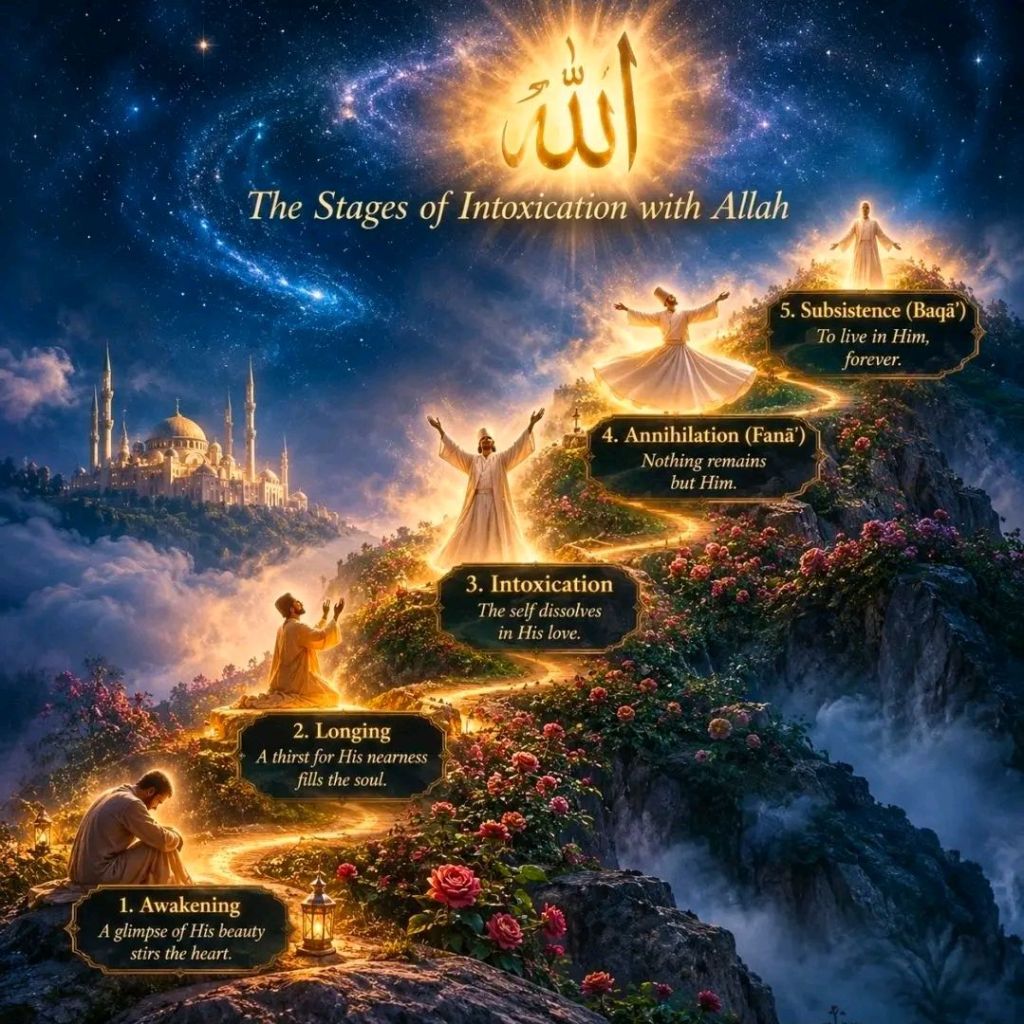
Khamr-i Ilāhī (Divine Wine):The Ecstasy of Annihilation.

■ Khamr-i Ilāhī (Divine Wine):
The Ecstasy of Annihilation.

In Sufism, the language of the heart often
turns to metaphors that challenge literal understanding. Among these, the concept
of ‘Khamr-i Ilāhī’ (Divine Wine) occupies a particularly profound place.

Unlike worldly wine, this spiritual wine represents the overwhelming experience of Divine love, remembrance and the awakening of the heart to the realities of spiritual witnessing.

It is an intoxicant that dissolves the ego, burns away worldly attachments and awakens the soul to realities beyond ordinary perception.

The Awliyāʾ frequently employed the imagery of wine, the cup, the cupbearer and the tavern to describe the mysteries of spiritual experience. These expressions are symbolic, pointing towards realities that ordinary language struggles to convey.

■ The Symbolism of Wine in Sufi Thought

Sufi poets and masters frequently liken the experience of Divine love to wine.

The wine represents the sweetness of spiritual realisation; the cup represents the heart; and intoxication represents the overwhelming influence of Divine love upon the inward consciousness.

▪︎ Mawlānā Jalāl al-Dīn Rūmī, may Almighty Allah sanctify his secret, writes in the Mathnawī:

“Love makes the wine of realisation to bubble: He is the cup-bearer to the true lover in secret.”

▪︎ Mawlānā Rūmī continues:

“When you seek (the reality) with good help (from Allāh), the water (essence) of the spirit is the wine, and the body is the flagon.”

These verses employ the imagery of fermentation and overflowing vessels to describe the transformative influence of
Divine assistance upon the human spirit.

The spiritual opening is not something the servant independently produces. It is a gift bestowed by Almighty Allah.

■ Shaykh Abū Yazīd al-Bisṭāmī: The Ocean
of Divine Wine

One of the most remarkable accounts of spiritual intoxication is recorded by Dātā ʿAlī ibn ʿUthmān al-Hujwīrī, may Almighty Allāh sanctify his secret in Kashf al-Maḥjūb.

Yaḥyā ibn Muʿādh once wrote to Abū Yazīd al-Bisṭāmī, may Almighty Allah sanctify his secret, asking about someone who drinks a single drop from the ocean of love and becomes intoxicated.

▪︎ Shaykh Abū Yazīd replied:

“What do you say of one who, if all the oceans in the world were filled with the wine of love, would drink them all and still cry for more to slake his thirst?”

This saying expresses the inexhaustible nature of Divine love. The lover’s thirst is not satisfied by spiritual attainment. Every opening awakens a greater longing, and every experience of love reveals how little the servant possesses independently.

The heart does not become proud of having tasted the wine. Rather, it becomes increasingly conscious of its poverty before the Beloved.

■ Shaykh Ibn ʿArabī: The Drink of Divine Love

Shaykh Muḥyī al-Dīn Ibn ʿArabī, may Almighty Allah sanctify his secret, discusses the mysteries of love in al-Futūḥāt al-Makkiyyah.

In Question 116, specifically entitled “What
is the Drink of Love?” (Sharāb al-Ḥubb), he explains the different dimensions of love and its relationship with Divine reality.

▪︎ He writes:

“Whoever has not tasted it by direct ‘drinking’ doesn’t really know it; and whoever says ‘I have drunk my fill of it’ doesn’t know it at all, for love is a drinking without ever being satiated!”

This is among the most beautiful passages concerning the symbolism of Divine wine.
The true lover never considers himself to have reached the limit of Divine love.

The more he receives, the more he recognises the immensity of what remains beyond his comprehension. The heart discovers that even its capacity to love and remember is dependent upon Divine generosity.

■ Mawlānā Rūmī: The Wine That Breaks the Vessel

▪︎ In another passage concerning the symbolism of wine, Mawlānā Rūmī writes:

“Oh Cupbearer! Fill the soul from that pre-existent Cup, that thief of the heart, that ambusher of formal religion.”

▪︎ He continues:

“Fill it with the wine that springs from the Heart and mixes with the Spirit, the wine whose bubbling intoxicates the God-seeing eye.”

▪︎ And further:

“Vats of this wine, vats of that: until you break that vat, you will never taste this wine.”

Yet Rūmī immediately follows the imagery of intoxication with a warning:

“Beware lest the bad companion (your own lower self) deceive you through whisperings – never break the covenant with kings (the Sharīʿah) through weakness.”

This final warning is particularly important.
The breaking of the vessel is an image of the dissolution of egoic limitations, not the abandonment of religious obligations.

The lover may experience overwhelming spiritual states, but the covenant of Sharīʿah remains. The lower self must never use the language of Divine love to justify disobedience.

■ Sukr and Ṣaḥw: Intoxication and Sobriety

Classical Sufi literature distinguishes between sukr (spiritual intoxication) and ṣaḥw (spiritual sobriety). Sukr describes the overwhelming experience of Divine love, in which ordinary self-consciousness becomes diminished beneath the intensity of remembrance and spiritual witnessing.

Ṣaḥw, by contrast, describes sobriety and the return to spiritual balance.

▪︎ Dātā Al-Hujwīrī records the following teaching from his own Shaykh, who followed the doctrine of Imām al-Junayd:

“The perfection of the state of the intoxicated man is sobriety.” (Kashf al-Maḥjūb)

This teaching is essential to understanding
the complete spiritual journey. Intoxication
may overwhelm the seeker’s ordinary consciousness, but the perfection of the path is not remaining perpetually overwhelmed.

The mature servant returns to sobriety, carrying the inward fruits of that experience into ordinary life. He fulfils his obligations, observes the limits of Sharīʿah, serves creation with humility and maintains his worship.

His heart is alive with Divine remembrance, while his outward conduct remains governed by the Qur’ān and Sunnah.

■ Fanāʾ and Baqāʾ: Annihilation and Subsistence

The wine of Divine love is frequently associated with fanāʾ (annihilation) and baqāʾ (subsistence). However, these concepts must be understood within the boundaries of Islāmic Tawḥīd.

Fanāʾ does not mean that the human servant disappears into the Divine Essence, nor that the distinction between Creator and creation is abolished. Rather, it describes the annihilation of the ego’s domination, self-admiration, pride and illusion of independent power.

The seeker becomes increasingly conscious that all power, ability, knowledge and existence are dependent upon Almighty Allāh.

Baqāʾ is the continuation of the servant’s life through the sustaining grace of Almighty Allāh, with the heart illuminated by remembrance and the outward life governed by obedience.
The servant returns to ordinary existence with a transformed inward orientation.

He worships without self-admiration, serves without seeking recognition, gives without expecting praise and remembers Almighty Allah without becoming distracted by his own spiritual attainments.

Thus, fanāʾ is not an escape from servanthood. It is the purification of servanthood from the claims of the ego. Baqāʾ is the continuation of that purified servanthood.

■ The Two Kinds of Intoxication

Dātā Al-Hujwīrī, in Kashf al-Maḥjūb, makes a subtle distinction between intoxication arising from affection (mawaddah) and intoxication arising from love (maḥabbah).

He explains that the former arises from contemplating the blessing, whereas the latter arises from contemplating the Benefactor.

▪︎ He writes:

“He who regards the benefit sees through himself and therefore sees himself, but he who regards the benefactor sees through Him and therefore does not see himself.”

This distinction reveals a profound movement in spiritual understanding. The seeker may initially become absorbed in the blessings of Almighty Allāh.

He contemplates the gifts, mercy, beauty of creation and countless favours bestowed upon him. But a deeper orientation emerges when his attention moves beyond the gifts towards the Giver.

The heart no longer becomes occupied merely with what it receives, but with the One from whom everything originates. The servant loves the blessings because they are gifts from Allāh, but his ultimate love is directed towards the Bestower.

■ Divine Wine and the Purification of the Ego

The true intoxication of Divine love destroys the false claims of the lower self. It destroys pride in worship, attachment to worldly recognition, the illusion of independent power, spiritual conceit and the constant desire to be recognised by others.

The seeker begins to understand that whatever goodness emerges through him is from the mercy of Almighty Allāh. His knowledge is a trust, his worship is a gift, his spiritual progress is a blessing and his very ability to remember is dependent upon Divine generosity.

The more he advances, the more humble he becomes. The more he recognises, the less he claims.

The more he loves, the more he realises his need for the Beloved. This is the paradox of Divine wine: the servant becomes inwardly enriched through the recognition of his own poverty before Almighty Allāh.

■ The Return to Sobriety: The Perfection of Servanthood

The spiritual journey does not conclude with intoxication. The seeker who has tasted the sweetness of Divine remembrance returns to his responsibilities with greater consciousness.

He observes the obligations of Sharīʿah, maintains the Sunnah, treats creation with mercy and guards his tongue and actions.
His inward experience does not make him superior to others.

Indeed, it makes him more conscious of his own shortcomings and more compassionate towards the weaknesses of creation.

The two wings of the spiritual path remain
the Qur’ān and Sunnah. Any spiritual state
that leads a person towards abandoning the obligations of Islām cannot be regarded as
the perfection of Divine love.

The true intoxication of the heart is inseparable from the sobriety of outward obedience.

■ The Deeper Meaning of Khamr-i Ilāhī

Through the actual writings and teachings of the Awliyāʾ, we may understand that Divine wine represents:

▪︎ The overwhelming sweetness of Divine love.
▪︎ The purification of the heart from the domination of the ego.
▪︎ The annihilation of pride and self-admiration.
▪︎  The awakening of longing through remembrance.
▪︎ The recognition that all spiritual openings are gifts from Almighty Allāh.
▪︎ The transition from spiritual intoxication to mature sobriety.
▪︎ The perfection of servanthood through fanāʾ and baqāʾ.

The cup is the heart. The wine is the sweetness of Divine love. The cupbearer is a poetic symbol of the Bestower of Divine grace.

The intoxication is the overwhelming influence of love, remembrance and spiritual witnessing.
The thirst is the servant’s inexhaustible longing..And sobriety is the return to complete servanthood, with the heart illuminated by what it has received.

■ Conclusion: The Cup, the Wine and the Beloved

The language of Divine wine is among the most delicate expressions in the literature of the Awliyāʾ. It describes a reality that ordinary language cannot adequately contain.

The seeker begins by purifying the heart, remembering Almighty Allah and struggling against the lower self. Through Divine mercy, the heart gradually awakens to the sweetness of love.

He drinks from the wine of remembrance, becomes overwhelmed by longing and discovers that the greatest obstacle to his journey was never the world itself, but the ego’s attachment to its own claims.

Yet the ultimate sign of having tasted this wine is not that a person speaks of extraordinary spiritual experiences, visions or ecstatic states.
It is that he becomes more humble, more obedient, more compassionate and less attached to himself.

The wine of Divine love does not make the servant claim divinity; it makes him realise his servanthood. And perhaps this is the deepest secret of the cup:

The more the heart is filled with love for Almighty Allāh, the less room remains within it for the self. The lover drinks, yet his thirst remains.

He remembers, yet desires to remember more. He worships, yet considers his worship insufficient. He receives, yet recognises that everything belongs to the Bestower.

And when the intoxication of love gives way to the sobriety of realisation, he returns to creation carrying no claim for himself, but a heart increasingly devoted to Almighty Allāh.

And only with Almighty Allāh is true success.