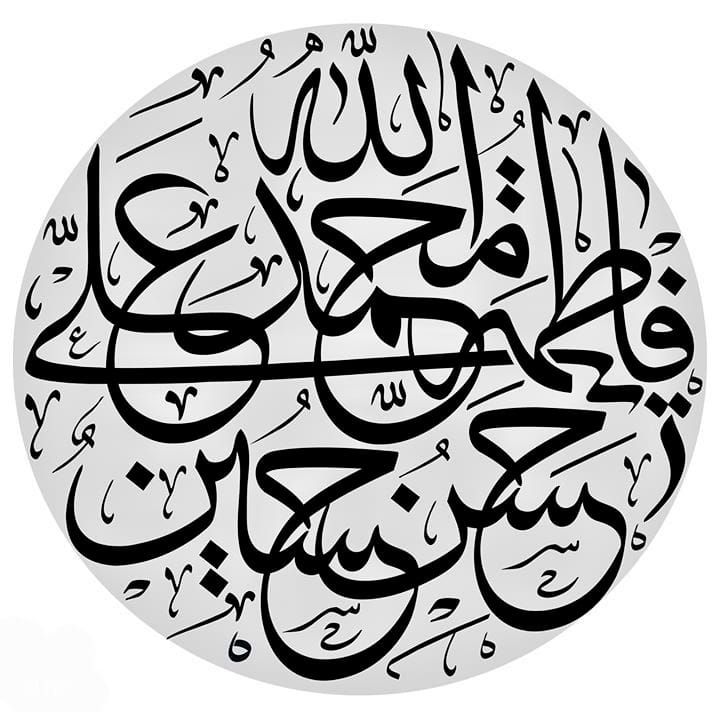
“And whoever does a good-deed, We shall increase to him good in respect thereof.”
Hadrat Sayyiduna ibn Abbas Radi Allahu Anhuma states that, “In this verse, the meaning of ‘good-deed’ implies doing good to the Ahle Bayt.” (As Sawaaiqu Al Muharriqah)
• Supporting Classical Sources. Beyond Al-Sawa’iq al-Muhriqah, classical Hadith and Tafsir works record similar narrations connecting hasanah in this verse to the love of the Ahl al-Bayt: • Imam Ahmad ibn Hanbal in Musnad Ahmad • Imam al-Hakim in Al-Mustadrak • Imam al-Tabarani and Ibn Abi Hatim in their respective collections • Broader Exegetical Context. Classical commentators also note a related narration from Ibn Abbas in Sahih al-Bukhari regarding the first half of the same verse (al-mawaddah fi al-qurba), where he explained it to Sa’id ibn Jubayr as encompassing the broader blood ties between the Prophet ﷺ and the clans of Quraysh. Both Sunni and Shia scholars highlight how these narrations collectively emphasize the elevated status of the Prophet’s family and the spiritual reward of showing them affection and respect.
Surah Ash-Shura (Ayat 23) ke dusre hisse se hai, jisme Allah Ta’ala farmata hai: “Aur jo koi neki (hasanah) kamayega, Hum uske liye usme bhalai badha denge.” Yeh tafseer mashhoor Sunni aalim Imam Ibn Hajar al-Haythami ki kitab Al-Sawa’iq al-Muhriqah mein darj hai.
Zaroori Tafseel aur Hawale
• Ayat ka Pas-e-Manzar. Mukammal ayat (Surah Ash-Shura 42:23) ke do hisse hain. Pehle hisse mein Nabi Kareem ﷺ ko hukm diya gaya ke aap farma dein, “Main tumse is par koi ajr nahi maangta siwaye rishtedaron ki mohabbat ke (al-mawaddah fi al-qurba).” Uske foran baad ayat mein “neki” (hasanah) kamane ke ajr ka zikr hai. • Al-Sawa’iq al-Muhriqah ka Hawala. Al-Sawa’iq al-Muhriqah ke Baab 11, Fasl 1 mein Imam Ibn Hajar al-Haythami ne Hadrat Abdullah ibn Abbas (Radi Allahu Anhuma) ka qaul naqal kiya hai. Unhone farmaya ke is ayat mein hasanah (neki) se murad Ahl-e-Bayt se mohabbat karna aur unke saath bhalai karna hai. • Deegar Mustanad Kitabein. Al-Sawa’iq al-Muhriqah ke ilawa bhi kai purani Hadith aur Tafseer ki kitabon mein is tarah ki riwayatein milti hain jo is ayat ki hasanah ko Ahl-e-Bayt ki mohabbat se jodti hain: • Imam Ahmad ibn Hanbal ki Musnad Ahmad • Imam al-Hakim ki Al-Mustadrak • Imam al-Tabarani aur Ibn Abi Hatim ki kitabein • Tafseer ka Wasee Pehlu. Mufassireen ne Sahih al-Bukhari ki ek riwayat ka bhi zikr kiya hai jisme Hadrat Ibn Abbas ne Sa’id ibn Jubayr ko is ayat ke pehle hisse (al-mawaddah fi al-qurba) ka matlab samjhate hue Quraysh ke qabeelon aur Nabi ﷺ ke darmiyan rishtedari ka hawala diya tha. Sunni aur Shia dono ulama is baat par ittefaq rakhte hain ke yeh riwayatein Ahl-e-Bayt ke buland maqam aur unse mohabbat ki fazilat ko zahir karti hain.
God is the One Who created for you All that is on the earth. Moreover, He turned to the heaven and fashioned seven heavens with harmony. He is full of knowledge of all things.
Qur’an 23:17
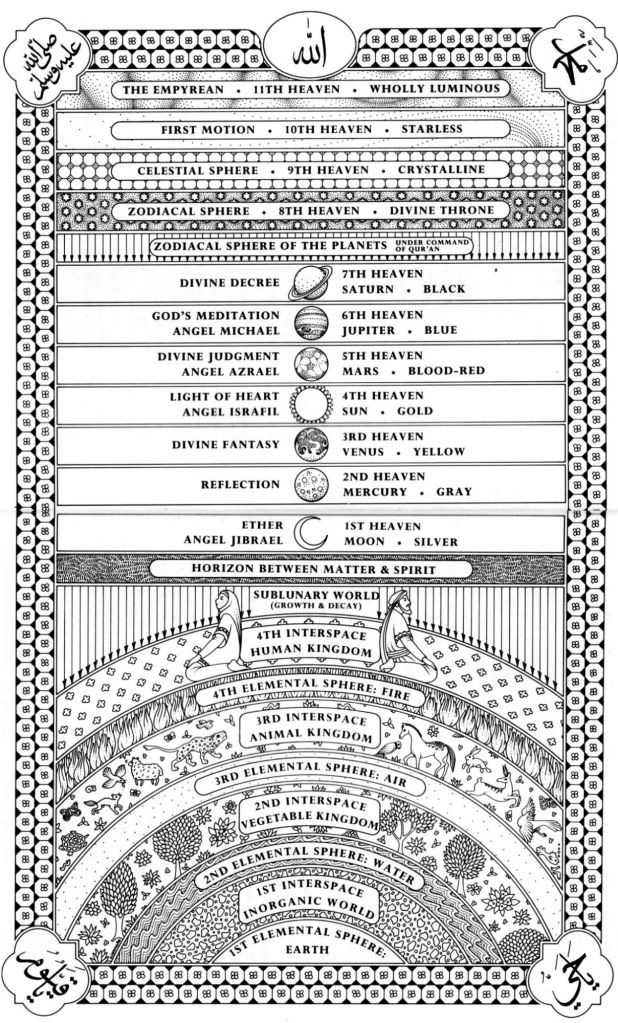
The hierarchy of creation extends from the most minute forms of terrestrial life up to Allah. The construction of this hierarchy was designed by Allah and is kept in form and balance by His will. In general terms, the whole of creation is divided into two parts: the known world of our human creation (insan) and the unseen (ghayb) and generally unknown world of the heavens.
The world below, as it were, is the sublunary world, consisting of four elemental spheres: the terrestrial, vegetative, animal, and human kingdoms. These four components are arranged in ascending order of creation, so that the human being occupies the highest position in the order of the physical creation. This dimension is governed by the rules of nature, which is to say the dominion of growth and decay, of life and death.
Above this created world of human existence lies the realm of the heavens, which are eleven in number. Each of these heavens is occupied by angelic forms and ultimately is populated with souls that depart from human bodies and earthly existence.
The various realms of earth and the heavens can be represented in their entirety in the accompanying chart.
Each of the elemental spheres-the terrestrial, vegetable, animal, and human kingdoms is composed of two parts: an elemental sphere and an interspace, with which it connects to the sphere above its own. Thus, the terrestrial sphere connects with the second elemental sphere via the in-organic world. When the element of water is combined with the terrestrial sphere, the vegetative world is created.
Likewise, the addition of air to earth and water creates fire. When all these combine-earth, water, air, and fire-the human form is made up.
The human kingdom is the interconnection to the heavenly realms. For most humans, the first heaven is represented by the moon: We first attain our strivings for the heavenly realms by viewing the moon. For those who occupy the dimension of the first heaven, or moon, the moon is the firmament and the second heaven represents a higher aspiration-Mercury is their heaven. And so on, up the hierarchy of the heavens.
Humans occupy the highest place in the realms of created life, by virtue of one reason only: Humans have been endowed with the faculty of reason, Cagl. The Cagl is the creative, rational reasoning power of the mind, which neither plants nor animals nor water has. These lower forms can only obey their instincts provided by the Creator. They are totally obedient to the laws of nature. For example, one can never “reason” with a deer. If one tries to approach one, it almost invariably bolts instantly and disappears, regard-less of the intent of the approaching human.
This holds true even for those animals that humans have sought to control. Dogs, for example, have not taken well to efforts to domesticate them. The more inbreeding that has occurred in a particular breed, the more neurotic the dogs become. Despite efforts to make dogs into pets, it is not so infrequent that a dog will for no reason turn wild upon a person or small child and kill him.
Animals that have been domesticated usually lose the natural dignity of their species. Animals of all kinds are marvelous in their natural terrain. But in that element they have intact all of their natural instinctive behavior, which is required for their survival. The lion does not kill in the wild out of malice. To be a killer is the position given to the lion in the creation, and the lion must do it.
Only humans have the capacity for creative reasoning, for the rational decision-making process by which we decide whether we are going to do a thing. This process is sometimes called free will. One can inform a human being that to do something dangerous will kill him; yet the human being-using his free will can act contrary to all the evidence and do it anyway. Animals have no such choice: A fish must be a fish.
Our mental decisions are accomplished by the ‘agl, and it is by virtue of this faculty alone that humans have been placed over all of the creation of the sublunary world.
When we aspire to something beyond the earthly existence, we move into the realm of the heavens. Most apparent to all are the zodiacal heavens, which are seven in number.
This is the realm of the planets, the first of which is the moon. Its color is white and silver, and it is constructed from the four elements mentioned, plus ether.
The second zodiacal planet is Mercury, whose color is gray. God said that He made Mercury with the addition of His own fikr, His own deep meditative thought.
Venus is the third zodiacal planet, and its color is yellow. Venus governs the world of similitudes, of analogies and metaphors, of poetry. Allah has informed us that Venus was created with the addition of His khayal, or imagination.
The sun, the fourth zodiacal planet, is presided over by Israfil, the Angel of Resurrection. The Prophet (s.a.w.s.) is reported to have related that Israfil told him that the Angel of Death scans the faces of seventy thousand people each day and, from these, chooses those who will be called from earthly existence. This planet God made from the light of His own heart, the fount of God, the absolute of the heart: love.
The fifth planet in the zodiac is Mars. Its color is blood-red. Azrael, the Angel of Death, presides over this planet, which is created from God’s wahm, or divine decision.
Jupiter is the sixth planet of the zodiac, presided over by the archangel Michael and formed of the Light of Himmah-the light of Allah’s reflection. The final zodiacal planet is Saturn. Its color is black. Saturn, being the highest in the hierarchy, was the first zodiacal constellation to be created. These first seven heavens (presented in reverse order, from lowest to highest) are descriptively named samā’. The word samā’ (heaven) is linked by sound to samā, an Arabic word meaning “ecstatic contemplation.” Each heaven exists with a relation to both something above and something below itself.
These heavens are inhabited by various beings of the creation. There are disembodied souls (having died already to earth life and awaiting the yawm al-qiyāmmah, or Day of Judgment) in one or other of the heavens. All the angels exist in all of these various heavens, depending upon their function and rank.
In addition to human souls and angels, Allah also created jinns. Whereas He created humans from the four elements of earth, water, air, and fire, He made the jinns from “smokeless fire.” The jinns, which are described fully in the Holy Qur’an, can from time to time assume human form. Generally, they are harmless or favorably inclined to humans, but they can be malevo-lent. They have great effect upon human affairs and frequently cause imbalances that we would identify as disease. A prime example is colic in infants, who are especially prone to the influence of jinns. Certain herbal substances and recitations are used to dispel jinns.
When the soul is extracted from human life, it begins to ascend through these heavenly realms. So a person would always have consideration of a prior state, and also something to look forward to. This is the reality of the heavenly existence. Those who believe in reincarnation have arrived at their concepts by only partially understanding the entire creation of the heavens.
When we arrive at the highest heaven of the zodiac, we are at the
threshold of the Throne of Allah, called the Carsh. This is actually a meta-phorical statement, as no one could imagine sitting in or anywhere near the seat of Almighty Allah. This eighth heaven constitutes the limit of the physical confines of our universe. The universe we study with telescopes, laser beams, and radio waves reaches its limit at this point of the eighth heaven. Although science has not arrived at this barrier yet, it may in time, God willing.
There are 18,000 created universes, of which we know about only one, the one we inhabit. The other 17,999 exist contiguous to our own and have other functions that we do not know about and never will. Allah has said that He did not create humans with the capacity to totally understand all of His creation. But at the moment of death, when the veils are torn away, each person will instantly see the whole nature of the heavens and the universe and will be astonished at the ingenuity of God’s design. Incidentally, Allah has said that despite the complexity of the heavens, He has created the human body infinitely more complex! But for now we shall have to be content to know that there is unimaginable vastness. This inspires us to accept the majesty and power of our Creator, Who has insisted upon many thousands of dimensions of creation; we humans see only one drop in this divine cosmic ocean.
The events of the eighth heaven are directed by Allah Himself; in the lower realms, Allah directs intermediaries to accomplish His designs. When events like shooting stars and meteorites occur in our zodiac, they are caused by actions in this ninth heaven. The regular orbiting of our fixed planets in the earthly heavens is regulated from this heaven.
The ninth heaven is the Crystalline, called the ‘arsh, meaning the Throne of Allah, the dazzlement of God’s glory. This state of existence is totally beyond conception or description. A great Sufi once said, “He who climbed over the wall to the ‘arsh, no one ever heard of him again.”
The tenth heaven contains no planets or stars and thus is called the Starless Heaven. It is where the motions of all the other spheres originate, directly under the command and decision of Allah the Almighty.
The eleventh heaven is called the Empyrean, or the Heaven of Heavens. It is wholly luminous, nothing but pure, complete, overwhelming light. Mawlānā Rūmī (r.a.) celebrated this realm when he wrote: “What do we care for the Empyrean and the skies? Our journey is to the Rose Garden of Union.”
Allah has informed us in the Qur’an that when He decided to make the creation, the first thing He made was the soul of prophecy. And, this, He said, He made from His own light, or nür. In other words, for all of the prophets Allah sent to earth with information for human beings about the nature of the creation, God made for them one soul only. He put this in 120,000 successive human forms, both male and female, some known to the world, some not. Allah made this unimaginably elegant soul from His nür,
His own light. That is why the prophets were able to have such amazing effect upon the world: Allah gave them the powers of illumination over the world.
Allah further said that “If I had not created the soul of prophecy, I would not have created the world.” After Allah created this soul of prophecy, it was so brilliant and luminous that it began to perspire. And from this perspiration of the soul of prophecy, Allah made the soul of the rose. This is why the rose has such a magnificent essence and is called the mother of scents. Anyone who looks at a rose smiles and is uplifted, and people all over the world honor and caress the rose instinctively. Indeed, the rose is the symbol of love itself.
We can see from this chart or pathway of the evolution through the hierarchy of creation that humans occupy a relatively low point in it all; there are many levels above that we cannot reach with the physical body. After the earthly, terrestrial life, there are many additional stages, which of necessity must be traversed using the vehicle of the soul. There is a stage beyond the Heaven of Heavens, past the Empyrean, called wişāl, or the wedding to God Almighty. This alone is the goal of the true Sufi and the real meaning of La ilaha illa Llah that one is content with nothing except the ultimate and final union with the Beloved, the Owner, Creator, and Sustainer of all the Worlds. Yā hayyū! Ya qayyūm!
Every scripture and every prophet from the first have said the same thing: that we are created by a wise and loving Creator, and that the special purpose of our existence is to endeavor to work our way back to Him. Our objective in life is to regain union with God, and everything in our life is an immense pageant designed to assist us in that journey. That is why one who is active on the Sufi path is referred to as sālik, the traveler.
Everything we consider to be kind, good, and desirable in this life is but the minutest manifestation of the final, absolute, and incontrovertible ac-tuality of those things which are owned by Allah and not by anyone else. This final and ultimate knowledge about all things is called haqiqat (from haqq, truth).
When we speak of love and say we want to be loved or to love someone, what we mean is that we yearn for that absolute love that will overwhelm us and burn us to ashes so that we die of love. One human cannot provide such majestic power of love for another. It is only the Divine Beloved who can annihilate us. That is what the Sufi seeks, or dies trying to achieve.
The journey from a confused, earthly person to one united forever with the Divine Reality is a long, complex, and difficult journey. Therefore, the Sufis have elaborated the various stages on this path and have developed various signposts and measures that can be used to identify where one is on the path. This chart of progression on the journey to the Beloved is called the stations of the soul.