
Military Activities continued

The Killing of Salam bin Abul-Huqaiq Salam bin Abul-Huqaiq (Abu Rafi’) was a terrible Jewish criminal. who had gathered the troops of the Confederates and provided them with a lot of wealth and supplies, on the one hand,’ and used to harm the Prophetﷺ on the other. When the Muslims settled their affair with Banu Quraizah, Al-Khazraj tribe asked for the Prophet’s ﷺpermission to kill that criminal in order to merit a virtue equal to that of Al-Aws who had killed another criminal of the Jews, Ka’b bin Al-Ashraf. The Prophet ﷺgave them his permission provided that no women or children be killed. A group of five people with ‘Abdullah bin ‘Ateek their head. headed for Khaibar where ‘Abu Rafi’s fort was situated. When those men approached after the sun had set and the people had brought back their livestock to their homes, ‘Abdullah said to his companions, “Sit down at your places. I am going, and I will try to trick the gate-keeper so that I may enter.” So, ‘Abdullah proceeded towards the castle, and when he approached the gate, he covered himself with his clothes, pretending to answer the call of nature. The people had gone in, and the gate-keeper addressed him saying, “O servant of Allâh! Enter if you wish, for I want to close the gate.” ‘Abdullah added in his story: So, I went in and hid myself. When the people got inside, the gate-keeper closed the gate and hung the keys on a fixed wooden peg. I got up and took the keys and opened the gate. Some people were staying late at night with Abu Rafi’ for a pleasant night chat in one of his rooms. When his companions of nightly entertainment left, I ascended to him, and whenever I opened a door, I closed it from inside. I said to myself. “Should

these people discover my presence, they will not be able to cach me till i have killed him,” So, I reached him and found him sleeping in a dark place amidst his family. I could not recognize his location in the house. So, I shouted, “Abu Rafil” Abu Rafi’ said, “Who is it?” I proceeded towards the source of the voice and hit him with the sword, but because of my confusion, I could not kill him, He cried loudly, and I came out of the house and waited for a while, and then went to him again and said, “What is this voice Abu Rafi’?” He said, “Woe to your mother! A man in my house has struck me with a sword!” I again hit him hard but I did not kill him. Then I drove the point of the sword into his belly till it hit his back, and I realized that I had killed him. I then opened the doors one by one until I reached the stairs, and thinking that I had reached the ground, I stepped out and fell down, breaking my leg on a moonlit night. I tied my leg with a turban and proceeded on until I sat at the gate, and said, “I will not leave tonight until I know that I have killed him.” So, (in the early morning) when the cock crowed, the announcer of the casualty stood on the wall saying: “I announce the death of Abu Rafi’, the merchant of Hijaz.” Then I went to my companions and said, “Let us save ourselves, for Allâh has killed Abu Rafi’.”

So, I went to the Prophet ﷺand described the whole story to him. He said, “Stretch out your leg.” I stretched it out and he rubbed it, and it became alright as if I never had any ailment whatsoever.” Sahih Al-Bukhari 2/577

This is the report of Al-Bukhari. According to Ibn Ishaq, all five of the group participated in killing that enemy of Islam. Ibn Hisham 2/247, 275

This incident took place in Dhul-Qa’dah or Dhul-Hijjah in the fifth year after Hijrah. Rahmatul-lil-‘Alamin 2/223

Shortly after the conclusion of the battle with the Confederates and Quraizah, the Prophetﷺ began to dispatch disciplinary expeditions to force the aggressive tribes and rebellious Arabs to come to peaceful terms with the rising state of Islam.

Mission of Muhammad bin Maslamah

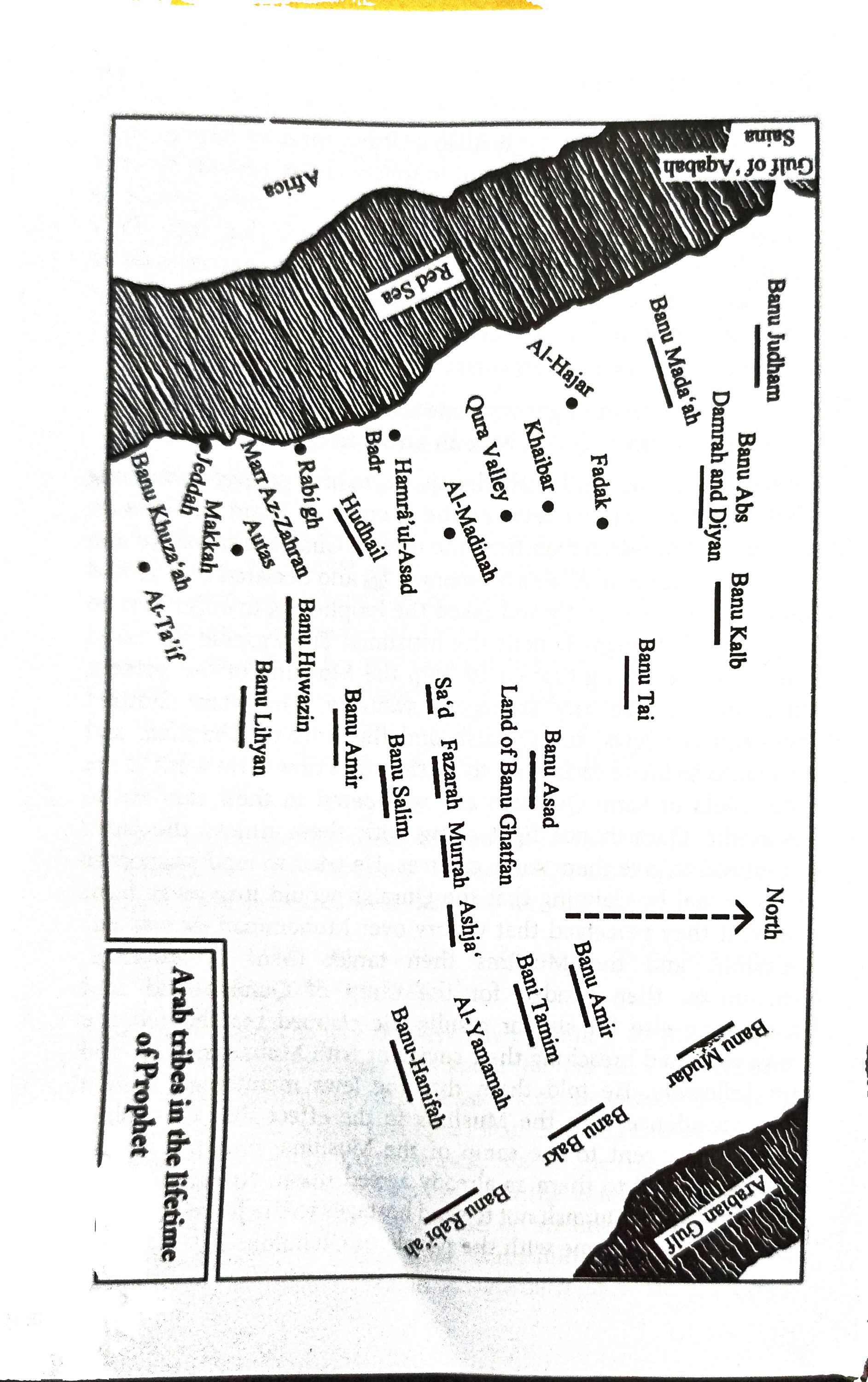
A platoon of thirty believers under the leadership of Muhammad bin Maslamah Radiallahu anhoo was dispatched on a military mission in Muharram, the sixth year of Al-Hijra, following the two previous battles. It headed for the area of Bani Bakr bin Kilab about seven nights journey from Madinah into the Najd. The Muslims attacked them and dispersed them in all directions. Plenty of spoils fell to the lot of the Muslims who returned home with a terrible disbeliever, Thumamah bin Uthal Al-Hanafi, chief of Bani Hanifah, who had gone out by order of Musailimah the

to assassinate the Prophetﷺ The Prophet’s Companions tied him to a pole of the Prophetic Mosque. To a question posed by the Prophetﷺ “What have you got, O Thumamah?” Thumamah used to say: “I have got a good thought, O Muhammad!ﷺ If you were to kill someone, then you would have to choose one who has already killed someone; if you were to be gracious, then let it be to a grateful man; and if you were to ask for money, you would have to ask for it from a generous man.” He repeated that three times on three different occasions. The third time, the Prophetﷺ ordered that he should be released. He soon went nearby, washed and then came back to profess the new faith addressing the Prophet ﷺ”There was no face on the surface of the earth most disliked by me than yours, but now your face has become the most beloved face to me. By Allâh, there was no religion most disliked by me than yours, but now it is the most As-Seeratul-Halabiyah 2/297.

beloved religion to me. Now I want to perform ‘Umrah (lesser pilgrimage).” The Prophet ﷺ gave him good tidings and asked him to do that. On his arrival in Makkah, the Quraishites accused him of apostasy. He denied it and affirmed that he had embraced Islam, and then swore that they would never get a grain from Yamamah, a suburban area around Makkah, unless the Prophetﷺ would allow it. In fact, he refused to send food supplies to Makkah until the Prophetﷺ interceded at the Makkans’ earnest plea.’)

Bani Libyan Invasion

Bani Lihyan had acted treacherously towards ten of the Prophet’s Companions at Ar-Raji’ and had them hanged. Their location being situated deep in the heart of Hijaz on the borders of Makkah, and due to deep-seated blood revenge between the Muslims on the one hand, and Quraish and the Arabians on the other, the Prophet ﷺconsidered it unwise to penetrate deep and come close to the greatest enemy, Quraish. However, when the power of the allied Confederates collapsed and they began to slacken and resign to the current unfavorable balance of power, Allâh’s Messengerﷺ seized this rare opportunity and decided that it was time to take revenge on Bani Lihyan. He set out in Rabi’ul-Awwal or Jumada Al-Ula in the sixth year of Al-Hijra, at the head of two hundred Muslim fighters and pretended to be heading for Syria, then soon changed route towards Batn Gharran, the scene of his Companions’ tragedy, and invoked Allâh’s mercy on them. News of his march reached Bani Lihyan, who immediately fled to the mountain tops nearby and thus remained out of his reach. On his way back, the Prophet ﷺdispatched a group of ten horsemen to a place called Kura’ul-Ghamim, so that the Quraish would hear of that which would confirm his growing military power. All of these clashes took fourteen days. after which he left to return home.

Zadul-Ma’ad 2/119: Sahih Al-Bukhari no. 4372, Fathul-Bart 7/688.

Expeditions and Delegations continued

1. A platoon led by ‘Ukashah bin Al-Mihsan was dispatched in the sixth year of Al-Hijrah. to a place called Al-Ghamr inhabited by Bani Asad. The enemy immediately fled leaving behind them to hundred camels which were taken to Madinah.

2. A platoon led by Muhammad bin Maslamah is set out towards the habitation of Bani Tha’labah in Dhul-Qassah. But a hundred enemy soldiers ambushed and killed all of them when they were sleeping, except Muhammad bin Maslamah who managed to escape badly wounded.

3. In retaliation against Bani Tha’labah, Abu ‘Ubaidah bin AlJarrah e, at the head of forty men, was dispatched to Dhul-Qassah. They walked that night and took the enemy by surprise in the morning. Again, they fled to the mountains except one who was injured, and later embraced Islam. They gained a lot of booty in that particular incident.

4. A platoon, under the leadership of Zaid bin Harithah was sent to Al-Jamum, area of Bani Sulaim in Marr Az-Zahran, in the same year. A woman from Bani Muzainah showed them the way to the enemy’s camp. There the Muslims took some captives and gained a lot of booty. Later on, Allâh’s Messengerﷺ granted the woman her freedom and married her to one of his followers.

5. Zaid bin Harithah &. in Jumada Al-Ula, sixth year of Al-Hijra, at the head of a hundred and seventy horsemen, set out to a place called Al-‘Eis, intercepted a caravan of Quraish led by Abul-‘As,and looted their camels. Abul-‘As escaped and took refuge in Zainab’s (his wife and the Prophet’s ﷺdaughter) house He begged her to ask the Prophet ﷺfor the refund of his wealth. The Prophetﷺ recommended, but without compulsion, that the people do that. They immediately gave the man back all his

wealth. He went back to Makkah, gave over the trusts to those entitled to them, embraced Islam and emigrated to Madinah where the Prophet ﷺunited him with his wife, Zainab, after three and a half years of their first marriage contract The Verse relating to prohibition of marriage between women Muslims and disbelievers had not been revealed then

6. In Jumada Ath-Thaniyah, the same year, Zaid at the head of fifteen men raided Bani Tha’labah at the place Taraf or Tarag and captured twenty of their camels but the people had fled.

7. In Rajab of the same year, Zaid tege, at the head of twelve men set out to a place called Wadi Al-Qura on a survey mission to explore the movements of the enemy. The people there attacked the Muslims, killed nine of them, while the rest including Zaid bin Harithah its managed to escape.

8. The invasion of Al-Khabat took place in the eighth year of AlHijra, i.e., before Al-Hudaibiyah Treaty. Abu Ubaidah bin AlJarrah led three hundred horsemen to observe a caravan belonging to Quraish. Because of the lack of food supplies, they began to starve so much that they had to eat Khabat (leaves of trees), hence the appellation “The Army of Al-Khabat”. One of the men slaughtered nine camels on three occasions, three each time at different stages of the mission. Abu ‘Ubaidah the leader of the campaign prohibited him from doing so. The sea presented them with a whale rich in fat and they subsisted on it for half a month. When they came back home, they narrated the story to the Prophet who ﷺcommented that it was provision granted by Alláh, and asked them to share him some of its meat. Chronologically this occurred before the Treaty of Al-Hudaibiyah, after which the Muslims stopped intercepting Quraisht caravans.

Taleemat e Ameer r.a part 86

** تعلیمات امیر (Taleemat e Ameer r.a)
** چھیاسیواں حصہ (part-86)

حضرت سرکار خواجہ خواجگان ہندل ولی خواجہ معین الدین چشتی اجمیری رحمت اللہ علیہ

  • ولادت مبارک –
    حضرت خواجہ معین الدین القاظمی السنجری الچشتیؒ کی ولادت مبارک ۵۳۷ھ میں سنجر کی سرزمین پر ہوئی۔ اسی باعث آپ کو سنجری بھی کہا جاتا ہے۔
  • والدین شریفین-
    آپ کے والد ماجد کا اسم شریف حضرت خواجہ غیاث الدین حسن القاظمی السنجری رحمت اللہ علیہ اور والِدہ کا اسم شریف حضرت بی بی سیدہ ماہ نورؒ تھا۔
  • شجرہ نسب-
    حضرت قطب الاقطاب خواجہ خواجگان معین الدین حسن چشتی ابن غیاث الدین ابن کمال الدین ابن احمد حسین ابن نجم الدین طاہر ابن عبدالعزیز ابن ابراہیم ابن امام موسیٰ کاظمؑ ابن امام جعفر صادقؑ ابن امام محمد باقرؑ ابن امام علی زین العابدینؑ ابن سیدنا امام حسینؑ ابن علیِ مرتضیٰ رضوان اللہ علیہم اجمعین و رحمہم اللہ تعالیٰ۔ آپ حسینی قاظمی سادات ہیں۔
    اور آپ کی والدہ بی بی سیدہ ماہ نور امام حسن علیہ السلام کی اولادوں میں سے ہیں اور حضور غوث الاعظمؒ کی عم زاد ہیں۔

📚 ماخذ از کتاب چراغ خضر۔

Hadith Aḳhrajah al-Nasā’ī fī al-Sunan al-kubrá, 05/133, al-raqm: 8476

  • “Ḥaz̤rat ʻAbd Allāh bin Jadalī raḍiya Allāhu ‘anhu se marwī hai ki maiṅ Ḥaz̤rat Ummi Salamah raḍiya Allāhu ‘anhā kī ḳhidmat meṅ ḥāz̤ir hūā to unhone mujhe farmāyā: kyā tum logoṅ meṅ Ḥuz̤ūr Nabīye Akram ṣallá Allāhu ‘alayhi wa-Ālihi wa-sallam ko gālī dī jātī hai? Maiṅ ne kahā: Allāh kī panāh yā Allāh kī ẕāt pāk hai yā isī ṭarḥ kā ko’ī aur kalimā kahā to unhone farmāyā: maiṅ ne Ḥuz̤ūr Nabīye Akram ṣallá Allāhu ‘alayhi wa-Ālihi wa-sallam ko farmāte hū’e sunā hai ki jo ʻAlī ko gālī detā hai woh mujhe gālī detā hai.”
  • Is ḥadīs̲ ko imām Nasā’ī, Aḥmad aur Hākim ne riwāyat kiyā hai. Imām Ḥākim ne farmāyā: yeh ḥadīs̲ kī sanad ṣaḥīḥ hai. Imām Hayṯẖamī ne farmāyā: is ke rijāl ṣaḥīḥ ḥadīs̲ ke rijāl haiṅ.

[Aḳhrajah al-Nasā’ī fī al-Sunan al-kubrá, 05/133, al-raqm: 8476, Aḥmad bin Ḥanbal fī al-Musnad, 06/323, al-raqm: 26791,

Aḥmad bin Ḥanbal fī Faḍā’il al-ṣaḥābah, 02/594, al-raqm: 1011,

al-Ḥākim fī al-Mustadrak, 03/130, al-raqm: 4615,

al-Hayṯẖamī fī Majmaʻ al-zawa’id, 09/130,

Quran and Modern Science : THE POINT OF DEPARTURE OF OUR ODYSSEY

30- Do not these disbelievers see that the heavens and the earth were an integrated mass, which We then split, and from water We made all living things? Will they not believe even then?-(21-Al-Anbiya The Prophets, 30)

We deduce from the contents of this verse that it admonishes the unbe-lievers for ignoring the apparent miracles. The atheists’ basic contention is that matter has no beginning and that it is the matter that has gener-ated everything, both living and inanimate things, by fortuitous act. The Big Bang theory refutes the basic assertion of atheism in positing that the universe and time had a beginning. “Do not these disbelievers see that…?” is significant.The fact that matter was created – that it had had beginning – as proven by the Big Bang theory, was a blow for unbelievers. The con-cluding sentence of the verse “Will they not believe even then?” is sig-nificant in that history confirmed the truth of this and the unbelievers remained adamant despite evidence producedIn history, there has been no one, other than the God through Quran, who claimed that the uni-verse had been expanding and that the heavens and the earth had been split asunder. Ancient Greece, the Middle Ages, the Modern Age,Plato, Thales – all those who had attempted to explain natural phe-nomena in natural terms – Ptolemy, Copernicus, Kepler and Kant,none of humanity’s great minds, had had an inkling of an expanding universe and of the fact that before creation the heavens and the earth had been an indivisible whole. Without the sophisticated equipment of the twentieth century at their disposal, and devoid of all accumu-lated scientific data, all of these celebrated philosophers and physicists had failed to take cognizance of this fact. The Creator of the universe communicated such important facts about His creation in His book and shed light on the celestial bodies, also proving thereby that the Quran had been His revelation. God unfolded to man the evidences of His creation, the creation that had originated from a single point in which man stood as another point. It is significant to note that while pointing at the comprehensibility of this revelation in the verse, “Do not these disbelievers see…?” He prefigures the stubbornness of unbelievers: “Will they not believe even then?” Einstein himself said that what astounded him was the comprehensibility of his discoveries about the universe, rather than the discoveries themselves. This shows how significant it was to stress the fact that these phenomena were in fact within the reach of man’s mental capacity.

COSMIC BACKGROUND RADIATION

The original unity of the universe is expressed by the Arabic word
“ratq,” meaning the integrated state and the word “fatq,” signifyingdisintegration by separation. I have already mentioned that whenLemaître had posited this separation as described in the Quranic verse,his theory was first refuted. One of the contenders of this argumentwas Fred Hoyle. In the 1940s Fred Hoyle contended that if the BigBang had effectively taken place there should have been a residue ofthe explosion, and asked that this fossil be shown. This satirical criti-cism led to the discovery of much evidence in support of the Big Bangtheory. The expression “fossil” which was mockingly uttered byHoyle became the scientific word for real evidence discovered later.While he was trying to debunk the theory of the Big Bang in a humor-ous way, he had unwittingly contributed to the confirmation of the Big Bang theory.In 1948, George Gamow and his student Ralph Adler concluded that if the Big Bang theory were true, it must have had a fossil left behind as Hoyle had claimed. According to their logic, the low-level background radiation must have existed in every direction since the universe had begun expanding in every direction following the Big Bang. Radiation other than that caused by the Big Bang must have had particular points in space from which it departed. But the radia-tion generated by such an explosion could not be traced back to a point. With the universe’s dynamic expansion radiation must have scattered in every direction. In the 1960s, the form of radiation imag-ined by Gamow and Adler was made the subject of research by a group of scientists with precision instruments at their disposal at Princeton University. However, what they had been looking for was to be discovered by others in a very interesting way. Arno Penzias and Robert Wilson were researchers at the Bell Telephone Company. One day, quite unexpectedly, they detected a uniform microwave radiation that suggested a residual thermal energy throughout the universe of about 3 Kelvin, which is a temperature of 3 degree Celsius above absolute 0. At first Penzias and Wilson could not unravel the mystery and had to call their colleagues Robert Dicke and his team. When he hung up, Dicke understood that he had lost the cause as he took cog-nizance of the fact that the discovery that was to bring the Nobel Prize award had been the lot of others. Surveys of the cosmic 3-Kelvin radiation indicated that it was perfectly uniform in all directions. The residue that Hoyle believed nonexistent had been found. So the Nobel Prize went to Penzias and Wilson.

SATELLITE IN SUPPORT OF BIG BANG

After Penzias and Wilson shared the Nobel Prize in 1965, the Cosmic Background Explorer (COBE), was rocketed into the sky in 1989.The data received from COBE confirmed the discovery of Penzias and Wilson. A great number of scientists evaluated the data produced by COBE as conclusive proof. Thus the process initiated by Lemaître in the 1920s was substan-tiated once again with new discoveries in the 1990s. 1400 years had elapsed since the reve-lation of the Quran and the satellite’s find-ings validated its state-ments. Supposing that we landed on a desert island and stumbled upon ashes: no one would doubt the fact that there had once been a fire on this island.The residue radiation that Penzias and Wilson ran across, and the COBE’s data, indicated the existence of the Big Bang. The contention by dissenters that the radiation scattered all over space had to be per-fectly uniform in all directions is another indicator of the soundness of this evidence. One of the proofs substantiating the Big Bang theory is related to the hydrogen-helium ratio in the universe. In the 1930s, astronomers, basing their studies on the fact that every celestial object emits a par-ticular light, had recourse to a spectroscope to analyze the composition of the stars and galaxies. Calculations made by means of the spectro-scope and mathematical formulas demonstrated that the universe, at its initial stage, comprised an average of 73% hydrogen and 25% helium and 2% other gases like carbon and oxygen. Stars did not generate hydrogen and that much helium. Calculations made by scientists made it clear that 20%-30% of the helium must have been produced before the evolution of stars. Only the primordial fireball at the outset of the Big Bang could have generated such a light synthesis; the expectations in the wake of the Big Bang and the quantity of hydrogen and helium in space are just a few of the proofs validating the theory.Although the available scientific evidence is in itself sufficient to prove the Big Bang theory, we are witnessing a steady increase of this evidence. A Big Bang medium was created in Switzerland at CERN (Conseil Européen pour la Recherche Nucléaire), the famous center that has the most powerful and versatile facilities of their kind in the world.The findings of the research carried out here lends further support to the theory.The law of thermodynamics supports the theory according to which the universe must have had a beginning; the second law of thermody-namics states that some processes in nature are irreversible and unidi-rectional, the direction being dictated by an overall increase in entropy.Thus, the energy grows less and less utilizable until it becomes of no profit. If the universe and matter had existed from eternity, the move-ment would have come to a standstill in eternal time. On the other hand, eternity does not pass; if it does, then it is no longer an eternity.In brief, the very fact that we happen to be at this point connotes the existence of a beginning. If we think that time was not created, the contradiction is inevitable and ends up with a dilemma. The only solu-tion to the dilemma would be positing that time was created and that the universe must have had a beginning; these, as proved by the Big Bang Theory, are mutually validating evidences.

BIG BANG:
SIGN OF GOD’S UNITY

Polytheistic beliefs have exhibited structures that differ according to the communities and times in which they have evolved. The polythe-istic beliefs in ancient Egypt differ greatly from the polytheism of India. However, these systems have something in common. Every god has his apportioned domain where he exerts his sovereignty. The sun is a god, so is the moon, and the divinity whose sanctuary is the hills is another such being. Some of these control the rains, others the winds; some have control over the mountains, some over the rivers…In opposition to belief-systems that parcel out the universe, the monotheistic religions, namely Judaism, Christianity and Islam, saw the universe as a whole. These religions professed that severance and sundering could not be imagined in a universe created by one God. According to these religions what seems to be divided is but in appearance only, while the essence of the universe is one whole; the universe ruled over by God is one entity, with every one of its points being interrelated with all the other points. Famous philosophers of the past, from Kindî, Farabi, Averroes and Avicenna to Christian scholars, had announced that “One comes out of one,” positing thus the unity of God. These thinkers had tried to find a correlation between the occurrences in the universe whose log-ical conclusion would be the unity of God. In the aftermath of the Big Bang, this unity was once again proven. The origin of the universe was irrefutably one single composition. Considering that everything evolved out of this single entity, all elements should be in correlation with each other. No one could henceforth declare that the sun, the moon, man, the serpent or a plant had its respective creators. Unity lay beneath everything, and the Creator of this unity was also the Creator of the sun, the moon, the beasts and the plants that emerged from this unity. Even before the Big Bang theory, the irrationality of the idea that attributed different creators to different objects was evi-dent. However, the Big-Bang proved with new evidence that God is One.

1- Say: He, God, is One.
2- God is He on Whom all depend.
3- He begets not, nor is He begotten. 4- And none equals Him. 

112-Al-Ikhlas Absoluteness, 1-4