Human Rights in Islam – Hadith about Kindness and Equality in Islam

humanrights-in-islam


Fundamental human rights in Islam are well defined.

Protection of human life is fundamental objective and principle of Islamic teachings. The Holy Qur’an says:

“Whoever kills a human being without (any reason like) murder, or corruption on earth, it is as though he had killed all mankind.” (5:32)

“God does not like that evil be spread.” (4:148)

“O believers! Avoid suspecting each other: In some cases suspicion is an offence, and do not spy on or speak ill of each other in the absence.” (49:11)

“O believers! Do not enter houses of others, without respectfully seeking permission of their occupants; this is the conduct enjoined on you. And if you find none in a house, do not enter it unless directed otherwise. And go back if you are not allowed entry, this is what behooves you; and God knows all that you do. There is nothing wrong on your part, if you enter uninhabited places, if they are of any use to you; but God knows what you express or conceal.” (24:27-29)

“O mankind! God has created you from one man and one woman, you are divided into nationalities and communities, only so that you may identify one another; in the sight of God the most pious among you is most respectable among you; verily God is oft-knowing, well acquainted.” (49:13)

“Do not envy those whom God has given more than you, to every man belongs what he earns; and to every woman belongs what she earns; seek God’s grace; verily He knows everything well.” (4:32)

“O believers! Do not unlawfully benefit from one another’s property, but have trade of goods by mutual consent.” (4:29)

“Come to a word common between us and you”(3:64)

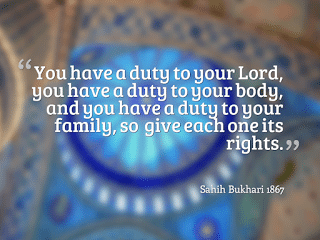
Hadith: You have a duty to your Lord, you have a duty to your body and you have a duty to your family so give each one its rights” (Sahih Bukhari:1867)
Give-everyone-their-rights-in-Islam
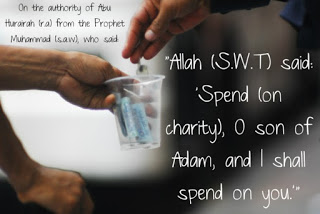
Hadith: “Spend (on charity) O son of Adam and I shall spend on you”
hadeess
Hadith: “He is not a true Believer who eats his fill while his neighbor is hungry”
hadith-on-neighbours
Hadith: “A funeral procession passed in front of our Prophet (PBUH) and he stood up. When he was told by the people that it was the coffin of a Jew, he said, “Was he not a human being? (Bukhari)
hadith
Hadith: “Feed the hungry, visit the sick and set the captives free” (Bukhari)

Islam-set-the-captives-free

Quotes about Sadaqah – Quranic Verses and Hadith about Sadaqa

Medina-HD-salafiaqeedah-Blogspot-com

Sadaqa comes from the word : Sadaqa : to be truthful. Sadaqa is derived from Sidq meaning that the person is giving charity to help the poor and needy confirming his true devotion and service to Allah.

Quranic Verses about Sadaqah

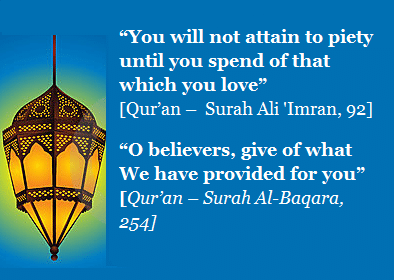
Allah says: “You will not attain to piety until you spend of that which you love” (Surah Al’Imran, 92)
“O believers give of what We have provided for you” (Surah Al’Baqara, 254)
charity (1)
The Quran says: “The example of those who spend their wealth in the way of Allah is like seed of grain which grows seven spikes, in each spike is a hundred grains. And Allah multiplies His reward for whom He wills” (The Holy Quran)
Quranic-verse-1
Allah says: “Verily those who give sadaqah, men and women, and lend Allah a goody loan, it shall be increased manifold, and theirs shall be an honorable good reward” (Quran 57:18)

sadaqa..

Al’Quran: “Those who spend  in charity will be richly reward” (57:10)
verse
Hadith about Sadaqah
 
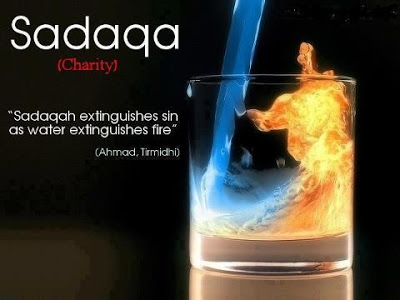
“Sadaqah extinguishes sin as a water extinguishes fire” (Tirmidhi)

hadith-1

Tirmidhi Hadith
saqada
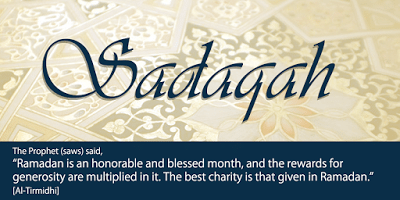
“Ramadan is an honorable and blessed month, and the rewards for generosity are multiplied in it. The best charity is that given in Ramadan” (Al’Tirmidi)
sadaqah1
“Sadaqah does not decrease wealth” (Muslim)
Sadaqah

The Aim and Goal of the Prophet’s i’tikaaf was to seek Laylat ul-Qadr

saw-300x300

Abu Sa’eed al-Khudri (radi Allahu anhu) said: The Messenger of Allah (sal Allahu alaihi wa sallam) observed i’tikaaf during the first ten days of Ramadan, then he observed i’tikaaf during the middle ten days in a small tent at the door of which was a reed mat. He took the mat in his hand and lifted it. Then he put his head out and spoke to the people, and they came close to him. He (sal Allahu alaihi wa sallam) said: “I observed i’tikaaf during the first ten days seeking this night (Laylat ul-Qadr), then I observed i’tikaaf during the middle ten days. Then someone came and said to me that it is in the last ten days, so whoever among you wishes to observe i’tikaaf let him do so.” So the people observed i’tikaaf with him.

[Sahih Muslim]

Commentary:

We learn a number of things from this Hadith and they are as follows:

  1. That the basic goal of the i’tikaaf of the Prophet (sal Allahu alaihi wa sallam) was to seek Laylat ul-Qadr and to prepare to spend that night in worship. That is because of the great virtue of that night of which Allah says (interpretation of the meaning): “The Night of Al?Qadr (Decree) is better than a thousand months (i.e. worshipping Allah in that night is better than worshipping Him in a thousand months, i.e. 83 years and 4 months).” [Al-Qadr 97:3]
  2. The Prophet (sal Allahu alaihi wa sallam) strove to seek that night before he was told when it is. So he started with the first ten days, then he observed it during the middle ten, then he continued to observe i’tikaaf during the last ten days, when he was told that it is in the last ten days. This is the utmost effort to seek Laylat ul-Qadr.
  3. The Sahaaba (radi Allahu anhum) followed the Messenger of Allah (sal Allahu alaihi wa sallam), because they started i’tikaaf and continued with him until the end of the month, because they were so keen to follow his example.
  4. The Messenger of Allah (sal Allahu alaihi wa sallam) was compassionate towards his companions and showed mercy to them, because he knew that i’tikaaf was difficult for them. So he gave them the choice between staying with him or of leaving, and said: “…so whoever among you wishes to observe i’tikaaf let him do so.”

There are other aims of i’tikaaf as well, including the following:

  1. Being alone with Allah and cutting oneself off from people if possible, so that one may focus completely on Allah.
  2. Renewing oneself spiritual by focusing totally on Allah.
  3. Cutting oneself off completely in order to worship Allah with prayer, du’aa’ (supplication), dhikr (remembrance) and reading Qur’aan.
  4. Protecting one’s fast from everything that may affect it of whims and desires.
  5. Reducing permissible worldly pleasures and refraining from many of them even though one is able to enjoy them.

And Allah knows best!

Narrated Abu Huraira

FB_IMG_14654817027451854

Once while I was in a state of fatigue (because of severe hunger), I met ‘Umar bin Al-Khattab, so I asked him to recite a verse from Allah’s Book to me. He entered his house and interpreted it to me. (Then I went out and) after walking for a short distance, I fell on my face because of fatigue and severe hunger. Suddenly I saw Allah’s Apostle standing by my head. He said, “O Abu Huraira!” I replied, “Labbaik, O Allah’s Messenger (ﷺ), and Sadaik!” Then he held me by the hand, and made me get up. Then he came to know what I was suffering from. He took me to his house, and ordered a big bowl of milk for me. I drank thereof and he said, “Drink more, O Abu Hirr!” So I drank again, whereupon he again said, “Drink more.” So I drank more till my belly became full and looked like a bowl. Afterwards I met ‘Umar and mentioned to him what had happened to me, and said to him, “Somebody, who had more right than you, O ‘Umar, took over the case. By Allah, I asked you to recite a Verse to me while I knew it better than you.” On that Umar said to me, “By Allah, if I admitted and entertained you, it would have been dearer to me than having nice red camels.

وَعَنْ أَبِي حَازِمٍ، عَنْ أَبِي هُرَيْرَةَ، أَصَابَنِي جَهْدٌ شَدِيدٌ فَلَقِيتُ عُمَرَ بْنَ الْخَطَّابِ، فَاسْتَقْرَأْتُهُ آيَةً مِنْ كِتَابِ اللَّهِ، فَدَخَلَ دَارَهُ وَفَتَحَهَا عَلَىَّ، فَمَشَيْتُ غَيْرَ بَعِيدٍ، فَخَرَرْتُ لِوَجْهِي مِنَ الْجَهْدِ وَالْجُوعِ فَإِذَا رَسُولُ اللَّهِ صلى الله عليه وسلم قَائِمٌ عَلَى رَأْسِي فَقَالَ ‏”‏ يَا أَبَا هُرَيْرَةَ ‏”‏‏.‏ فَقُلْتُ لَبَّيْكَ رَسُولَ اللَّهِ وَسَعْدَيْكَ‏.‏ فَأَخَذَ بِيَدِي فَأَقَامَنِي، وَعَرَفَ الَّذِي بِي، فَانْطَلَقَ بِي إِلَى رَحْلِهِ، فَأَمَرَ لِي بِعُسٍّ مِنْ لَبَنٍ فَشَرِبْتُ مِنْهُ، ثُمَّ قَالَ ‏”‏ عُدْ يَا أَبَا هِرٍّ ‏”‏‏.‏ فَعُدْتُ فَشَرِبْتُ، ثُمَّ قَالَ ‏”‏ عُدْ ‏”‏‏.‏ فَعُدْتُ فَشَرِبْتُ حَتَّى اسْتَوَى بَطْنِي فَصَارَ كَالْقِدْحِ ـ قَالَ ـ فَلَقِيتُ عُمَرَ وَذَكَرْتُ لَهُ الَّذِي كَانَ مِنْ أَمْرِي وَقُلْتُ لَهُ تَوَلَّى اللَّهُ ذَلِكَ مَنْ كَانَ أَحَقَّ بِهِ مِنْكَ يَا عُمَرُ، وَاللَّهِ لَقَدِ اسْتَقْرَأْتُكَ الآيَةَ وَلأَنَا أَقْرَأُ لَهَا مِنْكَ‏.‏ قَالَ عُمَرُ وَاللَّهِ لأَنْ أَكُونَ أَدْخَلْتُكَ أَحَبُّ إِلَىَّ
مِنْ أَنْ يَكُونَ لِي مِثْلُ حُمْرِ النَّعَمِ‏.‏

Reference

 : Sahih al-Bukhari 5375

In-book reference

 : Book 70, Hadith 3

USC-MSA web (English) reference

 : Vol. 7, Book 65, Hadith 287

Narrated `Umar bin Abi Salama

masjid-229x300

I was a boy under the care of Allah’s Messenger (ﷺ) and my hand used to go around the dish while I was eating. So Allah’s Messenger (ﷺ) said to me, ‘O boy! Mention the Name of Allah and eat with your right hand, and eat of the dish what is nearer to you.” Since then I have applied those instructions when eating.

حَدَّثَنَا عَلِيُّ بْنُ عَبْدِ اللَّهِ، أَخْبَرَنَا سُفْيَانُ، قَالَ الْوَلِيدُ بْنُ كَثِيرٍ أَخْبَرَنِي أَنَّهُ، سَمِعَ وَهْبَ بْنَ كَيْسَانَ، أَنَّهُ سَمِعَ عُمَرَ بْنَ أَبِي سَلَمَةَ، يَقُولُ كُنْتُ غُلاَمًا فِي حَجْرِ رَسُولِ اللَّهِ صلى الله
عليه وسلم وَكَانَتْ يَدِي تَطِيشُ فِي الصَّحْفَةِ فَقَالَ لِي رَسُولُ اللَّهِ صلى الله عليه وسلم ‏ “‏ يَا غُلاَمُ سَمِّ اللَّهَ، وَكُلْ بِيَمِينِكَ وَكُلْ مِمَّا يَلِيكَ ‏”‏‏.‏ فَمَا زَالَتْ تِلْكَ طِعْمَتِي بَعْدُ‏.‏

Reference

 : Sahih al-Bukhari 5376

In-book reference

 : Book 70, Hadith 4

USC-MSA web (English) reference

 : Vol. 7, Book 65, Hadith 288