HIQAYAT:- ********** Ek Din Hazrat Imaam Hasan Radi-Allahu-Ta’aala-Anhu Apne Daulat-Khane Per Kuch Logon Ke Sath Milker Khana Tanawul Farma Rahe The Ki Aapne Apne Gulam Ko Saalan Lane Ke Liye Irshad Farmaya! Wo Saalan Laya To Achanak Uske Hath Se Bartan Gir Pada Aur Tut Gaya! Salan Ka Kuch Hissa Hazrat Imaam Hasan Radi-Allahu-Ta’aala-Anhu Per Bhi Gira! Gulam Yeh Manzar Dekhker Ghabraya! Hazrat Imaam Hasan Radi-Allahu-Ta’aala-Anhu Ne Uski Taraf Dekha To Usne Zhatse Yeh Aayat Padh Di!”Gussa Pine Walon”Aapne Farmaya, Maine Gussa Pi Liya! Usne Fir Padha,”Aur Logon Se Darguzar Karne Walon”Aapne Farmaya, Jao Maine Muaf Bhi Kerdiya! Usne Fir Padha,”Aur Ehsaan Karne Wale ALLAH Ke Mehboob Hain”Aapne Farmaya, Jao Maine Tumeh Aazaad Bhi Kerdiya!
(Roohul Bayaan Jild-1,Pg-367)
******************************** SABAK:- ******** Apne Maat-haton Per Rahem Karna Chahiye Aur Gusse Ko Pi Lena Aur Khatakaar Ko Muaf Kerdena Aur Usper Ehsaan Bhi Karna Yeh ALLAH-TA’AALA Ke Mehboobon Ka Kaam Hain! Imaam Hasan Radi-Allahu-Ta’aala-Anhu ALLAH Ke Mehboob The!
✦ Ye dua Mareez ke paas padhne se Allah usko shifa ata farma dega ——————— ✦ Ibn Abbas Radi Allahu Anhu se rivayat hai ki Rasool-Allah Sal-Allahu Alaihi wasallam ne farmaya jab koi shakhs kisi aise mareez ki ayadat kare jiski maut ka waqt qareeb nahi aaya ho to uske paas jakar 7 martaba ye dua padhe to Allah usko us marz se shifa ata farma dega
أَسْأَلُ اللَّهَ الْعَظِيمَ رَبَّ الْعَرْشِ الْعَظِيمِ أَنْ يَشْفِيَكَ
As’alullah Al-‘Azeem Rabbal ‘Arshil ‘Azeem an Yashfik
(Main Azmat wale Allah , jo Arsh azeem ka malik hai se dua kart ahu ki wo aapko shifa ata farmaye)
Sunan Abu Dawud, Jild 2,1329-Sahih
—————-
✦ इब्न अब्बास रदी अल्लाहू अन्हु से रिवायत है की रसूल-अल्लाह सल-अल्लाहू अलैही वसल्लम ने फरमाया जब कोई शख्स किसी ऐसे मरीज़ की अयादत करे जिसकी मौत का वक़्त क़रीब नही आया हो तो उसके पास जाकर 7 मर्तबा ये दुआ पढ़े तो अल्लाह उसको उस मर्ज़ से शिफा अता फरमा देगा
أَسْأَلُ اللَّهَ الْعَظِيمَ رَبَّ الْعَرْشِ الْعَظِيمِ أَنْ يَشْفِيَكَ
अस’अलुललाहा अल-‘अज़ीम रब्बल ‘अर्शील ‘अज़ीम अन यशफिक
(मैं अजमत वाले अल्लाह , जो अर्श ए अज़ीम का मलिक है से दुआ करता हूँ की वो आपको शिफ़ा अता फरमाए)
सुनन अबू दाऊद, जिल्द 2,1329-सही
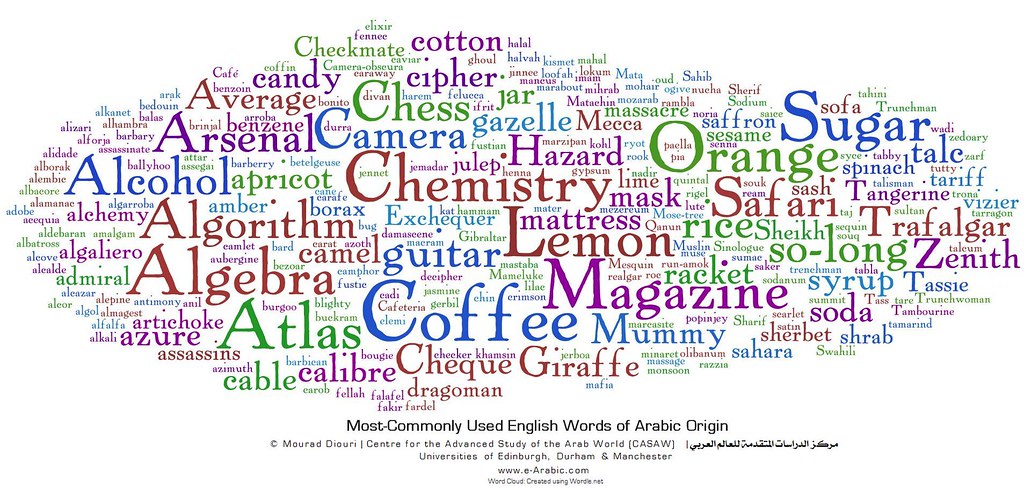
This alphabet lists just some of the words that have come from sources in Muslim civilization and have passed into the English language with their original meaning intact. It is only a small selection…
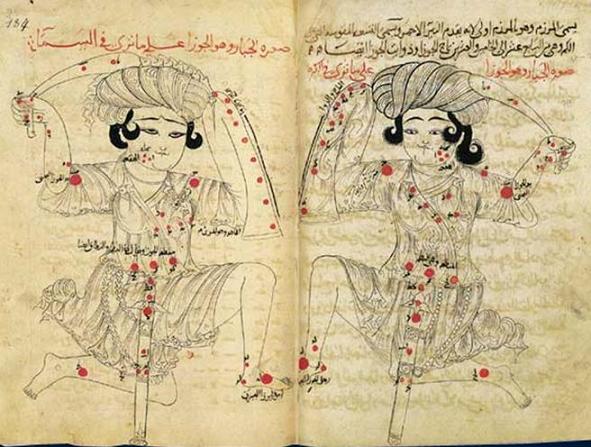
A is for admiral, from amir-al-, “commander of . . .”, like amir al-bahr, or “commander of the seas.” When the Europeans adapted amiral, they added their own Latin prefix ad-, producing “admiral.” When this reached English, via Old French, it still meant “commander,” and it was not until the time of England’s Edward III that a strong naval link began to emerge.
A is also for azimuth (denoting the arc of a celestial circle from the Zenith to the horizon), from old French azimut, from Arabic as-samt meaning “way or direction.”
B is for barbican, from the Arabic bab al-baqarah, or “gate with holes.”
C is for crimson, from qirmizi, which is related to the qirmiz, the insect that produced the red dye qirmizi.
C is also for cotton, from the Arabic qutn.
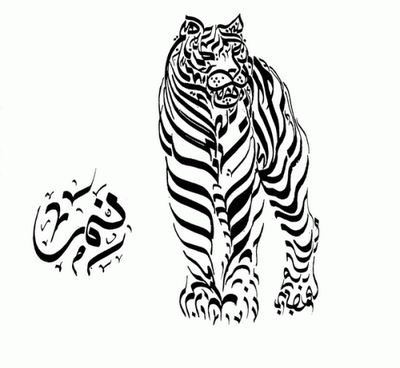
Arabic ‘Zoomorphic’ Calligraphy. The word ‘Cat’ in Arabic is قَطّqaṭṭ ~ قِطّqiṭṭ. The English word for ‘Cat’ comes from Latin word Cattus, which goes back to Nubian (Afro-Asiatic Language) word kadīs and according to M. Lionel Bender this Nubian term was a loan from Arabic
D is for dragoman, an interpreter or guide in countries where Arabic, Turkish, or Persian is spoken; from the Arabic tarjuman and the verb, tarjama, “to interpret.”
E is for Earth, from German Erde and Arabic Ardh.
F is for Fomalhaut, the brightest star in the constellation Piscis Austrinus, the Southern Fish, 24 light-years from Earth; fam al-hut means “mouth of the fish.”
G is for ghoul, from the Arabic ghul, meaning “the demon.”
G is also for giraffe, from the Arabic zarafa.
H is for hazard, from Old French hasard, from Spanish azar, from Arabic az-zahr, meaning “chance or luck,” from Persian zār or Turkish zar, meaning “dice.”.
I is for Izar, the name of a star in the constellation Andromeda, from the Arabic al’izar, meaning the “veil or covering.”
J is for jar, from jarrah, a large earthen vase.
J is also for jasmine, from the Persian yasmin.
K is for kohl, from kuhl, meaning “a fine powder,” often of antimony, used in eye decoration or as eyeliner.
L is for lilac, from the Arabic lilak, which was taken from the Persian nilak, meaning “indigo.”
L is also for lemon, from the Persian limun, meaning “lemon.”
M is for magazine, from an Arabic word makhzan, meaning “store.”.
M is also for mattress, coming from Old French materas, which was taken from matrah, a “place where something is thrown” and taraha, meaning “to throw.”
N is for nadir, a point on the celestial sphere directly below the observer and diametrically opposite the zenith. It comes from nadir assamt, meaning “opposite the zenith.”
O is for orange, from the Persian naranj or narang, meaning “orange.”
P is for Pherkad, a star in the constellation Ursa Minor, from the Arabic al-farqad, meaning “the calf.”
Q is for qanun, the ancestor to the harp and zither, introduced by Al-Farabi in the tenth century, but used in Roman times as a freestanding instrument.
R is for risk, from the Arabic rizq, meaning earning provided by God.
S is for sofa; the seat was originally an Arabian ruler’s throne and has been in existence since antiquity. Originally suffah, meaning “long bench” or “divan.”
S is also for sugar from the Arabic sukkar, meaning “sugar”; and for so long, from salam, a greeting and goodbye meaning “peace.”
T is for tariff, via French from Italian tariffa, based on Arabic ‘arrafa, meaning “notify.”
T is also for talcum powder, which is from the Latin talcum, from the Arabic talq. It was first used in medieval Latin as talc around 1317, and in Spanish as talco and in French as talc in 1582. In German, it is talkum.
U is for Unukalhai, a star in the constellation of the Serpent, from the Arabic ’unuq alhayyah, meaning the “neck of the snake.”
V is for vizier, from wazir, meaning “porter, public servant,” from the verb wazara, “to carry.”
V is also for Vega, the brightest star in the constellation Lyra, from the Arabic al-nisr alwaqi’, meaning “the falling vulture.”
W is for wadi, a valley or gully that remains dry except during the rainy season, from the Arabic wadi, which means “valley.”
X in algebra, meaning “a thing,” is an Arabic invention to solve mathematic equations.
Al Quran : Kah do Wo ALLAH Ek hai, ALLAH beniyaz hai, Na uski koi Aulad hai aur na wo kisi ki Aulad hai, Aur uskey barabar ka koi nahi hai AL Quran , Surah Al-ikhlas (112)
Rasooll-ِِAllah Sallallahu Alaihi farmaya Qul Huwallahu Ahad.. (Surah Al-ikhlas) Ek teehaii Quran ke barabar hai Sahih Muslim, 1886
Abu Hurairah Radi allahu anhu se rivayat hai ki Rasool-Allah Sallallahu alaihi wasallam hamarey pass aaye aur farmaya main tumhare samne Ek Tihaii Quran parhta hu , phir Aap Sallallahu Alaihi Wasallam ne Qul Huwallahu Ahad (Surah Al-ikhlas) parhi yahan tak ki is surah ko khatam kiya Sahih Muslim, 1889
अल क़ुरान : कह दो वो अल्लाह एक है, अल्लाह बेनीयाज़ है, ना उसकी कोई औलाद है और ना वो किसी की औलाद है, और उसके बराबर का कोई नही है अल क़ुरान , सुरह अल-इख्लास (112)
रसूल-ِِअल्लाह सलअल्लाहू अलैही वसल्लम ने फरमाया क़ुल हुवल्लाहू अहद.. (सुरह अल-इख्लास) एक तिहाई क़ुरान के बराबर है सही मुस्लिम, 1886
अबू हुरैरा रदी अल्लाहू अन्हु से रिवायत है की रसूल-अल्लाह सलअल्लाहू अलैही वसल्लम हमारे पास आए और फरमाया मैं तुम्हारे सामने एक तिहाई क़ुरान पढता हूँ , फिर आप सलअल्लाहू अलैही वसल्लम ने क़ुल हुवल्लाहू अहद (सुराह अल-इख्लास) पढ़ी यहाँ तक की इस सुरह को ख़तम किया सही मुस्लिम, 1889






 Aal-e-Qutub Aal-e-Syed Abdullah Shah Ghazi