

The complex of disciplines composed of mathematics, architecture and art in Islamic civilisation has been an important field of recent research. The scholars showed the interaction between mathematical reflexion and procedures and their implementation in designing concrete and symbolic forms in buildings, decoration and design. Furthermore, recent scholarship pointed out the amazing progress that this marriage brought about in prefiguring outstanding mathematical results that scientists proved only in late 20th century. In the following survey, Professor Salim Al-Hassani explores the various facets of this exciting subject that is still full of discoveries to come. By drawing attention to the ongoing debates in scholarly circles among physicicts, mathematicians and historians of science, art and architecture, he shows how the connection between theoretical and applied mathematics was fruitful and creative in the Islamic tradition
Note of the editor
This essay is a revised and expanded version of a lecture presented at the 28th Annual Conference on the History of Arabic Sciences organised by the Institute for the History of Arabic Sciences, Aleppo University, Aleppo, Syria, in 25-27 April 2007. It was submitted for publication in the proceedings of the conference.
1. Introduction
“Sophisticated geometry in Islamic architecture”, “Geometry meets artistry in medieval tile work”, “Geometry meets Arts in Islamic tiles”. These were some of the headlines we saw in February 2007 in the main news agencies and science dispatches giving coverage to an exciting discovery published by two American scholars, Peter J. Lu and Paul J. Steinhardt (respectively from the Department of Physics at Princeton and Harvard universities).[1] The discovery is “that medieval Islamic artists produced intricate decorative patterns using geometrical techniques that were not understood by Western mathematics until the second half of the 20th century”. The combinations of ornate stars and polygons that have adorned mosques and palaces since the 15th century were created using a set of just five template tiles, which could generate patterns with a kind of symmetry that eluded formal mathematical description for another 500 years. The authors suggest that the Islamic artisans who created these typical girih[2] designs had an intuitive understanding of highly complex mathematical concepts. They also suggest that these could be proof of a major role of mathematics in medieval Islamic art or it could have been just a way for artisans to construct their art more easily.
Girih designs feature arrays of tessellating polygons of multiple shapes, and are often overlaid with a zigzag network of lines. It had been assumed that straightedge rulers and compasses were used to create them — an exceptionally difficult process as each shape must be precisely drawn. From the 15th century, however, some of these designs are symmetrical in a way known today as “quasi-crystalline”. Such forms have either fivefold or tenfold rotational symmetry — meaning they can be rotated to either five or ten positions that look the same — and their patterns can be infinitely extended without repetition. The principles behind quasi-crystalline symmetry were calculated by the Oxford mathematician Roger Penrose in the 1970s, but it is now clear that Islamic artists were creating them more than five centuries earlier.
The present paper reviews this discovery and discusses related literature on the subject of mathematics and arts in Muslim heritage. In particular, it accounts the related works of:
1. Alpay Özdural who showed how such geometrical patterns were used to solve cubic algebraic equations and also used the manuscript of Abu’l-Wafa and other mathematical Islamic mathematical treatises as evidence that mathematicians instructed artisans,
2. Gülru Necipoglu who discussed geometry, muqarnas and the contribution of the mathematical sciences and
3. George Saliba who presented critical arguments against some of the derived conclusions.
4. Zohor Idrisi who belives that ongoing work on Islamic tiles lacks the essential historical context that is required to inform the reader of how and when these mathematical techniques developed.
It is hoped that this review paper will bring to life the debate on the subject of Mathematics and Islamic Art and Architecture.
2. Geometry at the basis of Islamic architectural decoration
A study of medieval Islamic art has shown that some of its geometric patterns use principles established only centuries later by modern mathematicians. In particular, recent research has provided the ground for the astonishing claim that 15th century Muslim architects and artists used techniques inspired by what mathematicians nowadays call “quasicrystalline geometry”. This indicates intuitive understanding of complex mathematical formulae, even if the artisans had not worked out the underlying theory.

Figure 1: A computer reconstruction of the quasicrystalline patterns of the Darb-i Imam shrine (Isfahan, Iran), which was built in 1453 (Science Magazine, vol. 315, n° 1106, 2007).
The discovery was published in the journal Science in February 2007 by Paul J. Steinhardt and Peter J. Lu.[3]The research shows that an important breakthrough had occurred in Islamic mathematics and design by 1200. The core of the discovery claims that Muslim architects of central Asia made tilings that reflected mathematics, they were so sophisticated that they were only figured out in the last decades of our age.
The similarity between ancient Islamic designs and contemporary quasicrystalline geometry lies in the fact that both use symmetrical polygonal shapes to create patterns that can be extended indefinitely. Until now, the conventional view was that the complicated star-and-polygon patterns of Islamic design were conceived as zigzagging lines drafted using straightedge rulers and compasses.
With this discovery, one can conclude that the combinations of ornate stars and polygons that have adorned mosques and palaces since the 15th century were created using a set of just five template tiles, which could generate patterns with a kind of symmetry that eluded formal mathematical description for another 500 years.
The discovery suggests that the Islamic artisans who created these typical girih designs had an intuitive understanding of highly complex mathematical concepts. “We can’t say for sure what it means,” says Lu, a graduate student in physics at Harvard’s Graduate School of Arts and Sciences. “It could be proof of a major role of mathematics in medieval Islamic art or it could have been just a way for artisans to construct their art more easily. It would be incredible if it were all coincidence, though. At the very least, it shows us a culture that we often don’t credit enough was far more advanced than we ever thought before.” [4]


Figure 2A & 2B: Girih tile reconstruction of the strapwork pattern on an interior archway in the Sultan’s Lodge in the Green Mosque in Bursa, Turkey. Adapted from Science Magazine, vol. 315, n° 1106, 2007) and Hamish Johnston, “Islamic quasicrystals’ predate Penrose tiles”, Physicsworld.com, Feb 22, 2007
Girih designs feature arrays of tessellating polygons of multiple shapes, and are often overlaid with a zigzag network of lines. It had been assumed that straightedge rulers and compasses were used to create them — an exceptionally difficult process as each shape must be precisely drawn. From the 15th century, however, some of these designs are symmetrical in a way known today as “quasi-crystalline”. Such forms have either fivefold or tenfold rotational symmetry — meaning they can be rotated to either five or ten positions that look the same — and their patterns can be infinitely extended without repetition. The principles behind quasi-crystalline symmetry were calculated by the Oxford mathematician Roger Penrose in the 1970s, but it is now clear that Islamic artists were creating them more than 500 years earlier.
Peter Lu, one of the authors of this discovery, began wondering whether there were quasi-crystalline forms in Islamic art after seeing decagonal artworks in Uzbekistan, while he was there for professional reasons. On returning to Harvard, he started searching the university’s vast library of Islamic art for quasi-crystalline designs. He found several, as well as architectural scrolls that contained the outlines of five polygon templates — a ten-sided decagon, a hexagon, a pentagon, a rhombus and a bow-tie shape — that can be combined and overlaid to create such patterns.
In keeping with the Islamic tradition of not depicting images of people or animals, many religious buildings were decorated with geometric star-and-polygon patterns, often overlaid with a zigzag network of lines. Lu and Steinhardt show in their study published in the journal Science that by the 13th century Islamic artisans had begun producing patterns using a small set of decorated, polygonal tiles which they call “girih” tiles.
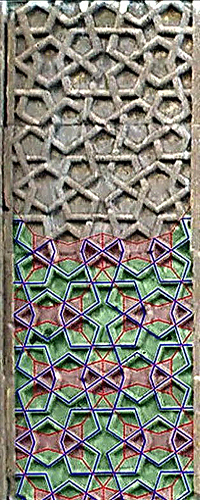
Figure 3: Periodicgirih pattern from the Seljuk Mama Hatun Mausoleum in Tercan, Turkey (~1200 CE), with girih-tile reconstruction overlaid at bottom.
Art historians have until now assumed that the intricate tile work had been created using straight edges and compasses, but the study suggests that Muslim artisans were using a basic toolkit of girih tiles made up of shapes such as the decagon, pentagon, diamond and hexagon.
“Straight edges and compasses work fine for the recurring symmetries of the simplest patterns we see, but it probably required far more powerful tools to fully explain the elaborate tiling with decagonal [10-sided] symmetry,” P. J. Lu said, quoted by the journal The Independent on 25 February 2007. He adds that “individually placing and drafting hundreds of decagons with a straight edge would have been exceedingly cumbersome. It’s more likely these artisans used particular tiles that we’ve found by decomposing the artwork”.[5]
The scientists found that by 1453, Islamic architects had created overlapping patterns with girih tiles at two sites to produce near-perfect quasi-crystalline patterns that did not repeat themselves. “The fact that we can explain so many sets of tiling, from such a wide range of architectural structures throughout the Islamic world with the same set of tiles, makes this an incredibly interesting universal picture,” P. J. Lu said.[6]
With this result, despite the debate that surrounded it in scholarly circles, we can see that very important discoveries in the Islamic scientific tradition are still to come, and that with the continuing research in different sources, including those of material remains of Muslim civilisation, the picture of our knowledge may be enriched and even changed dramatically.
3. The ‘Muqarnas’ Project
As a background to the present day research on Islamic architecture as a conjunction of mathematics, arts and practical knowledge, we can mention the ongoing work on the Muqarnas. A Muqarnas is a type of corbel used as a decorative device in traditional Islamic architecture. The term is the Arabic word for stalactite vault, an architectural ornament developed around the middle of the 10th century in north eastern Iran and almost simultaneously, but apparently independently, in central North Africa. A Muqarnas is a three-dimensional architectural decoration composed of niche like elements arranged in tiers. The two-dimensional projection of a Muqarnas vault consists of a small variety of simple geometrical elements. Excellent examples can be found in the Alhambra in Granada, and in the mausoleum of Sultan Qaitbay in Cairo.[7]


Figures 4: The iwans that surround the courtyard of Masjid-i-Jame in Isfahan consist of three Muqarnas, each giving different impressions:(4A) the southern Muqarnas, occupying a frontal position facing the courtyard, has an apex made up of 8 segments, suggesting a primitive strength; (4B)the eastern Muqarnas, with its 11-segmented apex, is complex and not aesthetically pleasing.
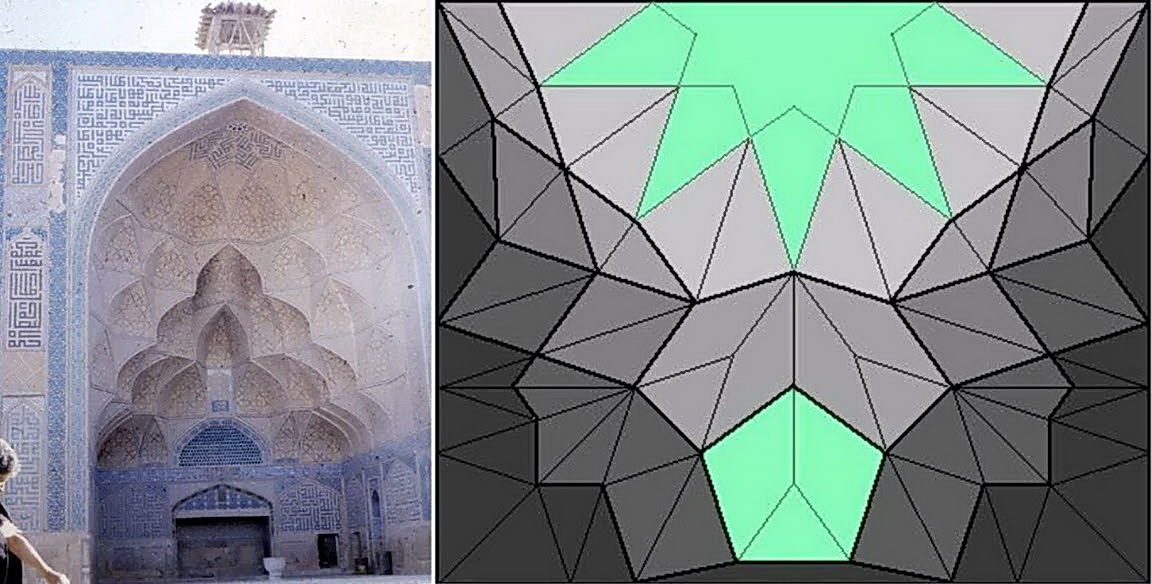
(4C) the western Muqarnas has a 5-segment apex, and displays an elegant form such as that seen in Hakuho sculptures.(Source).
The singular beauty of the Muqarnas has been reported by travellers throughout history. Their descriptions, however, are no more than brief introductions, and many details remain unclear. In his work on such architectural ornaments, Shiro Takahashi created exact drawings of many varieties of Muqarnas, classifying them into types in an attempt to clarify the formative styles of Muqarnas.[8]
On the other hand, scholars from Heidelberg University in Germany, led by Yvonne Dold-Samplonius, designed The Muqaras Project aimed at the study of Muqarnas tradition in Islamic architecture. The project is entitled: Mathematical Concepts and Computer Graphics for the Reconstruction of Stalactite Vaults – Muqarnas – in Islamic Architecture.[9]
The focus in this project is laid on two main points. One is that, from the late 11th century on, all Muslim lands adopted and developed the Muqarnas, which was widely used in constructions. The second and far more important point is that, from the moment of its first appearance, the Muqarnas acquired four characteristic attributes, whose evolution and characteristics form its history: it was three-dimensional and therefore provided volume wherever it was used, the nature and depth of the volume being left to the discretion of the maker; it could be used both as an architectonic form, because of its relationship to vaults, and as an applied ornament, because its depth could be controlled; it had no intrinsic limits, since not one of its elements is a finite unit of composition and there is no logical or mathematical limitation to the scale of any one composition; and it was a three-dimensional unit which could be resolved into a two-dimensional outline.


Figures 5: Muqarnas drawings in The Topkapi Scroll, the best preserved example of its kind, displaying geometry and ornament of Islamic architecture: (5A) Vault fragment with black-dotted polygonal grid lines, triangular one-twentieth repeat unit of a decagonal vault, and fan-shaped radial Muqarnas quarter vault; (5B) Fan-shaped radial muqarnas quarter vault, and shell-shaped radial muqarnas quarter vault; (5C)Fan-shaped radial muqarnas quarter vault, rhombodial one-eight repeat unit of an octagonal fan-shaped radial muqarnas quarter vault, fan-shaped radial muqarnas quarter vault, and rectangular repeat unit of stellate Muqarnas fragment. (Source).
“The muqarnas is a ceiling like a staircase with facets and a flat roof. Every facet intersects the adjacent one at either a right angle, or half a right angle, or their sum, or another combination of these two. The two facets can be thought of as standing on a plane parallel to the horizon. Above them is built either a flat surface, not parallel to the horizon, or two surfaces, either flat or curved, that constitute their roof. Both facets together with their roof are called one cell. Adjacent cells, which have their bases on one and the same surface parallel to the horizon, are called one tier.” [10]The work of the group is based on the analysis made by Yvonne Dold-Samplonius of the mathematical work of the 15th century Timurid mathematician Ghiyath al-Din Mas’ud al-Kashi (ca. 1380-1429). Al-Kashi defines the Muqarnas as:
Building on the classification of different varieties of Muqarnas by al-Kashi, the project analyses the intermediate elements which connect the roofs of adjacent cells. In this sense, al-Kashi distinguishes four types of Muqarnas: The Simple Muqarnas and the Clay-plastered Muqarnas, both with plane facets and roofs, as well as the Curved Muqarnas, or Arch, and the Shirazi, in which the roofs of the cells and the intermediate elements are curved. The plane projection of a simple element (either cell or intermediate element) is a basic geometrical form , namely a square, half-square (cut along the diagonal), rhombus, half-rhombus (isosceles triangle with as base the shorter diagonal of the rhombus), almond (deltoid), jug (quarter octagon), and large biped (complement to a jug), and small biped (complement to an almond). Also rectangles occur.
The elements are constructed according to the same unit of measure, so they fit together in a wide variety of combinations. Al-Kashi uses in his computation the module of the Muqarnas, defined as the base of the largest facet (the side of the square) as a basis for all proportions.
The Muqarnas is used in large domes, in smaller cupola, in niches, on arches, and as an almost flat decorative frieze. In each instance the module as well as the depth of the composition is different and adapts to the size of the area involved or to the required purpose. The Muqarnas is at the same time a linear system and an organization of masses.[11]


Figures 6: South octagon vault of the Takht-i Suleyman (Throne of Salomon), the ruins of which are situated ca. 30 km North of Takab, N.W. of Tehran. Takht-i Suleyman was a palace built in the 13th century by the Ilkhanid ruler Abaqa (1265-1281). In the ruins of the western part of the palace a plate has been found, which was recognized as a construction plan for a Muqarnas vault. In analogy to this plan, the scholars of The Muqarnas Project at Heidelberg University in Germany proposed a possible plan to reconstruct the much simpler south octagon vault. (Source).
Departing from the existence of a lot of ground plans of existing Muqarnas, some of these 3D-vaults are still in good shape, others broke down and have to be reconstructed from their plans; but even in many cases such plans do not exist any more. The Muqarnas Project mentioned above intends to convert existing Muqarnasplans into the computer in such a way that their properties can be analyzed (what kind of elements occur, which elements can be connected and how, what are the possible heights of the succeeding tiers, what about regional differences, cultural differences, differences in time, and so forth). In addition, the inherent aim to such an investigation is to build a computer program that is able to answer these questions on Muqarnas plans automatically. The obvious material to start with, according to the scholars of this project, are the Illkhanid Muqarnas plans.[12] These plans can be compared with existing architecture and thus show limitations in computer possibilities.
In the second stage, the scholars are inclined to apply these methods on plans which are not known to have been realized, such as those recorded in the Topkapi Scroll. With all this knowledge in hand, it will be possible to apply these methods for different purposes, such as reconstructing Muqarnas vaults in ruins (like for instance in Varamin, Iran), or to produce short videos tapes on Muqarnas to be used for teaching.[13]
4. Conflicting Views on Mathematical Islamic Art
The subject of the influence of mathematicians on the artisans is a hotly debated subject which requires scholarly resolution. Recently, the author of this article consulted colleagues on this subject and in particular asked their views on the recent discoveries of Lu and Steinhardt. I give below the views of two contemporary scholars, Dr Zohor Idrisi and Prof. George Saliba. In addition, I account briefly of the tantalizing work achieved by the late Alpay Özdural.
4.1. Dr Zohor Idrisi’s View
Dr. Idrisi considers that we should not jump too quickly into claiming the ground breaking character of the ongoing work on tiling, tessellating and crystallography. This subject is far removed from Greek style elementary geometry. For mathematicians, the work on tiling is a real nightmare as it is a highly specialised field that industry has been researching ever since the 1970s with the work of Penrose.[14]
Scholars, such as Branko Grünbau[15] (from the University of Washington in Seattle), had worked intensively on the subject of tiling before P. J. Lu and P. J. Setinheardt published their article recently. Surprisingly though, Grünbaum’s work is coloured by the view point he expresses being that the Muslims did not understand the mathematics of their artistic work. It is interesting to note that several of the press reviews accounting of P. J. Lu and P. J. Setinheardt’s discovery are similar to those expressed by Grünbaum.
This is why Dr. Idrisi stresses that without doubt this discovery is a fascinating one for a mathematician, but the ongoing work on Islamic tiles lacks the essential historical context that is required to inform the reader of how and when these mathematical techniques developed.
4.2. Professor George Saliba’s View
Referring to the breakthrough the Harvard/Princeton scientists that already stormed the public media, Professor Saliba[16] wrote:
“I have seen several references to that, and of course in all instances the question of the relationship between the artisans and the mathematicians is brought up.
Thanks for looking into this relationship a little closer, and for finding out that I had already written something about it quite some time ago, and for referring to the article in which I discuss this relationship in Islamic civilization.[17] I hope this article is read carefully as it should constitute a good warning to those who jump to conclusions way too quickly. History does not work in that fashion, and I for one do not believe, nor can I defend a statement that says that artisans have achieved a breakthrough in the 15th century, or even earlier as some accounts now speculate, that bespoke of quasi-crystalline symmetries when the very concept of crystalline structures and their geometry was not known as far as I can tell. In my article… I warn that we should stick to the exhibitable evidence, preferably textual, before we jump to conclusions on how to interpret artistic designs, no matter how tempting the process of “discovering” breakthroughs is. The warning should be heeded especially when we are always accused of tooting our own horns way too loudly, and thus loosing credibility in the process. And that is why I stick to exhibitable evidence. Not speculation.
Of what I have read so far, the authors of the “discovery” of the breakthrough do not even claim that there was an exhibitable connection between the artisans’ work and the geometry of quasi-crystalline symmetries, and admit that they are speculating, and I agree with them that Islamic civilization never received its fair share of credit. But that does not mean that artisans achieved a breakthrough, the description that gets repeated in the press all over the place, when the very concept of the structures of crystalline symmetries had not even been conceived.
One of the participants in the discussion that I have read is a physicist down at Duke, and he even uses such terms as “almost” got it, but never says that the said symmetries were actually or precisely duplicated. I pay a much closer attention to this innocuous “almost”, just as much as Abu al-Wafa’ al-Buzjani did when he evaluated the artisans’ work of his time. They also “almost” got it.
I withhold comments on the subject until I find the textual evidence I argued for in my article.”
5. The Work of Alpay Özdural
In the work of another scholar, the research on the Islamic complex of mathematics, architecture and art was conducted in another direction. Indeed, recently, Alpay Özdural, a scholar from the Eastern Mediterranean University in North Cyprus, carried on investigations the results of which he published in a series of articles.[18]Unfortunately, the early passing away on 22 February 2003 of this brilliant scholar has put an end to this wave of promising research.

Figure 7: Constructions 37 (left) and 42 (right) reconstructed by Alpay Özdural from the anonymous work On Interlocks of Similar or Corresponding Figures (Fi tadakhul al-ashkal al-mutashabiha aw al-mutawafiqa) (ca. 1300).
In one of his articles, Özdural draws conclusions from the analysis of two mathematical sources, On the Geometric Constructions Necessary for the Artisan (Kitab fima yahtaju ilayhi al-saani’ min al-a’mal al-handasiya) by Abu ‘l-Waf al-Buzjani (ca. 940-998), and an anonymous work, On Interlocks of Similar or Corresponding Figures (Fi tadakhul al-ashkal al-mutashabiha aw al-mutawafiqa) (ca. 1300).[19] These sources provide us with insight into the collaboration between mathematicians and artisans in the Islamic world. Studying this connection, the author presents a series of quotations from these two sources, which show that mathematicians taught geometry to artisans by means of cut-and-paste methods and of geometrical figures that had the potential of being used for ornamental purposes.

Figure 8: Decorative brickwork on the northern iwan of the Esfahan’s Great Mosque showing clockwise and counterclockwise swastikas in one of the circumferential bands. (Source).
Alpay Özdural points out in particular that the anonymous work on ornamental geometry, On interlocks of similar or complementary figures, appears to be compiled by a scribe at a series of meetings between mathematicians and artisans. Some of those constructions display the highest advancements attained by Muslim mathematicians thus represent the intimate link between theory and praxis that created the intriguing and awe-inspiring ornamental patterns. For instance, three of these are in fact the solutions to problems that require cubic equations. In those times mathematicians solved the cubic equations by means of conic sections; but such solutions were only for demonstration purposes with no practical application. These three constructions in Interlocks of Figures, which records the collaboration of mathematicians and artisans, are the cases of “moving geometry,” that is to say, mechanical procedures that are equivalent to the solutions for cubic equations.[20]
The first construction is about “a right-angled triangle such that if [a length equal to the shortest side] is cut from the hypotenuse of the triangle towards the shortest side and a perpendicular is erected at the point of cutting, it cuts off the intermediate side at a point where [the distance] from it to the right angle is equal to the perpendicular itself”. The solution is achieved by trial-and-error, i.e., by moving a straightedge around a pivotal point until the required position is reached. It actually corresponds to solving the cubic equationx³ + 2x² – 2x – 2 = 0 giving a real positive value of x=1.17 approximately.
The second construction concerns again the same right triangle; but in this case joining two such triangles facing opposite directions completes the rectangular repeat unit of the ornamental pattern in question. This time the moving instrument was a prototype of the T-square. It revolves around the centre of a circle so that the solution is achieved by the intersection of two implied hyperbolas, which is equivalent to equation x³ – 3x² – x + 1 = 0. The T-square, which appears to be introduced at that particular meeting, was meant to facilitate drawing patterns that involve conic sections. After the invention of this simple drafting instrument, we can interpret by hindsight that transmission of knowledge by way of architectural drawings-mostly ground plans based on square grids-gained impetus.
The third construction consists of four right-angled triangles rotating around a central square so as to form an ornamental pattern. The special property of this triangle is that “the altitude plus the shortest side is equal to the hypotenuse.” Omar Khayyam (1048-1122), the celebrated poet-mathematician, had written a treatise on this triangle and offered the solution of equation x³ – 20x² + 20x – 2000 = 0 by means of conic sections. The solution in Interlocks of Figures was achieved again with the aid of the T-square. In this case, its sliding movement translates the solution of equation x³ – 4x² + 6x – 2 = 0 into the intersection of a circle and a parabola, by way of focus-directrix property. The triangle that Omar Khayyam had discovered has other properties; it embodies what the Greeks called “the musical proportion.” A mathematical analysis of the North Dome Chamber (constructed in 1088-89 CE) of the Great Mosque of Isfahan, reveals that its proportions were generated wholly by Omar Khayyam’s triangle, thus exemplifying the active involvement of prominent mathematicians in the great accomplishments of Islamic architecture.
6. Combination of Mathematics, Astronomy, Art and Architecture
One recent discovery reveals that Muslim architects and scientists used mathematics far beyond producing decorative patterns. This is revealed in the Divrigi Ulu mosque, one of the masterpieces of Selçuk architecture located in Sivas, Turkey. It is known for its outstanding geometric styles and botanic designs. This astonishing mosque was founded in 1228 by the Mengücekid emir, Ahmet Shah. It was built by the architect Hürremsah from Ahlat. The UNESCO recognised, is cultural significance and it placed in the World Heritage List in 1985.
Recent discoveries show that there shadows of different silhouettes appear on the carvings of the outside walls of the mosque.During the different hours of a day, four shadows appear on the walls facing different directions: the first three are the silhouettes of a man looking straight, reading a book and praying, respectively, and the last one is the silhouette of a praying woman. These remarkable features could not have been designed without the combination of mathematics, astronomy and art. Actually, before the construction of the mosque had started, the scientists observed the positions of the sun and stars for two years. After very careful calculations had been done, the results were applied in the construction of the walls and the carving of the outside doors.


Figure 9: Divrigi Mosque praying man shadow.
7. Conclusion
In this short paper, our aim was to review some important results of the ongoing research on the connections of mathematics, architecture and art in Muslim heritage. It is obvious that this survey is far from covering the subject as it deserves. Our hope is that, by drawing the attention to these ongoing debates in scholarly circles, in particular Arab scholars, artists, mathematicians and architects will take a serious interest in this very exciting subject.
8. Bibliography and Resources
References
[1.] Peter J. Lu and Paul J. Steinhardt, “Decagonal and Quasi-crystalline Tilings in Medieval Islamic Architecture,” Science vol. 315, n° 1106 (2007). See the review FSTC, A Discovery in Architecture: 15th-Century Islamic Architecture Presages 20th-Century Mathematics (published online on www.MuslimHeritage.com in 26 February, 2007) where numerous links to the article published in Science and to supporting online material, as well as links to media coverage resources for interested readers, are provided.
[2.] Girih as defined by Gülrun Necipoglu The Topkapi Scroll: Geometry and Ornament in Islamic Architecture:, Santa Monica, 1995, pp. 92-93): “The girih [is] a highly codified mode of geometric patterning with a distinctive repertoire of algebraically definable elements… The girih mode, with its two- and three-dimensional formulations compiled in surveying examples of pattern scrolls, is characterized by its self-consciously limited vocabulary of familiar, almost emblematic, star-and-polygon compositions generated by invisible grid systems that eliminated a broad spectrum of alternative geometric designs”.
[3.] Ibid
[4.] David Baron, “Medieval Islamic Architecture Presages 20th-Century Mathematics”, Harvard University Gazette, February 22, 2007.
[5.] Steve Connor, “Islamic artists were 500 years ahead of Western scientists”, The Independent (London), Friday, February 23, 2007.
[6.] Ibid
[7.] See on Muqarnas Doris Behrens-Abouseif, “Mukarnas”, Encyclopaedia of Islam, vol. VII, Leiden-New York: E.J.Brill, 1993; Naoko Fukami, “Studies on Muqarnas-vaulting in the Islamic Architecture: 1) the Area of central Asia: Khorasan, Khoarzum and Turan, Journal of the Society of Architectural Historians of Japan No. 22 (1994): pp. 2-36; Naoko Fukami, “Studies on Muqarnas-vaulting in the Islamic Architecture: 2) the Area of Iran: Mazandaran, Azerbaijan, Tehran, Isfahan and Yazd-Fars-kerman”, Journal of the society of Architectural Historians of Japan No. 25 (1996): pp. 23-61; Naoko Fukami, “Studies on Muqarnas-vaulting in the Islamic Architecture: 3) the Areas of Anatolia, Syria and Iraq”, Journal of the society of Architectural Historians of Japan No. 27 (1997): pp. 2-46; Kamil Haydar, Al-‘Amarah al-‘Arabiyya al-Islamiyyah: al-Khasa’is al-takhtitiyya li-‘l-muqarnasat [Arabic Islamic Architecture: Characteristics of Muqarnas], Beirut: Dar al-Fikr al-Lubnani, 1994. For a general bibliography and links, click here.
[8.] Shiro Takahashi, “Muqarnas: A Three-Dimentional Decoration of Islam Architecture”. See especially the “Muqarnas Database” comprising 617 ceiling plans and 1645 examples by Shiro Takahashi): for access, click here.
[9.] The group includes Silvia Harmsen, Susanne Krömker and Michael Winckler (Heidelberg University) and several international cooperation partners: Gülru Necipoglu Sackler (Museum Aga Khan Chair for the History of Architecture, Harvard), Mohammad Al-Assad (Center for the Study of the Built Environment, Amman), and Jan P. Hogendijk (Mathematical Institute, University of Utrecht): click here for more information. An important outcome of the research conducted by this group of scholars concerning al-Kashi’s contribution to architecture was issued as a video tape distributed by The American Mathematical Society: Qubba for al-Kâshî. Video Tape (Heidelberg: Institut für Wissenschaftliches Rechnen, Universität Heidelberg), 1996. Another video tape was produced later on by the same group: Yvonne Dold-Samplonius et al., Magic of Muqarnas: Stalactite Vaults in Islamic Architecture, Video, Duration 18 min, Format PAL or NTSC, May 2005.
[10.] Quoted in Yvonne Dold-Samplonius, “Practical Arabic Mathematics: Measuring the Muqarnas by al-Kashi”, Centaurus vol. 35 (1992), pp. 193-242; idem, “How al-Kashi Measures the Muqarnas: A Second Look”, in Mathematische Probleme im Mittelalter: Der lateinische und arabische Sprachbereich. Edited by Menso Folkerts (Wolfenbütteler Mittelalter-Studien, vol. 10), Wiesbaden: Harrassowitz Verlag, 1996, pp. 56-90.
[11.] On all these varieties of Muqarnas, click here to visit the survey provided by Shiro Takahashi on a large array of plans of, ordered by their geographic and historic relations.
[12.] These plans are reproduced in Ulrich Harb’s book: Ilkhanidische Stalaktitengewolbe Beitrage zu Entwurf und Bautechnik, Berlin: Dietrich Reimer Verlag, 1978.
[13.] See the Project website at Heidelberg University: Muqarnas Visualization in the Numerical Geometry Group.
[14.] Private communication on 25 February 2007.
[15.] See in particular for a first view on the work of this scholar: Branko Grünbaum, Zdenka Grünbaum, G. C. Shephard, “Symmetry in Moorish and Other Ornaments”, in Computers & Mathematics with Applications, Part B 12 (1986), no. 3-4, pp. 641-653; Branko Grünbaum, G. C. Shephard, “Interlace Patterns in Islamic and Moorish Art,” The Visual Mind, Leonardo Book Series, MIT Press, Cambridge, Mass., 1993, pp. 147-155.
[16.] Private communication on 7 March 2007.
[17.] George Saliba, “Artisans and Mathematicians in Medieval Islam”, Journal of the American Oriental Society, vol. 119 (1999), pp. 637-645. In this article, George Saliba reviews the book by Gülru Necipoglu, The Topkapi Scroll: Geometry and Ornament in Islamic Architecture. Getty’s Sketchbooks and Albums, vol. 1. Santa Monica, The Getty Center for the History of Art and the Humanities, 1995.
[18.] Alpay Özdural 1995. “Omar Khayyâm, Mathematicians and Conversazioni with Artisans” Journal of the Society of Architectural Historians vol 54: pp. 54-71 (establishes a connection between a triangle constructed by al-Khayyâm in his treatise of algebra and mosaic drawings); Alpay Özdural, “On Interlocking Similar or Corresponding Figures and Ornamental Patterns of Cubic Equations” Muqarnas (Leiden) vol. 13 (1996): pp. 191-211 (a partial analysis of an Iranian manuscript from the 13th-14th centuries including mosaic drawings that could not be drawn by compass and ruler); Alpay Özdural, “A Mathematical Sonata for Architecture: Omar Khayyam and the Friday Mosque of Isfahan.” Technology and Culture vol. 39 (1998): pp. 699-715; Alpay Özdural, “Mathematics and Arts: Connections between Theory and Practice in the Medieval Islamic World.” Historia Mathematica vol. 27 (2000): pp. 171–201
[19.] This work can be dated to around 1300 because the mathematician, Abu Bakr al-Khalil al-Tajir al-Rasadi (ca. 1300), is cited twice as one of the participants of the discussions, and the text probably came from Tabr¯iz he capital city of the Ilkhanids, which was the scene of huge construction campaigns under the sponsorship of Gazan Khan and his vizier Rashid al-Din at the turn of the fourteenth century.
[20.] Özdural, Alpay “The Use of Cubic Equations in Islamic Art and Architecture”, in Nexus IV: Architecture and Mathematics, edited by José Francisco Rodrigues and Kim Williams. Turin, Italy: Kim Williams Books, 2002.
~ End ~

When a sixteenth-century medical writer referred to Phoenicians, alongside Arabs, as exceptionally important medical sources, he was probably referring to the Muslim and Jewish doctors of Qayrawan, who were writing in Arabic in the tenth century, and Constantine the African, who was translating their writings into Latin in the late eleventh century. The resultant corpus of medical works, transmitted initially from the Benedictine monastery of Montecassino, formed the core of medical education in the West, and continued to be influential into the Renaissance.
See also articles on ‘Salerno and Constantine the African’, ‘Kairouan’ and ‘The Aghlabids of Tunisia’ in Muslim Heritage.

Article Banner: An early illustrated work dealing with the school of Salerno. The cover shows Constantine the African lecturing to the school. From Anastasiuset al., Regimen sanitatis Salernitanum (Source)
On the title page of a medical work published in Lyons in 1517 we read:
‘The New Practice (of medicine) of the Lyonais compiler, Lord Symphorien Champier, concerning all the kinds of diseases, <compiled> from the traditions of the Greeks, the Latins, the Arabs, the Phoenicians, and recent authors, <in> five golden books.’[1]
In the preface Symphorien Champier refers to the ‘Arabs and Phoenicians, as the most serious and brilliant interpreters <of medicine>’ (fol. 3v: ‘Arabes vero et Penos velut gravissimos splendidissimosque interpretes’), and on a typical page, from book four, we read the heading ‘From the tradition of the Phoenicians and the Arabs’ (fol. 86r: ‘Ex traditione Penorum et Arabum’; Figure 1). The Arabs and Phoenicians are also mentioned in other works of Symphorien Champier, such as in his preface to De curatione pleuritidis per venae sectionem autore Andrea Turino (‘On the cure of pleuresis through bloodletting, by Andrea Turino’), published in Basel in 1537, where we have the phrase ‘Andrea has the support of all the Arabs and Phoenicians’ (sig. a2 verso: ‘Habet et Andreas secum Arabes et Pœnos omnes’).

Figure 1. Symphorien Champier, Practica nova, Lyons, 1522, f. 86 recto.
Symphorien Champier (1471-1539) was a prolific humanist and doctor, who spent his career in Lyons, and wavered between attacking the science of the Arabs and embracing it.[2] Using the Classical adjective ‘Peni/Poeni’ he is referring to the Phoenicians, who wielded power over the Western Mediterranean from their base in Carthage from the ninth to the third century BCE. But it is not these ancient Phoenicians that Symphorien has in mind. The quotations attributed to them turn out to be from the works of Isaac Isra’ili and his translator Constantine the African. Since they both from the area formerly under control of the Phoenicians—Ifriqiya, roughly equivalent in area to modern Tunisia—he can honour them with the Classical title of ‘Phoenician’.
We know about the life of Constantine only from Western sources (mainly Peter the Deacon and a certain ‘Matthew F.’).[3] These, naturally, are much vaguer about his life before he suddenly appeared at Salerno, the leading medical school in the West. He is said to have been born in ‘Carthago’ (‘Carthage’). He then travelled throughout the known world (Babylonia, India, Ethiopia and Egypt) in pursuit of knowledge. But on his return home he was persecuted by the ‘Afri’ (‘Africans’), and ‘secretly fled to Salerno’, where he found the state of medical learning so poor in comparison with what he knew in his native land, that he immediately returned home and collected a number of Arabic manuscripts on medicine, intent on bringing them to Salerno to improve the standards there. Unfortunately, he suffered shipwreck on Cape Palinuro, and staggered into Salerno with only half his manuscripts. This account probably deliberately recalls Aeneas’s own journey from Carthage to Italy (after the episode with Dido), and the drowning of his oarsman Palinurus, after which the cape took its name.[4]
The story from here on is somewhat clearer, since we are now on the same soil as the biographers, and backed up by contemporary documents. He was in Salerno by 1077, but in 1078 he entered the Benedictine Abbey of Montecassino (the mother house of the Benedictine Order), as a monk. His entry coincided with the splendid revival of the abbey under Abbot Desiderius (1058–1086), who later became Pope Victor III (1086-7). Desiderius’s Montecassino was a centre for Greek learning as well as Arabic. The Abbey had its own infirmary where certain monks performed the role of doctors and nurses. But even more so, it had its own scriptorium, where texts were copied and illustrated. This was the gateway through which Arabic medicine first entered Europe. Constantine died there in the very last years of the eleventh century. He was always known as the African (sometimes with the addition ‘monk of Montecassino’).
But how much faith can we put in the story that he originated from Carthage? In the mid-eleventh century Carthage was a ruin. After the Romans sacked the Phoenician city, it re-emerged as a Roman city, the capital of Africa Proconsularis, which coincided with the borders of modern Tunisia, with an extension along the coast eastwards. As such it survived into the Christian era. It was the capital of the exarchate of Africa, an administrative division of the Byzantine Empire encompassing its possessions in the Western Mediterranean, and ruled by an exarch (viceroy). The exarchate was created by Emperor Maurice in the late 580s and survived until the Muslim conquest of the Maghreb in the late seventh century. Carthage was destroyed in 698, but it was still possible to speak of a ‘bishop of Carthage’. Pope Leo IX (1049-54) urged African bishops in 1053 to support the archbishop of Carthage, who ‘presided over the entire African church, and was second only to the Pope’.[5]The name ‘Carthage’ harked back to the Classical city, but, in fact, by this time, what had been left of ancient Carthage was subsumed into the area of the newly emerging Arabic city of Tunis, which started to rise to prominence as the chief city of the Arabic region of Ifriqiya in 1059. This is the very time that Constantine might have been in this region, and thus, with some justification (and maintaining the ‘Classicizing’ language of Latin humanists), he could be called a ‘Poenus’.
In all likelihood Constantine belonged to a Christian community in Africia/Ifrikiya–even a community that still had some knowledge of Latin.[6] It is unclear for how long Romance continued to be spoken, but its influence on North African Arabic (particularly in the language of northwestern Morocco) indicates it must have had a significant presence in the early years after the Arab conquest. In the twelfth century the geographer al-Idrisi, describing Gafsa in southern Tunisia, writes that ‘its inhabitants are Berberised, and most of them speak the African Latin tongue (al-laṭīnī al-ifrīqī)’.[7] Calques like dura mater, pia mater for the two meninges covering the brain—al-umm al-jāfiya and al-umm al-raqīqa—might suggest the native knowledge of Latin or ‘African Romance’.
But Constantine was not Champier’s only Poenus. He also mentions ‘Isaac’. In this he is referring to the chief Arabic author whose works Constantine translated. In fact, Constantine relied on the works of three authors, who were related as a succession of master and pupil: Isḥaq ibn ‘Imran (d. ca. 903-9), his pupil Isḥaq al-Isra’ili (who died in the mid-tenth century, Champier’s ‘Isaac’) and Isḥaq’s pupil Abu Ja‘far ibn al-Jazzar (who died in 980). These doctors all lived and worked in al-Qayrawan, 184 kilometers south of Tunis and the most important city in Ifriqiya before the rise of Tunis. In 800 the Aghlabids made al-Qayrawan their capital and there followed a period of prosperity and cultural flowering. The Shi’ite Fatimids arose in Ifriqiya and, replacing the Aghlabids in 909, spread over the whole of the North African coast, making Cairo their capital. But the Zirids were their vassals in al-Qayrawan, and brought about another period of splendor for al-Qayrawan. However, when they declared their independence, the Fatimids in Cairo encouraged the Banu Hilal to invade Ifriqiya from the West and, in 1057, they utterly destroyed al-Qayrawan. In 1059 the population of Tunis swore allegiance to the Hammadid prince al-Nasir ibn Alnas, who was based in Bejaia (in modern-day Algeria), and this was the beginning of the rise of Tunis in power and population. This political upheaval could be what Peter the Deacon referred to as the reaction against Constantine that forced him to leave Africa. Whatever the case, it would not be a stretch to call the Arabic doctors and medical writers of al-Qayrawan also ‘Poeni’, and Constantine could just as easily have been a Poenus of al-Qayrawan as of Tunis (or of both).
Isaac, of course, was a Jew. Jews formed an important part of the population of al-Qayrawan which was a center of Talmudic and Halakhic scholarship until forced conversion in 1270. Another pupil of his was Dunash Ibn Tamim, another Jew—who was well known for his astronomical and cosmological learning, including, as it now seems, a cosmology attributed to Masha’allah in two Latin translations, called De orbe (‘On the World’).[8]
So what were these ‘Phoenician’ sources that Champier could have had access to? What were the works that Constantine translated?
A story goes that, as a kind of letter of introduction and witness to his competence, he presented the short Introduction to Medicine of Hunayn ibn Isḥaq to Alfano, archbishop of Salerno (1058-1085), when he arrived in Salerno.[9] This story may be apocryphal. The earliest version of the Isagoge is heavily Grecized, and could already have belonged to a South Italian trend of translating works on physics and astronomy from Greek and, when the Greek was not available, from Arabic, but giving the appearance that they were all translated from Greek. [10] Alfano himself (archbishop 1058-1085) translated Nemesius’s On the Nature of Man from Greek into Latin, whilst an unknown translator rendered parts of the same work from Arabic. In this case Constantine might have been responsible for making the text of the Isagoge less Greek. In any case it is an apt text from which to begin any account of the medical corpus translated from Arabic at the time .
The Isagoge gives, in very straightforward terms, the basic elements of Greco-Arabic humoral medicine. This is already clear from its opening:[11]
Medicine is divided into two parts, i.e. in theory and practice, of which theory is divided into three: into the observation of natural things, of non-natural things and those which are contrary to nature, from which the knowledge of health, illnesses and the neutral state arises… Natural things are seven in number, namely elements, mixtures, composite bodies, limbs, forces, actions, spirits. Others have added to these four others factors, namely ages, colours, appearances and the difference between male and female.[12]
This Isagoge was to form the first text of the corpus of Latin medical texts known as the Ars medicinae or Articella, which has survived in over 200 manuscripts, and incorporated texts translated from Greek as well as from Arabic: Hippocrates, Prognostics and Aphorisms (both from Arabic), Philaretus, On Pulses, and Theophilus, On Urines (both Byzantine Greek texts), and finishing with Galen’s Tegni or Ars parva (a general guide to medicine). But parallel to these texts, and exceeding them in quantity were translations that no modern scholar disputes belong to Constantine.
Constantine contributed several texts of the Qayrawani doctors, and a magnum opus which summates his life work and was probably left incomplete on his death.
The oldest of the Qayrawani corpus is a text by by Isḥaq ibn ‘Imran, On Melancholy, which deals with psychological diseases and their cure.[13] More substantial are the works of the Qayrawani doctor, Isḥaq Isra’ili.
An appropriate introduction is provided by Constantine’s preface to his translation of his work on urines:
Among Latin books I was able to find no author who published reliable and authoritative learning concerning urines. Hence I turned to the Arabic language, in which I found a wonderful book with information on this subject. This book I, Constantine the African, a monk of Montecassino, decided to translate into the Latin language, so that I might obtain a reward for my soul from my efforts and might widen the path for those beginning to learn about urines. This book has been collected and excerpted from ancient authors. From it one can easily approach the knowledge of urine, and also its divisions and indications. It was composed in Arabic by Isaac, the adoptive son of Solomon, and he divided it into ten parts.[14]
Urines were an important diagnostic aid. In the frontispiece of one manuscript of this text Constantine is depicted as a monk, receiving urine bottles from his patients (see Figure 2).
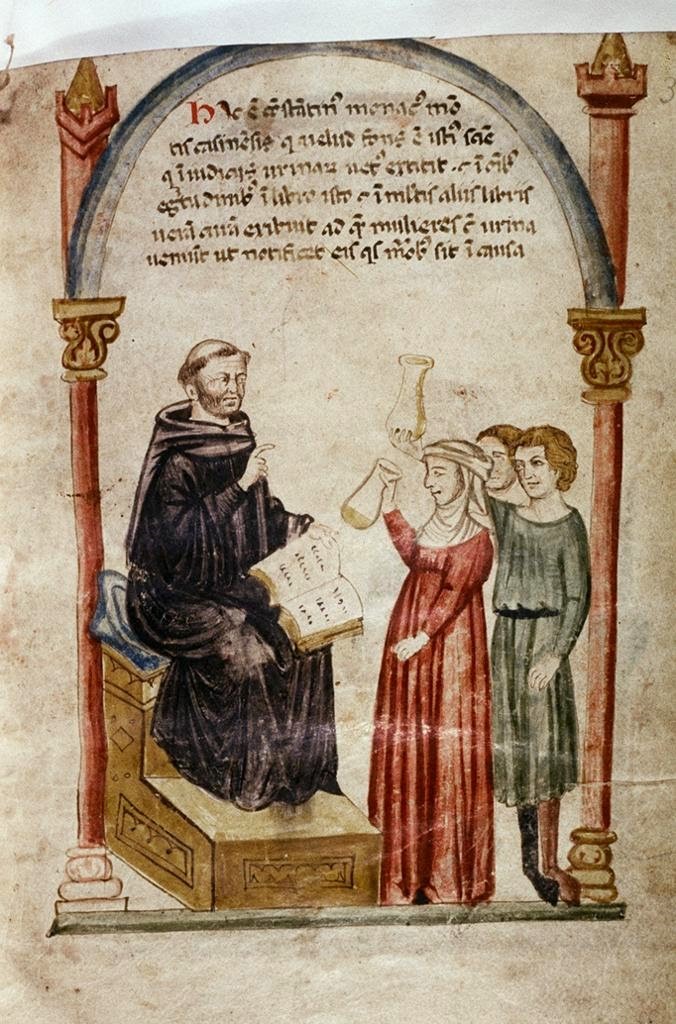
Figure 2. The Preface to Isaac Isra’ili’s On Urines, from Oxford, Bodl., Rawl. C. 328, f. 3r (image in public domain)
The rubric reads:
Here is Constantine, the monk of Montecassino, who is like the fount of this knowledge. He was well known for his judgements concerning all illnesses. In this book and in many other books he shows the true cure. Women come to him with <their> urine so that he can tell them what illness they are suffering from.[15]
The other texts of Isḥaq translated by Constantine were his books on fevers, and two books on healthy living: the Diaetae universales (‘General rules on health living’) and Diaetae particulares (‘Particular rules on health living’). These deal respectively with general effects on diets of age, gender, location and time of year, and specific foodstuffs.
The list of texts translated by Isḥaq’s pupil Ibn al-Jazzar includes works on healthy sexual intercourse (fi ’l-jimā‘, de coitu), on the stomach, on forgetfulness (fi ’l-nisyān, de oblivione)—this being written in response to a letter to Ibn al-Jazzar from somebody who had been suffering from ‘too much forgetfulness and inability to retain things as a result of too much reading’.[16]
The most important work of Ibn al-Jazzar that he translated, however, is the Zād al-musāfir, or ‘Guide to the Traveller’ (in Latin: Viaticum), whose full title is ‘Guide to the Traveller and Nourishment to the One who Stays at Home’ (… wa-qūt al-ḥāḍir). As the title is meant to imply, this is a self-help manual, for the patient who has no access to a doctor—or even to a pharmacist, for it provides ingredients for medicines which can easily be found in the locality of the patient. A famous example of its contents appears among the remedies for what we would call psychological diseases: in this case, lovesickness, which appeared also as a separate text (Liber de heros morbo—‘The Book on the Heroic Disease’).[17]
In case of sickness caused by excessive love, to prevent men from being submerged in excessive brooding, tempered and fragrant wine should be offered, and hearing various kinds of music, speaking with dear friends…
Rufus says: ‘’Sadness is taken away not only be wine drunk in moderation but also by other things like it, such as a temperate bath. Hence it is that when certain people enter a bath, they are inspired to sing. Therefore certain philosophers say that the sound is like the spirit, the wine is like the body of which the one is aided by the other.’[18]
The major work of Constantine the African, however, was his adaptation of the Kitāb or Kunnāsh al-malakī (‘The Royal Collection’), or Kāmil as-sinā’a aṭ-ṭibbiya (‘The Complete Book of the Medical Art’) of ‘Ali ibn al-‘Abbas al-Majusi al-Arrajani. Kunnāsh is originally a Syriac word indicating a collection of treatises, or a work of encyclopedic character, while Kāmil aṣ–ṣinā ‘at also indicates the comprehensiveness of the book. ‘Ali ibn al-‘Abbas lived during most of the tenth century (chronologically between the Arabic doctors Abu Bakr al-Razi and Ibn Sina). His nisbas indicate that he was a Zoroastrian from a Persian town situated between Shiraz and Ahwaz, and his work (his only work) was dedicated to the Buyid emir ‘Adud ad-Dawla who ruled in Shiraz and Baghdad from 949-83.[19] But the work must have spread westwards soon after its composition. It was certainly known in al-Andalus in 1068 when Ṣa’id al-Andalusi mentions the author and his book ‘as the best encyclopedia (kunnash) of medicine that he knows’.[20] So it is not surprising that Constantine should have got to know it in Ifriqiya. The Arabic text consists of ten books of theory and ten books of practice.
Constantine evidently regarded his version of this book as his most important work. He dedicated it to Abbot Desiderius in a florid style:
To the lord abbot of Montecassino, Desiderius, the most reverend father of fathers—nay rather the shining jewel of the whole ecclesiastical order, Constantine the African, although unworthy, nevertheless his monk,… <dedicates this work>.[21]
He gives it a name which picks up the ‘completeness’ in the Arabic title: ‘Pantegni’—a title concocted from two Greek words, meaning ‘all’ and ‘the art’, mirroring the Arabic title Kāmil aṣ-ṣinā ‘a, and the book promises to include the ten books of theory and the ten books of practice which the Arabic has. In fact, this is not exactly what we have. Perhaps because of the shipwreck on Cape Palinurus, most of the early manuscripts have only the ten books of theory and two and a half books of the practice, while later manuscripts have completed the practice, following the order of subject matter of ‘Ali ibn al-‘Abbas’ text, but replacing the contents with those of a variety of other texts, some being translations by Constantine and his circle, others pre-Salernitan Latin medical texts. Thus, some short texts of Ibn al-Jazzar are included: On Leprosy, and On Degrees (of qualities in medicines). The Viaticum above all is used to fill up the Practica. Since some chapters come from the Liber aureus of Constantine’s pupil, Johannes Afflacius (a Muslim convert, also a monk at Montecassino), it may be that he (or other students) was responsible for adding some of the material. But the compilatory nature of the work is also implied by Constantine’s own words at the beginning of the Pantegni (Theorica): that he is the author in the sense of being the ‘coadunator’ of the whole work—somebody who puts together the whole thing from many books.[22]
‘Ali ibn al-‘Abbas’s own name does not appear in any of the manuscripts. Sometimes the work is attributed to the better-known ‘Rhazes’ (i.e. Abu Bakr Muhammad ibn Zakariyya ar-Razi).[23] But usually only Constantine’s name is given, and for this he was much criticized by later scholars, and especially by Stephen of Antioch who, in 1127, made a much more literal translation of the whole 20 books of the Kitāb al-malakī.[24] But, nevertheless, the Pantegni was very popular, surviving in over 100 manuscripts.
One reason for this popularity was 1) that it was the first fully comprehensive medical textbook, covering anatomy, surgery, regimen, diseases from head to toe, and fevers which afflicted the whole body, and finally giving a comprehensive list of materia medica and their properties (the pharmacy). Avicenna’s Canon was to fulfil the same roll and eventually to displace the Pantegni in the education of the doctor, but it wasn’t translated until a century later, by Gerard of Cremona. 2) That it was written in an accessible language. Constantine does not stick close to the Arabic, but paraphrases, abbreviates, avoids the excessive Greek terminology of earlier medical texts, and invents calques on the Arabic that are easy to understand (the already mentioned dura mater and pia mater), or retains the Arabic word, e.g. ṣifāq—‘peritoneum’, or part of the uterus–as siphac.[25] 3) The marketing strategy of the Benedictine monasteries, of which Montecassino was the hub. 4) The universalising of the relevance of medicine.
Constantine introduces ‘Ali ibn al-‘Abbas’s text with these words:
Since the whole of science has three principal parts—for all secular or divine letters are subject to logic, ethics or physics—many people have wondered to which of these parts ‘literal’ medicine should be subject. It is not put under logic alone, since neither invention nor judgement are predominant in it. It is not subject to physics alone, since it does not depend only on necessary arguments, whether they can be proved or not. It seems absurd to subject it to ethics alone, since it is not its intention to dispute about morals alone. But, since the doctor ought to be a dealer in natural and moral things, it is clear that, because it falls into all (categories), it must be subject to all different ways of thinking. Hence I, Constantine, weighing up the very great usefulness of this art, and running through the volumes of the Latins, when I saw them, in spite of their number, not to be sufficient for introducing <medicine>, I turned to our old or modern writers.[26]
The first chapter (where Constantine returns to ‘Ali ibn al-‘Abbas’s text) is a version of the Hippocratic Oath in which the one who wants to be a doctor should promise to honour his parents and his teacher, not to practice medicine for the sake of money, not to make poisons, not to learn how to abort unborn children, not to make amorous advances to the patient’s wife, maidservant or daughter, be ready to hear confessions from the patient which he would not dare to confess to his parents, and to read assiduously (and memorise the contents, in case you lose a book).
What is striking is that, when it came to printing the text, the work was no longer attributed to ‘Ali ibn al-‘Abbas, or even to Constantine, but to the Qayrawani doctor, himself, Isaac, and is printed alongside the other texts that are genuinely by Isaac, and Isaac is even given as the author of Ibn al-Jazzar’s Viaticum. The editor, Andrea Turino of Pescia, refused to publish these translations under the name of Constantine, because, he says, ‘everybody knows full well that Constantine stole these works’ (‘apud omnes liquido compertum sit id Constantini furtum esse’). Even when the original author cannot be recognized, we must suspect, Turino says, Constantine of theft, as is clear in the case of the Viaticum (‘ … Addidimus multa Constantini opuscula verentes et illa furta esse, ut de Viatico manifeste patet’); all the writings under his name fall under suspicion. As the title of the Pantegni Turino gives: ‘The book, Pantegni, of Isaac Isra’ili the adopted son of Solomon, king of Arabia: which Constantine the African, the monk of Montecassino, claimed was his own work’. [27]

Figure 3. Frontispiece to Omnia opera Ysaac, Lyons, 1515, showing Halyabbas (‘Alī ibn al-‘Abbās al-Maǧūsī), Ysaac (Isḥaq al-Isra’ili) and Constantinus monachus (Constantine the African)
This edition was printed by Barthélemi Trot in Lyons in 1515 (see Figure 3). It is endorsed by none other than Symphorien Champier, the citizen of Lyons, who, as the ‘illustrissimus philosophus’, addresses Andrea Turino with fulsome praise, for sweating over the emendation of the works of Isaac. When we return to the Practica nova (‘The New Practice’), published two years later, we find that Champier repeats his arguments for the authorship of Isaac.[28] And we can make sense of the quotation of the passage of the Viaticum as being by ‘Constantinus sive Isaac’ (‘Constantine or Isaac’). Champier gives the reference in the margin: ‘Isaac or Constantine in Isaac, the fourth <book> of the Viaticum chapter 14’ (‘Isaac sive Constantinus in Isaac .iiii. Viatici caput .xiiii.’; see Figure 1).
While there is some appropriateness in calling both Constantine and Isaac ‘Poeni’ there remains the question as to what led Symphorien Champier to adopt this name. Did he mean to suggest something distinctive about the contribution of the ‘Poeni’, as opposed to the ‘Arabes’—a different geographical origin, or a different kind of medicine? This seems unlikely, since he always groups the ‘Poeni’ and ‘Arabes’ together. But it might also be possible to see the reference to ‘Poeni’ in the light of a Classicizing tendency both in the eleventh-twelfth century and in the Renaissance. To openly declare in the late eleventh that one’s work was taken from the Saracens would not, perhaps, have been the best way to advertise its value, at a time when Christians were in open conflict with Muslims in Spain and Sicily and the First Crusade was just about to begin. in the late eleventh. But to imply that Constantine the African’s itinerary was similar to that of Aeneas restored some respectability to what he achieved. Just as Aeneas brought the benefits of Phoenician royal culture from Carthage to Rome and founded Roman civilisation, so Constantine brought medicine (including a ‘royal’ book) from Carthage to Salerno and founded Western medicine.
Printed books
[1] Lyons, 1522, title page: ‘Practica nova Aggregatoris Lugdunensis domini Simphoriani Champerii de omnibus morborum generibus ex traditionibus Grecorum, Latinorum, Arabum, Penorum ac recentium auctorum Aurei Libri quinque’.
[2] D. N. Hasse, Success and Suppression: Arabic Sciences and Philosophy in the Renaissance, Cambridge MA, 2016, pp. 42-45.
[3] Peter the Deacon, De viris illustribus. The entry on Constantine the African is edited in H. Bloch, Montecassino in the Middle Ages, 3 vols, Rome, 1986, I, pp. 126-9. See also F. Newton, ‘Constantine the African and Monte Cassino: New Elements and the Text of the Isagoge’, in Constantine the African and ‘Ali ibn al-‘Abbas al-Maǧusi: the Pantegni and Related Texts, ed. C. Burnett and D. Jacquart, Leiden, 1994, pp. 16-47, id., ‘Arabic Medicine in Italy: Constantine the African,’ in Mediterranean Passages, from Dido to Derrida, eds Miriam Cooke, Erdağ Göknar, and Grant Parker, Chapel Hill NC, 2008, pp. 115-121, translation of the two sources and the useful blog https://constantinusafricanus.com.
[4] Virgil, Aeneid, 5.857-8. Virgil’s story was based on the real history of Queen Elissa, who founded Carthage in 814 B.C.
[5] Patrologia Latina 143, cols 729-31, see col. 729: ‘dignitatem Carthaginensis Ecclesiae … quia sine dubio post Romanum pontificem primus archiepiscopus et totius Africae maximus metropolitanus est Carthaginensis episcopus’. See Jonathan Conant, Staying Roman: Conquest and Identity in Africa and the Mediterranean, 439-700, Cambridge, 2012, p. 368 and T. Lewicki, ‘Une langue romane oubliée de l’Afrique du Nord. Observations d’un arabisant’, Rocznik Orientalistyczny, 17 (1958), pp. 415–480.
[6] The Arabic equivalent of Constantine—Qusṭa—was a common name for a Christian Arabic speaker.
[7] Lewicki, ‘Une langue romane oubliée’, p. 430.
[8] See D. Jacquart and F. Micheau, La Médecine Arabe et l’Occident Médiéval, Paris, 1990, pp.112-18, and Taro Mimura, ‘The Arabic original of (ps.) Māshā’allāh’s Liber de orbe: its date and authorship,’ The British Journal for the History of Science 48, 2015, pp. 321-52.
[9] C. Burnett, ‘Encounters with Encounters with Razi the Philosopher: Constantine the African, Petrus Alfonsi et Ramon Martí’, in Pensamiento hispano medieval: Homenaje a Horacio Santiago-Otero, ed. J.-M. Soto Rábanos, Madrid, 1998, pp. 973-92 (pp. 974-8).
[10] C. Burnett, ‘Physics before the Physics: Early Translations from Arabic of Texts concerning Nature in MSS British Library, Additional 22719 and Cotton Galba E IV’, Medioevo, 27, 2002, pp. 53–109.
[11] A translation of the whole text is included in E. Grant, A Source Book for Medieval Science, Cambridge, MA, 1974, pp. 705-15.
[12] Isagoge Iohannitii, ed. G. Maurach, Sudhoffs Archiv, 62, 1978, pp. 148-74 (with variants from passages transcribed in Newton, ‘Constantine the African’): ‘Medicina dividitur in duas partes, scil. in theoricam et practicam (speculativa et operativa), quarum theorica dividitur in tria, in contemplationem naturalium rerum et non naturalium et earum quae sunt contra naturam, ex quibus sanitatis, egritudinum et neutralitatis scientia procedit… Res vero naturales septem sunt, scilicet elementa, commixtiones, compositiones vel complexiones, membra, virtutes, actiones, spiritus, et alii addiderunt his alias .iiii. scilicet etates, colores, figuras, distantiam inter masculum et feminam’.
[13] Isḥaq ibn ‘Imran, Maqāla fī l-mālīhūliyā (Abhandlung über die Melancholie) und Constantini Africani libri duo De melancholia, ed. K. Garbers, Hamburg, 1977.
[14] Omnia opera Ysaac, f. 156r and edited in Bloch, Montecassino, I, p. 103.
[15] MS Oxford, Bodl., Rawl. C. 328, f. 3r:‘Hic est Constantinus monacus Montis Casinensis qui velud fons est illius scientie, qui in iudiciis urinarum notus extitit et in omnibus egritudinibus in libro isto et in multis aliis libris veram curam exibuit, ad quem mulieres cum urina veniunt ut notificet eis quis morbus sit in causa’.
[16] ‘De nimia oblivione et inminuta retentione cum nimia assiduitate legendi’: see G. Bos, ‘Ibn al-Ğazzār’s Risāla fi ’n-nisyān and Constantine’s Liber de oblivione’, in Constantine the African, pp. 203-32 (p. 226).
[17] M. Wack, ‘‘Alī ibn al-‘Abbās al-Maǧūsī and Constantine on Love, and the Evolution of the Practica Pantegni,’ in Constantine the African, pp. 161-202. ‘Heroic’ plays on the double meaning of ‘heroicus’: ‘belong to passionate love’ (erōs) and ‘heroic’.
[18] Viaticum, 1.20, quoted and discussed in C. Burnett, ‘European Knowledge of Arabic Texts Referring to Music: Some New Material’, Early Music Theory, 12, 1993, pp. 1-17 (see pp. 3-4).
[19] See F. Micheau, ‘‘Alī ibn al-‘Abbās al-Maǧūsī et son milieu’, in Constantine the African, pp. 1-15.
[20] Ṣa‘id al-Andalusi, Kitāb ṭabaqat al-umam ou Les catégories des nations, ed. L. Cheikho, Beirut, 1912, p. 62.
[21] Preface to Pantegni in MS Cambridge, Trinity College, R.14.34: ‘Domino suo montis cassinensis abbati .D. reverentissimo patrum patri, immo totius ordinis æcclesiastici gemmæ prænitenti CONSTANTINUS Affricanus, licet indignus suus tamen monachus …’ (the capital letters are in the manuscript).
[22] Omnia opera Ysaac, f. 4r: ‘Est ergo Constantinus Affricanus auctor, quia ex multorum libris coadunator’.
[23] E.g. MS Hildesheim, Dombibl. 748, f. 1r: ‘Incipit liber Pantegni a Constantino Affricano translatus. Nomen auctoris fuit Rasis’.
[24] C. Burnett, ‘The Legend of Constantine the African’, in The Medieval Legends of Philosophers and Scholars, Micrologus 21, 2013, pp. 277-94.
[24] For more examples, see G. Strohmaier, ‘Constantine’s Pseudo-Classical Terminology and its Survival’, in Constantine the African, pp. 90-98.
[26] For the Latin original see D. Jacquart in ‘Le sens donné par Constantin l’Africain à son oeuvre: les chapitres introductifs en arabe et en latin’, in Constantine the African, pp. 71-89 (see p. 84).
[27] ‘Liber Pantegni Ysaac israelite filii adoptivi Salomonis regis Arabie: quem Constantinus Aphricanus monachus montis cassinensis sibi vendicavit’. See Burnett, ‘The Legend of Constantine the African’, pp. 278-30.
[28] Practica nova, f. 4r, summarised in the margin as ‘Constantinus monachus falso sibi ascripsit Pantegni et Viaticum Ysaac’ (‘Constantine the monk falsely attributed to himself the Pantegni and Viaticum of Ysaac’).

 Aal-e-Qutub Aal-e-Syed Abdullah Shah Ghazi