

■ The Sufi Science of Dhikr al-Nafas: Remembrance with the Breath
The science of Dhikr al-Nafas, remembrance through the breath concerns one of the most intimate realities of the human being: the continual movement between inhalation and exhalation.
Every breath reminds the seeker of dependence. We do not possess the next breath before it arrives, nor can we retain the previous breath after it departs. In this sense, the breath becomes a living sign of faqr absolute need before Almighty Allāh.
The Sufi does not regard the breath merely as
a physiological movement. Through conscious remembrance, it can become a vehicle of ḥuḍūr (presence), a means of gathering the scattered heart, and a reminder that the servant is sustained at every moment by the One upon whom all existence depends.
▪︎ The Qur’ān says:
وَاذْكُرْ رَبَّكَ فِي نَفْسِكَ تَضَرُّعًا وَخِيفَةً
“And remember your Lord within yourself, humbly and with awe.” (Qur’ān 7:205)
Thus the deepest purpose of breath remembrance is not the breath itself.
It is dhīkr Allāh: that the heart should cease wandering in heedlessness and become turned toward its Lord.
1. The Entry: Inhalation and the Secret of “Hu”
In the contemplative symbolism of Dhikr al-Nafas, inhalation may be associated with هُوَ Hu, “He.”
“Hu” points toward the Divine Reality beyond limitation, form and created resemblance. It is not a separate divine name independent of Allāh, but the pronoun of reference to the One whose Essence cannot be encompassed by created perception.
The inhalation therefore becomes an inward movement: from dispersion toward gathering, from heedlessness toward remembrance, and from multiplicity toward awareness of the One.
▪︎ The famous saying attributed to Sayyidunā ʿAlī ibn Abī Ṭālib, may Allāh ennoble his countenance, expresses the language of inward witnessing:
“I would not worship a Lord whom I do not see.”
In another transmitted formulation, when asked how he sees Him, he replied that the eyes do not perceive Him through ordinary visual sight, but that the hearts perceive Him through the realities of faith.
This is crucial: the “seeing” of which the gnostic speaks is not physical sight. It is basīrah, the inward perception of faith, certainty and maʿrifa.
The breath therefore does not cause Divine witnessing. Rather, conscious remembrance can help gather the heart so that the servant becomes more attentive to the Divine signs already surrounding him.
2. The Breath as a Sign of Faqr
Every inhalation silently declares:
I am in need.
Every exhalation silently declares:
I cannot retain what has been given to me.
Between the two lies the entire condition of servanthood.
The seeker discovers that he does not
create his own existence, sustain himself independently, or command the continuation
of his life.
Each breath arrives as a gift. This is the inward meaning of faqr. The Sufi therefore learns to regard the breath as an amānah, a trust.
A breath spent in heedlessness has passed and cannot be recalled. A breath accompanied by remembrance becomes an opportunity for gratitude, repentance, presence and return.
The aim is not anxiety over every breath,
but adab with the gift of every breath.
3. The Heart: Qalb as the Centre of Dhīkr
The inhaled remembrance is symbolically gathered into the qalb.
The qalb is called “heart” because it turns and changes. It can turn toward heedlessness or remembrance, toward the nafs or toward the Divine command.
For the Sufi, purification therefore does not mean merely acquiring information. It means transforming the condition of the heart.
The heart may be compared to a mirror.
When covered by ghaflah, heedlessness,
its capacity to reflect becomes obscured.
Dhīkr, repentance and obedience polish
“Everything has a polish, and the polish
of the hearts is the remembrance of Allāh.”
(Abū al-Dardāʾ, may Allāh be pleased with him, in Shuʿab al-Īmān of al-Bayhaqī)
The metaphor is profound. Dhīkr does not place Allāh into the heart. Rather, it removes something from the heart: heedlessness.
The heart becomes increasingly capable of recognizing what was always true:
Almighty Allāh is the Lord, the servant is the servant, and everything besides Him is dependent upon Him.
4. The Nafs: From Breath of Instinct to Breath of Remembrance
The breath is also connected to the nafs, because human beings naturally breathe without conscious remembrance.
The spiritual path does not require the
servant to abandon ordinary human existence.
Rather, the nafs is gradually educated..
At first, the breath belongs almost entirely
to unconscious habit.
Then the tongue remembers.
Then the mind remembers.
Then the heart remembers.
Eventually, remembrance becomes so deeply rooted that the servant finds himself returning to Allah almost instinctively whenever heedlessness appears.
This is why the Sufi tradition speaks of moving from Dhīkr al-lisān. remembrance of the tongue toward dhīkr al-qalb, remembrance of the heart.
The breath becomes the meeting place between the outward and inward dimensions.
The tongue pronounces.
The breath carries.
The heart receives.
The intellect understands.
The soul becomes attentive.
And the whole human being gradually becomes gathered in remembrance.
5. The Exhalation: Returning “Allāh ” to the World
Within the symbolic diagram, exhalation is represented by the Name:
الله — Allāh
The movement is therefore:
Hu to Heart to Allāh to Breath
The symbolism can be understood as a movement from inward recollection toward outward manifestation. The seeker does not merely retreat from the world. He returns to it carrying the consequence of remembrance.
If the heart has genuinely remembered Allāh, the remembrance should begin to appear in the servant’s speech, character, patience, mercy, humility and conduct.
Thus the exhalation is not simply the release
of air. Spiritually, it signifies, what has been remembered inwardly must become visible outwardly.
The tongue should become truthful.
The hands should become merciful.
The eyes should become guarded.
The feet should walk toward goodness.
The breath that enters the heart through remembrance should emerge through character.
6. The Divine Name: From Pronunciation to Presence
The Divine Name Allāh is not treated by the Sufi merely as a sound. The Name gathers within itself the meanings of Divine Lordship, mercy, majesty, beauty, knowledge, power and perfection.
Yet the seeker must distinguish between the Name and the Named. Pronouncing “Allāh”
is not itself the attainment of maʿrifa.
One may repeat a Name with the tongue while the heart remains distracted..Therefore the progression of dhikr is not measured merely
by the number of repetitions.
The more the heart becomes present, the more dhikr moves from being something the servant does to something that increasingly pervades his awareness.
7. The Qalb and the ʿAql: Two Dimensions of Understanding
The diagram places the ʿaql above the heart because spiritual understanding requires more than emotional experience. The Sufi tradition does not teach the abandonment of reason.
Rather, the purified intellect is brought into harmony with the purified heart.
The ʿaql distinguishes.
The qalb recognizes..
The rūḥ turns toward its Origin.
The nafs is disciplined.
The sirr receives the subtler dimensions of spiritual awareness. Thus maʿrifa is not mere accumulation of information.
A person may know many descriptions of
Allāh while remaining heedless of Allāh.
Another may possess little formal learning
yet have developed profound yaqīn, humility and awareness of his Lord.
This does not mean that knowledge is unnecessary. Rather, knowledge must descend from the tongue and intellect into the heart until it becomes ḥāl, a lived spiritual condition.
8. Dhīkr and the Illumination of the Heart
▪︎ The Qur’an repeatedly connects remembrance with spiritual awakening.
«أَلَا بِذِكْرِ اللَّهِ تَطْمَئِنُّ الْقُلُوبُ»
“Surely, in the remembrance of Allāh
do hearts find rest.” (Qur’ān 13:28)
The movement is therefore:
Dhikr to Ṣafāʾ to Nūr to Ṭumaʾnīnah to Yaqīn to Maʿrifa
Dhikr produces ṣafāʾ, purification. Purification makes the heart receptive to nūr, light. Light produces deeper ṭumaʾnīnah, tranquillity.
Tranquillity strengthens yaqīn, certainty..
And certainty opens the servant toward maʿrifa, according to the degree Allāh grants him.
This is why the Sufi does not seek mystical experience merely for experience’s sake.
The purpose is transformation.
9. The Sevenfold Movement of the Breath
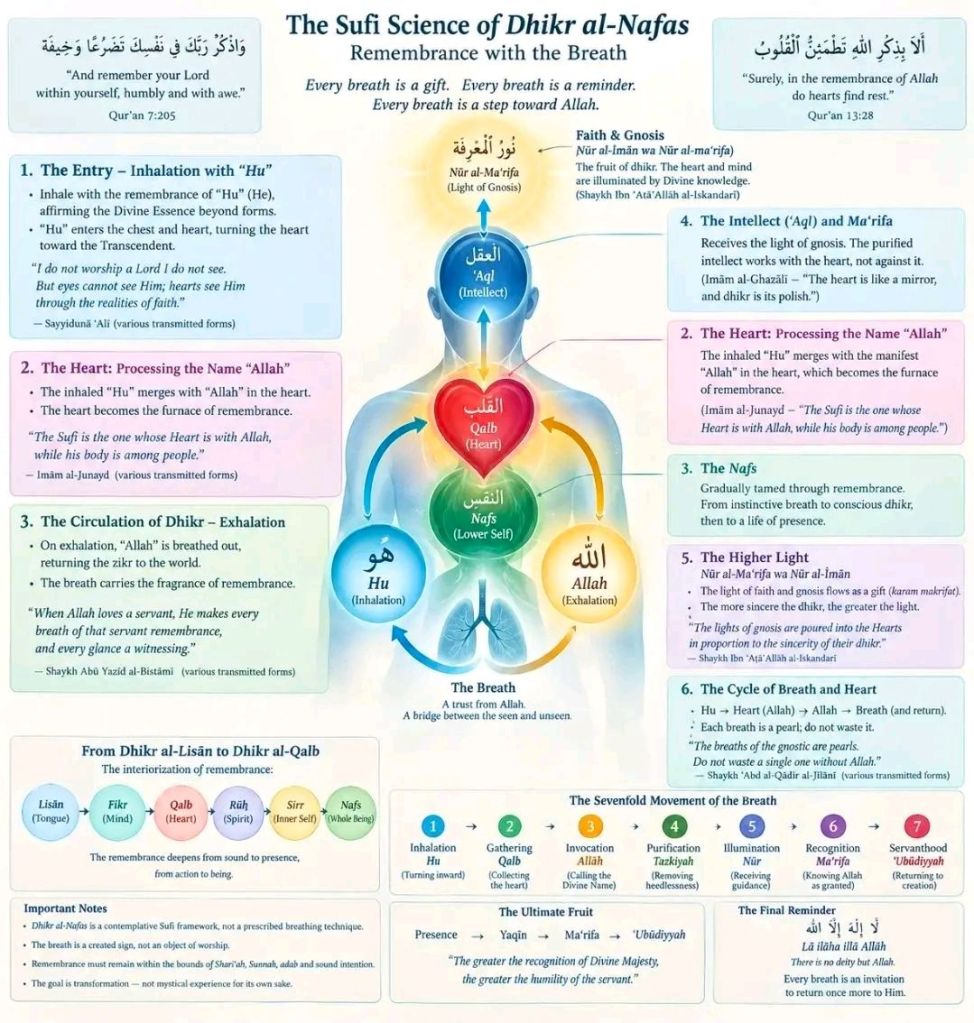
The entire diagram may therefore be understood through seven movements:
1. Inhalation — Hu
Turning inward toward the One.
2. Gathering — Qalb
Collecting the scattered heart.
3. Invocation — Allāh
Calling upon the Divine Name.
4. Purification — Tazkiyah
Removing heedlessness and attachment to the nafs.
5. Illumination — Nūr
The heart becoming receptive to Divine guidance.
6. Recognition — Maʿrifa
Knowing Allah according to the measure He grants.
7. Return — ʿUbūdiyyah
Returning to creation as a servant of Allah.
The final stage is essential.
The Sufi does not seek to escape servanthood.
He seeks to become a better ʿabd.
10. Dhikr al-Nafas and the Muhammadan Balance
The highest form of spiritual remembrance cannot be separated from the Prophetic path.
▪︎ The Qur’ān commands:
فَاذْكُرُونِي أَذْكُرْكُمْ
“Remember Me; I will remember you.”
(Qur’ān 2:152)
And the Prophetic tradition teaches the reciprocal reality of remembrance: when the servant remembers Allāh, Allāh remembers
His servant.
Therefore breath-remembrance must remain within Sharīʿah, Sunnah, adab and sound intention.
The breath is not worshipped.
The technique is not worshipped.
The sensation is not worshipped.
The spiritual state is not worshipped.
Only Allāh Almighty is worshipped.
The breath is simply one of the created signs through which the servant may become more conscious of his absolute dependence upon his Creator.
11. From Dhīkr al-Lisān to Dhīkr al-Qalb
There is a gradual interiorization of remembrance:
Dhikr al-Lisān
The tongue remembers Allāh.
Dhikr al-Fikr
The mind reflects upon Allāh’s signs.
Dhikr al-Qalb
The heart becomes attentive to Allāh.
Dhikr al-Rūḥ
The spirit becomes oriented toward its Lord.
Dhikr al-Sirr
The innermost faculty becomes increasingly detached from heedlessness.
Dhikr al-Nafs
Even the habitual movements of the self become disciplined by remembrance.
Dhikr al-Wujūd
The whole life of the servant becomes ordered around ʿubūdiyyah.
At this level, “every breath” is not necessarily
a claim about a mechanical breathing exercise.
It means that remembrance has become so deeply rooted that the servant strives not to allow his moments to become empty of awareness of Almighty Allāh.
12. The Breath and the Shahādah
There is also a profound relationship between negation and affirmation.
▪︎ The Shahādah begins:
لَا إِلٰهَ — Lā ilāha
There is no deity.
▪︎ Then:
إِلَّا الله — illā Allāh
Except Allāh.
The Sufi may contemplate this movement inwardly:
Lā — release the false objects of dependence.
Illā Allāh — affirm the One upon whom dependence truly rests. In this sense, the breath itself becomes a reminder of tawḥīd.
Inhalation gathers.
The heart recognizes.
Exhalation releases.
The servant returns again.
And the journey repeats.
13. From Presence to Maʿrifa
The ultimate fruit is not simply tranquillity.
Tranquillity is a mercy along the way.
The deeper fruit is ḥuḍūr, then yaqīn, then maʿrifa, and finally deeper realization of ʿubūdiyyah. The gnostic does not emerge from remembrance saying:
“I have become divine.” Rather, authentic realization deepens the opposite recognition:
“I am His servant.” The greater the recognition of Divine Majesty, the greater the humility of the servant.
The more the heart recognizes the generosity of Allāh, the more gratitude appears.
The more the servant recognizes Divine Independence, the more clearly he recognizes his own faqr. Thus true maʿrifa does not inflate the ego. It breaks its claim to independence.
14. The Breath as a School of Tawakkul
Every breath teaches tawakkul. The servant cannot see the next breath before it arrives.
Yet he does not normally live in fear that breathing will cease in the next moment.
He receives.
He releases.
He receives again.
The rhythm itself becomes a lesson:
Receive from Allāh.
Give thanks to Allāh.
Release what must be released.
Return to Allāh.
This is the inward education of the breath.
15. The Final Cycle — From Breath to Presence
▪︎ The complete diagram can therefore be
read as:
Hu
Inhalation
Qalb — Heart
Dhīkr — Remembrance
Tazkiyah — Purification
Nūr — Illumination
ʿAql — Intellect
Yaqīn — Certainty
Maʿrifa — Gnosis
ʿUbūdiyyah — Servanthood
Allāh
Exhalation
Return to creation with remembrance
▪︎ Then the cycle begins again.
The seeker inhales.
He remembers.
He gathers.
He exhales.
He returns.
And throughout it all, the servant remains what he has always been: a servant before his Lord.
The deepest secret of Dhīkr al-Nafas is therefore not that the breath itself possesses some independent mystical power. Its secret
is that every breath exposes the poverty of the servant and the generosity of the Sustainer.
We enter this world breathing by His permission. We live through breaths we did
not create..We cannot command the final breath to remain.
And when the final breath departs, all that remains is the truth toward which every breath was pointing:
لَا إِلٰهَ إِلَّا الله
Lā ilāha illā Allāh.
There is no deity but Allāh.
Thus the science of the breath becomes, at
its deepest level, a science of presence, faqr, tawḥīd, tazkiyah and ʿubūdiyyah. The seeker does not attempt to possess Allāh through the breath. He learns instead to recognize his own complete dependence upon Allāh with every breath.
And when remembrance has entered the heart, illuminated the intellect, disciplined the nafs and transformed conduct, the breath becomes more than a biological rhythm: it becomes a continual reminder of the Divine gift of existence.
Hu — the inward turning.
Allāh — the remembrance.
Qalb — the receiving heart.
Nūr — the illumination.
Maʿrifa — the recognition.
ʿUbūdiyyah — the return to servanthood.
And every breath becomes an invitation to return once more to Almighty Allāh.
And only with Almighty Allāh is true success.


