
Khana Kaaba Aur Shehar-e-Makkah Ki Mukhtasar Tareekh | Allama Syed Habib Al Husaini


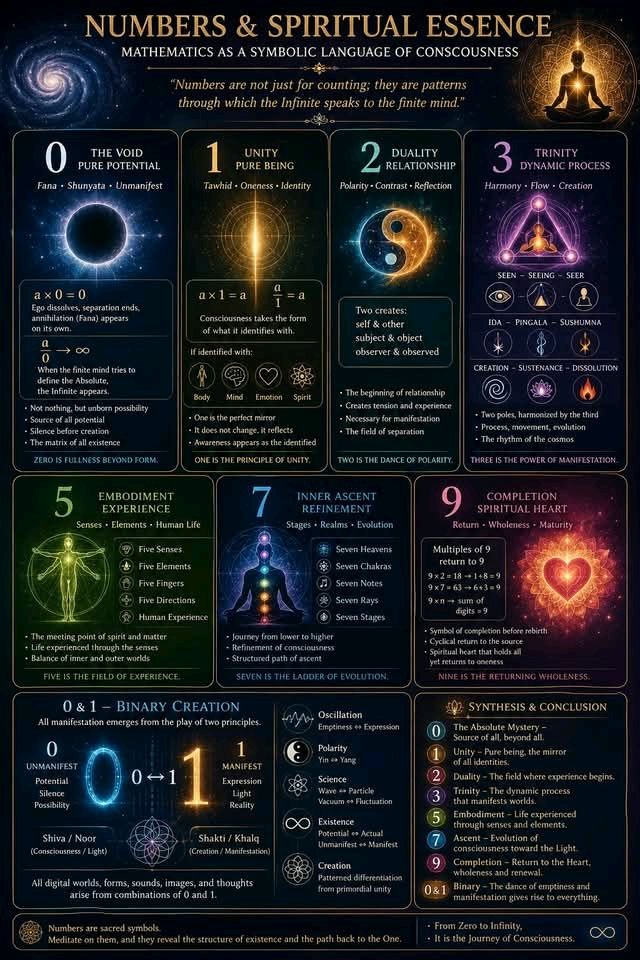
🔢✨ Numbers and Spiritual Essence ✨🔢
A Contemplative Exploration of Mathematics & Consciousness
—
🌌 0 — The Void, Fana, Pure Potential
Zero is one of the most mysterious discoveries in human civilization.
➗ Mathematically
✖️ Anything multiplied by zero dissolves into zero.
♾️ Division by zero becomes undefined/infinite.
🕊️ Spiritually
This mirrors profound mystical ideas such as:
☪️ Fana in Sufism
🪷 Shunyata in Buddhism
🕉️ The unmanifest Brahman in Advaita
🌑 The primordial void before creation
💡 Symbolic Insight
If ego dissolves into absolute emptiness, separateness collapses naturally.
Zero can symbolize:
🌊 Identity merging into the Absolute
🫥 Dissolution of self-centeredness
🤍 Return to primordial silence
🌌 Infinite latent possibility
Yet zero is not “nothing” in a negative sense.
It is:
🌱 unborn possibility
⚡ latent intelligence
🕯️ unmanifest existence
And the mystery of division by zero beautifully hints that:
> 🌀 The finite mind cannot fully define the Infinite.
When ordinary structures collapse, infinity appears.
—
☀️ 1 — Unity, Identity, Pure Being
One symbolizes:
☝️ Oneness
☪️ Tawhid
🕉️ Non-duality
✨ Pure Being
➗ Mathematically
🔹 Any number multiplied by one remains itself.
🔹 Any number divided by one remains unchanged.
🧠 Spiritual Reflection
Consciousness takes the form of whatever it identifies with.
If identified with:
🧍 Body → “I am the body”
💭 Mind → “I am thoughts”
😔 Emotion → “I am suffering”
👁️ Awareness → “I am consciousness”
One acts like a perfect mirror:
🪞 It does not alter
🌈 It reflects
This resembles the mystical idea that consciousness becomes colored by the vessel through which it manifests.
—
❤️ 9 — Completion, Spiritual Heart, Return
The number 9 carries a fascinating symbolic quality.
➗ Mathematical Pattern
9 × 2 = 18 → 1 + 8 = 9
9 × 7 = 63 → 6 + 3 = 9
No matter how it expands, it returns to itself.
🌿 Symbolically
This suggests:
🔄 Self-return
🌕 Completion
♾️ Cyclical wholeness
Across traditions, 9 often represents:
🚪 Completion before rebirth
🔥 Final maturation before transcendence
💎 Ripened consciousness
❤️ The Spiritual Heart
Mystical traditions often describe the “heart” as:
🏠 The returning center
🌌 The place where multiplicity reunifies
🕊️ The bridge between finite and Infinite
In that sense:
> 🌟 9 participates in manifestation, yet remembers its source.
It resembles zero in subtle ways:
🌑 Hidden totality
🔄 Cyclic return
🌱 Latent wholeness
—
🔺 3 — Trinity of Experience
The number 3 appears almost universally in mystical traditions.
👁️ Perception
👀 Seen
👁️ Seeing
🧘 Seer
🌀 Yogic Energy
🌙 Ida
☀️ Pingala
🕉️ Sushumna
🌍 Cosmic Functions
🌱 Creation
🌿 Sustenance
🔥 Dissolution
✨ Universal Structure
Manifestation requires:
⚖️ Polarity
🔄 Relationship
👁️ Awareness/Witnessing
Examples:
🧍 Subject + 🌍 Object + 👁️ Awareness
☯️ Masculine + Feminine + Union
🌊 Motion + 🪨 Stillness + ⚖️ Balance
Three therefore symbolizes:
🔄 Process
⚡ Dynamism
🌌 Unfolding intelligence
—
💻 0 & 1 — Binary Creation
One of the most fascinating modern parallels.
🖥️ In Computation
Everything digital emerges from combinations of:
0️⃣
1️⃣
Including:
🎵 Sound
🖼️ Images
🗣️ Language
🌐 Virtual worlds
🤖 AI systems
🌌 Symbolically
🌑 0 → Unmanifest potential
☀️ 1 → Manifest expression
Or spiritually:
✨ Shiva / Noor → Pure consciousness/light
🌺 Shakti / Khalq → Manifest creation
Binary becomes a metaphysical metaphor:
> 🌊 Existence emerges through oscillation between emptiness and expression.
Even physics reflects similar dualities:
🌊 Wave / Particle
⚡ Presence / Absence
🕳️ Vacuum / Fluctuation
☯️ Yin / Yang
🌱 Potential / Actual
Creation itself may be understood as:
> 🌌 Patterned differentiation emerging from primordial unity.
—
⚖️ 2 — Duality
Two introduces:
🧍 Self & Other
👁️ Observer & Observed
☯️ Polarity
Without duality:
❌ No relationship
❌ No experience
❌ No manifestation
Yet duality also creates:
🌫️ The illusion of separation
—
✋ 5 — Human Experience
Five often symbolizes embodiment:
👁️ Five senses
🌍 Five elements
✋ Five fingers
🧭 Five directions
Human life becomes the meeting point of:
✨ Spirit & Matter
♾️ Infinity & Finitude
—
🌈 7 — Inner Ascent
Across traditions:
☁️ Seven heavens
🌀 Seven chakras
🎵 Seven musical notes
🚶 Seven stages of ascent
Seven symbolizes:
📈 Structured evolution
🧘 Refinement
🌱 Progressive unfolding
—
📐 Mathematics as a Spiritual Mirror
Numbers need not be treated as literal metaphysical proof.
Yet symbolically, they can function as:
🪞 Mirrors of consciousness
🧩 Archetypal patterns
🧘 Contemplative tools
The danger comes only when symbolism is mistaken for empirical certainty.
Still, these contemplations reveal something profound:
> 🌌 Mathematics and consciousness may share deep structural resonances.
—
🌟 A Deeper Synthesis
Our framework beautifully unfolds as:
🌑 0 → Absolute Mystery
☀️ 1 → Undivided Being
☯️ 2 → Duality
🔺 3 → Relational Manifestation
❤️ 9 → Completion & Return
And binary creation (0 & 1) symbolizes:
> 🌊 The eternal dance between emptiness and manifestation.
In this contemplative view:
🌌 Existence is not merely material
🧠 It is intelligible
🎼 Patterned
🤝 Deeply relational
Ultimately:
> ✨ Numbers become symbols through which consciousness contemplates itself.

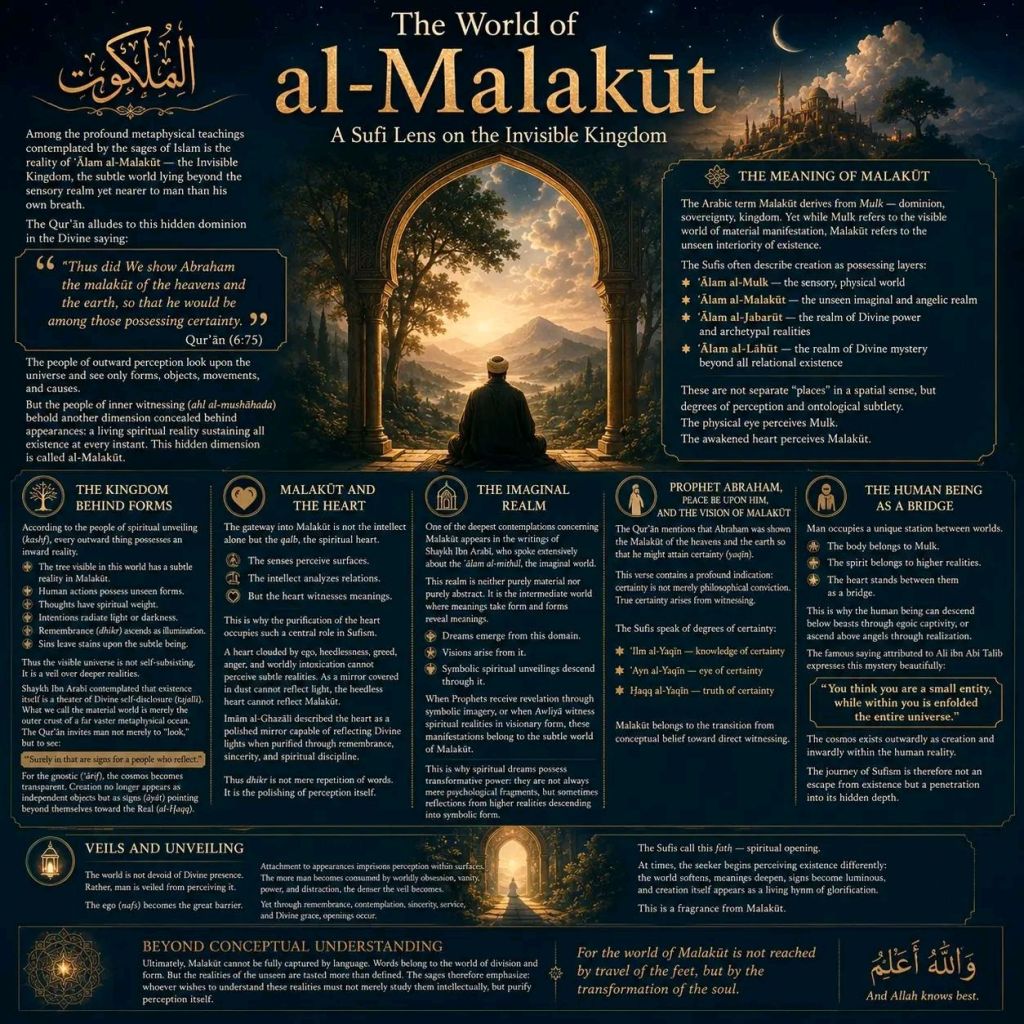
■ The World of al-Malakūt: A Sufi Lens on the Invisible Kingdom.
Among the profound metaphysical teachings contemplated by the sages of Islam is the reality of ʿĀlam al-Malakūt the Invisible Kingdom, the subtle world lying beyond the sensory realm yet nearer to man than his own breath.
The Qur’ān alludes to this hidden dominion in the Divine saying:
“Thus did We show Abraham the malakūt of the heavens and the earth, so that he would be among those possessing certainty.”
Qurʾān (6:75)
The people of outward perception look upon the universe and see only forms, objects, movements, and causes.
But the people of inner witnessing (ahl al-mushāhada) behold another dimension concealed behind appearances: a living spiritual reality sustaining all existence at
every instant. This hidden dimension is called al-Malakūt.
■ The Meaning of Malakūt
The Arabic term Malakūt derives from Mulk dominion, sovereignty, kingdom.
Yet while Mulk refers to the visible world of material manifestation, Malakūt refers to the unseen interiority of existence.
▪︎ The Sufis often describe creation as possessing layers:
ʿ▪︎ Ālam al-Mulk — the sensory, physical world
ʿ▪︎ Ālam al-Malakūt — the unseen imaginal and angelic realm
ʿ▪︎ Ālam al-Jabarūt — the realm of Divine power and archetypal realities
▪︎ ʿĀlam al-Lāhūt — the realm of Divine mystery beyond all relational existence
These are not separate “places” in a spatial sense, but degrees of perception and ontological subtlety. The physical eye perceives Mulk. The awakened heart perceives Malakūt.
■ The Kingdom Behind Forms
According to the people of spiritual unveiling (kashf), every outward thing possesses an inward reality.
The tree visible in this world has a subtle reality in Malakūt. Human actions possess unseen forms. Thoughts have spiritual weight.
Intentions radiate light or darkness.
Remembrance (dhikr) ascends as illumination.
Sins leave stains upon the subtle being.
Thus the visible universe is not self-subsisting. It is a veil over deeper realities.
Shaykh Ibn Arabī, may Almighty Allāh sanctify his secret, contemplated that existence itself is a theater of Divine self-disclosure (tajallī). What we call the material world is merely the outer crust of a far vaster metaphysical ocean.
The Qurʾān repeatedly invites man not merely to “look,” but to see:
“Surely in that are signs for a people who reflect.”
For the gnostic (ʿārif), the cosmos becomes transparent. Creation no longer appears as independent objects but as signs (āyāt) pointing beyond themselves toward the Real (al-Ḥaqq).
■ Malakūt and the Heart
The gateway into Malakūt is not the intellect alone but the qalb, the spiritual heart.
The senses perceive surfaces.
The intellect analyzes relations.
But the heart witnesses meanings.
This is why the purification of the heart occupies such a central role in Sufism.
A heart clouded by ego, heedlessness,
greed, anger, and worldly intoxication
cannot perceive subtle realities.
As a mirror covered in dust cannot reflect light, the heedless heart cannot reflect Malakūt.
Imām Abu Hamid al-Ghazāli, may Almighty Allāh sanctify his secret, described the heart
as a polished mirror capable of reflecting Divine lights when purified through remembrance, sincerity, and spiritual discipline.
Thus dhikr is not mere repetition of words.
It is the polishing of perception itself.
■ The Imaginal Realm
One of the deepest contemplations concerning Malakūt appears in the writings of Shaykh Ibn Arabī, who spoke extensively about the ʿālam al-mithāl, the imaginal world.
This realm is neither purely material nor purely abstract. It is the intermediate world where meanings take form and forms reveal meanings.
Dreams emerge from this domain. Visions arise from it. Symbolic spiritual unveilings descend through it.
When Prophets receive revelation through symbolic imagery, or when Awliyā witness spiritual realities in visionary form, these manifestations belong to the subtle worldof Malakūt.
This is why spiritual dreams possess transformative power: they are not always mere psychological fragments, but sometimes reflections from higher realities descending into symbolic form.
■ Prophet Abraham, peace be upon him, and the Vision of Malakūt
The Qur’ān specifically mentions that Abraham was shown the Malakūt of the heavens and the earth so that he might attain certainty (yaqīn).
This verse contains a profound indication: certainty is not merely philosophical conviction. True certainty arises from witnessing.
▪︎ The Sufis speak of degrees of certainty:
ʿIlm al-Yaqīn — knowledge of certainty
‘Ayn al-Yaqīn — eye of certainty
Ḥaqq al-Yaqīn — truth of certainty
Malakūt belongs to the transition from conceptual belief toward direct witnessing.
■ The Human Being as a Bridge
Man occupies a unique station between worlds.
The body belongs to Mulk.
The spirit belongs to higher realities.
The heart stands between them as a bridge.
This is why the human being can descend below beasts through egoic captivity, or ascend above angels through realization.
The famous saying attributed to Sayyidīnā Imām ibn Abi Talib, may Almighty Allāh enoble his blessed face, expresses this mystery beautifully:
“You think you are a small entity, while within you is enfolded the entire universe.” Dīwān
The cosmos exists outwardly as creation
and inwardly within the human reality.
The journey of Sufism is therefore not an escape from existence but a penetration into its hidden depth.
■ Veils and Unveiling
The world is not devoid of Divine presence. Rather, man is veiled from perceiving it.
The ego (nafs) becomes the great barrier.
Attachment to appearances imprisons perception within surfaces. The more man becomes consumed by worldly obsession, vanity, power, and distraction, the denser the veil becomes.
Yet through remembrance, contemplation, sincerity, service, and Divine grace, openings occur. The Sufis call this fatḥ, spiritual opening.
At times, the seeker begins perceiving existence differently: the world softens, meanings deepen, signs become luminous, and creation itself appears as a living hymn of glorification. This is a fragrance from Malakūt.
■ Beyond Conceptual Understanding
Ultimately, Malakūt cannot be fully captured by language. Words belong to the world of division and form. But the realities of the unseen are tasted more than defined.
The sages therefore emphasize: whoever wishes to understand these realities must not merely study them intellectually, but purify perception itself.
For the world of Malakūt is not reached by travel of the feet, but by the transformation of the soul.
And Allāh knows best.

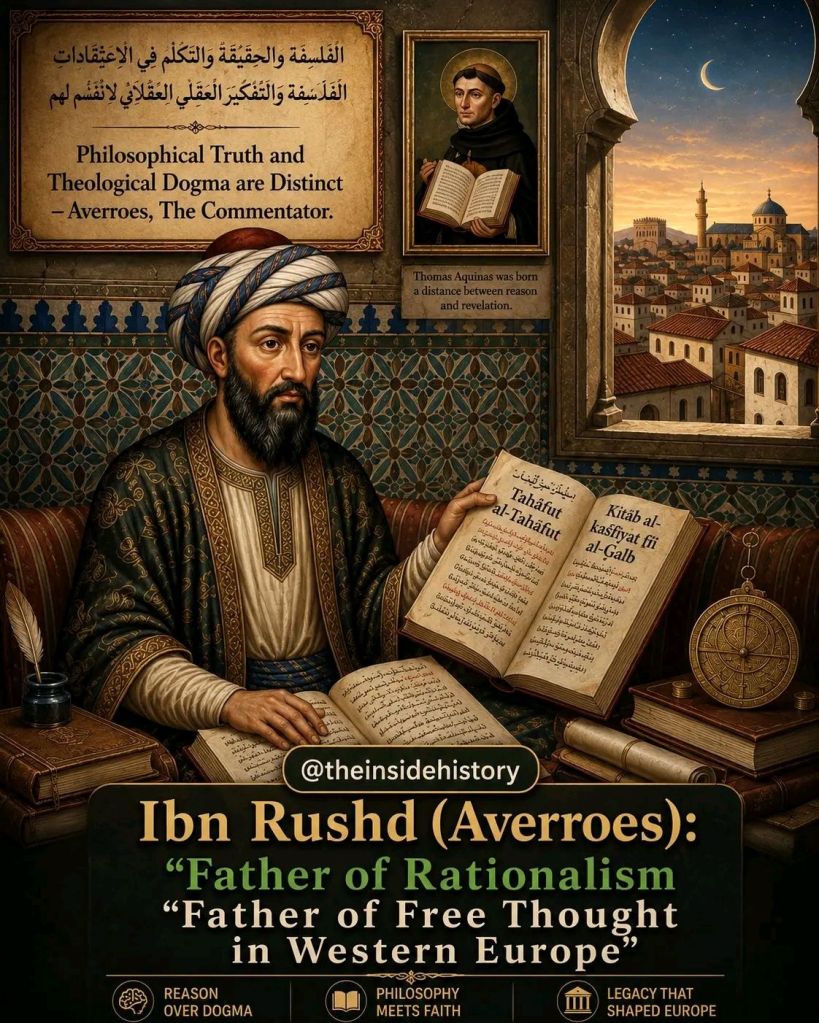
इब्न रुश्द (Averroes) 12वीं सदी के मशहूर अंदलुसी दार्शनिक, फ़क़ीह, तबीब और बहु-विषयक विद्वान थे, जिन्हें “फ़ादर ऑफ़ रेशनलिज़्म” और “द कमेंटेटर” के नाम से याद किया जाता है। उन्होंने अक़्ल (Reason) और ईमान (Faith) के दरमियान हमआहंगी पर ज़ोर दिया और यह साबित करने की कोशिश की कि दीन और फ़लसफ़ा एक-दूसरे के मुक़ाबिल नहीं, बल्कि एक-दूसरे की तकमील करते हैं।
इब्न रुशद ने अरस्तू (Aristotle) की किताबों पर ऐसी गहरी और तफ़्सीली शरहें (Commentaries) लिखीं जिन्होंने क्लासिकी यूनानी फ़लसफ़े को ज़िंदा रखा और यूरोप तक पहुंचाया। उनकी तहरीरों के लैटिन तराजिम ने मीडीवल यूरोप में इल्मी और फ़िक्ऱी बेदारी पैदा की, जिसकी वजह से उन्हें पश्चिमी दुनिया में “The Commentator” कहा जाने लगा।
उन्होंने मध्यकालीन Scholasticism की तश्कील में भी अहम किरदार अदा किया। थॉमस एक्विनास जैसे यूरोपीय मुफक्किर उनके अफ़कार से गहराई से मुतास्सिर हुए। इब्न रुश्द ने फ़लसफ़ियाना हक़ीक़त और मज़हबी तालीमात के बीच फ़र्क़ को वाज़ेह करते हुए यह दलील दी कि अक़्ल और वही (Revelation) के दरमियान टकराव नहीं होना चाहिए।
फ़लसफ़े के अलावा उन्होंने तिब्ब (Medicine) और क़ानून (Law) के मैदान में भी बेमिसाल ख़िदमात अंजाम दीं। उनकी मेडिकल किताबें सदियों तक यूरोपीय यूनिवर्सिटियों में पढ़ाई जाती रहीं, जबकि इस्लामी फ़िक़्ह पर उनकी तस्नीफ़ात आज भी इल्मी हल्कों में अहम मानी जाती हैं।
हवाला (Reference):
Adamson, Peter (2016). Philosophy in the Islamic World: A History of Philosophy Without Any Gaps. Oxford University Press.
#

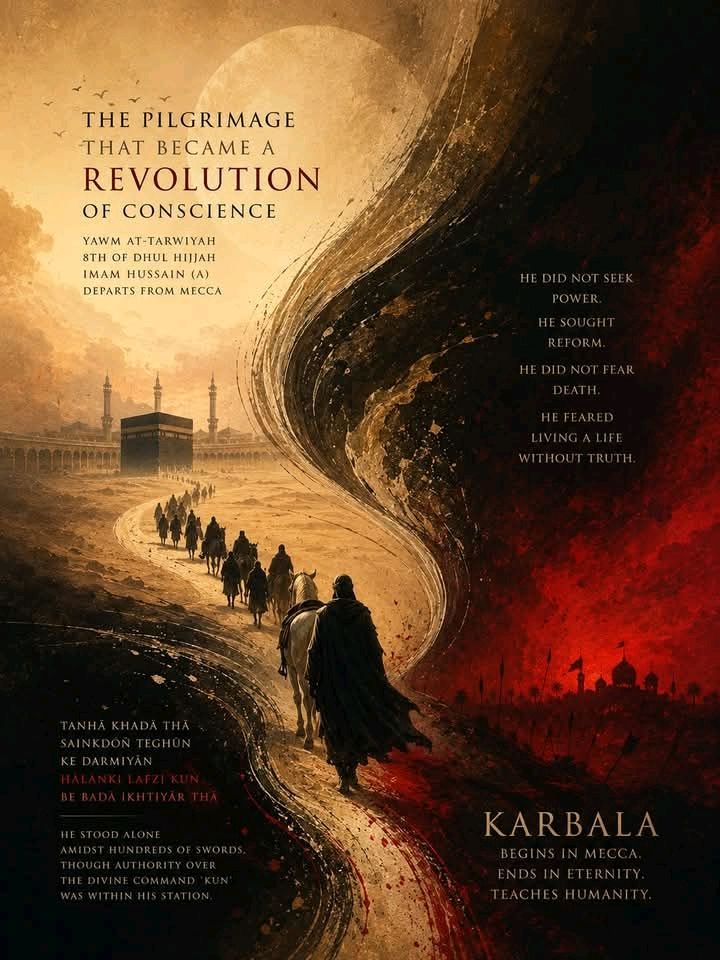
🟢🟡🟢 The Pilgrimage That Became a Revolution of Conscience : Imam Hussain’s (A) Journey of Eternal Witness From the Haram to the Desert
On the 8th of Dhul Hijjah – Yawm at-Tarwiyah – while the multitudes prepared themselves for Hajj in the sacred precincts of Mecca, Imam Husayn (A) departed from the city of his grandfather (saww).
Outwardly, it appeared to be the leaving of a sanctuary. Inwardly, it was the beginning of the greatest revolutions of conscience in human history.
The atmosphere around Mecca had darkened under the rule of Yazid ibn Mu‘awiyah (la). A tyrannical political authority sought sacred legitimacy. Allegiance was being demanded not only from bodies, but from souls. Imam Hussain (A), the grandson of Rasulullah (saww), understood that to endorse such tyranny with silence or bay‘ah would be to place the seal of Prophetic legitimacy upon corruption itself.
Yet even then, Imam Hussain (A) did not rise for worldly power. He himself declared:
«إِنِّي لَمْ أَخْرُجْ أَشِرًا وَلَا بَطِرًا وَلَا مُفْسِدًا وَلَا ظَالِمًا، وَإِنَّمَا خَرَجْتُ لِطَلَبِ الْإِصْلَاحِ فِي أُمَّةِ جَدِّي»
Innī lam akhruj ashiran wa lā baṭiran wa lā mufsidan wa lā ẓāliman, wa innamā kharajtu li-ṭalab al-iṣlāḥ fī ummati jaddī.
“I have not risen out of arrogance, vanity, corruption, or oppression. Rather, I have risen only to seek reform in the Ummah of my grandfather.”
These were not the words of rebellion for dominion.
They were the words of a divine witness refusing to allow Islam to become a servant of empire.
Reports had already emerged that assassins intended to spill his blood even within the sanctity of the Haram. Imam Hussain (A) chose to leave before the outward completion of Hajj so that the Sacred House of Allah would not become desecrated by bloodshed. Thus, his pilgrimage transformed into something far greater than ritual movement – it became a migration of truth itself.
From that moment onward, every step towards Karbala carried the weight of destiny.
He travelled not alone, but with the household of Prophethood – women, children, companions, and inheritors of divine light. This itself was a proclamation: this was not an army marching towards conquest, but truth walking knowingly towards sacrifice. Perhaps nothing captures the solitude and grandeur of that stand more than these lines by an Ahl al-Sunnah brother (I fail to recall the name):
تنہا کھڑا تھا سینکڑوں تیغوں کے درمیان
حالانکہ لفظِ کُن پہ بَدا اختیار تھا
Tanhā khadā thā sainkṛoñ teghoñ ke darmiyān,
hālānki lafẓ-e-Kun pe badā ikhtiyār thā.
“He stood alone amidst hundreds of swords,
though authority over the Divine command ‘Kun’ was within his station.”
For Karbala was never about inability. It was about divine proof. Had Imam Hussain (A) wished merely for worldly survival, history would have unfolded differently. But the purpose of Karbala was not the destruction of enemies through miraculous force. Rather, it was THE UNVEILING OF TRUTH BEFORE HUMANITY SO COMPLETELY THAT NO VEIL COULD REMAIN OVER FALSEHOOD.
Thus Imam Hussain (A) stood in the scorching plains of Karbala not as a defeated man, but as the AXIS SEPARATING TRUTH FROM DISTORTION. Through thirst, abandonment, martyrdom, and grief, he exposed the nature of tyranny more powerfully than armies ever could. And in that lies the eternal mystery of Ashura:
🟢 that apparent worldly defeat became metaphysical victory. Empires possessed soldiers, wealth, palaces, and propaganda.
But Imam Hussain (A) possessed truth.
And truth, even when left with only a few companions beneath the burning desert sky, outweighs entire civilizations built upon falsehood.
This is why the departure on Yawm at-Tarwiyah still echoes across centuries.
Because it was not merely a journey from Mecca to Karbala. It was the migration of Wilayah carrying the final proof against oppression. A pilgrimage that became a revolution of conscience. A DEPARTURE FROM THE HARAM THAT AWAKENED THE SOUL OF HUMANITY FOREVER.

