


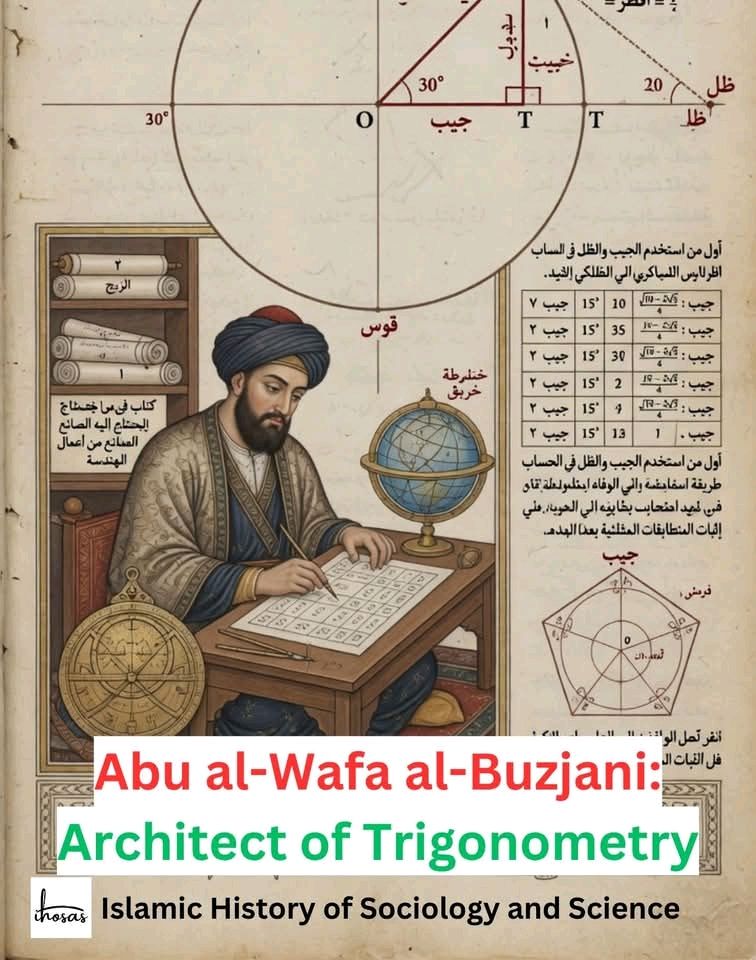
Abū al-Wafāʾ al-Būzjānī (940–998) was a Persian mathematician and astronomer who formulated the foundations of modern trigonometry in Baghdad during the Islamic Golden Age.
He simplified astronomy and navigation by introducing the tangent function and compiling precise trigonometric tables.
His contributions encompassed the general law of sines for spherical triangles, exhaustive sine and tangent tables, and the definitions of secant and cosecant functions.
As an astronomer, he enhanced observational instruments, particularly the use of a wall quadrant for precise sky measurements, and worked in conjunction with al-Biruni to ascertain precise longitude differences.
A lunar crater named in his honor and some of the earliest applications of negative numbers are among his legacy.
Reference:
Biographical Encyclopedia of Astronomers Reference work entry
Būzjānī: Abū al-Wafā’ Muḥammad ibn Muḥammad ibn Yaḥyā al-Būzjānī

 Aal-e-Qutub Aal-e-Syed Abdullah Shah Ghazi