


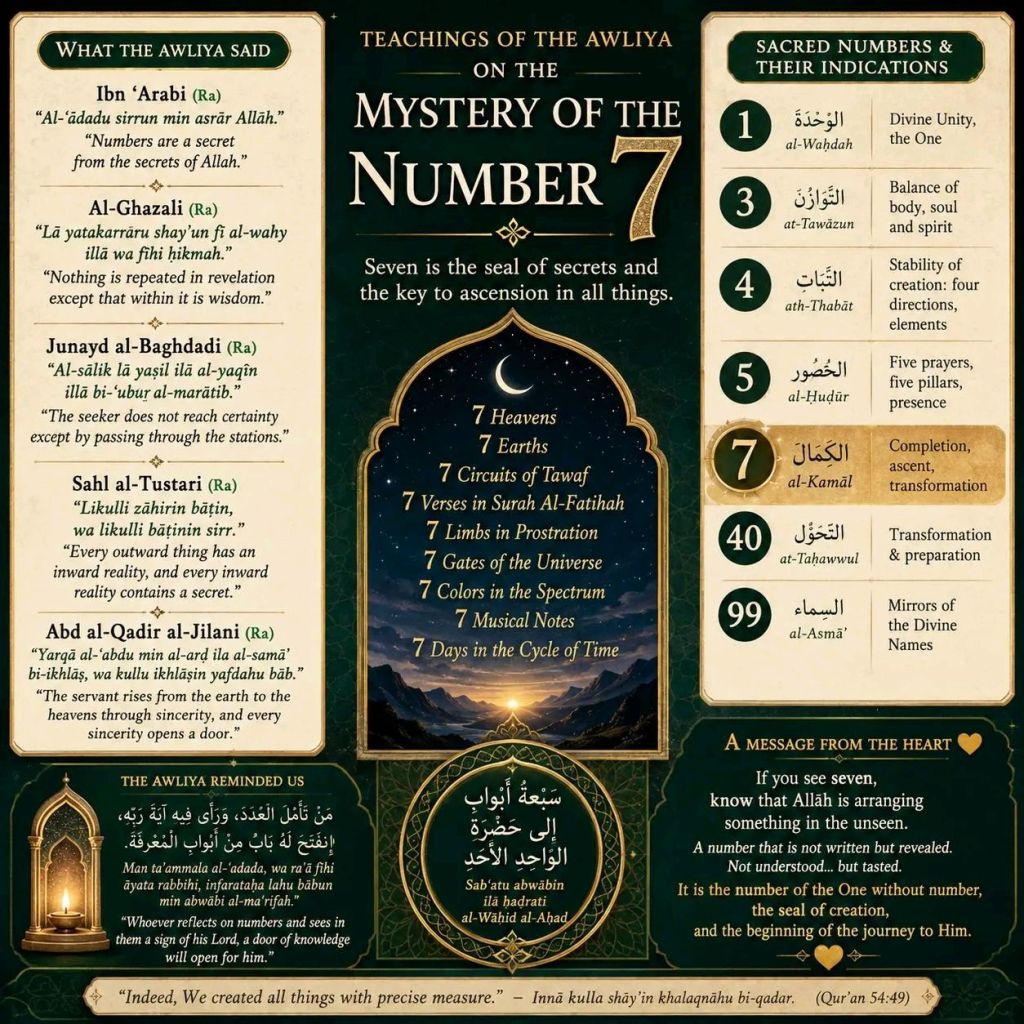
■ The Mystery of the Number Seven.
The Awliyā of Allāh did not look at numbers as mere symbols of mathematics or instruments of calculation.
To them, numbers were signs woven into the fabric of creation, carrying subtle indications
of Divine wisdom, balance, and order.
They believed that existence itself was built upon measure, proportion, and harmony, as Allāh says in the Qur’ān:
“Innā kulla shay’in khalaqnāhu bi-qadar.”
“Indeed, We created all things with precise measure.”
For this reason, the people of spiritual insight reflected deeply upon recurring numbers in revelation and in the universe, seeing them not as coincidences but as mirrors through which Divine realities become visible to the contemplative heart.
Shaykh Mūhyiddīn Ibn Arābi, may Almighty Allāh sanctify his secret, spoke of numbers as one of the languages through which existence reveals its hidden structure.
He taught that multiplicity flows outward from Divine Unity, and that every number ultimately points back toward the One. According to him, the many are nothing but manifestations of the One Reality appearing in different forms.
Thus, numbers were not independent powers, but signs revealing the order placed by Allāh within creation.
Likewise, Imām Abu Hamid al-Ghazali, may Almighty Allāh sanctify his secret, emphasized that repetition within revelation is never without wisdom.
When certain numbers recur throughout the Qur’an and sacred rites, this repetition carries meanings intended for reflection.
The Awliyā understood that numbers in revelation are not empty quantities, but symbols connected to spiritual realities,
states of the soul, and stages of ascent
toward Allāh.
Among the great figures associated with sacred numerical symbolism was Shaykh Ahmad al-Buni, may Almighty Allāh sanctify his secret who explored the relationship between letters, numbers, and Divine patterns.
He described numbers as lights and letters
as vessels carrying hidden meanings. In the understanding of many Sufis, letters form the body of sacred speech, while numbers represent the hidden rhythm and balance flowing beneath those forms.
The Awliyā often reflected upon the symbolic meanings of certain sacred numbers found repeatedly in revelation and creation.
The number one symbolized Divine Unity, at-Tawḥīd, the absolute Oneness of Allāh before whom all multiplicity disappears.
Three represented balance and harmony,
while four symbolized stability and completion within the created world, reflected in the four directions and four elements.
Five became associated with spiritual presence through the five daily prayers and the five pillars of Islam. Among all sacred numbers, seven occupied a particularly profound place
in Sufi contemplation.
▪︎ The Qur’ān speaks repeatedly of seven heavens and seven earths:
“Sab‘a samāwāt.”
“Seven heavens.”
Tawaf around the Kaaba is performed seven times, as is the walking between Safa and Marwa. There are seven verses in Surah al-Fatihāh and seven limbs placed upon the earth during prostration.
To the people of spiritual unveiling, this repetition indicated that seven symbolizes completion, ascent, and the full cycle of spiritual transformation.
The Sufis also reflected deeply upon the number forty, seeing it as the number of transformation and preparation.
Prophets and saints often passed through
forty days or forty years of spiritual discipline before receiving openings and responsibilities.
Through this, the Awliyā understood that spiritual growth unfolds according to Divine timing and measured progression.
▪︎ Shaykh Sahl al-Tustarī, may Almighty Allāh sanctify his secret, said:
“Likulli ẓāhirin bāṭin, wa likulli bāṭinin sirr.”
“Every outward thing has an inward reality,
and every inward reality contains a secret.”
And the people of gnosis used to say:
“Al-jāhil yarā al-a‘dād kamiyyāt.
Wa al-ḥakīm yarāhā ishārāt.
Wa al-‘āshiq lā yarā illā al-Wāḥid yatajallā fīhā.”
“The ignorant see numbers as quantities.
The wise see them as symbols.
The lover sees only the One manifested through them all.”
Yet despite their reflections on sacred numbers, the Awliyā never treated numerology as fortune-telling or magical control over destiny.
Their contemplation was not superstition but meditation upon Divine order. They sought to witness how Allāh placed harmony, rhythm,
and balance throughout creation.
Numbers, in their eyes, were signs pointing beyond themselves toward the wisdom of the Creator. Thus, sacred numerology in the tradition of Tasawwuf was ultimately a science of contemplation.
It was a way of reading the universe with the eye of the heart, seeing in every measure and pattern a reminder of Divine wisdom.
For the true Sufi does not worship numbers,
but worships the One who created measure, balance, and harmony in all things:
“Allāhu khāliqu kulli shay’.”
“Allāh is the Creator of all things.”


