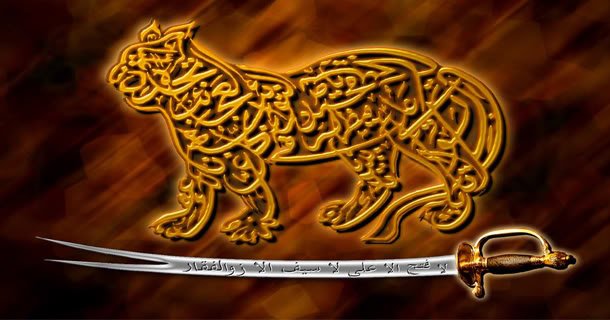
’’حضرت ابو سعید خدری رضی اللہ عنہ بیان کرتے ہیں کہ لوگوں نے (حضور نبی اکرم صلی اللہ علیہ وآلہ وسلم کی بارگاہ میں) حضرت علی رضی اللہ عنہ کے بارے میں کوئی شکایت کی۔ تو حضور نبی اکرم صلی اللہ علیہ وآلہ وسلم ہمارے درمیان کھڑے ہوئے اور خطبہ ارشاد فرمایا۔ سو میں نے آپ صلی اللہ علیہ وآلہ وسلم کویہ فرماتے ہوئے سنا: اے لوگو! علی کی شکایت نہ کرو، اللہ کی قسم وہ اللہ کی ذات میں یا اللہ کے راستہ میں بہت سخت ہے۔‘‘
اس حدیث کو امام احمد، ابو نعیم اور حاکم نے روایت کیا ہے۔ اور فرمایا: اس حدیث کی سند صحیح ہے۔
“Ḥaz̤rat Abū Saʻīd Ḳhudrī raḍiya Allāhu ‘anhu bayān karte haiṅ ki logoṅ ne (Ḥuz̤ūr Nabīye Akram ṣallá Allāhu ‘alayhi wa-Ālihi wa-sallam kī bārgāh meṅ) Ḥaz̤rat ʻAlī raḍiya Allāhu ‘anhu ke bāre meṅ ko’ī shikāyat kī. To Ḥuz̤ūr Nabīye Akram ṣallá Allāhu ‘alayhi wa-Ālihi wa-sallam hamāre darmiyān khar̥e hū’e aur ḳhuṭbā irshād farmāyā. So maiṅ ne āp ṣallá Allāhu ‘alayhi wa-Ālihi wa-sallam ko yeh farmāte hū’e sunā: ae logoṅ! ʻAli kī shikāyat na karo, Allāh kī qasam woh Allāh kī ẕāt meṅ yā Allāh ke rāstā meṅ bohat saḳht hai.” Is ḥadīs̲ ko imām Aḥmad, Abū Nuʻaym aur Ḥākim ne riwāyat kiyā hai. Aur farmāyā: yeh ḥadīs̲ kī sanad ṣaḥīḥ hai. – [Aḳhrajah Aḥmad bin Ḥanbal fī al-Musnad, 03/86, al-raqm: 11835,
Aḥmad bin Ḥanbal fī Faḍā’il al-ṣaḥābah, 02/679, al-raqm: 1161,
The debate among Muslims is not about the permissibility of audio art, but about what kind of audio arts are permissible. The Qur’an, the first source of legal authority for Muslims, contains no direct references to music. Legal scholars use the hadith (saying and actions of Prophet Muhammad) as another source of authority, and have found conflicting evidence in it. The consensus that has emerged is that the audio arts fall into three broad categories: legitimate, controversial, and illegitimate. Qira’at, the call to prayer, religious chants and the like are all considered legitimate. Controversial audio arts include almost all other types of music. Illegitimate audio arts are considered to be those that take people away from the commandments of the faith. Music that leads to drinking or licentious behavior is considered illegitimate. Depending on the community of interpretation, one can find devotional music legitimate, controversial, or illegitimate.
Sufis, a broad category for a group of Muslims who generally take on a more personal and esoteric approach to the faith, argue that devotional audio arts must be bound by three things to be considered legitimate: time, place, and companions. Al-Ghazali, the famed 11th/12th century Sunni Muslim, argues that a good time is one that allows you to complete religious and societal obligations and no diversion should take time away from performing obligations. The place for the performance of audio art should be an appropriate setting– no concerts in masjids, and no performances in bars. Finally, the companions, the people surrounding the listener, should encourage the best in the listener.
The 10th century philosophical group, the Ikhwan as-Safa, argue that the truest audio art is the Voice of God, which the Prophet Moses heard at Sinai. When Moses heard the Voice, he moved beyond the need for earthly music. Based on this moment, the Ikhwan as-Safa believe that human audio arts are necessary echoes to remind us of the true music. The 15th century Persian mystical poet Jami says that in the Qur’an, when God says He is blowing life into the form of man (38:72) it should be understood that human beings are the first musical instrument. The famous Sufi poet Rumi (13th century) also plays with the idea of human beings as musical instruments. He opens his work the Mathnawi, perhaps one of his most famous poems, with the lines, “Listen to the reed as it tells a tale/ a tale of separation,” a statement on the human condition of removal from the Divine. It is also argued that the Prophet David (who authored the Psalms according to Muslims) and the Prophet Solomon both had beautiful voices and sang freely.
Drawing from these traditions, Muslims have an understanding of the permissible audio arts. For the legally minded, the traditional consensus is that nothing can be forbidden that is not explicitly forbidden by the Qur’an or the Prophet.
This issue is very old and was resolved long time ago. Imam al-Ghazzali, one of the most famous Muslim scholars, writing almost a thousand years ago, reported several Ahadith and came to the following conclusion: “All these Ahadith are reported by al-Bukhari and singing and playing are not haram.” Al-Ghazzali also convincingly answered many critics who had raised such objections in his book, “Ihya Ulum al-Deen.”
Those who are opposed to music, quote this Hadith:
“Bukhari, Volume 7, Book 69, Number 494v: Narrated Abu ‘Amir or Abu Malik Al-Ash’ari: that he heard the Prophet saying, “From among my followers there will be some people who will consider illegal sexual intercourse, the wearing of silk, the drinking of alcoholic drinks and the use of musical instruments, as lawful. And there will be some people who will stay near the side of a mountain and in the evening their shepherd will come to them with their sheep and ask them for something, but they will say to him, ‘Return to us tomorrow.’ Allah will destroy them during the night and will let the mountain fall on them, and He will transform the rest of them into monkeys and pigs and they will remain so till the Day of Resurrection.”
It is dangerous to form an opinion on the basis of one or two Hadiths, and Hadith literature should be considered as raw data. Each Hadith should be evaluated and compared with other Ahadith as well as with other historical sources. The problem is that we usually don’t know the context of each Hadith, and it is difficult to know under what circumstances the Prophet (s.a.w) made certain statements.
The above Hadith most likely refers to musical instruments used in drinking parties during the period of “jahiliyaa” (pre-Islamic era) in which even men wore silk clothes and orgies included illegal sexual intercourse. Taken by itself, the Hadith should also ban silk, but that is not the case and silk is permitted for women. That is why it is important to look at all Ahadith and not come to a hasty conclusion. There are other Ahadiths which clearly show that musical instruments are permitted: For example this Hadith:
“Volume 6, Book 61, Number 568: Narrated Abu Musa:
That the Prophet said to him’ ‘O Abu Musa! You have been given one of the musical wind-instruments of the family of David .’”
Critics also argue that music instruments are ONLY allowed during festivities. They quote this Hadith:
Bukhari, Volume 2, Book 15, Number 72: Narrated Aisha: Abu Bakr came to my house while two small Ansari girls were singing beside me the stories of the Ansar concerning the Day of Buath. And they were not singers. Abu Bakr said protestingly, “Musical instruments of Satan in the house of Allah’s Apostle !” It happened on the ‘Id day and Allah’s Apostle said, “O Abu Bakr! There is an ‘Id for every nation and this is our ‘Id.”
That Hadith again has to be studied in proper context because the Prophet (pbuh) not only permitted singing on other occasions, he recommended it. “Aishah narrated that when her relative was married to an Ansari man, the Prophet (s.a.w) said: ‘Aishah, did they have any entertainment? The Ansar are fond of Entertainment.” He didn’t say they were fond of entertainment only on festivities or that it was wrong but allowed on some occasions.
In another Hadith, “Ibn Abbas said, ‘Aishah gave a girl relative of hers in marriage to a man of the Ansar. The Prophet (s.a.w) came and asked, ‘Did you send a singer along with her?’ ‘No,’ she said. The Messenger of Allah then said: ‘The Ansar are a people who love poetry. You should have sent along someone who would sing, ‘here we come, to you we come, greet us as we greet you.’”
Music-haters also reference this Hadith:
“Anas ibn Malik related from the Prophet (saws) that, “two cursed sounds are that of the musical instrument(mizmaar) played on the occasion of joy and grace, and the woeful wailing upon the occasion of adversity.”
It is not difficult to find contradictory Ahadith. However, almost all scholars of Islam are of the view that singing is not only permitted, it is recommended on the occasions of Eid, weddings, births, aqiqahs, and on the return of a traveler. {See Yusuf al-Qardawi’s “The Lawful and the Prohibited in Islam.”] Qardawi in the same book also states the following: “It is reported that many Companions of the Prophet (may Allah be pleased with them) as well as second generation Muslim scholars used to listen to singing and did not see anything wrong with it. As for the Ahadith which have been reported against singing, they all are weak and have been shown by researchers to be unsound. The jurist Abu Bakr al-Arabi says, ‘No sound Hadith is available concerning the prohibition of singing,’ while Ibn Hazm says, ‘ All that is reported on this subject is false and fabricated…he who listens to singing intending neither obedience nor disobedience in doing something neutral and harmless, which is similar to going to the park and walking around, standing by a window and looking at the sky, wearing blue or green clothes, and so on.’”
The best answer was given by Ibn Hazm who quoted another verse: “And what is beyond the truth except error?” (Quran 10:32). In other words, those who are prohibiting something which God has not forbidden, for no apparent reason, are simply falling into error.
Then there are some Muslims who argue that only drums are allowed. That too is false. Note the Hadith that I have quoted above:
“Narrated Abu Musa: “That the Prophet said to him ‘O Abu Musa! You have been given one of the musical wind-instruments of the family of David.’”
That makes it obvious that Prophet Muhammad (s.a.w) was not opposed to wind instruments. So there goes your “drums are OK” theory. Secondly, what is permitted on Eid day is also permitted on other days. There is not a single Hadith which says that what is permitted for Eid is not acceptable on other days. Muslims have been enjoying Music since the beginning of Islam with no guilt whatsoeve
117- Creator of the heavens and the earth from nothingness, He has only to say when He wills a thing, “Be,” and it is.( 2- Al-Baqarah The Cow, 117)
The Arabic word “beda’a” means creation of something out of nothing. This word also connotes the fact that something is created not on a pattern previously designed of something but as a completely new entity having no precedence. The greatest marvel of the creation is the creation of all concepts out of nothing. Think of the spectrum of colors. None of us can visualize a color that we have not already seen, nor can we produce that color. We are familiar with colors that already exist, but we cannot possibly create a new color. Allah, on the other hand, created all colors at a time when the concept of color did not exist, just as the universe did not exist before. To create a concept and its range of contents out of nothing is beyond human imagination and power.
1) Monotheism: There is but one Allah, He that created this magnificent physical universe and everything in it, living or inanimate. 2) Atheisticmaterialism: Matter has been in existence since eternity. Everything is made of matter from a chain of fortuitous events. 3) Agnosticism: We cannot know which of these two viewpoints is correct. Both may be justified in their postulates.
THE BIG BANG INVALIDATES BOTH AGNOSTICISM AND ATHEISM
The agnostic’s assertion may be expressed by the sentence, “We cannot know whether there is a Allah or not, and we cannot know whether the universe has been in existence since eternity or not.” He believes that nothing is or can be known. If the hypothesis “Matter had a beginning” is confirmed, the assertion that “Matter had no beginning” would be refuted and the contention “We cannot know whether it had a beginning or not” will be proved wrong. Thus, demonstration of the fact that matter had a beginning is a blow not only to atheism but also to agnosticism and skepticism. Once the hypothesis of the beginning and creation of matter has been confirmed, the atheists should abandon their disbelief and the agnostics their skepticism. If you remember the words in the sura The Prophets, verse 30, “Will they not believe even then?” this statement in the verse that described the Big Bang is a sign according to which the unbelievers will stick to their own convictions, or lack of conviction. It has become clear that an agnostic is no different than a man who worships the cow and the denial of the atheist is tantamount to the adoration of fire; these people base their philosophies on absolute lack of evidence, sheer delusion, total lack of logic and scientific reasoning. The claims of rationality and the so-called scientific approach of the atheists and agnostics have been debunked. In the coming pages we shall see that both in the creation of the universe, in things created within the universe and in the creation of living beings, an intelligently designed process is going on, and we shall demonstrate that the objections of agnostics and skeptics to this assertion are merely delusions.
BEFORE THE BIG BANG
It was understood that time existed in relation to the movements of matter. As matter and its movements did not exist prior to the Big Bang, time did not exist before the Big Bang. Matter and time came into being after the Big Bang. Their existence depends on each other. Roger Penrose and Stephen Hawking conclusively proved in mathematical terms that the universe had had a beginning. The Big Bang theory confirmed the hypothetical alternative suggested by atheists that the universe had to have a beginning if it had been created. In brief, the claims of atheists have been proven wrong in scientific terms and in terms of logic and reason; and yet the atheistic attitude is still prevalent today due to reasons like stubbornness, delusion and arbitrariness. If there are two theses that negate each other, the substantiation of either of them disproves the other’s argument. The contention of atheists that matter existed from eternity having thus been falsified, the fact that it was created becomes the incontestable truth, discrediting the conviction of unbelievers. Insistence of denial of this proven fact is a gross mistake and an example of inexcusable dogmatism.
49- To the contrary, these are clear signs in the hearts of those who are granted knowledge. None deny Our messages except the unjust. (29- The Spider, 49)
TEACHINGS OF THE BIG BANG
The Big Bang theory confirmed that the universe and time had a beginning and that matter did not exist from eternity but was created. The assertion that the universe existed from eternity was thus debunked. The Big Bang not only demonstrated that the universe was created by the Creator, but at the same time the false beliefs like the distribution of sovereignties among divinities, each having under his command the earth, the sun, the moon and the mountains respectively, were proved wrong. It became clear that whoever He was Who had devised the initial composition of the universe, having recourse to the Big Bang, was the Creator of everything. Thus the universe was under the exclusive control of One Single Power and this power was not shared. The universe evolved from a single point; the Author of that point was also the Originator of men, rivers, stars, butterflies, supernovas, colors, suffering and happiness, music and aesthetics. Since everything came into being emerging from the oneness, He must be the Author of that “oneness.” The Big Bang showed that the matter idolized by atheists, and the matter that makes up the entire universe is but an insignificant speck of dust, so to say. Those who witnessed that from that insignificant speck there have emerged men, beasts, plants, and the universe in its glowing colors understand that the genius was not inherent in the matter itself but in something exterior to it, i.e., in the Creator. Close your eyes and try to imagine the void and open them to behold the trees, the seas, the heavens, your own image reflected in the mirror, the food put at your disposal for your consumption and the works of art. . . . How could all these glorious things have emerged all by themselves from the dark and from one single point in the void? For intelligent minds, the creation unfolds itself not only in artistic aesthetics but also in mathematical terms. The velocity of expansion of the universe is of such a critical point that, according to the expression of a scientist, had the velocity been different at the primeval explosion less than 1/1018, the universe would have collapsed, sinking unto itself and never coming into being as it is. Likewise had the quantity of matter been less than it actually was, the universe would have scattered around, rendering the formation of the celestial bodies impossible. The force applied in the disintegration of the initial composition at the moment of creation is not only incommensurably great, but the design behind it is infinitely ingenious. Thus everything was designed by our Creator to make possible the existence of the universe. All these events are meant to show the blindfolded the infinite power of our Creator and the fact that He designed everything to the most infinitesimal detail perfectly. We are witnessing another fact through these phenomena: impossibility does not exist in the vocabulary of the Creator; it suffices Him to wish that something come about, and there it is.
A documentary about Shah Abdul Azeem who is arguably one of the most famous Imam Zadeh in Iran. He was a 5th generation descendant of Imam Hasan (a) who had the honour and distinction of being the companion of four Imams.

 Aal-e-Qutub Aal-e-Syed Abdullah Shah Ghazi