7- By the Sky with its ingeniously devised paths (orbits). (51-Adh-Dhariyat The Dispersing, 7)
The Arabic expression “zat-ul hubuk” means ingeniously devised paths (orbits). The expression connotes beautifully designed formations. The scintillating brilliance of the stars that has enchanted us ever since the beginning of our existence, the incomparable sight unfolded across the sky has always attracted our attention, overwhelming us. Numerous poems and prose works describe the charming sensations that the sky generates in the human breast. The rising and setting of the sun, the phases of the moon, the sky studded with stars give the picture of a steady state universe. The universe full of its orbits is not visible to the naked eye. Stars that move at incredible speeds seem stationary to us. The fact that all stars and heavenly bodies are in motion was only scientifically established after the discovery of the telescope and the advance of science. The number of galaxies in the universe exceeds hundreds of millions, each comprising more than one hundred million stars, some larger and some smaller than the sun. Our sun is comparably of middle size. These stars have many planets like the earth and the planets have their satellites like our moon. All these have come about after having detached from one single point. All these stars and planets and satellites have their respective orbits. The omnipotence of Allah is conspicuous in His creation. Allah who originated everything from a single point demonstrated that the skill involved was not inherent in that point; having generated from it billions of celestial bodies displayed the endlessness of His power and facility. Every one of these bodies moves in its own orbit so that the state of the universe changes every second. This variation takes place by the motion within the respective orbit of every star, planet and satellite. Every moment in the universe is a new occurrence: so is every instant of a star, a planet and a satellite.
ARGUMENT FROM MOTION
The process of motion has been the subject of study by many thinkers throughout history. Plato said that the source of motion must have been God and described the universe as being governed by a Designer who was good and beneficent. Aristotle inferred that God must be the Prime Mover, that He was the original source and cause of motion in the universe. Farabi, representative of the Islamic world, concluded that the Prime Mover was the source of all existence and that He, the Unmoved Mover, had generated the movement. The Ihvan-› Safa, a philosophical-religious association of the 10th century, produced encyclopedic works. This association underlined the motion of the universe, confirmed the process of creation out of nothing, drawing attention to the order reigning in the universe and the perpetual movement that proved the existence of God. A great many Christian thinkers like Thomas Aquinas saw the motion of the universe as an evidence of a Supreme Being. The fact that the motion in the universe is not limited to our solar system or to a handful of stars but is spread all over space is a very important point since it is also a proof of the endlessness of the power of God. The attention that the verse draws to the orbits in space is also meaningful. Galaxies move in perpetual motion; their constituent billions of stars float in their respective pathways; the planets trace elliptical orbits around the stars; and the satellites make their rounds about the planets, motion inside motion. If motion had not been devised to be an intrinsic part of matter we could not have sat comfortably in our chairs to watch TV. Nor would the sun, the earth or our very selves exist. All these formations owe their existence to the moving objects. The movement of stars in their orbits, the movement of planets around the stars have rendered our existence possible and our sipping coffee while watching television. The creation of motion in an ingenious and regular order generating chain reactions, and our observation of precise, ordered and perfect movements in galaxies of macrocosm and in atoms of microcosm are flamboyant invitations to conceive God’s power and knowledge. There will certainly be people who will turn a deaf ear to these invitations. Verse 7 of the sura The Dispersing that draws our attention to the orbits is followed by the following verses:
8- You are surely caught in contradictions 9- Deviating therefrom are the deviators. 51-The Dispersing, 8-9
Sayyidina Ibrahim AlaihisSalam was the son of Tarikh bin Nahur bin Sarukh bin Ragu bin Faligh bin ‘Aabir bin Shalih bin Arfakhshan bin Sam bin Nuh as This is from the text of the Book of the People of the Book. The ages of the ‘forefathers of Sayyidina Ibrahim to are respectively from Tarikh to Sam: 250 years, 148, 230, 239, 439, 464, 433, 438, 600 years. The age of Sayyidina Nuh tentang was mentioned when we narrated his biography.
Al-Hafiz Ibn ‘Asakir has related on the authority of Ishaq bin Bishr Al-Kahli, author of Al-Mubtada, that the name of the mother of Ibrahim was Aaneelah and he has narrated a long story about her birth. Al-Kalbi has said that her name was Buna bint Karbata bin Karshi of the Banu Arfakhshand bin Sam bin Nuh itu, Ibn ‘Asakir has reported for ‘Ikrimah that the kuniyalı, of Ibrahim was Aba Ad-difan.
Sayyidina Ibrahim AlaihisSalam , Nahur and Haran were born to Tarikh when he was seventy-five years old. Prophet Lut AlahisSalam started was the son of Haran. Among these three, Sayyidina Ibrahim was the second and Haran died while his father was alive in the land where he was born, Al-Kaldaneen (Chaldean) in Babel (Babylon).
Sayyidina Ibrahim AlaihisSalam married Sarah who was said to be barren and did not have a child.
Tarikh took his son Ibrahim and the wife of Ibrahim, Sarah, and Lut, the son of his brother, Haran and migrated to Kan’aneen ‘from Kaldaneen. However, Tarikh died in transit, at Harran. The party then set off to their. destination, Kan’an the land of Bayt-al-Maqdis. Meanwhile they had stopped at Harran, the Jazirah (Arabian Peninsula) and Syria. The people of Syria used to worship the seven stars, and those who lived in Damascus followed this religion. They turned to the North Pole and observed their rites verbally and physically. This is the origin of haykal, at each of the seven ancients gates of Damascus.
The most of the genealogists, including Ibn ‘Abbas centras, assert that his name was Tarih (or Tarikh, as stated in the beginning). It is said that the idol that he used to worship was called Aazar.The people of Harran also worshipped the stars and idols and, in fact, all the inhabitants of the world were disbelievers with the exception of Ibrahim AlaihisSalam, his wife and Luts AlaihisSalam . He had granted him wisdom and guidance right from his childhood.
When all the people went away to celebrate their festival, he remained behind in their land. He went quickly towards their gods secretly. He found them in a splendid surrounding with plenty of offerings before them. So, he said to them scornfully, “Do you not eat? What is wrong with you that you do not speak?”” Then he turned upon them smiting them with his right hand. And he broke them into fragments – all of them – “except a big one they had, perchance they might return to it.” (al-Anbiya, 21:58). It is said that he placed the axe in the hand of this one he had spared to make it look as though it had been jealous at the smaller ones being worshipped. When they returned they found out what had happened to their gods When they had gathered and brought him they asked, “Have you done this to our gods, O Ibrahim?” (al-Anbiya, 21:62). He answered, “Nay, … this big one has done it.” That is he urged me to do it. “So ask them, if they do speak.” He meant to make them realize that their gods cannot speak. So, they recognised
that they were inanimate and bits of inanimate material. On hearing this, they turned to themselves and blamed themselves for leaving the idols unattended and unguarded. In utter confusion, they lowered their heads down.
When they were overwhelmed in the debate and they had no answer available to them and there was no way out for them but to use their force and authority. They decided to burn Sayyidina Ibrahim and thereby help their gods.
They began to gather firewood from every place they could and it was a huge thing. They were so deeply attached to it that every woman who fell ill vowed to collect firewood for the furnace when she recovered. They set aside a huge land for it and set the collection to fire and it was a huge fire not seen before. Its sparks seemed to touch the sky,
To put Prophet Ibrahim AlaihisSalam into it, they devised a catapult at the hands of one called Hizan. He was the first one to make a catapult. Allah caused the earth to swallow him and he will go down into it till the Day of Resurrection.
Then they got hold of him to restrain him and tied his hands behind his back.
We said: “O Firel Be you coolness and safety for Ibrahim.”
(Al Anbiya 211 Hazrat Ali bin Abu Talib AlaihisSalam explained that the verse meant, “Do not harm Ibrahim.”
Ibn ‘Abbas and Abu Al-‘Aliyah said that if Allah had not commanded the fire to become safety for Ibrahim, its coolness would have harmed him
Ka’b al-Ahbar has said, “On that day the people of earth did not benefit from the fire and noting burned through except the chain with which to was tied.”
Suddi has said, “The angel of Shade was with him. Sayyidina Ibrahim A was in a garden and around him was the fire. People could see him but not reach him, and he could not go out to them.”
Ibn Asakir has transmitted from ‘Ikrimah, “The mother of Ibrahim AlaihisSalam was watching her son state and alled out to him, “O my son! I wish to come to you. So pray to Allah to protect me from the heat of the fire around you.’ He said, ‘Yes’ So, she went to him and nothing of the heat of the fire touched her. She embraced him, kissed him and returned
Minhal bin ‘Amr said that he was told that Ibrahim AlaihisSalam stayed there forty or fifty days. And, he (Ibrahim ) said, “There have not been days and nights more luxurious for me than when I was in the fire. I wish I had lived all my life like I lived when I was there.” May blessings of Allah and His peace be on him.
Bukhari has transmitted a Hadiths from Umm Sharik:
The Messenger of Allah ﷺordered that the gecko (house lizard) should be killed and said, “It blew (the fire) against Ibrahim.Bukhari #3359.
Ahmad has transmitted from Sayyidah ‘Ayshah Radiallahu anhoo said that the Messenger of Allah said, “Kill the house lizard because it blew the fire against Ibrahim.* Nafi’ who had heard this Hadith from Sayyidah ‘Ayshah who said that she used to kill the house lizard.Ahmad, 6/200.
Ahmad has transmitted again from Nafi’ that a woman entered the house of Sayyidah ‘Ayshah Radiallahu anhoo and found that a lance was grounded there. She asked, “Why is the lance here?” She replied, “We kill the gecko with it. Then she narrated to her the Hadith of the Nabi Pakﷺ “When Ibrahim was cast into the fire all the animals set to extinguish the fire except the house lizard. It blew on the fire to increase it. (Ahmad. 6/217)
THE DEBATE BETWEEN IBRAHIM AD AND ONE WHO REJECTED ALLAH AND PROCLAIMED DIVINITY
Allah has said in the Qurān:
Have you not considered the one who had an argument with Ibrahim, about his Lord, because Allah had given him kingdom?” When Ibrahim said, “My Lord is He Who gives life, and causes death,” he replied, “I give life and cause death.” Ibrahim said, “Surely Allah brings the sun from the east; so you bring it from the west.” Thereupon he, who disbelieved was confounded. And Allah guides not the evildoing people. (Al-Baqarah, 2:258) In these verses Allah has mentioned the debate between His Khalil with
the tyrant king who claimed for himself divine powers. So, Sayyidina Ibrahim AlaihisSalam turned on him his own arguments and brought to light his deep ignorance and lack of intelligence and the worthlessness of his arguments.
The exegetes and other scholars and genealogists suggest that he was the king of Babel (Babylon). He was Nimrud bin Kawan bin Kaush bin Sam bin Nuh. There are other suggestions too. Anyway, he was one of the several kings on earth. Of the four known kings he was one of them, two were believers and two disbelievers.
As for Nimrud when Sayyidina Ibrahim AlahisSalam invited him to worship Allah without associating partners with Him, he argued with him until Sayyidina Ibrahim is told him that Allah is One Who gives life and causes death.
According to Qatadah, Suddi and Muhammad bin Ishaq he summoned two men who had been sentenced to death. He commanded that one of them should be killed and forgave the other. But this was not the argument advance by Sayyidina Ibrahim AlahisSalam. He was speaking in a comprehensive manner of the creation of the universe and life from nothingness, and death and extinction. That was what he had meant by saying “My Lord gives life and causes death.”
So, when Nimrud claimed to be able to do that, Sayyidina Ibrahim AlahisSalam pointed out to him that Allah brings the sun from the east, “let us see you bring it from the west.” This sun is set on a daily course and moves on schedule just as its Creator has appointed for it. He, the Creator, is One besides Whom there is no God, Who is the Creator of all things. So, if you think you give life and cause death, let us see you alter the direction of the sun. His argument was that He who gives life and causes death can do what He wished. He is not hindered by anyone and is not overcome either. So, if you think you are able to do it, go ahead. But, if you cannot do it then you are not what you think.
Nimrud was confounded. He had no reply to that. According to Suddi this argument took place on the day Sayyidina Ibrahim AlahisSalam came out of the fire.
It is reported by Zayd bin Aslam that Nimrud had food supplies in his control and Ibrahim was not one of those who waited for it. Because of the argument, Nimrud did not provide Ibrahim AlahisSalam with any food while he gave it to others.
Since he was empty-handed, he filled his two bags with sand near his home. He said to himself that it would keep his family occupied. At home, he placed that sack on a side and rested himself but sleep overtook him. His wife Sarah opened the bags and found them full of delicious food. She prepared the food and when he woke up he asked her where she got it from. She reminded him that he had brought two bags filled with it. He understood it was the provision Allah had provided them with.
Zayd bin Aslam has also said that Allah sent to this oppressor king an angel who commanded him to believe but he refused to believe. He invited
him a second time and a third time but he refused each time. So the angel said to him, “You call your crowds and I will call mine.”
Nimrud collected his forces, his armies, at the time of sunrise but Allah sent to him armies of mosquitoes so many that the sun was eclipsed by their numbers. They overpowered Nimrud and his forces eating their flesh and sucking their blood. All that remained of them was bony skeletons. One of them got into the nostril of the king and stayed there for four hundred years. Allah punished him in this manner. All this time, he used to strike his head with a hammer until Allah caused him to die.
*ا لسَـــــــلاَمُ عَلَيــْــكُم وَرَحْمَةُ اللهِ وَبَرَكـَـاتُ* Ramzaan Ka Chand Ko Dekhne Ki Dua *Mafhoom-e-Hadees*
Rasool’Allah (ﷺ) Jab Chand dekhtey tou ye dua padhtey: ❝ Allahumma ahillahu alaina bil-amni wal-iman, was-salamati wal-islam, Rabbi wa Rabbuk-Allah, hilalu rushdin wa khairin. ❞
*Aye Allah ! Hum par is Chand ko khair, iman, salamati aur islam ke saath tulu farma (Aye Chand !) mera aur tera RAB Allah hi hai.*
Eh burayee ke Chahane wale apni burayee se ruk jaa
*Mafhoom-e-Hadees* Rasool-Allah Sallallahu Alahih Wasallam ne farmaya jab Ramzan ki pahli raat hoti hai to Shaitan aur sarkash Jin zanjiron main jakad diye jate hai Dozakh ke darwaze band Kar diye jaate hai aur iss ka koi bhi Darwaza khula hua nahi rehta Jannat ke darwaze khol diye jate hai aur iss Ka koi bhi darwaza band nahi rehta manadi ( awaz dene wala ) pukarta hai Eh bhalayee ke Chahane wale bhalayee ke kaam pe aagye badh aur Eh burayee ke Chahane wale apni burayee se ruk jaa Kuch logo ko Allah Subhanahu Dozakh ki aag se Azad karta hai aur ye Ramzan ki har Raat ko hota hai (Sunan Ibn Maja, Jild-2, Hadees No-1
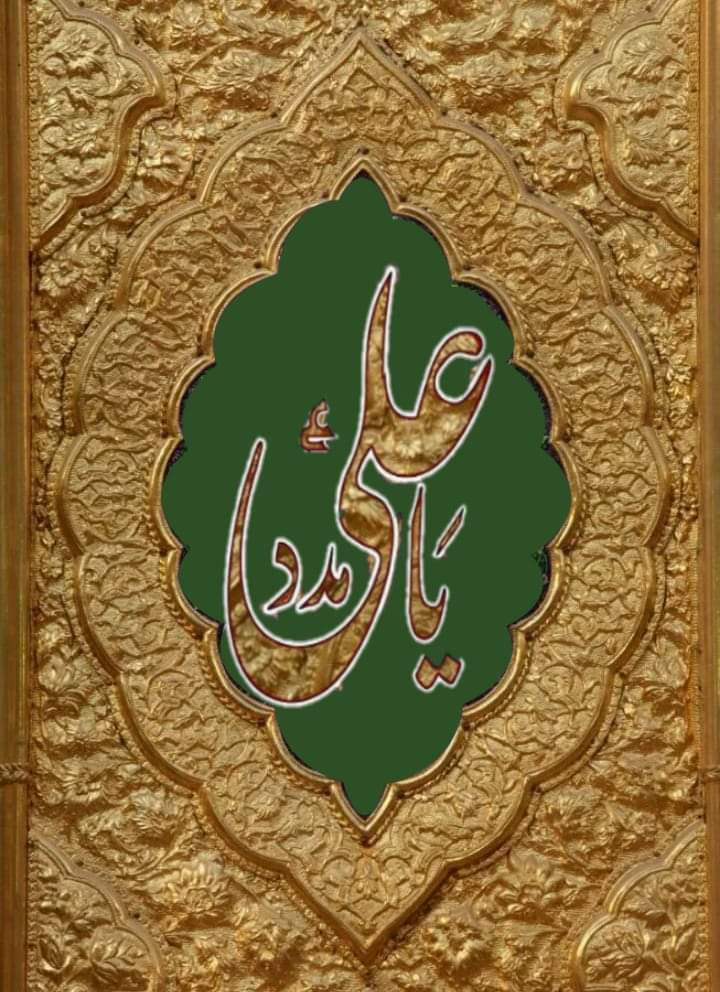
Sayyidina ʻAli Karrama Allahu Waj·hahu Al-karim Ka zikre Jamil
Ḥarfe Aġhaz Maulā-e kā’enāt Abū Turāb sayyidinā ʻAlī kī ẕāte aqdas kisī taʻāruf kī moḥtāj nahīṅ balki ḳhẉud taʻāruf āp kā moḥtāj hai. ʻAli woh jo daryā-e maʻrefat kā shanāwar, kitābe Ḥaqq kā mufassir, ʻilme Ilāhī kā Amīn, nafse Rasūl, zauje Batūl, Abū al-Ḥasan aur Abū al-Ḥusayn, Nabī kā rāz-dān, waṣī-e Rasūl, babe Madīnaṫ al-ʻilm, ġhazī-e Badr-o Ḥunain, fāteḥe Ḳhaibar, imam al-auliyā’ wa-al-ṣulaḥā’, imam al-s̲aqalain, qā’id al-muttaqīn aur Amir al-Mu’minīṅ wa-al-Muslimīṅ hai, ʻAlī maulūde Kaʻbā, shahīde masjid aur āyā-e raḥmat aur sāyā-e barkat-o rāfat Bārgāhe risālat meṅ ḥāṣile maqām maratbā hī sayyidinā ʻAlī ‘alayhi al-salām kī īmānī faz̤īlat aur ẕāte Muṣtafá ṣallá Allāhu ‘alayhi wa-Ālihi wa-sallam se ġhāir-maʻmūlī wābastagī kī dalīl hai. Āp woh ʻaẓīm al-ṣifāt shaḳhṣīyat haiṅ ki āp kī ẕāt meṅ sharfe ṣaḥābīyat ke sāth sāth sharfe Ahle Bait bhī jamʻa kar diyā gayā. Ḥaz̤rat ʻAlī ‘alayhi al-salām kī parwarish-o tarbīyat chuṅ-ki ḳhẉud mŏʻallime insānīyat aur murabbi-e kā’enāt ṣallá Allāhu ‘alayhi wa-Ālihi wa-sallam ne farmā’i thī. Yehī waj·h thī ki āp qubūle(e’lāne) Islām se qabl bhī zamānā-e jāhilīyat kī ālā’ishoṅ, ālūdagiyoṅ aur but-parastī kī najāsatoṅ se dūr rahe. Āp un shaḳhṣīyāt meṅ se haiṅ jinhone qubūle ḥaqq meṅ ek lamhā bhī tāmmul na kiyā aur ṣirf āt̥h yā das sāl kī ʻumr meṅ sab se pĕhle qubūle (e’lāne) Islām aur Āqā ṣallá Allāhu ‘alayhi wa-Ālihi wa-sallam kī maʻīyat meṅ namāz adā karne kī saʻādat ḥāṣil Umm al-mu’minīn sayyidah ʻĀʻishah Ṣiddiqah raḍiya Allāhu ‘anhā bayān farmātī haiṅ ki Ḥuz̤ūr Nabīye Akram ṣallá Allāhu ‘alayhi wa-Ālihi wa-sallam ko sab se ziyādā mĕḥbūb sayyidā-e kā’enāt Ḥaz̤rat Fāṭimaṫ al-Zahrā salāmu Allāhi ‘alayhā thīṅ aur mardoṅ meṅ sab se mĕḥbūb-tar un ke shauhar Ḥaz̤rat ʻAlī ‘alayhi al-salām the. Sayyidah ʻĀ’ishah Ṣiddiqah raḍiya Allāhu ‘anhā hī bayān farmātī haiṅ ki Ḥuz̤ūr ṣallá Allāhu ‘alayhi wa-Ālihi wa-sallam ne farmāyā: maiṅ tamām aulāde Ādam kā sardār hūṅ aur ʻAlī tamām ‘Arab kā sardār hai.ˮ
Maulā-e kā’enāt tājdāre iqlīm-o wilāyat sayyidinā ʻAlī karrama Allāhu ta’ālá waj·hahu al-Karīm kī zindagī kā ek goshā āp kī tamām faz̤īlatoṅ par ḥāwī hai ki āp ko zauje Batūl hone kā sharaf ḥāṣil hai. Rasūl Allāh ṣallá Allāhu ‘alayhi wa-Ālihi wa-sallam ne ḥukme Ilāhī se āp kā nikāḥ sayyidā-e kā’enāt Fāṭimah salāmu Allāhi ‘alayhā se kiyā jis meṅ chālis hazār firishtoṅ ne ba-ṭaur gawāh shumūlīyat kī. Āp ṣallá Allāhu ‘alayhi wa-Ālihi wa-sallam ne sayyidā-e kā’enāt se farmāyā: kyā tum is bāt par rāz̤ī nahīṅ ki maiṅ ne tumhārā nikāḥ apnī ummat meṅ sab se pĕhle Islām lāne wāle, sab se ziyādā ʻilm wāle aur sab se ziyādā burd-bār shaḳhṣ se kiyā hai?ˮ
Bārī taʻālá hameṅ un ʻazīm manābeʻ ʻilm-o wilāyat se iktesābe faiz̤ kī taufiq ʻaṭā farmā’e aur un ke taṣadduq se hamāre īmān kī bhī ḥifāẓat farmā’e. (Āmīn bijāhi Sayyid al-Mursalīn ṣallá Allāhu ‘alayhi wa-Ālihi wa-sallam)





 Aal-e-Qutub Aal-e-Syed Abdullah Shah Ghazi