The issue of Bid`ah or innovations in religion is a hotly debated one in current times. It has been argued, sometimes with much vigour and polemic that practises in the religion of Islam that were not current at the time of the Prophet sallallahu alayhi wa sallam or his companions and should be rejected and could even lead to kufr or disbelief. It has been the opinion of the vast majority of the Ulama throughout the ages that there is Bid’ah is of two types, that which is permissible, and that which is not. It is the purpose of this article to reiterate the correct position, that innovations or newly introduced practises in the Din of Islam can not only be permissible, but also rewarded, hopefully providing clarification to the many people who have been confused about the issue.
The Definition of the word Bid`ah
The word Bid`ah in Arabic is derived from the root word Bada`ah, literally meaning to create a new thing without precedence. It is synonymous with the word Khalk that means to create something out of something else. The attributive name Al Badi is also derived from the same root to denote Allah as the Creator of things that had no previous existence. In the Qur’an Allah is Badi ussamawaati wal ard i.e. the Creator of the Heavens and Earth (out of nothing). Therefore, in its literal sense, the word Bid`ah has no negative connotations, it plainly refers to anything that comes into existence that is novel or not previously known.
In the technical sense, in the way it is used in the Shariah it means an addition to the Din of Islam that was not known or practised at the time of the Prophet sallallahu alayhi wa sallam or his companions.
The concept of Bid`ah in the Qur’an.
The Holy Qur’an, the primary source of Knowledge in Islam, has a most important proof of the permissibility of beneficial introductions into the Din. In surah Al-Hadid, Allah says:
As for monasticism, they invented it themselves, for we had not enjoined it on them, seeking thereby to please Allah; but they did not observe it faithfully. We rewarded only those who were truly faithful, but many of them were transgressors.
The word ‘invented’ used in the above passage is a translation of the Arabic word Ibtada’uha which literally means ‘they made a Bid’ah.’ The verse tells us that monasticism (Rahbaniyat) was instituted by the followers of the Prophet Isa alayhi salaam after him as a new act, as a Bid’ah, for the purpose of seeking the pleasure of Allah. Allah does not condemn this act but rather tells us that after its adoption it was not followed properly. It is clear that this verse contains an implied permission granted to them for this new act. If one reads the words carefully, it is apparent that if Allah were condemning the new act, then there would be no need to remark that they did not observe it faithfully. Having introduced this new act of monasticism, they should have fulfilled its conditions and requirements to achieve the purpose for which they had adopted in the first place. Instead Allah condemns those who, having adopted monasticism, did not perform it in the proper way: but many of them were transgressors. In fact not only was the new act permitted, but it was also rewarded, as the verse tells us: We rewarded only those who were truly faithful. In the context of the preceding part, this would refer to those who were true believers and fulfilled the conditions of the new act and thus achieving the target of seeking thereby to please Allah.
There is an important point to consider here. The practice of monasticism has been abrogated and cancelled in Islam, but the principle contained in this verse of the acceptability of a new act performed with the correct intention and fulfilling certain conditions is not abrogated, but remains. The new practice introduced for the pleasure of Allah, in the principles of Islamic jurisprudence becomes a Bid’ah of guidance; that which violates the laws of Shari’ah becomes a Bid’ah of misguidance (see later).
The concept of Bid’ah in the Hadith.
It is related from the route of Jarir Ibn Abdullah that the Prophet sallallahu alayhi wa sallam said: Whosoever introduced a beneficiary action in Islam will be rewarded for his practice as well as for the practice of the people who follow him, without lessening their reward. Whosoever introduced a bad practice in Islam will take the sin for it as well as the sin of the people who follow him, without lessening their sin. (Muslim).
This hadith which is of sound classification is very clear and unambiguous and is a foundation for proving the validity of good innovations in Islam. The criterion used as to whether or not a new action is accepted is that it should be hasanah, or beneficial. If the action is beneficial then there is an immense reward for it.. New introductions that are bad are punished severely. Scholars of Islam, as will be seen later have derived the conditions for a new act to be considered beneficial or bad.
Although the context of this hadith relates to a specific incident during the time of the Prophet sallallahu alayhi wa sallam when some companions came forward to offer charity to some poverty-stricken new arrivals at Madinah, the meaning is general. It is not permissible to claim that this Hadith applies only to charity as a general term was used: Whosoever introduced a beneficiary action in Islam. The Prophet sallallahu alayhi wa sallam did not restrict the reward to ‘He who spends in charity.’ It is the rule among the scholars of Islam that if an ayah of hadith was revealed for a specific incident or reason yet a general term were used in it then its application would be general and not restricted to that incident.
Some people translate the word sunnatan as the specific Sunnah of the Prophet sallallahu alayhi wa sallam himself, instead the general word ‘action’ or ‘practice.’ In other words, whoever revived a Sunnah of the Prophet sallallahu alayhi wa sallam will be rewarded etc. However this is a gross mistranslation of the Hadith. It is impossible to differentiate such a thing as a good Sunnah, as all the practices of the Holy Prophet sallallahu alayhi wa sallam were good, and the concept of a ‘bad Sunnah’ for obvious reasons cannot be entertained at all. Therefore it is impossible for this Hadith to apply to the Sunnah of the Prophet sallallahu alayhi wa sallam.
The authentic Hadith of the Prophet sallallahu alayhi wa sallam translated as: Abstain from innovations, for every kind of innovation is a Bid’ah, and every Bid’ah is misguidance and all misguidance leads to hellfire is often used in an attempt to prove that all new things introduced in Islam are forbidden. This Hadith would apparently contradict with that given above, however one must study the whole Hadith of which this is only a portion, and thus read it in context to the rest. One must also interpret this Hadith according to the other evidence from either the Qur’an or Hadith instead of giving a meaning from our own (mis)understanding.. The whole Hadith is: I command you to have Taqwa, and to be obedient to those appointed leader over you, even if it be an Abysinnian slave. O my companions, those who live after me will, very soon, see a lot of differences among you. Stick to my path and the path of the Rightly Guided Khalifas. Abstain from innovations, for every kind of innovation is a Bid’ah, and every Bid’ah is misguidance and all misguidance leads to hellfire.
This Hadith is a warning about events to come very soon after the Prophet’s sallallahu alayhi wa sallam passing on; events characterised by differences among the companions. The Prophet’s advice was to stick to his path and that of the Rightly Guided Khalifas, indicating that there will be differences of opinion against Hazrat Abu Bakr, Hazrat Umar, Hazrat Usman, and Hazrat Ali, and that when these arise, the people should follow them and also the Sunnah of the Prophet sallallahu alayhi wa sallam. In fact, the time immediately after the death of the Prophet sallallahu alayhi wa sallam was a time of great disruption and tribulation for the Muslims. There came several people claiming to be prophets after the Holy Prophet sallallahu alayhi wa sallam who fought against Hazrat Abu Bakr Siddique. There were groups of Muslims who denied the paying of Zakat, and there were people who abandoned Islam and challenged the authority of the Prophet sallallahu alayhi wa sallam, becoming apostates. Hazrat Abu Bakr said he would fight those people who claimed to be prophets, who did not pay Zakat or became apostates. After him came people who denied the Kkalifate of Hazrat Usman, and that of Hazrat Ali. The Khwarij sect came about which fought against Hazrat Ali. In all, it was an extremely volatile time. It is clear that the ‘innovations’ mentioned in this Hadith refer to major disruptions that occurred, including people declaring prophethood after the Prophet sallallahu alayhi wa sallam, people denying the paying of Zakat, and the distorted beliefs of the Khwarij. These were the kinds of ‘innovation’ referred to by the Prophet sallallahu alayhi wa sallam that were misguidance and therefore leading to Hellfire.
Further evidence for this comes from another sound Hadith related by Ibn Abbas. The word ‘innovation’ used in the Hadith quoted above is a translation of the word Muhdasa, which is derived from the word Ihdas, meaning disruption. The following Hadith gives us the Prophet’s interpretation of this word: O people, you will be gathered on the Day of Judgement in the same way you were born (naked). The first person to be given the dress of the hereafter will be Hazrat Ibrahim. Some people from my ummah will be brought in front of me, and taken toward hell. I will recognise them and I will say, “These are my companions.” An angel will say, “Don’t you know what kinds of disruption (Ihdasa) they committed after you? Although they embraced Islam in your life, soon after your demise they became apostates and turned towards kufr.
This Hadith of the Prophet sallallahu alayhi wa sallam therefore defines what sort of innovation in the Din of Islam is a misguidance, that is something major in the fundamentals or belief system of Islam, typical of those innovations that occurred not long after his time. This argument enables us to understand the following Hadith: He who innovates something in this matter of ours that is not of it will have it rejected. (Agreed)
The same word Ahdasa is used here which is translated as ‘innovates.’ Using the hadith about the companions sent to Hellfire who committed grave disruptions to interpret the word Ahdasa, the Hadith is also referring to major additions or alterations to the Din of Islam, that are not of it. Another variation of this Hadith related by Muslim is as follows:
He who does an act which our matter is not (in agreement) with, will have it rejected.
The same word Ahdasa is used here which is translated as ‘innovates.’ Using the hadith about the companions sent to Hellfire who committed grave disruptions to interpret the word Ahdasa, the Hadith is also referring to major additions or alterations to the Din of Islam, that are not of it. Another variation of this Hadith related by Muslim is as follows: He who does an act which our matter is not (in agreement) with, will have it rejected.
This Hadith gives us a criterion by which every new act must be judged, namely that it should not go against the Shariah and be compatible with the Qur’an and Sunnah. Therefore every new act is not condemned but rather should be evaluated on its merits to see whether it is in agreement with the Qur’an and Sunnah.
A final point regarding the interpretation of Hadith needs to be mentioned.. If interpretation is attempted without proper knowledge, one may find apparent contradictions between various Hadith. If one interpreted the last few Hadith as meaning every new act in Islam is a misguidance, this would be in contradiction to the first hadith mentioned about the rewards of introducing beneficial practises into Islam and the punishments for introducing bad practises. All the Hadith mentioned above are of sound classification; in reality, there are no contradictions if the Hadiths are interpreted properly. This is what the great Scholars of Islam have done. By interpreting correctly and with proper knowledge, they have conformed and bridged the meanings between the Hadith. This concept is very well known in the science of Hadith exegesis, for example, takhsis al-amm is a frequent procedure of usul al-fiqh by which an apparently unqualified statement is qualified to avoid the contradiction of another necessary principle.
The concept of Bid’ah according to Scholars of Islam.
The vast majority of the classical Scholars of Islam make a distinction between innovations that are acceptable, that may be called innovations of guidance, and those that are not, that may be called innovations of misguidance. Imam ash-Shafiyy wrote, “There are two kinds of introduced matters. One is that which contradicts a text of the Qur’an, or the Sunnah, or a report from the early Muslims, or the consensus of the Muslims: this is an innovation of misguidance (bid’at dalala). The second kind is that which is in itself good and entails no contradiction of any of these authorities: this is a ‘non-reprehensible innovation’ (bid’a ghayr madhmuma).” (Ibn Asakir, Tabyin Khadib al-Muftari (Damascus, 1347), 97, tr. Abdul Hakim Murad. Similar definitions have been expounded by other great classical scholars, such as Imam al-Bayhaqiyy, Imam an-Nawwawiyy, and Izzudin Ibn Abdus-Salaam and Hafiz Ibn Hajar al-Asqalaniyy, among others. Izzudin Ibn Abdus-Salaam (one of the greatest mujtahids) categorised innovations into five types: the obligatory (wajib), the recommended (mandub), the permissible (mubah), the offensive (makruh), and the forbidden (haram). Quoted in Muhammad al-Jurdani, al-Jawahir al-lu’lu’iyyah fi sharh al-Arba’in al- Nawawiya (Damascus, 1328), 220-1. Among the obligatory innovations Ibn Abdus-Salaam cites the following examples: recording the Qur’an and the laws of Islam in writing at a time when it was feared they would be lost, studying Arabic Grammar in order to resolve controversies over the Qur’an, and developing philosophical theology (kalam) to refute the claims of the Mu’tazilites. Under recommended innovation come activities such as building madrassas, writing books on beneficial Islamic subjects, and in-depth studies of Arabic linguistics. Permissible innovations include worldly activities such as sifting flour, and constructing houses in various styles not known in Madinah. Reprehensible innovations include overdecorating mosques or the Qur’an. The category of forbidden innovations includes unlawful taxes, giving judgeships to those unqualified to hold them, and sectarian beliefs and practices that explicitly contravene the known principles of the Qur’an and Sunna.
Innovations of Guidance and Innovations of Misguidance.
With the concept of Bid’ah being clarified somewhat, the reader may want to know what practices fall with the domains of innovations of guidance, which are permissible and rewarded, and innovations of misguidance, which are forbidden and punishable. For innovations of guidance, it would be fair to say that every single Muslim practices these innovations, knowingly or otherwise, and the list is long. A few examples have been mentioned above.
For examples of innovations of misguidance it would be useful to look at the aforementioned Hadith about Bid’ah referring to the time soon after the death of the Prophet sallallahu alayhi wa sallam when there came false prophets, apostates and people who did not pay Zakat. Therefore, if one were to declare or follow another prophet after the Holy Prophet sallallahu alayhi wa sallam this would be an innovation of misguidance. Following on from this, any change in the major beliefs and tenets of Islam would be in the same category. This could include for example, denying the attributes of Allah, denying the existence of angels etc. Any change in the basic practises of Islam would also be an innovation of misguidance, such as reducing or increasing the number of salaats in a day or changing the number of rakaats, fasting on forbidden days. Decreeing those things that are Halaal as Haraam or vice versa would also be an innovation of misguidance as would be adding verses to the Qur’an or falsifying Hadith. As can be seen these are major sins and lead to Shirk and even Kufr. These things are not necessarily far-fetched as they seem as the history of Islam bears witness to a number of stray sects of Islam that adopted certain of these practices and beliefs.
Conclusion
There is an oft repeated concept held by some Muslims today, that any practice in religion that was not done by the Prophet sallallahu alayhi wa sallam or his companions should be rejected as it is a misguidance and therefore punishable in Hellfire. However one must go beyond slogans and oversimplifications and reach a correct opinion by examining the facts based upon the Qur’an and Sunnah. As we have seen, new practices are not rejected, but are accepted and even rewarded. However, the practice concerned should be compatible with the dictates of the Shari’ah, otherwise it will be rejected. The opinion of those who condemn any new act without qualification comes from a misunderstanding of the sources of the Qur’an and Hadith, for example by quoting passages out of context or without the true meaning. It is apparent that the classical scholars, who probably had a greater knowledge of Qur’anic or Hadith exegesis than any living person today decreed that newly introduced practices are allowed as long as they do not contradict the Qur’an or Sunnah. This stands in marked contrast to the opinion of many so-called learned people today. They should be careful of condemning an act as Haraam or prohibited if it is not specifically prohibited by the Qur’an or Sunnah, as judging a permissible act as Haraam may lead to Shirk. In fact, the introduction of new things into the deen ensures that Islam can apply itself to any given time and situation, and some new things have even been essential for its preservation and propagation.
This work was supported by the Science Development Foundation, The President of the Republic of Azerbaijan-Grant, EIF-2011-1(3)-82/19/1.
The bibliographic work of G.P. Matvievskaya and B.A. Rosenfeld[1] contains the titles and storage locations of 29 manuscripts of Nasir al-Din Abu Jafar Muhammad ibn Hasan Abu Bakr al-Tusi (1201-1274: see more on his life and work in Nasir al-Din al-Tusi): 4 on mathematics, 22 on astronomy, as well as 4 in physics, 5 in logic and philosophy, and one manuscript in economics, music, mineralogy, and poetry. We will focus hereafter on the four mathematical works of Al-Tusi.
1. Al-Tusi’s Tahrir of Euclid‘s Elements
Fig 1. Nasir al-Din al-Tusi is pictured at his writing desk at the Maragha observatory, which opened in 1259. (Source)
One of the most famous works of Al-Tusi is his “Exposition of Euclid’s Elements” (Tahrir al-Usul al-Handasiya li-Uqlidis). There are two versions of this treatise. The first version was published in 1594 in Arabic in Rome, and then in 1657 in Latin in London. The second version was published in Arabic in Tehran in 1881.
In the fifties of the last century, Azerbaijani researchers H. Zarinazade and G. Mammadbeyli translated the second version of the Exposition into Azerbaijani language, but for various reasons they did not finish the work of editing and publishing. Finally, in 2001, this work has been completed by A. Guliyev, E. Babaev and A. Babaev.[2]
The style of Al-Tusi’s Tahrir of Euclid’s Elements is characterized by citing the text of Euclid and producing comments on them, starting with the words: “I’m talking about.” In this process, Al-Tusi gives different proofs of the theorems than those produced by in the the Euclidean text.
The study of Al-Tusi’s comments, in terms of geometric concepts, terminology and demonstrations of theorems leads us to the conclusion that, at the time of writing the Tahrir, the nature and conception of of geometry has changed.
If the geometry of Euclid, as defined by the words of S.A.Yanovsky, was “the geometry of compass and ruler, but idealized ruler and compass,”[3]and according to the translator and commentator of the Elements D. Mordukhai-Boltovsky had a “constructive” nature, the “geometry of Al-Tusi” is the geometry of ideal entities. If the “existence” of Euclid is the ability to “build” even with “idealized compasses and rulers,” the “existence” of Al-Tusi has logically inferred an ideal character.
This is indicated by the following postulates, which Al-Tusi formulates before the Euclidean ones:
1. “Point, line, plane and surface by the most important way exist, and a circle exists.”
2. “On any line and on a surface we can take a point.”
3. “On any surface we can assume a line.”
4. “No matter how the point is, we can assume the line passing through this point.”
5. “Any point, line segment and a planar surface on the applicability of its similarity.”
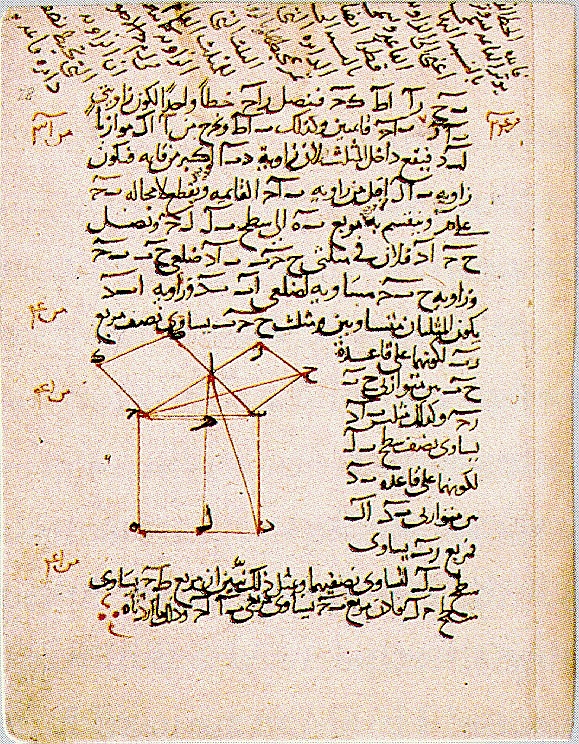
Fig 2. Al-Tusi’s record of Euclid’s proof of the Pythagorean theorem. (Source)
In the XIth book of the Elements on solid geometry, Euclid gives no stereometric axioms. It was thought that the first stereometric axioms were formulated only in the 17th century. Nasir al-Tusi formulated three stereometric axioms:
1. “Through a straight line can be drawn a plane.”
2. “Through a straight line and a point lying outside of it can be drawn (only one) plane.”
3. “Two straight lines do not include space.”
As it is known, up to the 15th century, the number “one” (the unit) was not considered as a number, because it was presented as a quantitative expression of the monad, and the number was defined aa a set of units (in the Greek tradition). Numerical characteristic of the units are not detected. In his commentary on the VIIth book of the Elements, Al-Tusi wrote:
“I say, the number is called something that takes place in a row of account. By this definition, the “unit” should be a number.”[4]
So, the property of the numbers (starting with one) is to be in the row of the account (i.e., to be a characteristic of factoring in one-to-one correspondence).
2. Trigonometry in the Shakl al-Qatta’
Fig 3. Front cover of Contemplation and Action: The Spiritual Autobiography of a Muslim Scholar: Nasir al-Din Tusi. Translated by Seyyed Jalal Hosseini Badakhchani. London: I. B. Tauris, 1999.
The work of Nasir al-Din al-Tusi Treatise on the Complete Quadrilateral(Shakl al-Qatta’)[5] is in essence the first mathematical work on trigonometry as a distinct science. Until Al-Tusi, trigonometry was considered as part of astronomy. In this treatise, Al-Tusi introduced the concept of the polar triangle and gives the calculations for it. In addition, he developed the theory of ratios of Eudoxus for incommensurable quantities and introduced the numerical characteristic of one ratio (the “measure” of ratio).
This treatise was known to European scholars, particularly to Regiomontanus (15th century), and in 1952 it was translated into Russian by G.D. Mammadbeyli and B.A.Rozenfeld.
V.N. Molodshy,[6]referring to the Shakl al-Qatta’, wrote: “In the 13th century, Azerbaijani astronomer and mathematician Nasir al-Din al-Tusi defined the concept of a positive real number, just like Newton (i.e., Al-Tusi defined that 400 years before Newton).” We must recall that the number in Newton’s definition is the relation of one quantity to another of the same kind, taken as a unit.
The new in Al-Tusi’s discovery in this work is that we could trace how he developed the notion of “measure” of ratio, what led him to the extension of the notion of rational number.
3. The parallels problem
The development of the theme of parallel lines was ongoing for two thousand years. The theory of parallels was substantially advanced in the works of the 9th-14th-centuries scholars of the Islamic world. Al-Tusi’s treatise on parallels is called Al-Risala al-shafiya ‘an al-shak fi al-khutut mutawaziyya (Treatise healing the doubt about the parallel lines). This is a very known work of Al-Tusi. The new in the investigation of this treatise is the possibility to study the Tusi view on axioms and postulates, because this logical problem was reduced to the question of “Y Postulate”. The translation into Russian of the treatise, carried by B. A. Rosenfeld and A. P. Yushkevich, was published in The Historico-Mathematical Investigation.”[7]
In this treatise, in addition to his theory of parallel, Al-Tusi produced also some of the results of ‘Umar al-Khayyam, Al-Hassan ibn al-Haytham and others.
4. The treatise of arithmeticJami’ al-hisab
Fig 4. Tashkent manuscript of Nasir al-Din al-Tusi’s treatise The Collection of Arithmetic (Jami’ al-hisab bi-‘l-Takht wa-‘l-turab), folio 120.
The treatise of Nasir al-Din al-Tusi The Collection of Arithmetic (Jami’ al-hisab bi-‘l-Takht wa-‘l-turab) was written in 1265. A fragment of this treatise (the 11th section of the first part) was translated into Russian in the 1960’s by S. A. Akhmedov and B. A. Rosenfeld.[8] The treatise was translated in full into Azerbaijani by scholars of the National Academy of Sciences of Azerbaijan A. Amirahmedov, E. Mamedov and A.Babayev (the author of this paper), from Tashkent and St. Petersburg manuscripts, and was published in 2008.[9]
Then the treatise was translated into Russian and completed with Azerbaijani translation, but verified against the Arabic original by the scientific workers of the Institute of Mathematics and Mechanics of the National Academy of Sciences of Azerbaijan A. A. Babaev, E. M. Mamedov, and V. F. Medzhlumbekova.[10]
Let us explain, first of all, the name of the treatise. In the East, a board covered with dust was used, from antiquity to the Middle Ages, as a means of calculation. On this board, with the pointy sticks (as a handle) arithmetic operations are recorded. Intermediate results were erased and replaced by others, so as to define the algorithmic character of the arithmetic operations. Thus a set of algorithms turned the board into a kind of computing device. Thus the Collection text was an excellent textbook lacking of methodological omissions.
The treatise consists of three parts. The first part is devoted to whole numbers and operations on them; the second part studies fractions and calculations over them; the third part is devoted to the operations on the fractions in the sexagesimal system of calculation, which was used by astronomers.
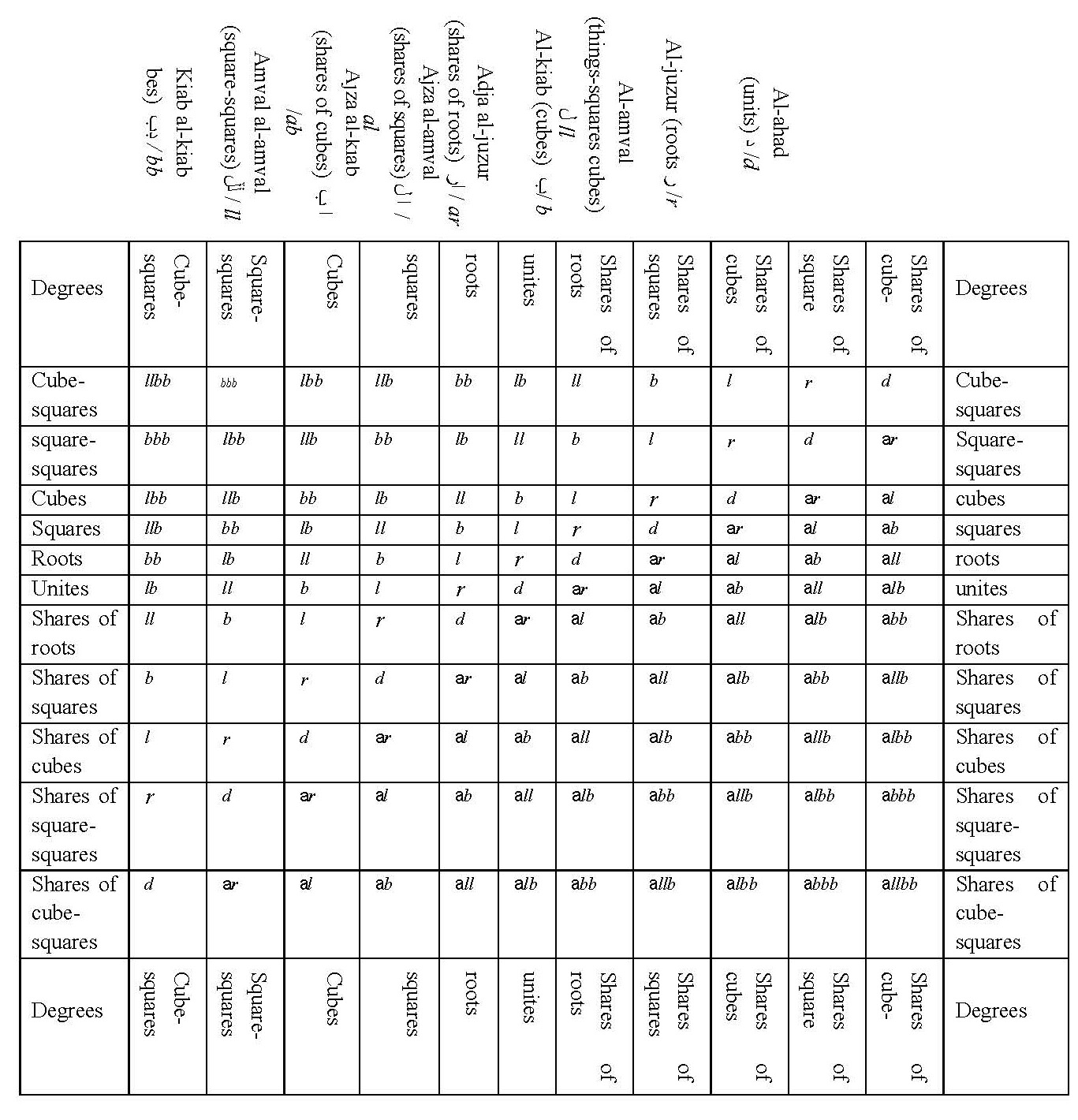
In the study of the treatise we found marvelous facts, previously unknown and changing the dating of some mathematical statements. Thus, in the 8th section, Part 1, Al-Tusi puts the table to denote the degrees (Table 1). In this table the letter designations of degrees are given. We compared this table with the table of Chapter 11 of John Wallis’ The Historical and Practical Treatise on Algebra (Table 2).[11]
This table shows the designations used by mathematicians in the 16th and 17th centuries, to denote the root, square, cube, from the 4th to the 16th degrees. In Table 1, the second column is the designation of Wyeth, the third column is the designation of Outred, the forth column is the designation of Garriot and the fifth column is the designation of Descartes. We compared the designations of Outred (1574-1660) and those of Tusi (Table 1).
In Table 1 r, l, b are the last letters of the Arabic words judhur (root), mal (square), ka’b (cube) respectively. Outred’s letters q, c are the first letters of words Quadratum, Cubus (square and cube). The designation A is not correlated with any word.
Table 1. Translation of Tusi’s table
Table 2: The table from Wallis work
Taking into consideration the fact that the Arabic words are written from right to left, the principle of designation of Al-Tusi and Outred are the same. In the Tusi’s table there are the designations of “negative” power – the sheaves of degrees.
Note that it is not known any use of such symbols, not only by the predecessors of Al-Tusi, but also by Arab mathematicians of the later period. For example, there is nothing like it in the famous work The Key to Arithmetic” of Al-Kashi, who lived two centuries later.
Table 3: The table of the comparison (Tusi-Outred)
Fig 5. TFolio From The Akhlaq-i Nasiri of Nasir al-Din al-Tusi: School courtyard with boys reading and writing. Lahore, Mughal period, circa 1595 CE. (Source)
Another impressive fact is Al-Tusi’s remark about the “criterion” in the first part of the 12th chapter of his treatise. Here we present a validation of the results of arithmetic operations with the help of this “criterion.” The method of “criterions” involves comparing the remainders, obtained by dividing by 9, 7, 11, etc. of the result of operation on digits of terms of arithmetic action and of number of the resulting of arithmetic operation. These remainders are called “criterions”. In the case of the division by 9 (“criterion” on 9) this operation on digits is the summation of the digits of the number. This method was known to the Greeks and to the Indians.
It was thought that the coincidence of those “criterions” of the initial numbers and of the result is the necessary and sufficient condition for conviction in the correctness of the calculation. This is indicated in the works of such great medieval mathematicians as Abu ‘l-Hasan ibn Ahmad al-Nasawi (10th century)[12] and Ahmad ibn al-Banna (13th-14th centuries).[13] However, this condition is necessary, but not sufficient. In the history of mathematics the first indication of insufficiency of that condition dates back to the 15th century.
In the twelfth chapter of the Collection, Nasir al-Din al-Tusi wrote:
“Calculators have a way to check, known as a” criterion.” If the calculation was carried out correctly, the “criterions” also coincide; if the “criterions” are not equal, then the computation was also carried correctly. We can not say that if the “criterions” are equal, then the calculation was carried correctly, (or) if the calculation was carried out correctly, the “criterions” do not coincide.”
Thus, the assertion that the condition of coincidence of criterions is insufficient appeared in the 11th century.[14]
In the 9th section of the first part, Al-Tusi gives the algorithm to extract the square root, in the 10th section – algorithm for cube root, and in the 11th – algorithm for root of any degree.
Fig 6. Page from Sharh Usul Ashkal Kitab Uqlidis fi ‘Ilm al-Handasa dated Sha’ban 1074/March 1664.
It can be argued that the algorithms for extracting the root of fourth and higher degrees have been found in this work of Al-Tusi. However, ‘Umar al-Khayyam[15] indicates that in his own book Problems of Arithmetic he gave the method of extracting the root of the fourth and higher.
In the 3rd section, there is a table compiled for the binomial coefficients and algorithm to determine them. Although it is believed that the author of the table of the binomial coefficients (triangle of Pascal) was a famous French mathematician and physicist Blaise Pascal (1623-1662). In support of this, we give a quote from the Encyclopædia of Mathematics published in 1998 in Moscow: “to calculate the binomial coefficients, Pascal developed a method (“Pascal’s triangle”).[16] However, such table is found in the work of al-Samaw’al (12th century).[17]
Another interesting fact contained in the 3rd section-Part II is the method of finding a common denominator as the least common multiple. All previous mathematicians and even Ahmad ibn al-Banna,[18] sixty years younger than Al-Tusi, in order to find a common denominator, they simply multiply the denominators of the terms. Finding a common denominator as the least common multiple dates from the second half of the 16th century (Tartaglia and Clavius).[19]
The scientific work of Al-Tusi is an invaluable source for the study of mathematical thought in the Eastern Middle Ages and for rethinking of many mathematical ideas. The works of Al-Tusi as well as those of his great predecessors – Ibn Sina, al-Khwarizmi, ‘Umar al-Khayyam, etc. – refute the perception among some researchers that the mathematics of the Eastern Middle Ages was purely practical, and that there was a regression in mathematical theoretical thought in comparison with the Ancient period.
5. Notes and references
[1] G. P. Matviyevskaya, B. A. Rosenfeld, Mathematicians and Astronomers of Medieval Islam and their Works(VIII-XVII centuries), vol. 2, Moscow 1983.
[2] Nasir al-Din al-Tusi, Tahriri oglidis. Baku 2001.
[3] S. A. Yanovski, “About the Axioms”, Historico-Mathematical Investigations. Moscow, No XIII, 1959.
[4] Al-Tusi, Tahriri oglidis, Baku 2001.
[5] Al-Tusi, The Treatise on the complete quadrilateral (Shyaklul Gita). Baku 1952. See also the reprint of this text in A Collection of mathematical and astronomical Treatises as revised by Nasiraddin al-Tusi, Frankfurt: Institute for the History of Arabic-Islamic Science, 1998, pp. 363-434.
[6] V. N. Molodshy, Foundations of the number’s doctrine in the XVIII and early XIX century. Moscow 1963.
[8] Al-Tusi, “Collection of arithmetic with the help of the board and the dust, 1st part,” Historico-mathematical investigations, Moscow 1999.
[9] Al-Tusi, Collection of arithmetic with the help of the board and the dust. Baku 2008 (Azeri), 2011( Russian).
[10] Ibidem.
[11] T. A. Tokareva, “On the John Wallis historical and practical treatise on algebra”, Historical-mathematical investigations, No. XXVII, Moskow 1983.
[12]Ali ibn Ahmad al-Nasawi, “Enough about Indian arithmetic,” Historical-mathematical investigations, No. XV, Moscow 1963.
[13] Ahmad ibn al-Banna, “Summary of arithmetic,” Historical-mathematical investigations, Series II, Vol. 9 (44), Moscow, 2005.
[14] Ahmad ibn al-Banna, “Summary of arithmetic,” op. cit.
[15] Omar Khayyam, “On the evidence of problems of algebra and almukabaly,” Historical-mathematical investigations, No. 6, Moscow 1953.
[16] Great Encyclopedic Dictionary of Mathematics, Moscow 1998, p. 175.
[17] B. A. Rosenfeld, “Algebraic treatise of al-Samaw’al,” Historical-mathematical investigations, No XX, 1975.
[18] Ahmad ibn al-Banna. “Summary of arithmetic,” op. cit.
The worst thing ethically and politically is to let [Eurocentric] separatism simply go on, without understanding the opposite of separatism, which is connectedness…. What I am interested in is how all these things work together. That seems to me to be the great task – to connect them all together – to understand wholes rather than bits of wholes…. In a wonderful phrase, Disraeli asks, ‘Arabs, what are they?” and answers: “they’re just Jews on horseback.’ So underlying this separation is also an amalgamation of some kind.”Edward Said 2004.
Introduction[1]
Figure 2. The Bab al-Ghuri gate in Khan el-Khalili, a famous market in Cairo from the times of the Fatimids (Source)
Under the reign of Eurocentrism, the Western mind imagines that even if Islam came up with all manner of new ideas and technologies – ideas in engineering, art, mathematics and at a big push, science – even if this were all true we know that Islam is antithetical to capitalism. Wasting time praying 5 times a day makes disciplined capitalist activity a near-impossibility. And in any case, all this ‘irrational’ religious behaviour is the counterpoint to the cold hard rationality of capitalism. Indeed we know that Islam rejects usury and so the possibility of banking and making profits from capitalist activity is ruled out tout court.
Given all this, even if the Muslims came up with all manner of ideas in the aforementioned areas, Europe and the West could have gained nothing from Islam in terms of developing capitalism. So what have the Muslims ever done in terms of enabling capitalism in general as well as contributing to the development of early capitalism in Europe? Obviously nothing, we are told in the West, which is precisely why in Western histories of the rise of capitalism it makes perfect and logical sense for us to focus solely on what went on in Europe as the Europeans pioneered capitalism and the institutions upon which it rests without any help from the non-Western world. Notable here is that our standard histories of the long rise of capitalism in Europe sometimes begin with the Italian commercial and financial revolution after about 1000; so it is to this that I shall now focus upon.
Islam and the first phase of ‘Afro-Eurasian regionalization’, c.650–1000
The notion that it was Venice that we should turn to rather than the Islamic Middle east and North Africa is problematic for at least four main reasons, all of which reveal that European commerce post-dated that of Islam and that without Islam there might never have been a Venetian trading hub at the centre of European commerce.
Figure 3. 15th century Ottoman maps of Venice (left) and the Mediteranean (right) (Source)
First, Islam had a high propensity for commercial trade and capitalistic activity. I can think of no better illustration of this than reminding ourselves that The Prophet Mohammed had been a commenda (qirād or mudaraba) trader. Moreover, in his twenties he married a rich Qurayshi woman (the Quraysh had grown rich from the caravan trade as well as banking). Interestingly ‘the Meccans – the tribe of Quaraysh – caused their capital to fructify through trade and loans at interest in a way that Weber would call rational…. The merchants of the Muslim Empire conformed perfectly to Weber’s criteria for capitalist activity. They seized every and any opportunity for profit and calculated their outlays, their encashments and their profits in money terms’ (Rodinson 1978: 14).
Second, many linkages between Islam and capitalism can be found in the Qu’rān. Thus the Qu’rān, ‘[d]oes not merely say that one must not forget one’s portion of the world, it also says that it is proper to combine the practice of religion and material life, carrying on trade even during pilgrimages and goes so far as to maintain commercial profit under the name of “God’s Bounty”’ (Rodinson 1978: 16–17).
Figure 4. 19th century depiction of a caravanserai, Richard Dadd (Source)
Islam prescribed that businessmen could more effectively conduct a pilgrimage than those who did only physical labour. Indeed the Qu’rān states that:
If thou profit by doing what is permitted, thy deed is a djihād…. And if thou invest it for thy family and kindred, this will be a Sadaqa [that is, a pious work of charity]; and truly, a dhiram [drachma, silver coin] lawfully gained from trade is worth more than ten dhirams gained in any other way (cited in Rodinson 1978: 29).
And The Prophet Mohammed’s saying that ‘Poverty is almost like an apostasy’, implies that the true servant of God should be affluent or at least economically independent. The booths of the money-changers in the great mosque of the camp-town Kufa illustrate the fact that there was no necessary conflict between business and religion in Islam. (Goitein 1968: 228–9).
It is also significant to note that the Qu’rān stipulates the importance of investment. And while many in the West associate the Sharīa (the Islamic sacred law) with despotism and economic backwardness, it was in fact created as a means to prevent the abuse of the rulers’ or caliphs’ power and moreover, it set out clear provisions for contract law. Not surprisingly there was a rational reason why the Islamic merchants were strong supporters of the Sharīa.
Figure 5. Umayyad Caliphate. Silver dirham of Hisham ibn Abdel Malik, Wasit mint (Iraq), dated AH 123 (741 AD) (Source)
Third, the picture of a dense Islamic urban trading network counters the traditional Eurocentric vision of Islam as a desert populated by nomads. Towns sprang up throughout the Middle East and rapidly formed the major sinews of the Afro-Eurasian trading network. Maxime Rodinson reinforces the general claim being made here:
The density of commercial relations within the Muslim world constituted a sort of world market… of unprecedented dimensions. The development of exchange had made possible regional specialisation in industry and agriculture…. Not only did the Muslim world know a capitalistic sector, but this sector was apparently the most extensive and highly developed in history before the [modern period] (Rodinson 1978: 56).
Figure 6. 1787 Ottoman Turkish map of the Masjid al-Haram and related religious sites (Source)
This naturally flows into the fourth counterpoint to the Eurocentric dismissal of Islam: that ultimately Islam’s comparative advantage lay in its considerable ‘extensive’ power. That is, Islam was able to conquer horizontal space, realised most fully in its ability to spread and diffuse across large parts of the globe, of which the expansion of commercial capitalism was but a symptom.
The centre of Islam, Mecca, was not some kind of irrational pilgrimage terminus, but it was one of the centres of the Afro-Eurasian trading network. Islam’s power spread rapidly after the seventh century so that the Mediterranean became in effect a Muslim Lake, and ‘Western Europe’ a tiny promontory lying on the far western tip of a vast Afro-Asian economy. Islam spread not only westwards into Christendom – most especially into Spain (al-Andalus) between 711 and 1492 as well as Sicily in 902 – but also eastwards right across to India, Southeast Asia and China, as well as southwards into Africa particularly through commercial influence.
Its economic reach was so extraordinary that by the ninth century there was one long, continuous line of transcontinental trade pioneered by Islamic merchants, reaching from China to the Mediterranean.[2] The key point here is that between about 600 and 1492 what we witness is what I call Afro-Eurasian regionalization, which was subsequently upgraded into the world’s first global economy after 1492. And throughout this period, the Muslims were the principal architects of the Afro-Eurasian trans-continental economy.
The Middle Eastern Ummayads (661–750 ce), Abbasids (750–1258 ce) and North African Fatimids (909–1171 ce) were especially important, serving to unite various arteries of long-distance trade known in antiquity between the Indian Ocean and the Mediterranean. These included the Red Sea and Persian Gulf routes. The Abbasid capital, Baghdad, was linked to the Persian Gulf route, which in turn fanned out through the Indian Ocean and beyond into the South China Sea as well as the East China Sea. This route has been termed the Middle Route by Janet Abu-Lughod.
Al-Ya’qūbi (c. 875), described Baghdad as the ‘water-front to the world’, while al-Mansūr proclaimed that ‘there is no obstacle to us and China; everything on the sea can come to us on it’. And there were numerous other Islamic ports that were important, especially Sīrāf on the Persian Gulf (on the coast of Iran south of Shīrāz), which was the major terminus for goods from China and Southeast Asia. The Red Sea route (guarded over by Egypt) was also of special importance.
Figure 8. Marco Polo wearing traditional Tartar attire (Source)
In addition to the sea routes, perhaps the most famous was the overland route to China, along which caravans passed through the Iranian cities of Tabriz, Hamadan and Nishapur to Bukhara and Samarkand in Transoxiana, and then on to either China or India. Marco Polo (the ‘Ibn Battūta of Europe’?) was particularly impressed by Tabriz:
The people of Tabriz live by trade and industry…. The city is so favorably situated that it is a market for merchandise from India and Baghdad, from Mosul and Hormuz, and from many other places; and many Latin merchants come here to buy the merchandise imported from foreign lands. It is also a market for precious stones, which are found here in great abundance. It is a city where good profits are made by travelling merchants (cited in Bloom and Blair 2001: 164).
The Muslims were particularly dependent on trade with many parts of Africa (not just North Africa). This was so for a number of reasons including first, that Egypt presided over one of the vital trade routes that linked the Far East and West (or the Southern Route in which Cairo was the terminus at the head of the Red Sea; and second, African markets constituted probably the most profitable branch of Islam’s foreign trade.
Islamic dhows carrying cargo plied the route down the East African coast as far south as Sufālah in Mozambique and Qanbalu (Madagascar). Gold was mined in various places including Ethiopia and Zimbabwe, while Kilwa (present day southern Tanzania) was the principal entrepôt. The most intense commercial relations experienced by the East African ports were with Aden, Suhār and Sīrāf. And this long-distance trade also helped stimulate trade into the African hinterland.
So it would be wrong to assume that West Africa was commercially isolated from the east coast and was ‘brought to life’ by the Europeans after 1492 (see Wolf 1982: 37–44). For it was the much earlier Islamic arrivalat western entrepôts such as Sijilmassa (in Morocco) and Awdaghast that enabled the inter-linking of the eastern and western coasts both in the northern and sub-Saharan regions (Bovill 1933: chs. 5–6).
All in all, even before the turn of the second millennium, on the very eve of the ‘European commercial revolution’ the Muslims in particular had woven together vast swathes of Afro-Asia into an increasingly singular economic unit. And it was into this wider circuit of trade that Europe became, albeit indirectly, inserted into when it turned to commerce after about 1000.
Figure 9. A 1937 Yemeni stamp depicting a typical Dhow (Source)
Islam and Europe, c.1000–1517: Commerce, Finance and the transmission of Eastern resource portfolios via the Islamic ‘bridge of the world’
Eurocentric world history, as already noted, assumes that the rise of commerce was given its decisive thrust by the Europeans, most especially the Italians, after about 1000 ce. This date, of course, conventionally signifies the end of the Dark Ages. But the period after about 500 and especially after 650 could be called the period of the Eastern ‘Bright Dark Age’, especially the Middle Eastern Dark bright Age (Bala et al 2010). While Afro-Asian trade accelerated after about 1000 this owes its primary thrust to the growing interconnections between the Islamic Middle East and Africa in the west, as well as India, Southeast Asia and especially China in the east. The Middle East in effect constituted the Bridge of the World.
Figure 10. Traders en route via the Gulf of Akaba, 1839 (Source)
And as noted above, it was into this vast system of commerce that the Europeans inserted themselves. Thus before I describe this wider system, it is necessary to begin this discussion by considering how Europe in general and Italy in particular benefited from the growing Eastern trade in general and the role of Islamic West Asia in particular.
The East not only lay at the other end of the European long distance trading circuit but it also played a crucial role in the rise of European trade itself. For the fact is that European trade was ultimately made possible only by the flow of Eastern goods which entered Europe, mainly via Italy. Nevertheless, this is not to say that Italy was unimportant to the fortunes of European commerce, finance and production. For it was in fact pivotal, constituting the heart of European trade thereby pumping goods all round the ‘continent’ and feeding them into the many intra-regional trading systems (such as the Hanse and the French Champagne Fairs). But it was only able to play this central role because Italy was one of the major conduits through which Eastern ‘resources’ and trade entered and reshaped Europe. Indeed, the vast majority of this trade entered Italy courtesy of the North African Muslims in Egypt, who were supplied by the Southern trade route (based in the Red Sea).[3]
Figure 11. Caravan on the Silk Road (Source)
I now want to sketch the role of the Muslims in shaping Afro-Eurasian regionalization in the 1000–1492/1517 era. While the Middle Route became particularly important after the sixth century, it became extremely influential when Baghdad was the prime Muslim centre of trade after 750. But when Baghdad was plundered by the Mongols in 1258, the route underwent a temporary decline. However, with Iraq being subsequently ruled from Persia, the Gulf route revived. This Middle Route was also important because it enabled a ‘deeply symbiotic’ trading relationship between the Crusader kingdoms and the Muslim merchants who brought goods from as far away as the Orient.
The chief Crusader port in the Middle East – Acre – was controlled upto 1291 by the Venetians, and there they excluded their Pisan and Genoese rivals. Nevertheless, although the Venetians dominated the Europeantrading system, they always entered the global system on terms dictated by the Middle Eastern Muslims and especially the North African Mulsims. Then with the Fall of Acre in 1291, the Venetians had no choice but to rely on the Southern route which was dominated by the Egyptians.
Figure 12. A map of Venice, c. 1000 AD (Source)
The Southern route linked the Alexandria-Cairo-Red Sea complex with the Arabian Sea and then the Indian Ocean and beyond. After the 13th century Egypt constituted the major gateway to the East. Importantly, ‘[w]hoever controlled the sea-route to Asia could set the terms of trade for a Europe now in retreat. From the thirteenth century and upto the sixteenth that power was Egypt’ (Abu-Lughod 1989: 149). Indeed between 1291–1517 about 80 per cent of all trade that passed to the East by sea was controlled by the Egyptians. But when Baghdad fell, Al-Qahirah – later Europeanised to Cairo – became the capital of the Islamic world and the pivotal centre of global trade (though this latter process had begun under the Fatimids in the tenth century).
Eurocentric scholars emphasise that European international trade with the East dried up after 1291 (with the Fall of Acre) as Egypt dominated the Red Sea trade to the East at the expense of the Christian Europeans. And it is this that supposedly prompted the Portuguese Vivaldi brothers to search for the more southerly route to the Indies via the Cape in 1291. But despite the proclamation of various papal prohibitions on trade with the ‘infidel’, the Venetians managed to circumvent the ban and secured new treaties with the Sultan in 1355 and 1361. And right down to 1517, Venice survived because Egypt played such an important role within the global economy.
Figure 13. Venetian traders and vessels (Source)
Moreover, Venice and Genoa were not the ‘pioneers’ of global trade but adaptors, inserting themselves into the interstices of the Afro-Asian-led global economy and entering the global economy very much on terms laid down by the Middle Eastern Muslims and especially the Egyptians.
In particular, European merchants were blocked from passing through Egypt. When they arrived in Alexandria they were met by customs officials, who stayed on board and supervised the unloading of the goods. Christians in particular required a special permit or visa and paid a higher tax than did their Muslim counterparts. The Europeans then retired to their own quarters which were governed by their own laws.
However, they were not allowed to leave their quarters in Alexandria and became wholly dependent upon the Egyptian merchants and government officials. Nevertheless, the Venetians and other Europeans accepted this regime because it was there whence they gained access to the many goods produced throughout the East. Indeed the fortunes of Venice were only made possible by its access to Eastern trade via North Africa.
Figure 14. Venetian traders and vessels (Source)
But in the end the most important function of Italy’s trading links with the Middle East and later Egypt lay in the fact that these commercial routes constituted important avenues along which many of the vital Eastern ‘resource portfolios’ diffused across to fertilise the backward West. And these resource portfolios enabled the various ‘Italian’ commercial, financial, and navigational revolutions for which they have become unjustifiably famous.
It is generally assumed that a whole series of financial institutions were pioneered by the Italians. The most important innovation we are told was the commenda (or collegantia), that the Italians allegedly invented around the eleventh century (e.g., North and Thomas 1973: 53). This was a contractual agreement in which an investor financed the trip of a merchant. Not only did it support international trade through the bringing together of capital and ‘trading labour’, but it had similar effects to a stock exchange in that it provided a market for savings which thereby fanned the flames of economic development.
The only problem, though, is that the commenda was invented in the Middle East. And although its roots stem back to pre-Islamic times (Kister 1965: 117ff), it was developed furthest by the early Islamic merchants. Indeed as Abraham Udovitch notes, ‘it is the Islamic form of this contract (qirād, muqārada, mudāraba) which is the earliest example of a commercial arrangement identical with that economic and legal institution which [much later] became known in Europe as the commenda’ (or Collegantzia) (Udovitch 1970a: 48).
Nevertheless this should hardly be a ‘revelation’ given that The Prophet Mohammed himself had been a commenda merchant. Nor should it be altogether surprising that the Italians came to use this institution given that Italy was linked directly into the Islamic trading system. It is also noteworthy that from the eighth century the qirād was applied in Islam to credit and manufacturing, not just to trade (Udovitch 1970b: 78; Kunitzsch 1967: 362–7).
The Italians are also wrongly accredited the discovery of a range of other financial institutions including the bill of exchange, credit institutions, insurance, and banking.
Islamic economic institutions
Figure 15. Jiaozi, the world’s first paper-printed currency, an innovation of the Song era (960-1279) (Source)
Turning therefore to the creation of economic institutions, while Rajat Kanta Ray claims that it is likely ‘that the use of bills of exchange and the art of banking evolved in China before any other civilization’,[4] it is more likely that these originated in Islam and the pre-Islamic Middle East. However, one of the principal reasons laid down by Eurocentrism for the so-called ‘impossibility’ of rational Islamic economic institutions and hence the absence of Islamic trade lies in its emphasis on Islam’s prohibition of usury or lending at interest (though Eurocentrism brushes over the fact that the Catholic Church no less prohibited usury).
But this Eurocentric dismissal is problematic in every respect for the irony is that Muslim traders found all manner of ingenious ways to circumvent this ban not least by creating various rational institutions that supported long-distance trade. As Abraham Udovitch explains:
The restrictions in the area of trade and exchange, as well as in other areas of life, placed certain areas of [mercantile] practice on an inevitable collision course with [Islamic] legal theory. This situation gave rise to a special branch of legal writings, the hiyal(legal devices) literature, in which the lawyers attempted to narrow down the area in which actions would be in violation of the law by making them conform to the law formally while in reality circumventing it.[5]
Of the three forms of hiyal it was those of the Hanafī School – Shaybānī and al-Khassāf – that applied to commercial practice. Thus, for example, to circumvent the religious ban on usury, payment was frequently delayed by several months;
or arrangements were made that entailed a higher price if credit rather than cash was extended in order to conceal the interest paid;
or again, qirād investments were deployed which allowed for a return on the capital advanced that exceeded the original amount that was offered.
‘All these satisfied the same needs as interest-bearing loans by realizing a profitable return for the investor, and providing a flow of capital for the trader’.[6]
Critically, Islamic bankers – known as hawaladars and sarāffs – were a common-place feature of Islamic trade. The hawaladars, operating in the bazaars, were a vital conduit for international trade, transferring funds from one place to another.[7]
The Islamic bankers issued credit notes – the ‘demand note’ or bill of exchange at a distant location (suftaja) and the ‘order to pay’ (hawāla) which was identical to a modern cheque: ‘[a]t the upper left corner was the amount to be paid (in numbers), and in the lower left corner was the date and then the name of the payer’.[8]
Equally, though, it would be wrong to presume that rational mercantile and capitalist activity occurred despitethe role played by Islam or that it happened purely behind the backs of the religious authorities. For Islam became a virtual synonym for trans-continental commerce and profit.[9] Indeed, contra our Eurocentric imagination, Islam could lay fair claim to the pursuit of rational commercial and profit-making activity throughout the period when Europe languished under Catholic rule.[10]
In addition, the Italians are usually attributed the discovery of advanced accounting systems. But various Eastern accounting systems were also well developed, especially in the Middle East, India and most notably in China. Indeed some of these were probably as efficient as Weber’s celebrated Occidental ‘double-entry’ method. It is true that the Pisan, Leonardo Fibonacci, living in Tunis, was an important figure within Europe, serving to advance the Italian accounting system. But he only was so because he had learned of the Eastern knowledge while living in Tunis.
Figure 16. A Yuan dynasty printing plate and banknote with Chinese and Mongol words, 1287 CE (Source)
All in all, Fernand Braudel described the economic activity of Islam after 800 in the following terms:
‘Capitalist’ is not too anachronistic a word. From one end of Islam’s world connections to the other, speculators unstintingly gambled on trade. One Arab author, Hariri had a merchant declare: ‘I want to send Persian saffron to China, where I hear that it fetches a high price, and then ship Chinese porcelain to Greece, Greek brocade to India, Indian iron to Aleppo, Aleppo glass to the Yemen and Yemeni striped material to Persia’. In Basra, settlements between merchants were made by what we would now call a clearing system.
Figure 17. This illustration of sugar cane is from an Arabic manuscript on natural history (Source)
A string of Islamic intensive (productive) innovations and technological/ideational refinements was crucial here. These comprised, inter alia, paper manufacturing, which began after 751, and textile-manufacturing with both Syria and Iraq being famous for their silk manufactures, while Egypt led the way in linen and woollen fabrics. Moreover, Islamic production extended to sugar-refinement, construction, furniture manufacture, glass, leather tanning, pottery and stone cutting and of course Yemeni steel.
Interestingly, Egyptian sugar-cane production was a leading global industry and extensively exported its refined ‘sukkar’ across much of the world (hence the term ‘sugar’). Indeed, when the Spanish developed sugar production they borrowed the ideas and technologies of the Muslims, as did the British later in Barbados after the 1640s. Muslims also used impressive dyes. Added to this list of Islamic gifts that were bequeathed to Europe were the Gothic arch and other architectural developments, developments in music, agriculture, and foods such as oranges, lemons, apricots, bananas, courgettes, artichokes and, last but not least, coffee.
The “Bala proof theorem of technological transmission”
However, so fraught in methodological terms is this transmission issue that the whole question of the transmission of non-Western resource portfolios in the context of the rise of Western modernity has been marginalised and often ignored or rejected by world economic-historians on the grounds that there is not always in place a paper trail of relics that such disciplinary scholars view as the cardinal criterion of proof of transmission.
Figure 18. The Dialogue of Civilizations in the Birth of Modern Science by Arun Bala (Source)
Where there is no clear evidence of transmission for the modern period under discussion then we find ourselves in the realm of ‘plausible conjecture’. Of what does this comprise? Here I offer up what I call the ‘Bala proof’ theorem of transmission (after Arun Bala’s argument that he made in his book The Dialogue of Civilizations in the Birth of Modern Science): that it is not enough to assert cross-civilizational transfer in those cases where an idea that appeared in Europe was invented previously elsewhere, nor is it enough to offer up only circumstantial evidence (though this can constitute part of what constitutes ‘plausible conjecture’).
Rather, Arun Bala argues that we can reasonably infer transmission in those situations where a particular culture, in this case Italy, is interested in understanding an earlier invention in various non-Western civilizations, in this case the Islamic Middle East and North Africa, and when the non-Western invention then soon after that interest is displayed becomes adopted (and adapted) within Europe.[11]
It is obviously the case that from at least 1000 onwards Italian merchants were engaged in looking for ways to tap into long distance trade that emanated beyond Europe’s boundaries. They would surely have been aware of the advanced institutions that existed in the Middle East as they would have encountered these in their dealings with them. Moreover, the Europeans learned not only about Islamic economic institutions but also their ideas on science, mathematics, philosophy, geography, engineering, astronomy and many others too numerous to list here.
In the early ninth century CE the seventh Abbasid caliph, al-Ma’mūn, founded the ‘House of Wisdom’ (Bayt al-Hikmah) in Baghdad where inter alia Greek works – especially those of Ptolemy, Archimedes and Euclid – were translated into Arabic. But Arab scholars also drew heavily on Persian and Indian (as well as Chinese) texts on medicine, mathematics, philosophy, theology, literature and poetry.
Figure 19. Scholars at an Abbasid library in Baghdad (Source)
They then crafted a new corpus of knowledge – with the help of Jewish scientists and translators – that was not only more than simply an amalgam of Greek thought but one that was often not only critical of Greek ideas but also took them much further, if not in new directions.
This process was aided by the fact that Baghdad stood at the centre of the Afro-Eurasian economy and not only received new Asian ideas but, having reworked them, transmitted them across to Islamic Spain. Increasingly after 1000, Europeans translated the Islamic scientific texts into Latin.
Figure 20. A 13th century French translation of Ibn Rushd’s commentary on Aristotle’s Book of the Soul (Source)
The fall of Spanish Toledo in 1085 was especially significant, for it was here where many European intellectuals gained access to Islamic technical books. Learning from Islam was continued on by the Spanish King Alfonso X (1252-1284), largely through Jewish intermediaries (as did the Portuguese kings). Of the many examples on offer, notable here is that in 1266 Ibn Khalaf al-Murādī’s important text, The Book of Secrets about the Results of Thoughts, was translated at the Toledan Court. This text and many others would have furnished the Iberians with a great deal of Islam’s innovations. Finally, the Italians also directly learned of these ideas both through their trading links with the Middle East and during the Crusades.
So to return to the point being made earlier: we can see that after about 1000 the Europeans demonstrated a strong and keen interest in learning from the Islamic Middle East and North Africa: Which means that this ticks the key box concerning the Bala Proof theorem of the transmission of Islamic economic institutions.
There is much more that could be said here regarding the influence of Islam on the development of a global economy – a story which continues on through to the 18th century. But the last point I want to make is that it was across the commercial sinews of the Afro-Eurasian economy that many ideas, techniques and technologies flowed across to Europe which in turn promoted, not least:
The Renaissance
The scientific revolution
The European voyages of discovery
The European military revolution
The European energy revolution
The early European cotton and sugar industries
Rather than go through all of these in detail since space has got the better of me, let me close with the following vignette.
Conclusion: What have the Muslims ever done for us?
Figure 21. Monty Python’s ‘The Life of Brian’ Theatrical release poster (Source)
Finally I want to conclude this piece by drawing from the scene in Monty Python’s famous film ‘The Life of Brian’, in which Reg, the ‘inspirational’ leader of the revolutionary party – the PFJ (Peoples’ Front of Judea)… or was it the PPFJ (the Popular Peoples’ Front of Judea)?… oh never mind… convenes a secret meeting to rally his revolutionary comrades to overthrow the ‘oppressive and much reviled’ Roman Empire. Here I shall modify that whole scene by substituting the Muslims for the Romans. In this alternative scene Reg obviously now stands for an anti-Muslim Western organization (though I shall leave it to your imagination as to which one that might be).
What follows is the transcript of the video that i have made (see the video clip at the bottom of this article)
Please note that Reg’s speech is presented without quotation marks, while the comments made by the audience members are placed in quotation marks.
Thus, Reg opens the scene by asking rhetorically:
The Muslims… have taken EVERTHING from us. And not just from us, but also from our fathers and fathers’ fathers
“and our fathers’ fathers’ fathers” interjects Stan, one of the revolutionary comrades…
Yeah OK…
“and our fathers’ fathers’ fathers’ fathers”, Stan continues…
Yeah alright Stan, don’t labour the point… And WHAT have the Muslims ever given us in return?
A LONG, SILENT PAUSE ENSUES, THEN SOMEONE FROM THE AUDIENCE SHEEPISHLY SPEAKS OUT:
“The noria?”…
What? Regs demands in a scathing tone.
“The noria… you know Reg, the huge water wheels that lift water up into the aqueducts”.
Oh, yeah… Yeah they did give us that, it’s true…
“And the sanitation…”
“Oh yeah, the sanitation Reg. You know what Europe used to be like…”
In increasingly exasperating tone Reg replies:
Yeah, alright, I grant you the noria and sanitation are two things that the Muslims have given us…
“And don’t forget astronomy Reg…”
Yeah, well obviously astronomy… I mean the Muslims are always plotting the position of the stars so as to carry on their incessant praying to Allah… But apart from the noria, sanitation and astronomy… What have…
“Windmills and water-mills”, another audience member interjects.
“Yeah, don’t forget all the new irrigation techniques that the Muslims pioneered. For they’ve been a positive boon here in the heat of al-Andalusian Spain”.
Another audience member then chimes in with:
“And mathematics… Remember Reg… it was the Muslims who developed trigonometry, geometry and algebra – with the term algebra being the translation of the title of al-Khwarizmi’s book Al-Jebr W’almuqalah (given that al-jabr was translated as algebra) and that al-Khwārizmī’s name was translated as ‘Algorithmi’ (hence the term ‘algorithm’). And his work in turn was taken further by the likes of al-Buzajānī and al-Kindī…”
Reg replies in a somewhat resigned tone:
Yeah OK, the Muslims did bring all of this to Europe when we were busy messing around with the abacus. Gee, I never did like the abacus.
“And what about mercantile capitalism Reg? Don’t forget that the Prophet Muhammad had been a trader for much of his life and that his wife was rich. She came from the Meccan tribe of the Quaraysh which had grown rich from caravan trade and banking…Without all of this and the institutions that went with Islamic long distance trade, we’d all still be in the Dark Ages here in Europe”…
In a now increasingly resigned tone Reg replies:
Yeah OK… fair enough… can’t argue with that one…
“Law and order”, comes another interjection…
“Yeah, you’ve gotta admit Reg, the Muslims certainly know how to keep order… they’re the only ones who could in a place like this.”
“And let’s be honest Reg, it’s been a whole lot more peaceful since the Muslims arrived here in Spain in 711. You can walk the streets safe at night now… And under Muslim rule here in Andalusian Spain us Christians can get along just fine with the Muslims and the Jews…”
“Yeah, yeah yeah” (they all say in rousing unison).
Thus after a whole series of similarly awkward and increasingly rowdy interventions, Reg might have finished his rallying speech with the words:
Alright, apart from the noria, windmills, water-mills, irrigation techniques that spurred on agriculture and manufacturing, as well as commenda (qirād) partnerships, bills of exchange and cheques, credit institutions, insurance and banking, all of which stimulated early capitalism in Europe and Afro-Eurasian regionalization…
as well as trigonometry, geometry and algebra, medicine and anaesthetics, public health and hygiene, philosophy and theology, literature and poetry, an optical revolution, engineering, astrology, astronomy and geography, all of which helped shape the European Renaissance…
not to mention science and the experimental method that helped shape the European scientific revolution…
as well as cartography, navigational techniques including the astrolabe, lunar and solar calendars, longitude and latitude tables, the lateen sail, all of which helped make possible the European Voyages of Discovery, in the absence of which the Europeans would have been confined to sailing within the Islamic Mediterranean…
and… last but not least… the creation of an Afro-Eurasian economy after 650 ce that linked Europe into the mainstream of Afro-Asian trade and later the Eastern creation of the first global economy after 1492 that delivered not only a vibrant stream of Eastern trade but more importantly the many Asian inventions, institutions, ideas, technologies, production techniques and a list of foods and agricultural and manufacturing products far too numerous to list here… apart from all of this, WHAT have the Muslims ever done for us?
References
[1] Please note that rather than supply a bibliography I refer my reader to three of my writings which provide all of these: The Eastern Origins of Western Civilisation (Cambridge: Cambridge University Press, 2004); ‘Islamic Commerce and Finance in the Rise of the West’, in Nayef R.F. Al-Rodhan (ed.), The Role of the Arab-Islamic World in the Rise of the West (Houndmills: Palgrave, 2012), 84–115; ‘What have the Muslims ever done for us?’, in Rajani K. Kanth (ed.) The Challenge of Eurocentrism (Houndmills: Palgrave Macmillan, 2009): 217–35.







 The worst thing ethically and politically is to let [Eurocentric] separatism simply go on, without understanding the opposite of separatism, which is connectedness…. What I am interested in is how all these things work together. That seems to me to be the great task – to connect them all together – to understand wholes rather than bits of wholes…. In a wonderful phrase, Disraeli asks, ‘Arabs, what are they?” and answers: “they’re just Jews on horseback.’ So underlying this separation is also an amalgamation of some kind.” Edward Said 2004.


 Aal-e-Qutub Aal-e-Syed Abdullah Shah Ghazi