Pharaoh’s Mummy

Pharaoh’s Mummy

Drowned Pharaoh was found mummified.

There is a problem in the Bible, it insists that Pharaoh’s body drowned in the Red Sea. The problem is that Pharaoh wore body armor that would have sunk his body to the bottom of the sea. But we already discovered all mummies of Pharaohs in the New Kingdom. There is no such thing as a missing Pharaoh’s mummy from the time of Moses. So if he really drowned then his body armor should have sunk him to the bottom of the sea and his body should be missing today.

The soldiers did not wear any armor but the Pharaoh did:

Because of the climate, very little armour was ever worn in Africa. Sometimes broad leather bands covered part of the torso of charioteers, but generally soldiers are depicted without any body protection. Again the pharaohs were – not surprisingly – the exception. 
Reshafim, Shields, helmets and body armour, 2018

Pharaohs wore scale armor. Copper and iron scales were sewn to leather and fabric. Then semi-precious stones were added for decoration:

The pharaohs often wore scale armour with inlaid semi-precious stones, which offered better protection, the stones being harder than the metal used for arrow tips.
Wikipedia, Military of ancient Egypt, 2018

This metal armor plus the semi-precious stones are much denser than water and should have sunk the corpse of the Pharaoh to the bottom of the sea. Instead we found his body inland mummified. Since they didn’t have the technology to find and raise his body, Christians have to explain “Who raised his body from the bottom of the sea?”.

But the Quran didn’t do this mistake. Instead the Quran insists that Allah specifically saved Pharaoh’s body:

[Quran 10:92] Today We will preserve your body, so that you become a sign for those after you. But most people are heedless of Our signs.

So Allah saved Pharaoh’s body because Pharaoh COULD NOT FLOAT. And since Allah saved his body then no mummy should be missing today.

Tawakkul and Submission

Tawakkul means to rely upon another, to appoint a trustee and to put one’s trust in that trustee.

tumblr_nyodm1wred1unx1mao1_1280

One of the beautiful names of Allah is ‘Al-Wakeel’. This name has the meanings of ‘the one who takes care of matters which have been referred to Him, (in a most suitable way), and the One who takes care of affairs in the best way, the One who is relied upon, and the One who controls and who rules over everything’.

It is a must that the sole Source to be relied upon in all matters is the immortal, everlasting Absolute One of Power. It would be meaningless to trust somebody who is in fact the opposite.

􏰀Almighty Allah says in the Qur’an:

‘Put your trust in the Living who does not die and glorify Him with praise’ (Al-Furqan, 25:58)

Allah Most High desires that we, His servants, rely upon Him only. He says in the Qur’an:

‘So let the believers put their trust in Allah’. (Ibrahim, 14:11)‘Whoever puts his trust in Allah – He will be enough for him’ (al-Talaq, 65:3)

tawakkul

The Prophet Muhammad (upon whom be peace and blessings) has said:

“If you were able to rely on Allah properly, you would be pro- vided for just like birds who leave their nests hungry and return full” (Tirmidhi, Zuhd, 33/2344; Ibn Majah, Zuhd, 14).

When it comes to submission, this has the meaning of acquiescence and acceptance of whatever events befall one without objection and thus arriving at peace. Submission is an act of the heart, and it is to be free of any doubts that arise in matters that have come from Allah. It is to be free of carnal desires that are contrary to divine commands, desires that are not compatible with sincerity, and the curse of resisting divine decree and Islamic law. It is stated in a verse from the Qur’an:

‘No, by your Lord, they are not believers until they make you their judge in the disputes that break out between them, and then find no resistance within themselves to what you decide and submit themselves completely.’ (An-Nisa, 4:65)

The word ‘teslimiyet’ or submission has the same root as the word ‘islam’. This is why to truly live Islam and to be a true servant of Allah is only possible through submission. This is because Allah (exalted and glorified be He) is not pleased when His servant yields to any other than Him.

Submission is an act of obedience based on love. It was through the blessings of this obedience and submission that nothing – not his life, his property or his son- could hinder the Prophet Ibrahîm (Abraham) (upon whom be peace) from the path of his exalted Lord. Thus his act of worship, of which the pilgrimage is the best symbol for his reliance and submission to his Lord, will continue until the end of time. The tongue of Ibrahîm was an interpreter of what was in his heart and he would constantly pray:

‘I am a Muslim who has submitted to the Lord of all the worlds.’ (Al-Baqara, 2:131)

The aim of tasawwuf, which takes love as its foundation and which is the essence of Islam, is the establishment of feelings of submission and contentedness with Allah by allowing the servant to live under divine guidance and move closer to Allah with every breath. The effects and deceits of the soul that arise from the thousand and one worries, anxieties and pains that are rife in this fleeting world, will only begin to abate as a result of contentment and submission to Allah. How beautifully Ibrahim Hakki Erzurumi puts it:

Rely upon Allah
Submit and find peace
Be content with all His affairs
And let us see what Allah has in store; For whatever it is, it will be for the best


Scenes of Virtue

Once a Bedouin came to the Prophet (upon whom be peace and blessings) and asked him:

“O Messenger of Allah! Shall I tie my camel and then trust in Allah or should I trust in Allah without tying my camel?”


The Prophet  replied:

“Tie your camel first, and then trust in Allah”. (Tirmidhi, Qiyamah, 60/2517)

1daee871a4afea6f369d5336fe89f1c5

According to reports by Ummu Seleme (May Allah be pleased with her), whenever the Messenger of Allah (upon whom be peace and blessings) would leave the house he would always make sure to turn his face to the heavens and say the following prayer:

“In the name of Allah! I put my trust in Allah. O Allah, I seek refuge in You that I should stray or be led astray, that I should slip, or be made to slip, that I should oppress or that I be oppressed, and that I should show ignorance or be subject to others ignorance” (Abu Dawud, Adab, 102-3/5094; Tirmidhi, Deavat 35).


 -An Excerpt from the book, “Civilizations of Virtues-II”

Al-Dinawari

Abu Hanifa al-Dinawari (d.895 CE), botanist, lived in Andalusia, in Muslim Spain. His work has been made known by the German scholar, Silberberg, in a thesis, published in Breslau in 1908 which contains the descriptions of about 400 plants. However, what is described by Silberberg is just a small part of what has survived; just two volumes out of the six.


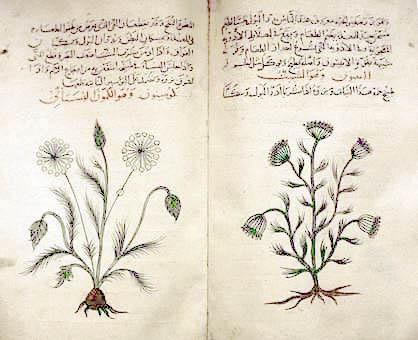
De Materia Medica in Arabic, Spain, 12th-13th century (Source)


Figure 1: 
Al-Dinwari, Manuscript

The place of Islamic botany and its role in medical human civilisation have received a great deal of interest in the works of very possibly today’s leading authorities on the subject: Bashar Saad and Omar Said.[1] The pioneering work of these two scholars, and some of their colleagues has brought to our knowledge, or more precisely, has reawakened world interest in the vast contribution of Muslim herbalists and botanists, and how the work of such medieval botanists remains a vast repertoire of knowledge that can help in the cure of many ailments.  They hence remind us that In the Middle Eastern region, there are more than 2600 known plant species; about 200–250 of them are still in use for the treatment and prevention of various diseases.[2] 

The number of herbal-derived substances that are in use as traditional compounds is about 286.[3] Results obtained in an extensive survey indicate that about 129 plant species are still in use in the treatment of various human diseases, including cancer, skin, respiratory and digestive disorders, diabetes and liver diseases. Plant parts used include leaves, flowers, stems, roots, seeds and berries.[4]


Cumin and dill from an Arabic book of simples (ca. 1334) after Dioscorides – British Museum (Source)

It is beyond the scope of this work to add anything further to what these scholars have studied. The use of their work is a necessity upon any curious mind. What can be said here is that these scholars are the continuators of a tradition, which began over a thousand years ago, and one of it earliest pursuers, if not the earliest, was Al Dinawari.

Abu Hanifa al-Dinawari (d.895 CE), botanist, lived in Andalusia, in Muslim Spain. His work has been made known by the German scholar, Silberberg, in a thesis, published in Breslau in 1908 which contains the descriptions of about 400 plants. However, what is described by Silberberg is just a small part of what has survived; just two volumes out of the six.

The surviving parts of this book, originally comprising 7 volumes, show clearly how far and how rapidly a branch of knowledge hitherto cultivated by the Greeks could already develop in complete independence from them amongst Muslim philologists before the end of the 9th century.[5]

Al-Dinawari’s «Kitab al-Akhbar al-Tiwal» An historiographical Study of Sasanian Iran. Series: Res Orientales, 23, Authors:  Jackson Bonner M.R. (Source)
 

In his expose on the earth, Al-Dinawari describes a variety of soils, explaining which is good for planting, its properties and qualities. Al-Dinawari also describes plant development from its birth to its death, including the phases of growth and the production of flower and fruit. He then covers various crops including: cereals, vines and date palms. Relying on his predecessors, he also explains trees, mountains, plains, deserts, aromatic plants and woods, plants used in dyes, honey and bees.

Al-Dinawari also devoted one chapter to the classification of plants (tajnis al-nabat) which he mentions in one of the volumes that have survived, but the work itself on the subject has also been lost. Al-Dinawari’s Book of Plants also covers various other subjects such as astronomy and meteorology. His book bears witness to the use of a scientific botanical terminology.

He knows a lot of specialised expressions for the diverse features of plants which in an unbiased reader evokes the impression that they were part of a scientific nomenclature created for the sake of greater precision.” He displays an advanced scientific–morphological attitude, is familiar with the observation and description of physiological aspects and illustrates “complicated shapes in plants by comparison with familiar types.[6]

It is interesting here to quote Sezgin on a very pertinent issue, which highlights some of the approaches to Muslim accomplishments. He remarks:

A study conducted in 1910–1911 by Bruno Silberberg exclusively on the basis of fragments of this book as cited in later dictionaries shows that Abu Hanifa’s botanical descriptions are equal to those of the Materia medica by Dioscorides. The descriptions prepared by Dioscorides had a different motivation from those in the Kitāb an-Nabāt of Abu Hanifa. The purpose of the former was to help the reader in the identification of herbs in the field, i.e. purely practical, while Abu Hanifa’s presentation seems to have been inspired by a delight in the manifold varieties of plant morphology. In those days, Silberberg would still wonder: “How could the people of Islam reach in this respect the level of the brilliant Greeks or even surpass them at such an early period of their literature?”[7]

As we began with Bashar Saad and Omar Said, we conclude this short section on a very important point they raise with their colleague Hassan Azaizeh:

Despite the increasing use of medicinal plants, their future, seemingly, is being threatened by complacency concerning their conservation. Medicinal plants in the Middle East are becoming increasingly rare, as a result of the ongoing destruction of their natural habitat, the over-harvesting of wild species and detrimental climatic and environmental changes. Hence, it is predicted that in semi-arid regions such as the Middle East, a number of species will have disappeared within the next 10 years or so, particularly in the desert or dry areas where almost a third of native plants are found, unless urgent measures are taken to protect and preserve them. This is paradoxical at a time when there is an increasing interest worldwide in herbal medicines accompanied by increased laboratory investigation into the pharmacological properties of the bioactive ingredients and their ability to treat various diseases.[8]


Front cover of Ibn al-Baytar (d. 646 H / 1248 AD): Tafsir kitab Diyasquridus fi al-adwiya al-mufrada (A Commentary on Dioscorides’ Materia Medica), edited by Ibrahim Ben Mrad (Carthage (Tunisia): Bayt al-hikma, 1990).

Read More

  • Botany, Herbals and Healing In Islamic Science and Medicine

References:


[1] Saad B and Said O: Greco-Arab and Islamic Herbal Medicine: Traditional System, Ethics, Safety, Efficacy and Regulatory Issues, Wiley-Blackwell John Wiley & Sons, Inc. 2011. 


[2] Azaizeh, H., Saad, B., Khaleel, Kh. and Said, O. (2006) The state of the art of traditional Arab herbal medicine in the eastern region of the Mediterranean: a review. eCAM 3, 229–235.

Said, O., Khalil, K., Fulder, S. and Azaizeh, H. (2002) Ethnopharmacological survey of medicinal herbs in Israel, the Golan Heights and the West  Bank region. Journal of Ethnopharmacology 83, 251–265.

[3] Lev, E. and Amar, Z. (2002) Ethnopharmacological survey of traditional drugs sold in the Kingdom of Jordan. Journal of Ethnopharmacology 82, 131–145.

[4] Bashar Saad, Hassan Azaizeh and Omar Said: Arab herbal Medicines; in “Botanical Medicine in Clinical Practice”, Ed. Watson, R. R. and Preedy, V.R.; CABI, Wallingford, UK. 2008; pp. 31-39; at pp. 33-4. 


[5] F. Sezgin: The Istanbul Museum for the History of Science and Technology in Islam, an Overview; Istanbul, 2010; p. 184.

[6] Ibid.

[7] Ibid.

[8] Bashar Saad, Hassan Azaizeh and Omar Said: Arab herbal Medicines; in “Botanical Medicine in Clinical Practice”, Ed. Watson, R. R. and Preedy, V.R.; CABI, Wallingford, UK. 2008; pp. 31-39; at p. 32.


 Oriental Garden in Berlin at the Marzahn Park, opened in 2005. This 58 x 31 metre garden offers a window onto Muslim civilisation in the multicultural city of Berlin. The layout adheres to the essential traditions of the Islamic garden: the garden courtyard is centred around a fountain pavilion and divided into quarters by water channels oriented to the cardinal points; ornamentation is essential to the garden: calligraphy, floral arabesques and ‘zillij’ are found on the walls, timber carving on the pavilion, ‘muqarnas’ on the vestibule, and painted wood in the arcades; planting provides shade, colour, fragrance and taste.

Gardens of Islam

The inhabitants of the early Islamic world were, to a degree that is difficult for us to comprehend, enchanted by greenery.

Early Muslims were pioneers in establishing botanical gardens and plant collections. Below is a quotation from A. Watson, Agricultural Innovation in the Early Islamic World; Cambridge Uni. Press 1983; pp. 117-8:

The inhabitants of the early Islamic world were, to a degree that is difficult for us to comprehend, enchanted by greenery.

This love of plants is clearly shown in a genre of poetry, the rawdiya or garden poem, probably of Persian origin, which came to be one of the main poetic forms in the Abbasid orient from the eighth to the tenth century.

In the garden poem, the author exclaimed at the coolness of the shade, the heaviness of the perfume, the music of the running water, the lushness of the foliage and so forth – in short at all the features of the artificially contrived environment which contrasted so strongly with the arid natural world. By the ninth century the genre had arrived in Spain where it was to reach its greatest heights in the eleven century; gardens became… probably the most common of all Arabigo-Andalus poetic themes.

These were not mere words; they corresponded to a reality. Early Muslims everywhere made earthly gardens that gave glimpses of the heavenly garden to come. Long indeed would be the list of early Islamic cities which could boast huge expanses of gardens.

To give only a few examples, Basra is described by the early geographers as a veritable Venice, with mile after mile of canals criss-crossing the gardens and orchards; Nisbin, a city in Mesopotamia, was said to have 40,000 gardens of fruit trees, and Damascus 110,000; Al-Fustat [Old Cairo],with its multi-storey dwellings, had thousands of private gardens, some of great splendour; in North Africa, one learns of a multitude of gardens, surrounding and even inside cities such as Tunis, Algiers, Tlemcen, and Marakesh, places which today are not conspicuous for their greenery; in Spain, writers speak endlessly of the gardens and lieux de plaisance of Seville, bCordoba and Valencia, the last of which was called by one of them “the scent bottle of al-Andalus”.

The most spectacular gardens of all were those of the rulers… the garden of al-Mu’tasim at Samarra; the great royal parks of the Aghlabid amirs of Tunisia, situated near Qairawan, and later the famous garden of the Hafsid rulers of Tunisia; those of the Fatimid caliphs of Egypt, and of the visier al-Afdal; the gardens surrounding the royal palaces at Fez and Marakesh; the great botanical gardens of `Abd al-Rahman, the first Ummayad amir of Spain; the Huerta del Rey in Toledo; the gardens of many of the Taifa kings of Spain; those of the Il-Khans and Timurids at Tabriz and elsewhere; and that of Mahmud of Ghazna at Balkh.

One of the more elaborate gardens was that of Khumarawaih, a Tulunid ruler of Egypt in the later ninth century, who made a royal garden said to be in the Persian manner. According to al-Maqrizi, the glory of this garden was its palm trees, whose trunks were covered with gold; behind this covering were pipes which brought water up the side of the trees and sprayed it out from various openings into pools.

In this way royal gardens might have been focal point in the process of plant diffusion. The evidence we have suggests that this was actually the case. It was in stocking their gardens with rare and exotic plants that many rulers gave full reign to their collecting instincts. We are told, for instance, that the first Umayyad amir of Spain, Abd al-Rahman, was passionately fond of flowers and plants, and collected in his garden rare plants from every part of the world. He sent agents to Syria and other parts of the east to procure new plants and seeds. A new kind of pomegranate was introduced into Spain through his garden.

 
(Left) Gardens of the Al-Hambra Palace, Granada, Spain, (Right) ‘Islamic Gardens and Landscapes’ book by D. Fairchild Ruggles (Source)

The date palm, too, was probably, or reintroduced, by him. By the tenth century, the royal gardens at Cordoba seem to have become botanical gardens, with fields for experimentation with seeds, cuttings and roots brought in from the outermost reaches of the world. Other royal gardens, in Spain and elsewhere, also became the sites of serious scientific activity as well as places of amusement.

A very important recently discovered geographical manuscript, that of al-Udhri, relates that al-Mu’tasim, a Taifa king, brought many rare plants to his garden in Almeira; these, we are told, included banana and sugar cane (both of which, however, were already known in other parts of Spain). At the other end of the Islamic world, in Tabriz, the garden of the Il-Khans was used to acclimatize rare fruit trees from India, China, Malaysia and Central Asia.

In many parts of the Islamic world this royal interest in botanical research and agricultural innovation outlasted the agricultural revolution by several centuries: the sources tell of Syrian plants introduced into his garden in Cairo by the Mamluk sultan Qalawun; of a thirteenth century king of Kanem who experimented with the growing of sugar cane in his garden; and of a number of fourteenth-century Yemeni sultans who were seriously interested in botanical and agricultural research, one of whom wrote an agricultural treatise, while another imported exotic tress and was the first to plant rice in the valley of Zabid.

Another sign of the serious nature of these undertakings is the fact that such gardens were often in the charge of leading scientists: that of the Il-Khans was directed by a Persian botanist who wrote a book on the grafting of fruit trees; al-Tignari, the author of an important Andalusian farming manual made botanical gardens for a Spanish Taifa king and then for the Almoravid prince Tamim; in the garden of a sultan of Seville, the author of an anonymous botanical treatise domesticated rare Iberian plants and acclimatized exotic ones; in the twelfth century the famous botanist and physician al-Shafran collected plants from many outlying regions of Spain for the garden of an Almohad sultan at Guadix ; the Huerta del Rey in Toledo was directed by two of Spain’s leading agronomes, Ibn Bassal and Ibn Wafid, both of whom carried out agricultural experiments and wrote important manuals of farming, the texts of which have recently been discovered.

Ibn Wafid was also the author of a book of simples, which gives, inter alia, the names and uses of many of the new plants being introduced into Spain. After the fall of Toledo in 1085, both scientists moved to the South of Spain and continued their work there; Ibn Bassal planted another botanical garden in Seville for his new patron, al-Mu’tamid, the Taifa king.

Thus the gardens of the medieval Islamic world, and particularly the royal gardens, were places where business was mixed with pleasure, science with art. By being part of a network which linked together the agricultural and botanical activities of distant regions, they played a role – perhaps one of great importance – in the diffusion of useful plants. Only many centuries later did Europe possess similar botanical gardens which helped to make it the same kind of medium for plant diffusion that the Islamic world had been in the Middle Ages.