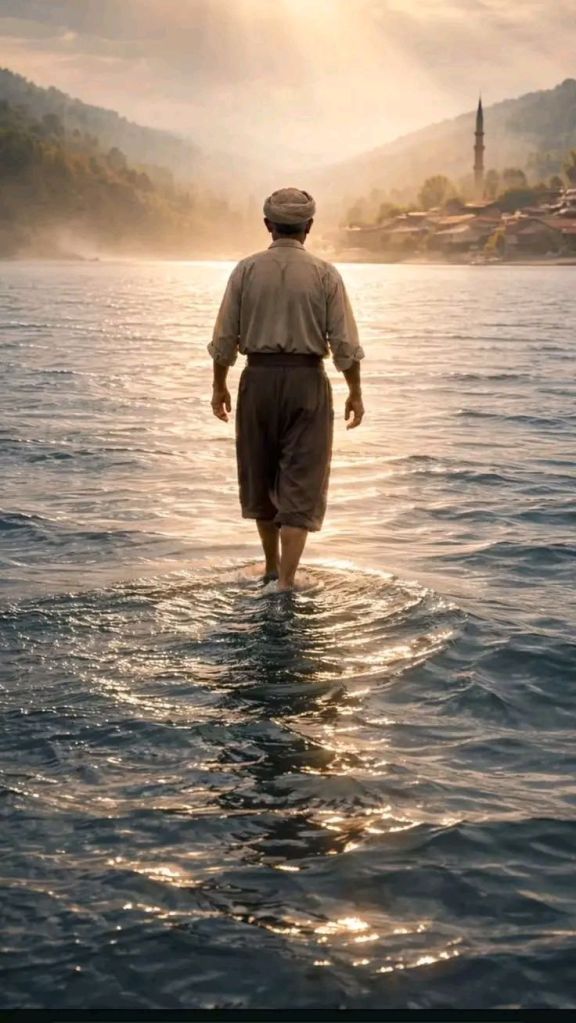
■ The Miracles of Walking on Water.
Karamāt (spiritual miracles) are extraordinary events that break the usual laws of nature, which Allāh manifests at the hands of His righteous Saints as a form of support and honor.
Among the most remarkable of these is walking on water, which appears in many narrations about saints and knowers of Almighty Allāh. Among the most famous:
1. Imam Abū al-Ḥasan al-Shādhili, may Almighty Allah sanctify his secret,
One of the great Saints of Sufism. It is related that when he intended to travel to Tunisia by sea, he boarded a ship. A passenger asked him:
“Do you not claim to be a friend of Allāh?
Why don’t you walk on water?” The Shaykh smiled and said:
“If I walked on water, you would say it is magic!” Then he stepped off the ship, walked steadily upon the water, and returned.
2. The knower of Almighty Allāh, Sayyidi Ahmed al-Rifā‘i, may Almighty Allah sanctify his secret.
It is narrated that he once came to a river, placed his feet upon it, and the water solidified beneath him. He and his companions walked across it, and he said:
“This is a grace from Allāh, not from ourselves.”
3. Sayyidi Ibrāhīm al-Desoukī, may
Almighty Allah sanctify his secret,
One of the great poles of Sufism in Egypt.
It is reported that he would cross the Nile walking upon the water as if it were land, saying:
“Whoever knows Allăh, knows everything.”
4. Shaykh ‘Abd al-Qādir al-Jilāni, may
Almighty Allah sanctify his secret
It is mentioned in some narrations that he walked upon water to save a drowning person, and he said his famous words:
“This foot of mine is upon the neck of every saint of Allăh,” indicating the greatness of his spiritual rank.
5. Sayyidi Abū al-‘Abbās al-Mursī, may
Almighty Allah sanctify his secret,
A disciple of al-Shādhilī. It is said that when
he went out to fish at sea, he would extend his hand into the water and fish would come out to him.
Let us reflect more deeply on this subject: the miracle of walking on water among the saints and knowers of Almighty Allāh.
Walking on water is among the greatest outward miracles attributed to the people of Allāh.
Yet its meaning is not merely the breaking
of natural laws, it is a sign of a high spiritual station in reliance upon Allāh, surrender to Him, spiritual purity, and sincerity.
A karāmah is an extraordinary event that
Allāh manifests through one of His Saints,
as an honor and a sign of their station.
▪︎ Almighty Allāh says:
“Indeed, the friends of Allăh, there will be
no fear upon them, nor will they grieve.”
(Yunus: 62)
▪︎ Among others reported to have walked on water:
1. Shaykh ‘Abd al-Qādir al-Jilāni, may Almighty Allāh sanctify his secret
He was asked about walking on water and said:
“Allăh has granted us that, but we are too shy
to ask for anything that displays the self. Rather, we ask Him for the hidden secrets.”
His disciples narrated that during a journey,
he crossed the Tigris with some of them walking upon the water, and their sandals
did not become wet.
2. Sayyidi Ahmād al-Rifā‘i, may
Almighty Allāh sanctify his secret.
Known for his humility. It is reported that when a disciple marveled at his miracles, he walked across the river toward him upon the water and embraced him.
3. Imām Abū Yazid al-Bistāmī, may
Almighty Allah sanctify his secret, he said:
“When my gaze left myself and others,
the gaze of the Truth overwhelmed me, and
the winds of love carried me over the water
as a ship is carried.”
4. Shaykh Ma‘rūf al-Karkī, may Almighty
Allāh sanctify his secret,
It is said he crossed the Tigris walking while remembering Allāh, without turning right or
left, as if he were on dry land.
5. Shaykh Abū Madyān al-Ghawth, may Almighty Allāh sanctify his secret,
On his way to pilgrimage, he crossed a great river with companions walking upon it while their hearts were filled with remembrance.
▪︎ Important notes:
The Saints do not seek miracles nor intend them; they occur as a result of sincerity with Allāh. Walking on water is an outward miracle; greater than it is rising above one’s desires
and ego.
Miracles do not necessarily indicate absolute superiority; rather, they are glad tidings for the believer.
▪︎ Spiritual conclusion:
Walking on water symbolizes complete certainty in Allāh, as if the Saint has detached from the world of causes and clung only to the Truth.
▪︎ Imām Al-Junāyd, may Almighty Allāh
sanctify his secret, said:
“The miracles of the Saints are a trial for those who seek them, and a grace for those who do not look toward them.”
The foundation of sainthood is adherence to the Sacred Law, not attachment to miracles.
“Indeed, the friends of Allăh, there will be no fear upon them, nor will they grieve.”
(Yunus: 62)